Diplomas Faculty of Architecture - UPT 2012: Culture and Archaeological Research Center, Paestum, Italy
project author: Alina Nariță
supervisor: arh. Dragoș Borcan
The idea to propose the creation of an Archaeological Culture and Research Center in Paestum, Italy, was born from the studies carried out on the archaeological site and its surroundings. The archaeological park is located about 100 km from Naples, in a region where the main activity is agriculture and which is part of the UNESCO World Heritage together with the Cilento National Park and the archaeological site of Velia.
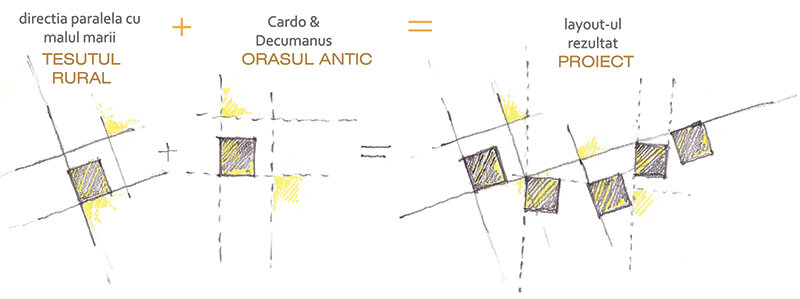
According to archaeological research, Paestum was founded around 625 BC as one of the colonies of Magna Graecia in southern Italy. Between 550 and 450 BC three famous temples were built: the Basilica, the Temple of Ceres and the Temple of Neptune. The city was later conquered by the Romans and became Paestum Romana. In the centuries that followed, the Romans organized the city around the Cardo and the Decumanus, also constructing the Capitolium, the Amphitheatre and other public buildings as well as private dwellings. After its decline, Paestum was isolated and abandoned by its citizens between the 8th and 9th centuries A.D. Its rediscovery took place in 1752 and is due to Carlo III of Bourbon, who built the road running north-south through the park.
In the 20th century, the layer of limestone covering the buildings was destroyed, with irreparable negative effects on the previous layers from the Greek period. Despite its rich cultural value, today tourists prefer to spend time at the beach rather than visit the site. Apart from six annual festivals, there is a lack of regular cultural activities, and the rural fabric has been given exclusively commercial or hotel functions, which are closed outside the summer season and the whole area is deserted.
The need for permanent cultural activities is increased by the resumption of the archaeological research work foreseen in the PUC of Capaccio. Consequently, spaces for research, storage and display of materials will be needed.
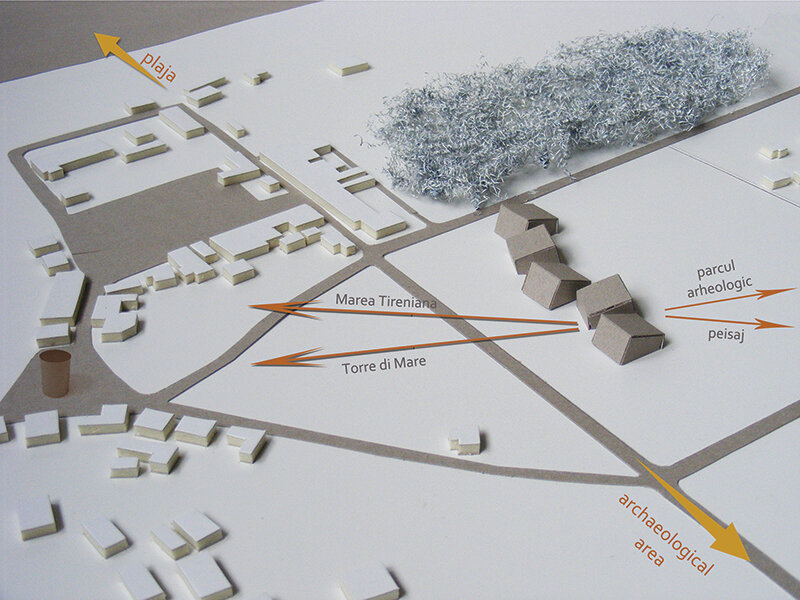
The physical link between the ancient city and the sea is provided by Via Nettuno, a third category road with no cycle paths or pedestrian routes to encourage the relationship between the archaeological park and the sea.
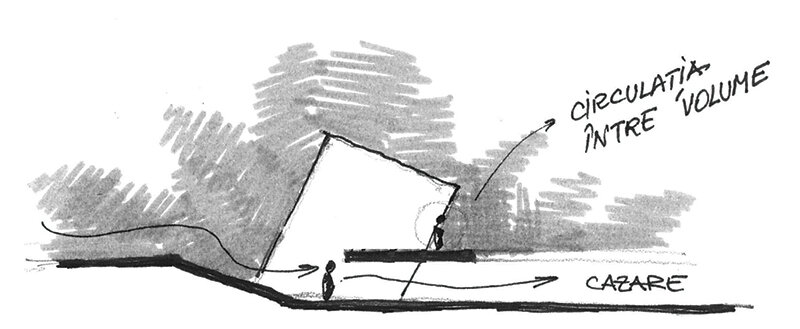
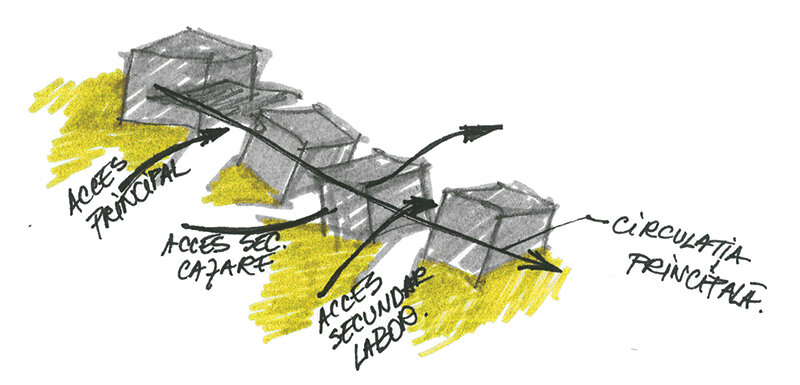
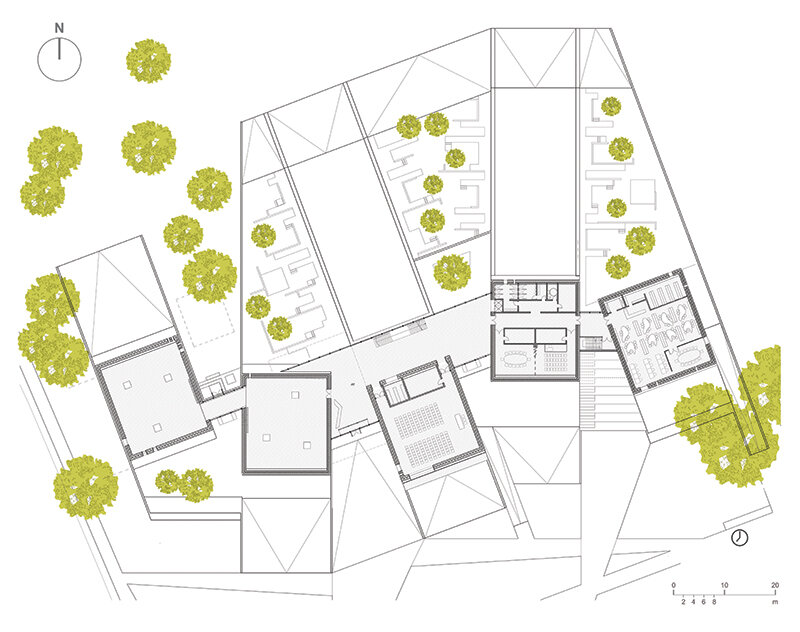
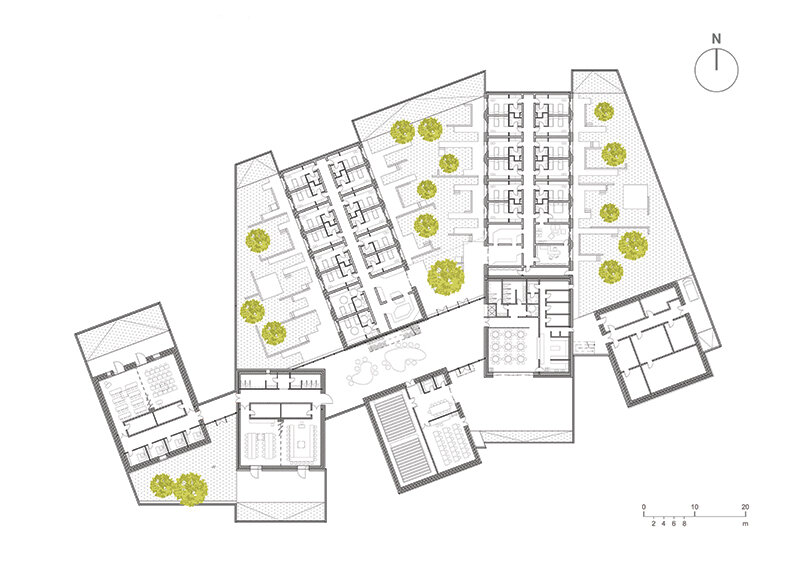
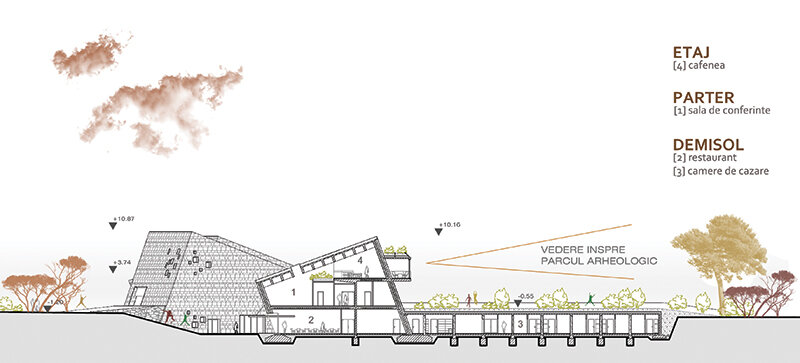
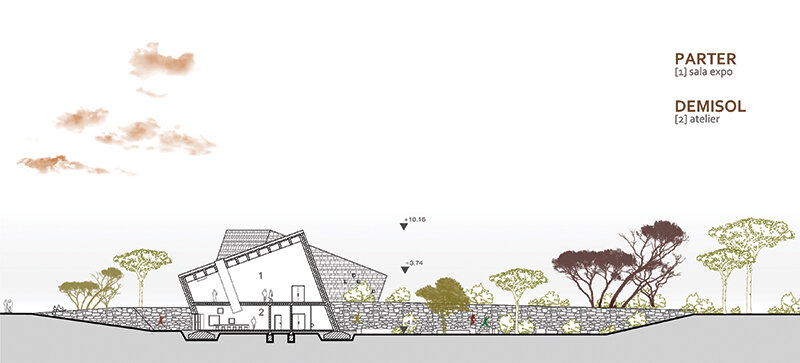
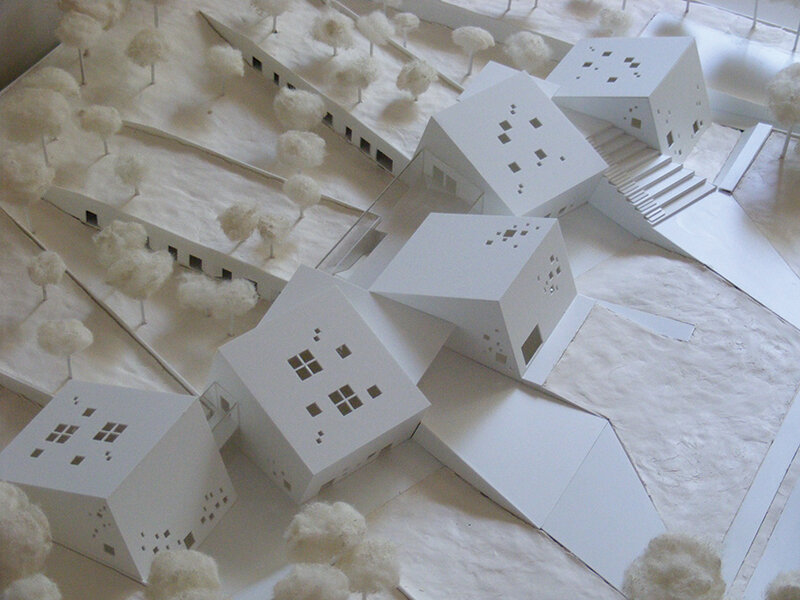
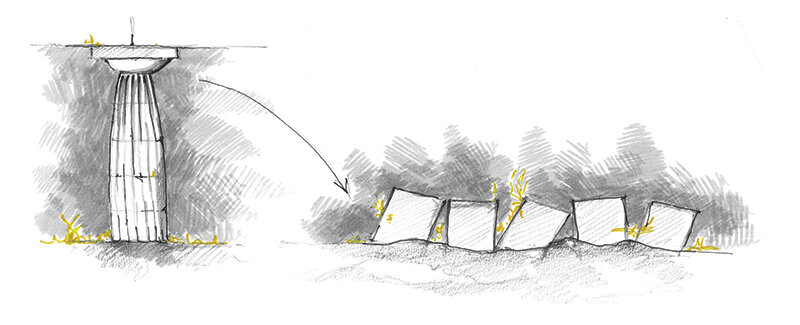
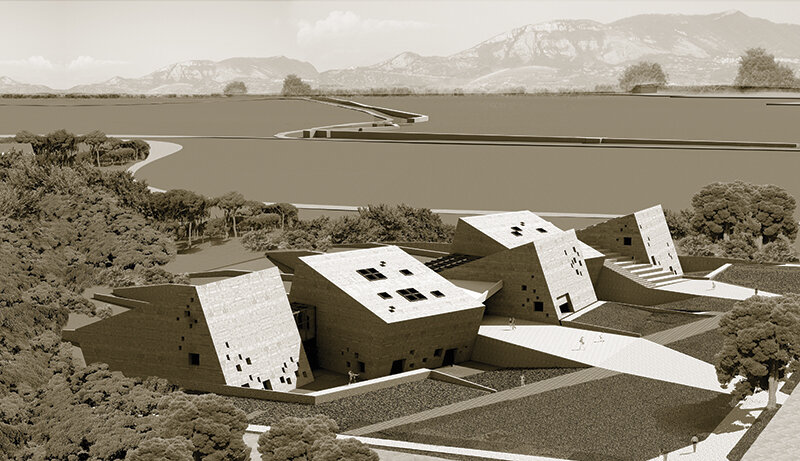
According to the same PUC, campsites within the protected area of the archaeological park are to be moved outside its boundary, thus leaving a deserted and unvalued area on the northern side of Via Nettuno. In order to mitigate the disadvantages caused by poor management and unsustainable tourism, a revitalization project is needed. The project should not be limited to meeting the requirements of archaeological research, but should provide public spaces usable by all, even those who do not attend cultural events. To this end, between Via Nettuno and the building itself there is a public square that leads to a café offering views of the archaeological park and the surrounding natural landscape. The very concept of the architectural project is inspired by the ruined state of Paestum today. The idea is materialized by five massive volumes to be dropped to the ground in apparent disorder. The volumes are oriented either parallel to the seafront and the streets of the rural nucleus into which they are integrated, or parallel to the Cardo and Decumanus, characteristic of the archaeological park. The functions are organized on two levels: the ground floor hosts cultural functions (exhibition halls, conference rooms, library and a multi-purpose hall), while the basement houses the archaeology department with its related storage, workshop rooms for students and children, restaurant and accommodation rooms, etc. For this reason, there are two main entrances. One serves the ground floor and is intended for use by participants and visitors to the exhibitions and performances, and the other for access to the research department. The height of the five buildings is about 12 meters above the ground level and does not exceed the height of the archaeological park, being 4 meters lower, nor the height of the Torre di Mare military tower, which is 40 cm higher. The construction is integrated into the surrounding landscape. Ramps of earth and vegetation rise above or between the volumes so that the interior and exterior spaces enter into dialog. One of these ramps is transformed into an open-air amphitheater, linking the public space in front of the building with the upstairs café area, from where the visitor can admire the surroundings and the archaeological park. From its steps you can see the sea and the military tower.
The contemporary aesthetics of the facades is inspired by the Romanesque style of architecture in which the full-hollow ratio of the facade tilts in favor of the full. The arrangement of the glazed surfaces refer to the ancient Greek belief in the ancient gods.
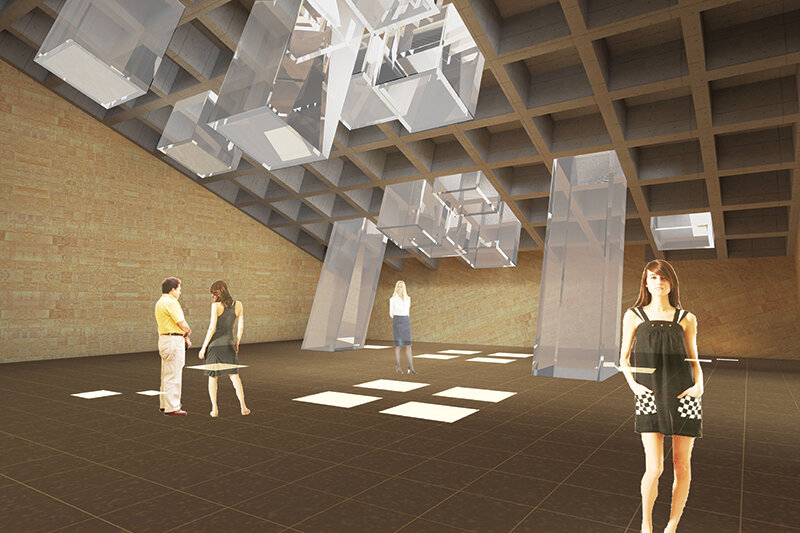
The strength structure of the building has been determined in accordance with the intended message and the requirements of intervention near archaeological sites. For this reason, a structure with large spans was chosen in order to minimize the foundation area. For reasons of seismic resistance, we chose a monolithic reinforced concrete structure poured between blocks of volcanic tuff stone (characteristic local material) to transmit the loads through elastic foundations. The 25 cm thickness of the stone layer inside and outside also ensures low heat transfer, so that cool temperatures can be maintained in summer. In this way the structure has stiffness, load-bearing capacity, ductility and stability while at the same time respecting the historic characteristics of the area. On the ground floor, the lighting is provided by zenithal skylights placed in the openings in the cassette floor, which are continued with frosted Plexiglas tubes to the basement, thus ensuring natural ventilation of the workshops. The strategy has been developed in line with ICOMOS requirements so that the local community and young people are involved in activities inspired by the cultural background. The end result is an intervention that does not contrast and becomes an integrated part of the landscape. In this way, people will feel encouraged to investigate not only ancient objects and working techniques, but also the political events and social factors that led to the crystallization of today's society and, as a consequence, develop pride in and a desire to respect the inherited cultural heritage.