STUDIO DMTW: Semnal / Landmark - Halde Duhamel
Anul / Year: 2011Status: competition / 2nd roundClient: RAGLoc: Ensdorf, Germania/Location: Ensdorf, GermanyProgram: Semnal/Typology: landmarkTeam/Team & credits: Marc Anton Dahmen, Maximilian Schmitz
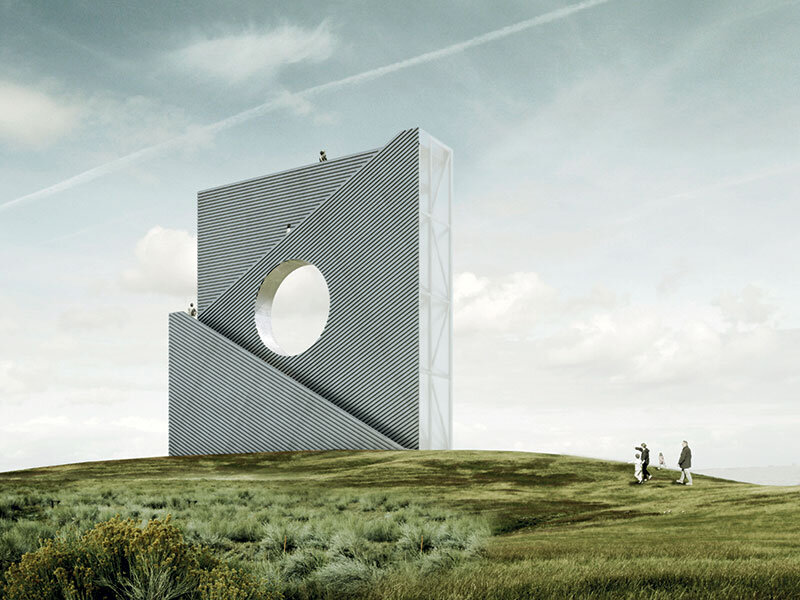
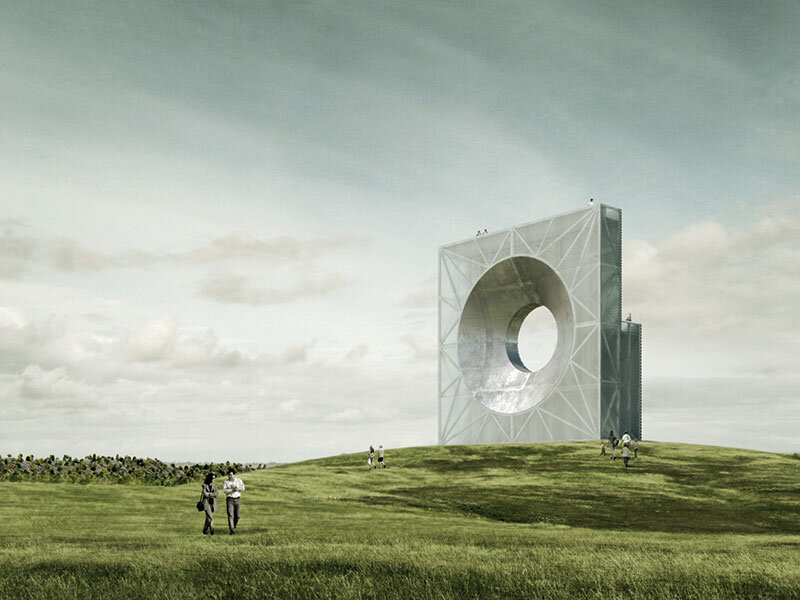
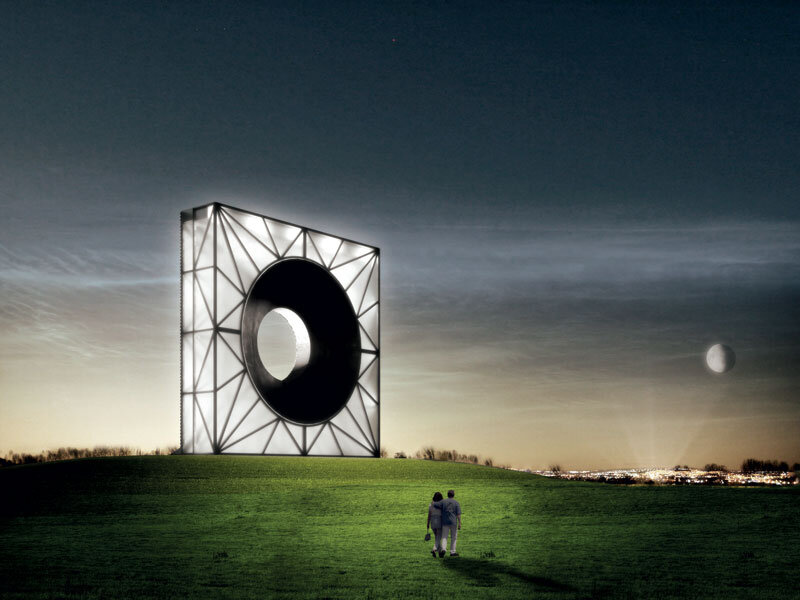
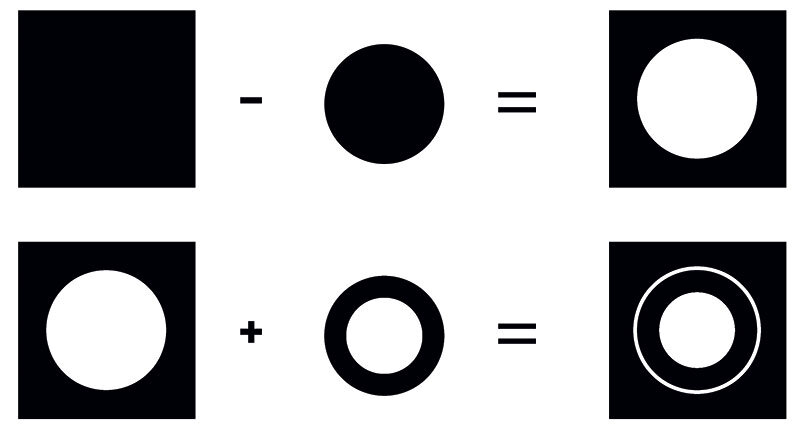
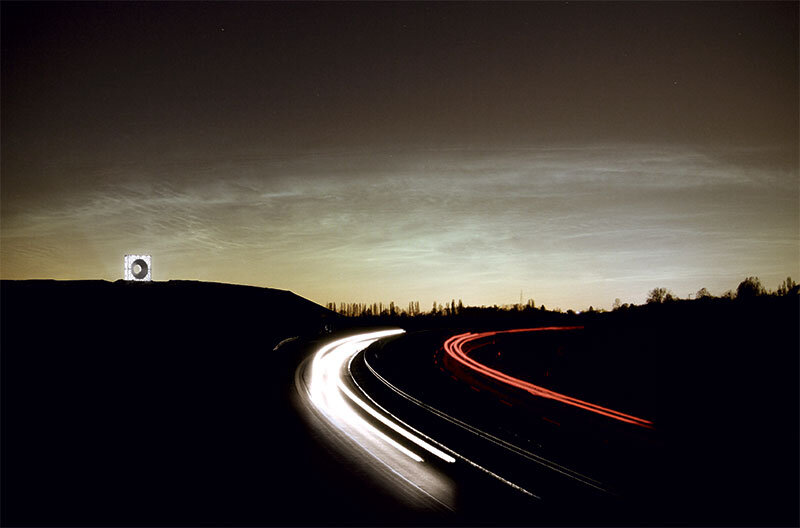
| On the occasion of the cessation of coal mining in the Saarland RAG decided to realize a competition for a topographic landmark on the Duhamel heap. From an artistic as well as an architectural point of view, the aim was to create a landmark which, through its formal clarity, could be recognized both from near and far, during the day and at night. The compositional elements used are simple geometric shapes: the square and the circle. The square as the primary compositional element symbolizes soil, matter and the principles of man-made order. "The 'hole' in the square represents the absence of matter, the end of coal mining. The circle is the perpetuum mobile element, representing the continuous transformation and reuse of matter. It indicates the cycle of energy regeneration. Millions of years ago, living matter was transformed into fossil energy, coal, energy used by modern man to survive, thus closing the circle. In addition to the sculptural symbolism, the signal is a functional construct. The sculpture can be used as a lookout, using the stairs and platform. In order to emphasize the industrial context, the materials used are easy to install, easy to maintain and good value for money. Three types of materials have been used, galvanized steel, curved sheet and polycarbonate. The structure is made of galvanized steel profiles. The stairs and platform are made of galvanized steel gratings. The back side of the structure is covered with coated sheet metal and the front and sides are covered with polycarbonate sheets. At night the signal is illuminated from inside with fluorescent tubes. The polycarbonate uniformly reflects the light, so the construction becomes a bright signal. |
| On the occasion of the end of the coal mining era around the Saarland the RAG decided to set up a competition for a landmark on top of the acclivity Duhamel.From both, an artistic as well as architectural viewpoint the central objective of this design has been to create a landmark that, by its clarity of shape, is recognized from near and far, during day and night, as an unmistakable icon. Because of its simplicity and clarity it is very important to be conscious of its symbolic effect and the resulting interpretation. Simple geometric shapes, that by themselves already exhibit a strong symbolic emanation, serve as the basic elements of this sculpture. The square, as its frontal projection, is its dominating silhouette. Since thousands of years in numerous cultures almost everywhere on earth the square symbolizes the soil, matter and also ordering principles created by men. The "hole" within the square emblematizes the missing matter, so to say the removal of resources, the essence of open cast mining. The second core element is the circle, respectively an annulus having neither a beginning nor an end. Yet it indicates a direction. It stands for a cycle such as the recycling of energy. In fact, eternities ago the coal retrieved here has accrued from petrified living creatures, animals and plants. Over thousands of years it has stored their energy. Now the coal got mined and its energy is returned to currently living animals and humans, ensuring their survival and closing the cycle. Aside from its symbolic message a second important aspect is the usability of the sculpture by visitors. Its simple accessibility makes it a walkable piece of art and hence a piece of architecture. To emphasize the industrial context the choice of materials was guided by good value for money as well as ease of processing and future maintenance. Three types of materials were used, hot zinc dipped steel, trapezoidal sheet and polycarbonate. The skeletal structure consists of hot zinc dipped steel profiles. Stairs and platform are formed by zinc dipped grids. The backside of the sculpture is covered by trapezoidal sheet. The sides and the front is formed by polycarbonate plates. During the night the interior skeleton of the landmark is illuminated by fluorescent tubes. The structure of the polycarbonate plates refractors the light in the interior and the whole sculpture emits a uniform illumination. |