El Laberinto del Fauno. Architecture, between temporal loss and spatial manipulation

El Laberinto del Fauno
Architecture in-Between Temporal Loss and Spatial Handling
| "Long ago, in the subterranean realm where there are no lies or pain, there lived a princess who dreamed of the human world. She dreamed of blue skies, gentle breezes and bright sunshine. One day, deceiving her jailers, the Princess escaped. Once outside, the glare blinded her and wiped all memory from her mind. She forgot who she was and where she came from. She suffered cold, sickness and pain. Eventually she died. However, her father, the King, always knew that the Princess's soul would return, perhaps in another body, in another place or time. And he would continue to wait for her until she drew her last breath, until the world stopped spinning."1 (Guillermo del Toro/ Pan, El Laberinto del Fauno) |
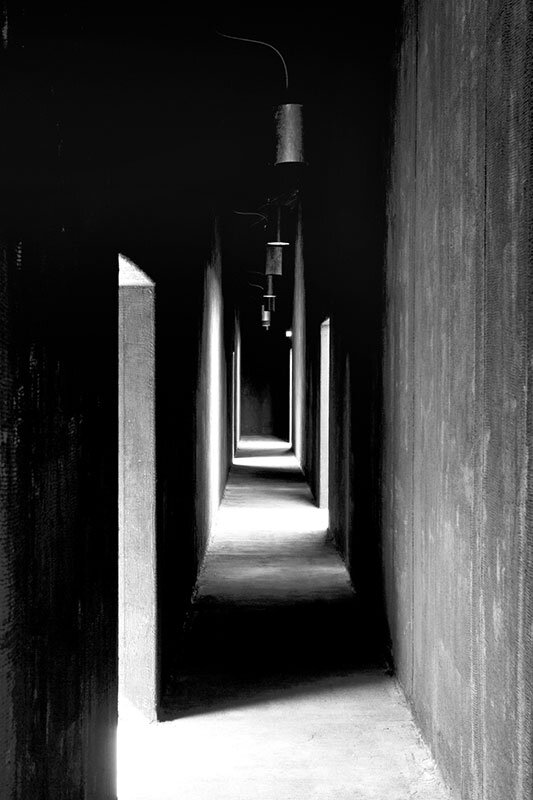
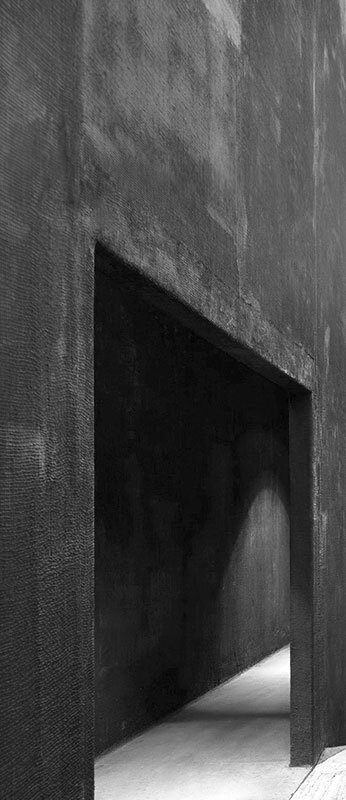
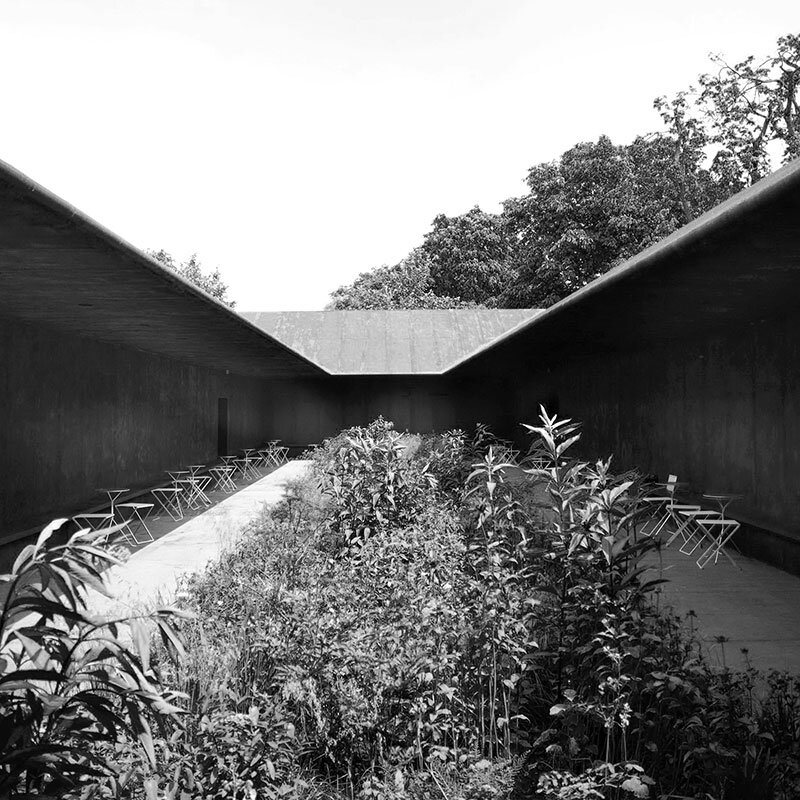
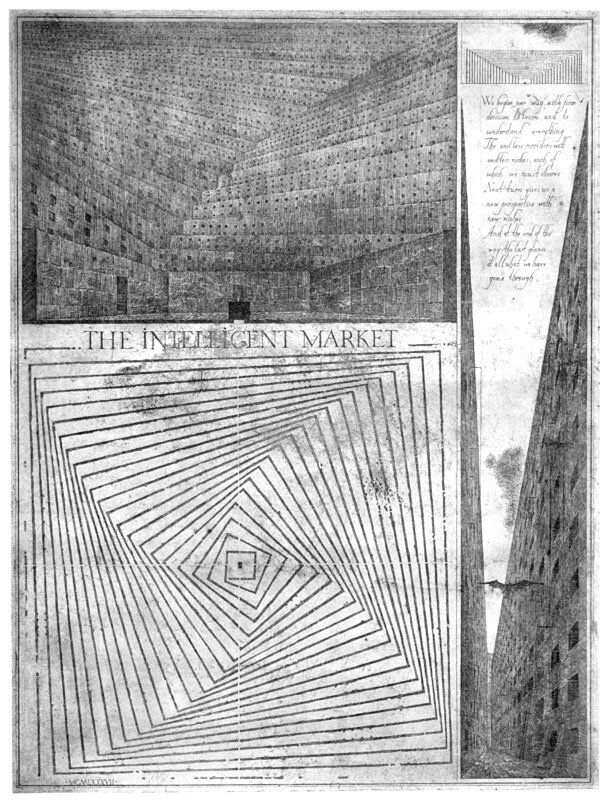
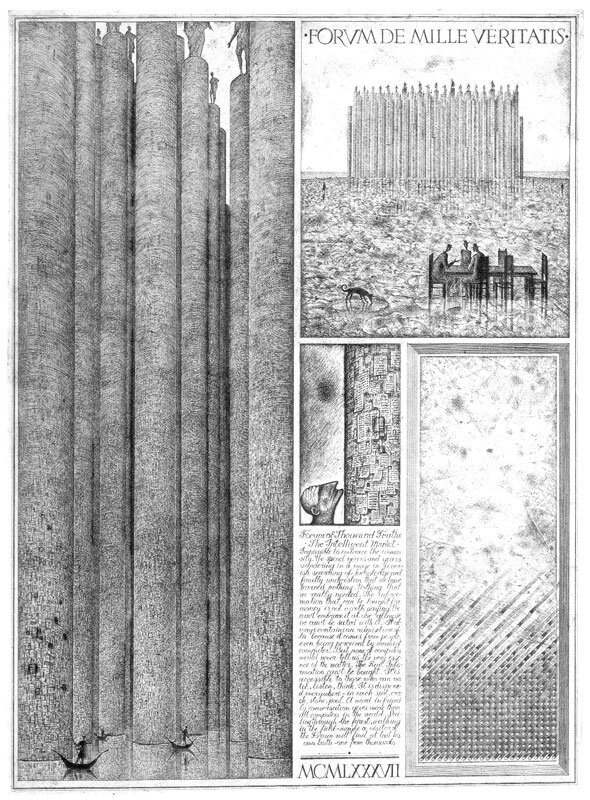
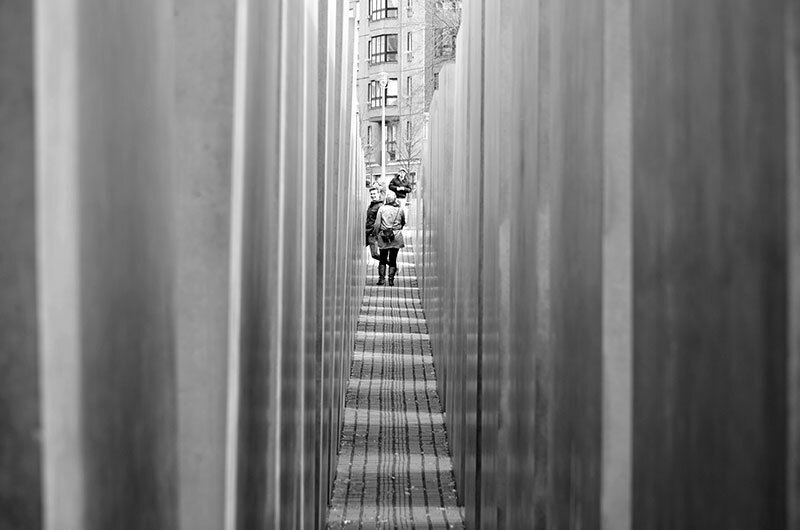
| The introduction in the movie El Laberinto del Fauno2 anticipates the journey of the little girl Ofelia, lost in reality. The key space introduced by director and screenwriter Guillermo del Toro is the labyrinth of the faun - the confluence of the reality of Franco's Italy with a magical world of origin. Paradoxically, the anguish of the historical period (the run-up to World War II3) causes a fracture in the story, developed by the director in two planes - on the one hand the reality of guerrilla warfare, and on the other the fantastic world reimagined by children. The two planes meet at the nodal point of the labyrinth - access to another time unit, a place of initiation, discovery, passage, return to a pure world of stories, a world of lost time "without lies, without pain". Remarkable is the ability to introduce the labyrinthine entity, on a frequency that brings together the architectural perceptions of the element. Guillermo del Toro composes a concentric, recurring system, coupling two of the typical, referential forms of the labyrinth4 - he constructs a world built hierarchically in successive layers. At ground level, the spatial intrigue unfolds in the garden, recalling the romantic vegetal circuits, and underground, taking up the original typology of the labyrinth/maze, a planimetric circuit. The stories frequently take up the garden typology, developing the model of sacred, enchanted forests, in the middle of which we find a temple or traces of ruined architecture, consumed by vegetation. The labyrinth and the fountain, often associated in 15th-19th century landscape design, are, in cinematic fantasy, parts of the same metaphorical system. By capitalizing on the complexity of the construction system - stairs, walls, pillars - the labyrinth exploits horizontal spatiality both at ground level in El Laberinto del Fauno and underground in Interview with a Vampire5. The typology of the fountain (well) develops the vertical axis of descent-ascension - it speculates the purity of the form dug ad invertum and the force of the center, the symbolic hypostasis of underground architecture as a punctual access to another world. "The labyrinth is a very, very powerful sign" - "it is a primordial, almost iconic symbol. Culturally, it can mean so many things, depending on the area of interpretation. But the main thing for me is that, unlike a vegetable labyrinth, the labyrinth is really about a continuous passage of finding, not getting lost. It's about finding, not losing your way. This was very important to me."6 Peter Zumthor materializes the labyrinth in terms of the introverted path and structure. The metaphor of rediscovery underlies the project Serpentine GalleryPavilion7 - the hidden garden (hortus conclusus) beneath the tree crowns of Kensington Gardens in London, is apparently a parallelepipedic, opaque, short volume, metaphorically concentrating light and vegetation in the central atrium. In the chromatic interpretation, the center is positive, luminous, spatially dominant, antithetical to the building itself - an enclosure, telluric, gravitational, weighted by the dark chromatics and minimal openings. "The concept is hortus conclusus, a contemplative room, a garden within a garden. The building acts as a stage, a backdrop for the interior garden of flowers and light. Through darkness and shade one enters the building from the lawn and begins the transition to the central garden, a place secluded/submerged from the world of London noise, traffic and smells - an interior space, where you can sit, walk, contemplate the flowers. This experience will be intense and memorable, like the materials - themselves full of memory and time."8 The construction is a garden within a garden, a world within a world, in the same way Umberto Eco designed his labyrinth9. In the spirit of postmodernist theories(Il Nome della Rosa), Eco argues for the cyclical nature of stories and their relation to other stories, in whole or in part: "books always talk about other books and each story tells another story that has already been told" - a recurrence he applies to architectural construction. Similarly, for Jorge Luis Borges, the universe of the Library of Babel is described as an infinite billibioteque, housing endless symmetrical rooms, containing the same number of books, containing the same number of symbols10. Anticipating contemporary games, the paper architects Alexander Brodsky & Ilia Utkin reinterpreted and transposed the concentric labyrinthine geometry by multiplying the enclosures, composing, in the graphic work The Intelligent Market, a seemingly ever-growing structure by cellular self-generation - etching, Central Glass International Architectural Design Competition, 1987. From a complementary perspective, the theorist Gilles Deleuze emphasized the interpretation of successive planes: "The exterior is not a fixed limit, but a moving subject animated by peristaltic movements, folds and folds that together make up an interior: no are nothing other than the exterior, even the interior of the exterior"11. In a gesture of material compression, Peter Zumthor crammed the Kensington Gardens pavilion into the thickness of the perimeter walls, minimizing the width of the built structure and amplifying the proportion of the garden-centre. Analogous to Umberto Eco's structures, the resolution leans towards labyrinthine typology through the obstructed perspectives, the fragmented introduction of light, the obscure chromatics, the cyclical-concentric route, continuously related to a center, offering frustratingly similar perspectives. The road is identified as the primary spatial structuring factor, the constructive elements subordinating themselves to the path, the route. The walls in this context become a boundary, standing out, first and foremost, as directional planes. "We begin our journey with a firm decision to learn and understand everything. Endless corridors with endless niches, each of which we must respect. The next turn gives us a new perspective with new niches. And at the end of the road - the last glimpse of the whole journey."12 (Alexander Brodsky & Ilia Utkin) Returning to the labyrinth in El Laberinto del Fauno, we notice the relevance of the path in the sense of finality. The garden is designed by integrating the labyrinth as a ritual and sacrificial space, based on religious/astrological components13, it is the central frame of correspondence between the earthly and the subterranean world. Ophelia traverses the volumetrically built terrestrial labyrinth, finds the central well, descends and, in the last stage of discovery, confronts a planimetric maze14 carved in stone. The director speculates the significance of the descent by associating the typologies of subterranean architectures with the columbarium model and the significance of necropolis, bringing them together stylistically. Spiritual fulfillment, maturation15, the awareness of the self as the finality of the tests are the key to the path in El Laberinto del Fauno; not completing the labyrinth, abandoning the path, implies the loss of sensibility, of the innocence of childhood. "Your spirit will remain forever among men. You will grow old like them, you will die like them. And all memories of you will fade in time. And we will go with them."16 (The Faun in conversation with Ophelia, El Laberinto del Fauno) The monuments to the Holocaust designed by Peter Eisenman and Daniel Libeskind in Berlin: Memorial to the Murdered Jews of Europe, 2003-2004, and Garden of Exile and Emigration, Jewish Museum, 1999, respectively, speak of loss, spirit and time in terms of the spatial labyrinth. The reactualization of labyrinth-garden models as monumental architectural spaces is realized in contemporary interpretation as a matrix-labyrinth structure through uniformity (Daniel Libeskind), stroboscopic multiplication of parallelepiped volumes - a cemetery-carpet made of tombstones17 (Eisenman) - or a field covered with fragments of the Treblinka (Haupt & Dyszenko). 'Diving' into the progressive labyrinth of the Berlin HolocaustMemorial18 induces spatial loss as a timeless state. The 2,700 concrete pillars, stelae, are arranged on a 19,000 square meter grid plan, mirroring the slope of the terrain; in the dynamic course, visibility is imperceptibly reduced, the human being getting lost in the repetitive structure. Two artifices lead to a disguised decrease in the height of the pedestrians and an imperceptible slope of the terrain, coupled with the progressive increase in the height of the volumes - a stroboscopic progression that plays with the perception of the human scale. Rememory is stimulated by inducing states of individual loss, spatial anxiety. "You know, if you go and go into (the labyrinth), you feel unsafe! These things are overwhelming. I don't know where I'm going. Am I gonna get lost? I'm alone. I can't hold anyone's hand. And these things, when they happen, make you feel what it was like to be a Jew in Germany in the 1930s."19 (Peter Eisenman) Eisenman advocated the route in order to involve pedestrians in a possible everyday experience. "I want it to be a part of ordinary, everyday life. People who have walked along it say it's very unassuming.... I'd like to think that people will use it to shorten the journey, as an everyday experience and not as a holy place."20 The empathy generated by the sympathetic transposition of sensory perception was the primary cause of abstraction, though later attacked by critics for the implicit degree of generalization and lack of religious symbolism, leading to the architect's compromise and the construction of an underground information center21: "I fought to keep the names of the deceased off the memorial stones, because otherwise it would have turned into a cemetery."22 A related image is that of the Treblinka memorial23, this time without a labyrinthine plan. Preceding the monument designed by Eisenman, the Treblinka memorial (1988), the concentration camp site is covered in a metaphorical explosion of hundreds of irregularly contoured stones, apparently ruins, a reference to the history of the site dynamited by locals in search of jewelry after World War II. The punctual elements on a smaller scale than the one mentioned evoke order/disorder, loss, projecting the architectural spatiality as a dialog between horizontal and vertical through the prism of visual perception. The repeating matrix of the built, the labyrinth managed as a succession of identical perspectives, of constrained visual openings, is clearly determined by Daniel Libeskind in the exterior design of the Garden of Exile24 at the Jewish Museum in Berlin. 49 earth-filled columns support the hanging garden of oaks, with a similar spatiality/plot to Eisenman's later creation, causing the concealment of ground-level perception as an anguished subterranean reception. Complementary to Peter Zumthor's approach, the labyrinth hides/suspends an intangible garden, brings into question a perception of architecture in terms of rediscovery, discovery. The road, ultimately, leads to truth and, as such, the forms that architecture takes on activate its transposition. The ideological determination derives from the ancient translation of meanings between truth and beauty: splendor veri (Platonists), splendor ordinis (St. Augustine), splendor formae (Thomas Aquinas), what we like without concept (Kant), the sensitive embodiment of the idea (R. Bayer). It is not by chance that Alexander Brodsky and Ilya Utkin25, in the graphic work Forum de Mille veritatis (1987-1990), discussed the immeasurable immensity, associating space, time and immediate perception in an anguish of wandering among similar elements - an architecture of multiplied substance, of pillars in a forum of 1,000 truths. Guillermo del Toro described The Faun's Labyrinth through the illusion of loss and constant movement. "It's a place where you suddenly turn abruptly and you may have the illusion of being lost, but in fact you're in continuous transit towards the inevitable center. That's the difference. A vegetable labyrinth has innumerable dead ends; the labyrinth may have the illusion of a terminus, but it always continues. In the movie I can ascribe two concrete meanings to the meanings of the labyrinth. One is the girl's transit to her own center; the other is her journey within reality, this one being real."26 The sensibility present in El Laberinto del Fauno is essentially a reflection of time, not of space, as we deduce if we analyze the recognized sources of influence27 (we refer in particular to Jorge Luis Borges, and the temporal-infinite perception). Another film produced by Guillermo del Toro - Cronos - is of reference in this respect. The interviews given by the architects P. Eisenman and D. Libeskind reflect the organization of structures as an implementation of empathy, of memory - a temporal phenomenon - implicitly appealing to the notion of the labyrinth: such a construction, in metaphor or in reality, does not actually manipulate space, but time. The game in which a labyrinth traps you is one of memory, implicitly motivated by the interpretation of spatiality as a consequence of time. Octavian Paler discusses in Subjective Mythologies the logic of the nodal point - labyrinth, time, memory. "... above all, the labyrinth speaks to us, in a new way, [...] about love and memory. In order to get out of the winding corridors, the unfaithful Theseus will remember the path he has traveled, because that is what Ariadne does, she helps him not to forget in the labyrinth... People say the Minotaur never even existed. The fact that they couldn't find their way out of the labyrinth killed those who were pushed into it"28. In a final interpretation, the labyrinth refers to the human inner structure29. The particular interpretation that emerges is related to this infinity of the continuum and cyclicity. The labyrinthine construction, as the sum of its elements, manipulates the time invested in traversing a structure, claustrant, it is fantastical through this temporal and spatial endlessness - a couple which, at any moment, can be defined by the other element without losing its meaning. Movement as a transition from one attitude toanother30 lies behind the particular temporal perception. Labyrinthine architecture spelunks stroboscopic movement, sensory imagery in the direction of spatial loss, uncomfortable tactility (the Treblinka stones), aggressive dynamics (Alexander Brodsky, Ilya Utkin). Composition and decomposition become the specific mechanisms of uncomfortable spatiality, relying on the repetition of constructive elements. "The labyrinth represents the world allegorically - wide/spacious for those who enter it, but extremely narrow for those who try to return," says the inscription in the 10th-century Church of San Savino in Piacenza, also quoted by Umberto Eco in Il Nome della Rosa. |
| The author would like to thank arh. Alexander Brodsky (Bureau Alexander Brodsky), arh. Vlad Eftenie, Pavilion Serpentine Gallery. |
| 1 Pan, in the plot of the movie El Laberinto del Fauno (The Labyrinth of the Faun), about dual worlds. 2.El Laberinto del Fauno, directed, screenplay by Guillermo del Toro, co-produced by Estudios Picasso, Tequila Gang, Esperanto Filmoj, in association with Sententia Entertainment, Telecinco, OMM; 2006; http://www.imdb.com /title/tt0457430/quotes, accessed: 02.03.2012; 3 Set in Spain in 1944, five years before the civil war. 4. The above-ground expression is a hybrid between the recognizable labyrinth of Epidaurus and romantic vegetal structures. The underground planimetric* projection marks the center, the axis of ascent/descent, the petroglyph-like incised design recalling one of the earliest prehistoric representations. Of reference are the Celtic drawings from the megalithic tomb on the island of Gavrinis, Larmor-Baden, France, dated ca. 3500 B.C. Also reproduced on the floor of the Gothic cathedral of Chartres(Cathédrale Notre-Dame de Chartres, France, 1193-1250), the design is a common one from the Middle Ages - a typical 11-circle circuit divided into 4 quarters, or maze. 5.Interview with theVampire: The Vampire Chronicles, director: Neil Jordan, screenplay, novella: Anne Rice, production: Geffen Pictures, 1994. 6. "Western cultures distinguish between inner and outer reality, one weighing more heavily than the other. Not me. I had an absolutely crazy upbringing. I had a miserable childhood. And I discovered that the [inner] reality is as important as the one I'm looking at right now. The other transit I can remember is the one that Spain went through, from a princess who forgot who she was and where she came from to a generation that will never know the name fascist. And the other is the path of the Captain fallen into his own historical labyrinth. These are things that I put. But then, as I said, the labyrinth is something else entirely. Each culture will give it a different weight" - Guillermo del Toro, apud Murray, Rebecca - Guillermo del Toro Talks About "Pan's Labyrinth", http://movies.about.com/ od/panslabyrinth/a/pansgt122206.htm, accessed: 02.03.2012. 7. Peter Zumthor (landscape designer: Piet Oudolf) Serpentine Gallery Pavilion, Kensington Gardens, London, 2011. 8. Peter Zumthor, about the Serpentine Pavilion, apud Glancey, Jonathan - 'Peter Zumthor unveils secret garden for Serpentine Pavilion', The Guardian, Monday, April 4, 2011, http://www.guardian.co.uk/ artanddesign/2011/apr/04/ peter-zumthor-serpentine-gallery-pavilion ?INTCMP=ILCNETTXT3487, accessed: 02.02.2012. 9. Haft, Adele J. - 'Maps, Mazes, and Monsters: The Iconography of the Library in Umberto Eco's The Name of the Rose', Studies in Iconography 14, Arizona State University (1995), http://www.themodernword.com /eco/ec/eco_papers_haft.html. 10. Borges, Jorge Luis - "Library of Babel", Ficciones - Part I, 1944-1946. 11. Deleuze, Gilles - Foucault, trans. Séan Hand. Minneapolis: University of Minneapolis Press, 1988, pp. 96-97. 12. Alexander Brodsky & Utkin apud http://aminotes.tumblr.com/ post/426888285/ alexander-brodsky-utkin-the-intelligent-market. 13. Cf. Turner, Tom - Garden History: philosophy and design, Routledge, 2011. 14. Guillermo del Toro prefers the planimetric labyrinth theme, developed as a planimetry in Hellboy and a garden labyrinth in El Laberinto del Fauno. Hellboy, director: Guillermo del Toro, screenplay: Guillermo del Toro, production: Lawrence Gordon Productions, Starlite Films, in association with Dark Horse Entertainment; 2004. 15. The meanings of the road in del Toro's Labyrinth, interpreted in connection with another of the director's films - El espinazo del diablo, refer to the identity acquired through maturation. 16. Free translation - El Laberinto del Fauno, directed, screenplay: Guillermo del Toro, co-produced by Estudios Picasso, Tequila Gang, Esperanto Filmoj, in association with: Sententia Entertainment, Telecinco, OMM; 2006. 17."The intention is to bring the Jewish cemetery into the everyday life of the Germans, to bring it into the middle of the city" - Peter Eisenman, apud Marzynski, Marian - "A Jew Among the Germans", Frontline, http://www.pbs.org/wgbh/ pages/frontline/shows/germans/ etc/script.html, accessed: 03.02.2012. 18. Peter Eisenman (engineer: Buro Happold), Memorial to the Murdered Jews of Europe - Holocaust Memorial, Berlin, 2003-2004. 19. Peter Eisenman on Memorial to the Murdered Jews of Europe, Berlin, 2003-2004, apud Marzynski, Marian - "A Jew Among the Germans", Frontline, http://www.pbs.org/wgbh/pages/ frontline/shows/germans/etc/ script.html, accessed: 03.02.2012. 20. Peter Eisenman, free translation, apud Rosh, Lea - "Berlin opens Holocaust memorial" BBC News, May 10, 2005, http://news.bbc.co.uk/2/hi/4531669.stm, accessed: 02.03.2012. 21. A visitors' center, with commemorative elements directly linked to the losses of the Jewish people during the Holocaust. "It will be a reminder to the land of the aggressors" - journalist Rosh, Lea, op.cit. 22. Peter Eisenman, apud Rosh, Lea, op.cit. 23. Haupt & Dyszenko, "Valley of Stones" Memorial, Treblinka, Radzilow, 1988. 24. Studio Daniel Libeskind, Garden of Exile and Emigration, Jewish Museum Berlin, Germany, 1999 - recalling the Jews who were forced to leave Berlin, cf.*** Studio Daniel Libeskind - Project Brief, http://daniel-libeskind.com/ projects/jewish-museum-berlin, accessed: 08.11.2011. 25 Graphic works by Russian architects: Alexander Brodsky, Ilya Utkin. Lois Nesbitt (ed.) - Brodsky & Utkin: The Complete Works, Princeton Architectural Press, New York, 2003. 26. "Western cultures differentiate between inner and outer reality, one weighing more heavily than the other. I do not. I had an absolutely crazy upbringing. I had a miserable childhood. And I discovered that [inner] reality is just as important as the one I'm looking at right now. The other transit I can remember is the one that Spain went through, from a princess who forgot who she was and where she came from, to a generation that will never know the name fascist. And the other is the path of the Captain fallen into his own historical labyrinth. These are things that I put. But then, as I said, the labyrinth is something else entirely. Every culture will give it a different weight" - Guillermo del Toro, apud Murray, Rebecca - Guillermo del Toro Talks About "Pan's Labyrinth", http://movies.about.com/od/ panslabyrinth/a/pansgt122206.htm, accessed: 02.03.2012. 27."Among the works that have served as inspiration are those of: Lewis Carroll "Alice" series, Jorge Luis Borges "Ficciones", Arthur Machen "The Great God Pan and The White People", Lord Dunsany "The Blessing of Pan", Algernon Blackwood "Pan's Garden" and the works of Francisco Goya. In 2004, del Toro said: "Pan is an original story. Some of my favorite writers (Borges, Blackwood, Machen, Dunsany) have explored the figure of the god Pan and the symbol of the labyrinth. I find these things very compelling and try to mix and play with them"! - "Influences", Pan's Labyrinth, http://en.wikipedia.org/wiki /Pan%27s_Labyrinth#Influences, accessed: 03.02.2012. 28. Paler, Octavian - Subjective Mythologies, Eminescu Publishing House, 2nd edition, Bucharest, 1976, p. 31. 29. To escape from the labyrinth is a matter of time, not of space, because space has relevance only in relation to others, not to the self. 30. Auguste Rodin apud Arnheim, Rudolf - Art and Visual Perception: A Psychology of Creative Vision. 2nd edition, translated by Florin Ionescu, Polirom, Bucharest, 2011, p.417. |
| Bibliography Arnheim, Rudolf - Art and visual perception: a psychology of creative vision. 2nd edition, translation by Florin Ionescu, Polirom, Bucharest, 2011. Arnheim, Rudolf - The power of the visual center. București: Editura Meridiane, 1995. Barker, Jennifer M. - The Tactile Eye: touch and the cinematic experience. London: University of California Press, Ltd., 2009. Borges, Jorge Luis - "Library of Babel", Ficciones, p. I, 1944-1946. Deleuze, Gilles - "The Fold-Leibniz and the Baroque: The Pleats of Matter". Architectural Design Profile, No.102: Folding in Architecture, 1993. Deleuze, Gilles - Difference and Repetition, Tr.: Paul Patton, Columbia University Press, New York, 1994. Crișan, Ana-Maria - The Anagram of Imaginary Architecture. Metamorphosis - re-evaluating the temporal paradigm in architecture, PhD thesis, 2012. Eco, Umberto Eco - Art and Beauty in Medieval Aesthetics,Bucharest:Editura Meridiane, 1999. Eco, Umberto - The Name of the Rose. Hyperion, Bucharest, 1992. Eco, Umberto - Six walks through the narrative forest. Constanța: Pontica, 1997. Eco, Umberto Umberto - Limitele Interpretării. Constanța: Pontica, 1996. Gombrich, E.H. - The Sense of Order: A Study in the Psychology of Decorative Art ( The Wrightsman Lectures, V. 9), Phaidon Press;2nd edition, 1994. Hocke, Gustav Rene Rene - The World as Labyrinth. Translation by Victor H. Adrian. București: Editura Meridiane, 1973. Kern, Hermann - Through the Labyrinth: Designs and Meanings over 5000 Years. Prestel, Verlag Munich, 2000. Paler, Octavian - Mitologii Subiective, Editura Eminescu, 2nd edition, Bucharest, 1976. Turner, Tom - Garden History: philosophy and design, Routledge, 2011. Zumthor, Peter - Atmospheres: Architectural Environments - Surrounding Objects, Basel: Birkhäuser Architecture,5th Printing. Edition, 2006. Reference works: Haupt & Dyszenko, Valley of Stones Memorial, Treblinka, Radzilow, 1988. Peter Eisenman, Memorial to the Murdered Jews of Europe, Berlin, 2003-2004. Studio Daniel Libeskind, Garden of Exile and Emigration, Jewish Museum, Berlin, Germany, 1999. Alexander Brodsky & Ilia Utkin, Forum de Mille Veritatis, 1987/90, 30 3/8" x 22 1/2", etching ("The Intelligent Market", Central Glass Co. Competition Japan Architect, Tokyo, Japan, 1987). Alexander Brodsky & Ilia Utkin, The Intelligent Market (Central Glass International Architectural Design Competition 1987), etching. Peter Zumthor (landscape designer: Piet Oudolf) Serpentine Gallery Pavilion, Kensington Gardens, London, 2011. El Laberinto del Fauno(The Labyrinth of the Faun), directed, screenplay: Guillermo del Toro, co-production: Estudios Picasso, Tequila Gang, Esperanto Filmoj, in association with: Sententia Entertainment, Telecinco, OMM; 2006; Hellboy, director: Guillermo del Toro, screenplay: Guillermo del Toro, production: Lawrence Gordon Productions, Starlite Films, in association with Dark Horse Entertainment; 2004. Interview with theVampire: The Vampire Chronicles, director: Neil Jordan, screenplay, novel: Anne Rice, production: Geffen Pictures, 1994. |
| "A long time ago, on the underground realm where there are no lies or pain, lived a princess who dreamed of the human world. She dreamed of blue skies, breezes and bright sun. One day, deceiving her jailers, the Princess escaped. Once she was out, the brilliance blinded her and deleted any recollection of her memory. She forgot who she was and where she was. She suffered from cold, disease and pain. Finally, she died. However, her father, the King, always knew that the Princess's soul would return, perhaps in another body, in another place or at another time. And ke kept on waiting until he pulled the last breath, until the world ceased to spin."[1] - (Guillermo del Toro/ Pan, El Laberinto del Fauno) The introduction of the cinematographic work El Laberinto del Fauno[2] anticipates the way of the little girl Ofelia, lost from reality. The key space introduced by the director and writer Guillermo del Toro is Pan's labyrinth, representing the point of confluence between Franco's Spain reality in a magical originating world. Paradoxically, the anxieties of the historical period (prior to World War II[3]) determine a fracture of the story developed on two levels - on one hand the reality of the guerrillas fighting, on the other a fantastic world imagined by the children. The two levels meet at the nodal point of the labyrinth - it offers the access to a different temporal unit, a place of initiation, discoveries, shift and return in a pure world, a world of fairy tales and of the lost time "without lies, without pain". The ability to introduce the entity of the labyrinth on a frequency that meets the architectural perceptions of the element is outstanding. Guillermo del Toro composes a concentric recurring system, by coupling two of the typical, referential forms of the labyrinth[4] - he creates a world built hierarchically in successive layers. At the ground level, the spatial plot develops in the garden space, reminiscent of the Romantic vegetal routes, while the underground recalls for the originating typology of the labyrinth / maze, following a planimetric circuit. Frequently, the fairy tales include the typology of the garden by developing the model of the charmed, sacred forests, where temples or traces of a crumbling architecture, consumed by vegetation, are to be seen. Often associated with the landscape facilities in the 15-19 centuries, the labyrinth and the fountain are parts of the same metaphorical system in the cinematographic fantasies. Staking on the complexity of the constructive system - stairs, walls, poles - the labyrinth exploits the horizontal spaciousness, operating both at ground level in El Laberinto del Fauno and underground in Interview with a Vampire[5]. The typology of the fountain develops the vertical descending - ascending spindle; it speculates the purity of the form dug ad invertum and the force of the center, becoming a symbolic depiction of the underground architecture as an access point in another world. "The labyrinth is a very, very powerful sign," - "It's a primordial, almost iconic symbol. It can mean so many things, culturally, depending on where you do it. But the main thing for me is that, unlike a maze, a labyrinth is actually a constant transit of finding, not getting lost. It's about finding, not losing, your way. That was very important for me."[6] Peter Zumthor materializes the labyrinth in terms of sequence and of an introvert structure. The metaphor of the restoration is the basis for the Serpentine Gallery Pavilion[7] project; under the crown of the trees in Kensington Gardens in London, the Hidden Garden (Hortus conclusus) is apparently a parallelepiped, opaque, a much too short volume, metaphorically concentrating the light and the vegetation in the central atrium. In a chromatic interpretation, the Centre is positive, bright, dominant, antithetic to the building itself - a land-based enclosure, drawn by the constant gravitation, burdened by dark colors and minimal openings. "The concept is the hortus conclusus, a contemplative room, a garden within a garden. The building acts as a stage, a backdrop for the interior garden of flowers and light. Through blackness and shadow one enters the building from the lawn and begins the transition into the central garden, a place abstracted from the world of noise and traffic and the smells of London - an interior space within which to sit, to walk, to observe the flowers. This experience will be intense and memorable, as will the materials themselves - full of memory and time."[8] The building is a garden in the garden, a world in another world in the same manner in which Umberto Eco designed his labyrinth[9] In the spirit of post-modernist theories(Il Nome Della Rosa), Eco supports the cycle of the fairy tales and their reporting to other stories, in whole or in part:"books always talk about other books and each story tells another story that has already been told." He applies the same recurrence to the architectural constructions. Similarly, for Jorge Luis Borges, the universe in Library of Babel is described as a library, harbouring endless symmetrical rooms, containing the same number of books, containing the same number of symbols.[10] Anticipating the contemporary games, the visionary architects, Alexander Brodsky & Ilya Utkin, reinterpreted and transposed the concentric geometry of the labyrinth by multiplying enclosures. In their graphic work, The Intelligent Market, they compose a seemingly growing by auto-generating cellular structure - engraving, Central Glass International Architectural Design Competition, 1987. In a complementary perspective, the theorist Gilles Deleuze highlights the interpretation of the successive plans:"the outside is not a fixed limit, but a moving subject animated by the peristaltic movements, folds and plies that together make up an interior: there are none other than the exterior, even the inside of the outside." [11] In a gesture of material compression, Peter Zumthor condensed the Kensington Gardens pavilion in the outer wall thickness; he minimizes the width of the built structure and amplifies the proportion of the garden-centre. Analog to Umberto Eco's structures, the solution calls for the labyrinthine typology, such as: sectioned perspectives, a fragmented admission of the light, obscure chromatisms, a cyclic-concentric route, offering similar frustrating perspectives. The road / route is identified as a primary spatial factor, as the constructive elements subordinate thereto. Within the context, the walls become borders, being primarily straightforward planes. "We begin our way with firm decision to learn and to understand everything. The endless corridors with endless niches, each of which we must observe. Next turn gives us a new perspective with new niches. And at the end of the way - the last glance at all what we have gone throwgh."[12] ( Alexander Brodsky & Ilia Utkin ) Returning to the labyrinth in El Laberinto del Faun, we note the relevance of the road in terms of purposefulness. The garden is designed based on the labyrinth interpreted as a ritual and sacrificial space; according to its religious / astrological components[13], it focuses on the transition between the Earth and the underground world. Ofelia follows the labyrinth, volumetrically built, finds the central shaft / fountain, descends and, in the last stage of discovery, faces a planimetric "maze"[14] incised in stone. The director speculates the significance of the descent by associating the typologies of the types underground architectures with the columbarium model and the significance of the necropolis; he reunites them stylistically. The spiritual fulfillment, the process of growing up[15], the self awareness as a result of the trials, is the key road from El Laberinto del Fauno; the abandonment of the road and the impossibility to finish the maze involve loss of sensitivity, of the innocence of childhood. "Your spirit will remain forever among people. You will grow old too, you will die too. And all the memories about you will fade in time. And we will elapse with them." (Pan discussing with Ofelia, El Laberinto del Fauno)[16] The monuments dedicated to Holocaust designed by Peter Eisenman and Daniel Libeskind in Berlin: the Memorial to the Murdered Jews of Europe, 2003-2004 and the Garden of Exile and Emigration, Jewish Museum, 1999, talk about loss, time and spirit, in terms of the spatial labyrinth. In the contemporary interpretation, the updating of the labyrinthine garden designs into monumental architectural spaces is done either through uniformity, as a matrix- labyrinthine structure (Daniel Libeskind), as a stroboscopic multiplication of the parallelepiped volumes - a grave stones' carpet[17] in Eisenman's memorial, or as a field covered by rocky fragments at Treblinka (Haupt & Dyszenko). The "sinking" into the progressive labyrinth of the Berlin Holocaust Memorial[18] induces the spatial loss as a timeless estate. The 2,700 concrete pillars, stelae, are placed on a grid planimetry deployed on 19,000 sq m, speculating the land slope; along the dynamic roadmap, the visibility is reduced imperceptibly, one loses himself in a repetitive structure. Two artifices induce a concealed decreasing of the pedestrians' height, namely the imperceptible slope of the land correlated with a progressive increase of the height of the volumes - a stroboscopic progression that is playing with the perception of human scale. The recall is stimulated by inducing the states of individual loss, of spatial anguish. " You go and walk in it, and you will feel uncertain, you know? These things are tilting. I don't know where I'm going. Am I going to get lost? I'm alone. I can't hold anybody's hand. And that, when they get done, was what it felt like to be a Jew in Germany in the '30s. That all. Basta. That's the monument."[19] ( Peter Eisenman ) Eisenman supported the idea that, by following the undulating pathway, pedestrians may be involved in a daily experience."I want it to be a part of the everyday life. People that went on around it, say it is very humble.... I like to think that people will use it for short cuts, as an everyday experience, not as a holy place."[20] The empathy generated by the transposition of the sympathetic sensory perception was the primary cause of abstraction. Nevertheless, the abstraction was later attacked by critics for the implied degree of generalization and the lack of religious symbolism, hence the architect's compromise and his agreement for building an underground information centre[21]:"I fought to keep names off the stones, because having names on them would turn it into a graveyard."[22] A related image is that of the Valley of Stones Memorial[23], this time without a labyrinthine planimetry. Treblinka Memorial (1988) precedes the monument designed by Eisenman; the concentration camp site is covered in a metaphorical explosion by hundreds of stones with irregular edges, apparently ruins, with reference to the history of the site blown up by the locals that were looking for jewelry, after World War II. Specific items, at a smaller scale than the previously mentioned ones, evoke the order / disorder, the loss, by projecting the architectural spaciousness as a dialog between horizontal and vertical planes, visually perceived. In his construction of the Garden of Exile[24] in Jewish Museum in Berlin, Daniel Libeskind clearly determines the repeatable matrix of the built area: the labyrinth is managed as a sequence of identical perspectives, of partially closed visual openings. clear of in the. 49 columns, filled with ground, support the suspended oak garden, with a widening area similar to the one further created by Eisenman, concealing the perception at ground level as an underground full of anguish reception. Complementary to Peter Zumthor's approach, the labyrinth hides / suspends an intangible garden and brings into question a perception of the architecture in terms of retrieval and discovery. The road ultimately leads to the truth, and as such, the architectural forms activate its implementation. The ideological determination derives from the old translations of the meanings between truth and beauty: splendor veri (Plato's doctrine), splendor ordinis (Saint Augustine), splendor formae (Toma d'Aquino), what we like without concept (Kant), the sensitive embodiment of the idea (R. Bayer). Not incidentally, Ilya Utkin and Alexander Brodsky[25], in the graphics Forum de Mille Veritatis (1987-1990), were discussing the immensity of the immeasurable, they associated spaciousness, time and immediate perception in anguish of drifting among similar items - hence a substance multiplied by architecture, the pillars in a forum of the 1000 truths. Guillermo del Toro described Pan's labyrinth through the illusion of the loss and the continuous movement: "It is a place where you do sharp turns and you can have the illusion of being lost, but you are always doing a constant transit to an inevitable center. That's the difference. A maze is full of dead ends, and a labyrinth may have the illusion of having a dead end, but it always continues. I can ascribe two concrete meanings of the labyrinth in the movie. One is the transit of the girl towards her own center, and towards her own, inside reality, which is real. "[26] The sensibility present in El Laberinto del Fauno is essentially a reflection of the time, not of the space, as we abstract from the works of influence[27] (we refer in particular to Jorge Luis Borges, and the infinite temporal perception). Reference in this regard is another film produced by Guillermo del Toro - Cronos. The interviews given by P. Eisenman and D. Libeskind reflect the organization of built structures as an implementation of the empathy, of the memory - a time-default phenomenon - hence the notion of the labyrinth: such a construction, in metaphor or reality, does not actually handles space, but rather time. The labyrinth catches oneself in a special game of the memory, motivated by the interpretation of spaciousness in terms of time. In Mitologii Subiective (Subjective Mithologies ) Octavian Paler discussed the logics of the focal point - labyrinth, time, memory: "...first of all, the labyrinth talks, in a new way, [...] about love and about the memory. To exit the twisting corridors, the unfaithful Theseus will remember the followed road, that is what Ariadna does in fact, she helps him to remember the maze ... The world speaks that the Minotaur did not exist. The fact they could not find out the exit killed those that were pushed down there"[28]. In a final interpretation, the labyrinth refers to the inner human structure [29]. A particular emerging interpretation is connected to this infinity of the continuum and of the cycles. The labyrinthine construction, as the sum of the elements, manipulates the time invested in traveling through a given claustrophobic structure; it is a fantastic construction in this endless time and space - a couple, which at any moment may be defined by the other element without losing its meaning. The adjustability , as a transition from one attitude to another[30], stands behind the particular temporal perception. The labyrinthine architecture speculates the stroboscopic mobility, the sensorial imaginary in terms of spatial loss, the uncomfortable tactility (the sharp edged stones in Treblinka), the aggressive dynamics (Alexander Brodsky, Ilya Utkin). Composition and decomposition become the specific mechanisms for the uncomfortable spaciousness, staking on the repetition of the construction elements. "Hunc mundum Laberinthus denotat iste: Intrati largus, redeunti set nimis artus ..." - "The labyrinth is the allegory of the world - largely wide for those who enter it, but extremely tight for those who try to come back" says the inscription in the Church of San Savino, in Piacenza (the 10th century), quoted by Umberto Eco in Il Nome della Rosa as well. |
| Special thanks for the support in illustrating this article goes to: architect Alexander Brodsky (Bureau Alexander Brodsky), architect Vlad Eftenie, Peter Zumthor (courtesy of Serpentine Gallery Pavilion). llustratrations: Peter Zumthor, Serpentine Gallery Pavilion,2011, Photograph © Walter Herfst, courtesy of Serpentine Gallery Pavilion. Peter Zumthor, Serpentine Gallery Pavilion, 2011, Photograph © John Offenbach, courtesy of Serpentine Gallery Pavilion Alexander Brodsky & Ilia Utkin, The Intelligent Market, (Central Glass International Architectural Design Competition 1987), courtesy of Bureau Alexander Brodsky. Alexander Brodsky & Ilia Utkin, Forum de Mille Veritatis, 1987/90, 30 3/8" x 22 1/2", engraving ("The Intelligent Market," Central Glass Co. Competition Japan Architect, Tokyo, Japan, 1987), courtesy of Bureau Alexander Brodsky. Peter Eisenman, Memorial to the Murdered Jews of Europe, Berlin, 2003-2004 ©photo: Vlad Eftenie |
|
[1] Pan speaking about the dual worlds in Pan 's Labyrinth. [2] El Laberinto del Fauno (Pan's Labyrinth), director and script: Guillermo del Toro, co-production: Estudios Picasso, Tequila Gang, Esperanto Filmoj, in association with Sententia Entertainment, Telecinco, OMM, 2006. http://www.imdb.com/title /tt0457430/quotes, accessed: 02.03.2012. [3] The action takes place in the Fascist Spain in 1944, succeeding the Civil War with five years (1936-1939). [4] The over ground expression is a hybrid between the recognizable maze at Epidaurus and the Romantic vegetal structures. The underground planimetric projection marks the center, the descending - ascending spindle, while the incised drawing, similar to petroglyphs, recalls one of the earliest depictions of prehistoric times. For reference are the Celtic drawings from the megalithic tomb on the island of Gavrinis, Larmor-Baden, France, dated c. 3500 B.C. Reproduced on the floor of the Gothic Cathedral of Chartres (Cathédrale Notre-Dame de Chartres, France, 1193 - 1250), the drawing is one frequently encountered in the middle ages - a typical circuit with 11 circles, divided into 4 quarters, more precisely a maze. [5] Interview with the Vampire: The Vampire Chronicles, director: Neil Jordan, script & novel: Anne Rice, production: Geffen Pictures, 1994. [6] "I think that Western cultures make a difference about inner and outer reality, with one having more weight than the other. I don't. I come from an absolutely crazy upbringing. I had a f**ked up childhood. And I have found that [the inner] reality is as important as the one that I'm looking at right now. The other transit I can say is the transit that Spain goes through, from a princess that forgot who she was and where see came from, to a generation that will never know the name of the fascist. And, the other one is the Captain being dropped in his own historical labyrinth. Those are things I put in. But then, as I said, the labyrinth is something else. Each culture will ascribe a different weight to it." - Guillermo del Toro, apud Murray, Rebecca - Guillermo del Toro Talks About "Pan's Labyrinth", http://movies.about.com/od /panslabyrinth/a/pansgt122206.htm, accessed: 02.03.2012. [7] Peter Zumthor, (landscape architect: Piet Oudolf) Serpentine Gallery Pavilion, Kensington Gardens, London, 2011. [8] Peter Zumthor, about Serpentine Pavilion, apud Glancey, Jonathan - "Peter Zumthor unveils secret garden for Serpentine pavilion", The Guardian, Monday April 4, 2011, http://www.guardian.co.uk/artanddesign/ 2011/apr/04/peter-zumthor-serpentine-gallery-pavilion?INTCMP=ILCNETTXT3487, accessed: 02.02.2012. [9] Haft, Adele J. - 'Maps, Mazes, and Monsters: The Iconography of the Library in Umberto Eco's The Name of the Rose', Studies in Iconography 14, Arizona State University, (1995), http://www.themodernword.com/ eco/eco_papers_haft.html. [10] Borges, Jorge Luis - "Library of Babel", Ficciones- part I, 1944-1946. [11] Deleuze, Gilles - Foucault, trans. Séan Hand. Minneapolis: University of Minneapolis Press, 1988, p.96-97. [12] Alexander Brodsky & Utkin apud http://aminotes.tumblr.com/post/ 426888285 426888285/alexander-brodsky-utkin-the-intelligent-market [13] Cf. Turner, Tom - Garden History: Philosophy and Design, Routledge, 2011. [14] Guillermo del Toro prefers the theme of the planimetric labyrinth, developed as planimetry in Hell Boy, and a garden maze in El Laberinto del Fauno. Hellboy, director: Guillermo del Toro, script: Guillermo del Toro, production: Lawrence Gordon Productions, Starlite Films, in association with Dark Horse Entertainment, 2004. [15] The significances of the road in del Toro's El Laberinto del Fauno, interpreted in conjunction with his other film - El espinazo del diablo - send to the identity gained through growing up. [16] (free translation) El Laberinto del Fauno, director, script: Guillermo del Toro, co-production: Estudios Picasso, Tequila Gang, Esperanto Filmoj, in association with: Sententia Entertainment, Telecinco, OMM: 2006. [17] "... And it's to bring the Jewish cemetery into the everyday experience of the German, in the middle of the city." - Peter Eisenman, apud Marzynski, Marian - "A Jew Among the Germans" - Frontline, http://www.pbs.org/wgbh/pages/ frontline/shows/germans/etc/script.html, accessed: 03.02.2012. [18] Peter Eisenman, (engineer: Buro Happold), Memorial to the Murdered Jews of Europe - Holocaust Memorial, Berlin, 2003-2004. [19] Peter Eisenman about Memorial to the Murdered Jews of Europe, Berlin, 2003-2004, apud Marzynski, Marian - "A Jew Among the Germans"), Frontline, http://www.pbs.org/wgbh/pages/ frontline/shows/germans/etc/script.html, accessed: 03.02.2012. [20]Peter Eisenman, apud Rosh, Lea - "Berlin opens Holocaust memorial" BBC news, May10th, 2005, http://news.bbc.co.uk/2/hi/4531669.stm, accessed: 02.03.2012. [21] A visitors'center, where commemorative items link directly with the Jewish people and their suffered losses during the Holocaust. "Journalist Rosh, Lea, quoted works. [22] Peter Eisenman, apud Rosh, Lea, quoted works. [23] Haupt & Dyszenko, "Valley of Stones" Memorial, Treblinka, Radzilow, 1988; [24] Studio Daniel Libeskind, Garden of Exile and Emigration Jewish Museum Berlin, Berlin, Germania, 1999 - in Memoriam of the Jews forced out of Berlin, cf.*** Studio Daniel Libeskind - Proiect Brief, http://daniel-libeskind.com/ projects/jewish-museum-berlin, accessed: 08.11.2011. [25] The graphic works of the Russian architects: Alexander Brodsky, Ilya Utkin. Lois Nesbitt (ed) - Brodsky & Utkin: The Complete Works, Princeton Architectural Press, New York, 2003. [26] "I think that Western cultures make a difference about inner and outer reality, with one having more weight than the other. I don't. I come from an absolutely crazy upbringing. I had a f**ked up childhood. And I have found that [the inner] reality is as important as the one that I'm looking at right now. The other transit I can say is the transit that Spain goes through, from a princess that forgot who she was and where see came from, to a generation that will never know the name of the fascist. And, the other one is the Captain being dropped in his own historical labyrinth. Those are things I put in. But then, as I said, the labyrinth is something else. Each culture will ascribe a different weight to it."- Guillermo del Toro, apud Murray, Rebecca - Guillermo del Toro Talks About "Pan's Labyrinth", http://movies.about.com/od/ panslabyrinth/a/pansgt122206.htm, accessed: 02.03.2012. [27] "Some of the other works he drew on for inspiration include: Lewis Carroll "Alice" books, Jorge Luis Borges "Ficciones", Arthur Machen "The Great God Pan and The White People", Lord Dunsany "The Blessing of Pan", Algernon Blackwood "Pan's Garden" and Francisco Goya's works. In 2004, del Toro said: "Pan is an original story. Some of my favorite writers (Borges, Blackwood, Machen, Dunsany) have explored the figure of the god Pan and the symbol of the labyrinth. These are things that I find very compelling and I am trying to mix them and play with them. >> " - "Influences", Pan's Labyrinth, http://en.wikipedia.org/wiki/ Pan%27s_Labyrinth#Influences, accessed: 03.02.2012. [28] Paler, Octavian - Subjective Mythologies, Ed. Eminescu, second edition, Bucharest, 1976 p. 31. [29] To elope from the labyrinth is a matter of time and not of space, as the space is relevant only reported to others and not to oneself. [30] Auguste Rodin apud Arnheim, Rudolf - Art and visual perception: a psychology of the creative seeing. second edition, Polirom, Bucharest, 2011, p.417. |
| [1] Pan speaking about the dual worlds in El Laberinto del Fauno. |
BibliographyArnheim, Rudolf - Arta si perceptia vizuala: o psihologie a vazului creatorului. second edition, translation by Florin Ionescu, Polirom, Bucharest, 2011 Arnheim, Rudolf - The power of the visual center. Bucuresti: Editura Meridiane, 1995. Barker, Jennifer M. - The Tactile Eye: touch and the cinematic experience. London: University of California Press, Ltd., 2009. Borges, Jorge Luis - "Library of Babel", Ficciones, p. I, 1944-1946. Deleuze, Gilles - "The Fold-Leibniz and the Baroque: The Pleats of Matter." Architectural Design Profile No.102: Folding in Architecture, 1993 Deleuze, Gilles - Difference and Repetition. tr: Paul Patton, Columbia University Press, New York, 1994. Crișan, Ana-Maria - The Anagram of Imaginary Architecture. Metamorphosis - reevaluating the temporal paradigm in architecture, Ph.D. Thesis, 2012. Eco, Umberto - Art and Beauty in Medieval Aesthetics. Bucharest: Editura Meridiane, 1999. Eco, Umberto - The Name of the Rose. Hyperion, Bucharest, 1992. Eco, Umberto - Six walks through the narrative forest. Constanta: Pontica, 1997. Eco, Umberto - Limitele Interpretarii. Constanta: Pontica, 1996. Gombrich, E.H. - The Sense of Order: A Study in the Psychology of Decorative Art (The Wrightsman Lectures, V. 9), Phaidon Press; 2 edition, 1994. Hocke, Gustav Rene Rene - The World as Labyrinth. Translation by Victor H. Adrian. Bucuresti: Editura Meridiane, 1973. Kern, Hermann - Through the Labyrinth: Designs and Meanings over 5000 Years. Prestel, Verlag Munich, 2000 Paler, Octavian - Mitologii Subiective, Ed. Eminescu, 2nd ed., Bucharest, 1976. Turner, Tom - Garden History: philosophy and design, Routledge, 2011. Zumthor, Peter - Atmospheres: Architectural Environments - Surrounding Objects, Basel: Birkhäuser Architecture, 5th Printing. Edition, 2006. Reference Works: Haupt & Dyszenko, "Valley of Stones" Memorial, Treblinka, Radzilow, 1988. Peter Eisenman, Memorial to the Murdered Jews of Europe, Berlin, 2003-2004. Studio Daniel Libeskind, Garden of Exile and Emigration, Jewish Museum, Berlin, Germany, 1999. Alexander Brodsky & Ilia Utkin, Forum de Mille Veritatis, 1987/90, 30 3/8" x 22 1/2", engraving ("The Intelligent Market," Central Glass Co. Competition Japan Architect, Tokyo, Japan, 1987). Alexander Brodsky & Ilia Utkin, The Intelligent Market, (Central Glass International Architectural Design Competition 1987), engraving. Peter Zumthor, (landscape designer: Piet Oudolf) Serpentine Gallery Pavilion, Kensington Gardens, London, 2011. El Laberinto del Fauno, director, script: Guillermo del Toro, co-production: Estudios Picasso, Tequila Gang, Esperanto Filmoj, in association with: Sententia Entertainment, Telecinco, OMM; 2006; Hellboy, director: Guillermo del Toro, script: Guillermo del Toro, production: Lawrence Gordon Productions, Starlite Films, in association with Dark Horse Entertainment; 2004. Interview with the Vampire: The Vampire Chronicles, director: Neil Jordan, script / novel: Anne Rice, production: Geffen Pictures, 1994. |