V.I.C. - Very Important Chair
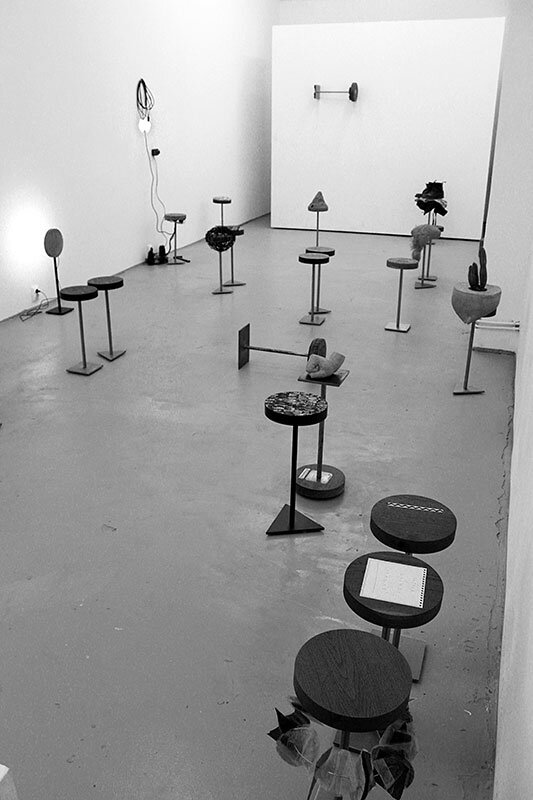
The V.I.C. "Very Important Chair" project involved several architects: Nicolas Dufeu, Andrei Ivănescu, Arthur O'Looney, Paramongols Association, Șerban Sturdza, Dorin Ștefan and, last but not least, Alexandru Popovici.
The exhibition is hosted by the BARIL gallery in Cluj.www. baril.ro
Revista Arhitectura: What made you get involved in the V.I.C. project?
Dorin Ștefan: From the very beginning I was hooked by the V.I.C. story, I even wrote a text about it, because I knew that world, where V.I.C. comes from, inside the factories of the communist period (in the 60s, my father took me to his factory from time to time, at the Tool Factory in Râșnov, and in high school I had compulsory practical training at the Tractorul Tractor Factory in Brașov). The V.I.C. was an accessory to have lunch during the 11.00 a.m. break (for shift 1). In factories and plants, work was done in three shifts, day and night, the first shift from 7 a.m. to 3 p.m.. There was a makeshift meal at the workplace, resembling the peasants' meal at the scythe: onions, bacon, bread, next to the lathe or near the workbench. The V.I.C. was a necessity and was made from whatever was at hand, from the materials from which drills or tractors were made. But it wasn't just any old thing. It came from a mentality of respect for work.
Arthur O'Looney: I first became familiar with the concept of the V.I.C. chair when I met Alex Popovici one winter evening in a café bar in Bucharest. Our communication was limited as neither of us spoke the other's language. However, through gestures, recalling the French I learned in school, helped by a few glasses of red wine, the image of this project began to take shape. Alex Popovici's enthusiasm together with the eerie story about the brave and innovative workers in Ceausescu's Romania and their hidden chairs aroused my interest to accept the invitation to participate in this project.
Nicolas Dufeu: I took part in this adventure with great pleasure. From the very beginning, Alexandru Popovici introduced me to a very talented cabinetmaker, Gérald Perrin, from the Kwantiq workshop, who helped me to realize the V.I.C TEN. On the other hand, the history of the transition from communism to capitalism interests me a lot, and that's how I started thinking about my project.R.A.: Designing a building, a public space, a fountain or a chair. What do you see as the differences and similarities in approaching the problem?
Dorin Stefan: Interest, knowledge, performance. Only the scale changes. And, of course, the story. The story is the basic, it gives substance to the ending.
Arthur O'Looney: First of all I have to say that the design approach to any kind of project, be it a chair or a building, varies from person to person. However, I do think that some similarities can be drawn in terms of the basic principles of design, such as: appropriateness of function, ease of workmanship, attention to detail and, of course, the most elusive and subjective principle, beauty. I believe that in the design of any object there are more similarities than differences, I personally don't try to change my approach according to one situation or another. Of course one project may be different from another in a technical manner, in size or perhaps in complexity, but these are only physical differences, which should not significantly influence the creative process of the designer's working method. Perhaps in the absence of a demanding client or a strict deadline, the designer will feel less pressured, however I ultimately believe that inspiration drives a pesoan to create a certain way, and how they turn it into reality, at least for me, does not change from project to project.
Nicolas Dufeu: Alexandru Popovici has clearly situated his hitherto anonymous chairs in the realm of art, I think this is the profound originality of the project. Each V.I.C. follows a different trajectory suited to each author, there is nothing to resolve, just to find an echo, a particular resonance.
R.A.: What is the message of the V.I.C. chair you designed?
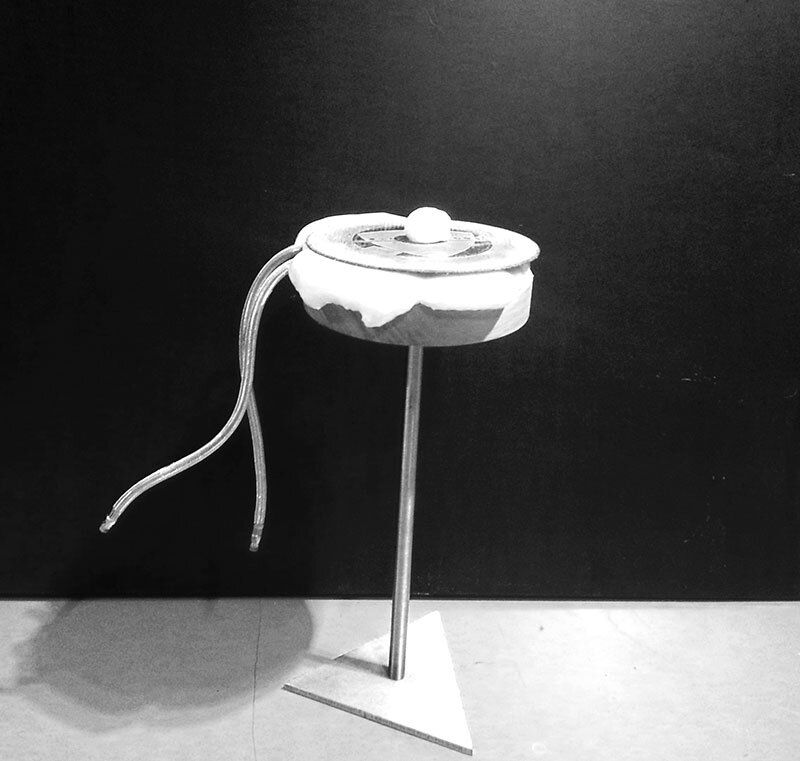
Dorin Ștefan: It is a continuation of the V.I.C. prefabricated by Alex Popovici and, at the same time, a return to what the V.I.C. could have been without Alex's "support". Using the materials at hand, now, on the workbench in my father-in-law's "home-made" mechanical workshop. Beyond the story of the V.I.C.-, I was fascinated by the determination with which Puiu Căciulescu, a dam engineer, wherever he set up on a domestic construction site (because I knew him in this capacity), first made a workbench with a vice, tools and a lot of "screwdriving" gathered together to use it for something. I rediscovered the fascinating mindset of sitting down to work. In this sense, my proposal does not bring time backwards, but is a present tense encroachment of the "it's just going" mentality. And it's called "Mr. Goe."
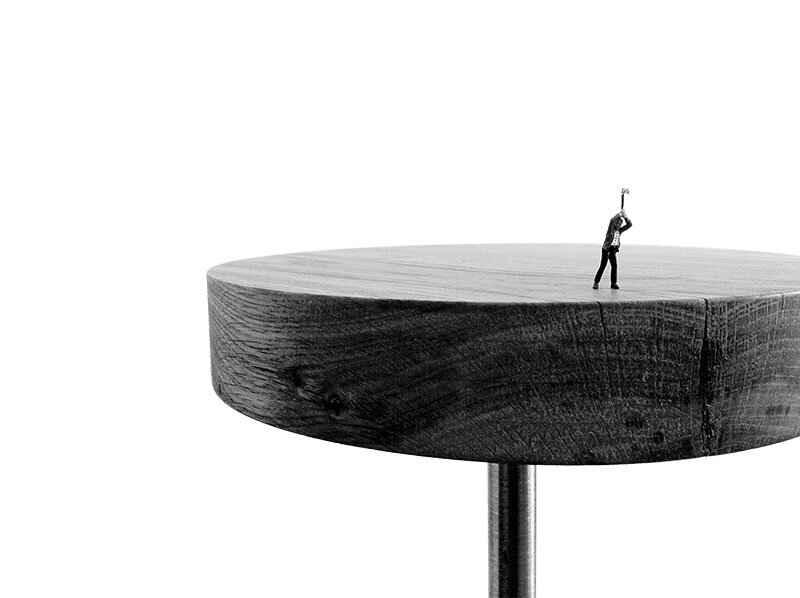
Arthur O'Looney: When I saw "my" chair V.I.C. I was impressed by the simplicity and scale of the design. It moved me that such a small, unassuming object of simple wood and cast steel could symbolize the titanic struggle between these men and the communist state. On inspecting it, I noticed that the surface of the wood was flawed due to small cracks. Trying to find the reason for the cracks in the structure of the object and without finding a direct one, I chose to invent one, which became a wood chopper with a raised axe, 1 inch high. To me, this small external influence in the form of a man wielding a dangerous tool symbolizes the relative importance of any human creation. While precariously perched on the edge of the wooden chair, this seemingly frail and anonymous figure, deeply focused in his endeavor, oblivious to his surroundings, actually exposes the fragility of the chair itself. This solitary figure has localized a weakness in the smooth, polished surface, which in time, like a proper companion, will slowly lead to inevitable destruction. I have chosen to call it 'Ananke', the primordial Greek deity of inevitability, the personification of necessity and destiny. Often depicted as carrying a torch. She carries the light that will illuminate all things, each with its destiny. In this case the torch has been replaced by this little man's axe. It is a blazing light through the glow of steel, but the ultimate reality of the creature, the life and death cycle of all things, through their corrupt political systems or through a mere chair, will eventually come to bear.
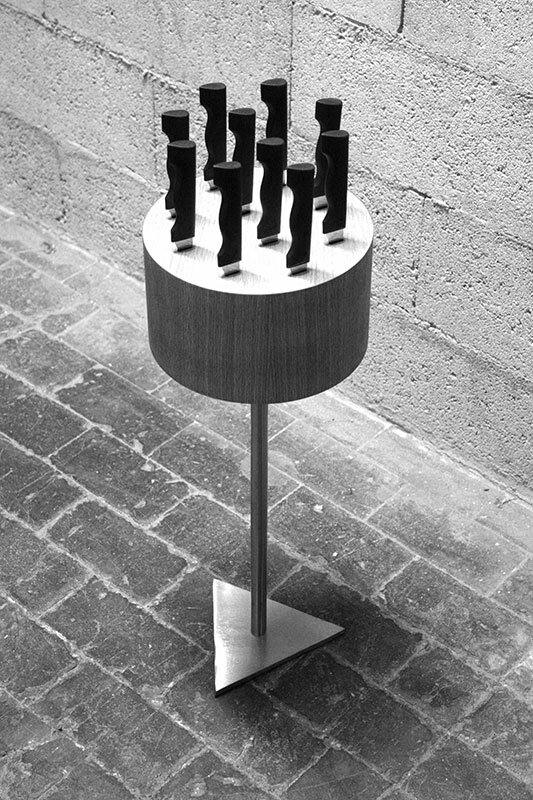
Nicolas Dufeu: I tried to disguise under another, absurd, everyday function, a chair camouflaged as a knife holder. This new function evokes a certain ambiguity between a wounded or armored seating, all while I kept the cake shape.
Details
https://www.facebook.com/pages/VIC-Very-Important-Chair/206690752717466