
Yesterday: yesterstep, yesterdream, yesterme. A vision of the path from inspiration to object
Yesterday:
yesterstep, yesterdream, yesterme
THE WAY FROM
INSPIRATION TO OBJECT
|
"What else could a poet or a painter express than his encounter with the world? The world is wholly inside and I am wholly outside myself" (Maurice Merleau - Ponty) |
| Yesterstep. Does it change anything if we add a dot to a line, which is made up of an infinity of dots? Nothing changes. We can add ten, a thousand, even an infinity, but it will still remain a line. By adding a point, the line does not become a surface. To get the desired surface area, we need more lines, but once the surface area is acquired - we can add as many lines as we want and we will not be able to get out of the surface area to get to the volume. The line-surface-volume analogy, still considered by the ancient philosophers, denotes the existence in mathematics of several orders separated from each other by a property: the lower order, no matter what it does, cannot reach the higher one. Between them, the orders are separated by what in philosophy is called a "relation of transcendence". The ratio of transcendence is not just a mathematical value: it is an index of power, of the propulsion to the higher level of all the processes of metamorphosis in life. The surpassing of a stage is not accomplished by adding other elements to the same quantity, but by an elevation to an irrational or complex power. Incidentally, also in mathematics, if a∈N and n∈N, thenan∈N. Conversely, if a∈N and n∈R, thenan∈R, where R is the set of real numbers.
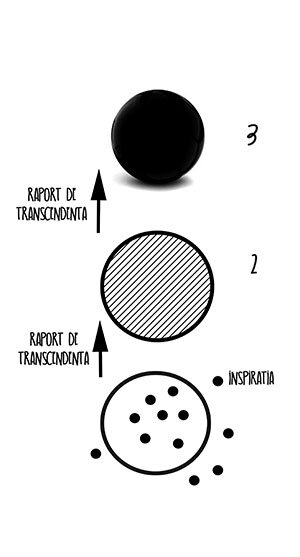
In the scheme above, which diagrammatically describes the route from Idea to Object, we find the hypotheses stated above: in the first order, the circular line delimits the areal of inspiration, and this areal can increase its perimeter to infinity, but it will never be able to evade the order autonomously by itself. Thus, the transcendence relation intervenes which transforms, in phase 2, corresponding to order 2, all the dispersed points of the process of inspiration into an area - in practice, a veritable system of relations. Finally, when this step is exhausted, the transcendence ratio transforms the Idea into an Object. |
| Read the full text in issue 6/2013 of Arhitectura magazine |
| Bilbliography: Lucian Blaga, Trilogy of Culture, 2011, Humanitas Arciszewski, T. and Kicinger, R. (2005) "Structural design inspired by nature". Innovation in Civil and Structural Engineering Computing, Saxe-Coburg Publications. On the phenomenology of language, Herman Leo Van Breda (ed.), Problèmes actuels de la phénoménologie, Editia Desclée de Brouwer, 1952. |
|
"What else could a poet or a painter express than his encounter with the world? The world is wholly inside and I am wholly outside myself". (Maurice Merleau -Ponty) |
| Yesterstep. Would anything would change if to a line, which consists of infinity of points, we add one point? Nothing changes. We can add ten, one thousand, even an infinity, it remains a line, whatsoever. By adding a point, the line does not become a surface. In order to obtain the surface that we want, we must have more lines, but once the desired surface is gained - we can add as many lines but we will never succeed escaping the surface in order to reach a volume. The line-surface-volume analogy, considered since the ancient philosophers, denotes the existence, in mathematics, of more categories/degrees separated by one property: the inferior rank, no matter what it would do, cannot reach the superior one. Amongst them, the ranks are divided by what in philosophy it is called: "transcendental ratio". The transcendental ratio is not just a mathematical value: it is a parameter of power, of propulsion to a superior level of all the processes of metamorphosis in the real life. The overcome of a stage is not obtained by adding other elements towards the same quantity, but by raising it to an irrational or complex power. Therefore, even in mathematics, if a ∈ N and n ∈ N, thenan ∈ N. However, if a ∈ N and n ∈ R, thenan ∈ R where R is the set of real numbers.
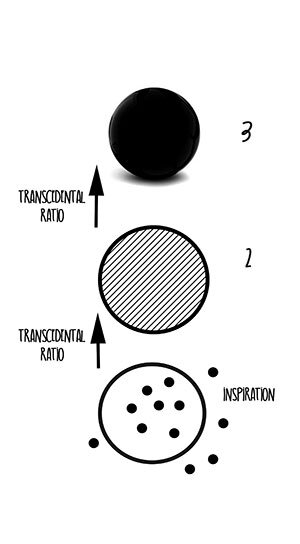
In the adjacent scheme, which diagrammatically describes the way from Idea to Object, we discover the hypostases previously enounced: firstly, the circular line delimits the area of inspiration, and this area can increase its perimeter to infinity, but it would never be able to subtract from the category autonomously. Otherwise, the transcendence ratio intervenes, which turns, in phase 2 (corresponding to the second order) all the dispersed points of the inspiration process in an area - practically, an entire system of relationships. Eventually, when this step ends, the transcendence ratio turns the Idea into Object. |
| Read the full text in the print magazine. |
| Bibliography: Lucian Blaga, Trilogia cultura, 2011, Humanitas. Arciszewski, T. and Kicinger, R. (2005) "Structural design inspired by nature". Innovation in Civil and Structural Engineering Computing,Saxe-Coburg Publications. On the phenomenology of language, Herman Leo Van Breda (ed.), Problèmes actuels de la phénoménologie, Editia Desclée de Brouwer, 1952. |