
Drawing in architecture. Drawing lines around ideas
"Drawing is an expressive gesture which has the advantage of permanence."
Henri Matisse The architect involved in the creative process develops his own figurative visual language. This personal universe is made up of notes, preliminary sketches, details, photographs and plans - indispensable tools for the talented and imaginative.
The architectural drawing is not illustrative. It is the principal means of expressing visual thinking and anticipates the final form of the project. Through this process, the architect's ideas take shape.
Drawing is communication, because the artist uses a certain language to promote his ideas. This graphic code consists of a universally accepted alphabet and "grammar". Architects use both conventional graphic formulations and their own ways of expressing themselves, acquired during their professional development. The hand drawing reflects ways of thinking and living, being honest, direct and personal.
The representation of architecture has created a true culture of the image, subject to permanent reinterpretation, a true mirror between reality and fantasy.
Drawing, sketch, sketch
Drawing has become the general term for graphic representation. Sketch and sketch indicate specific graphic techniques. The sketch contains little detail, its precision and accuracy are relative, and it is a preliminary stage before the drawing is elaborated. A sketch can also be a three-dimensional, wire-frame digital representation of an object.
Architects make sketches throughout the creative process, but also to make it easier to communicate with colleagues or clients.
Drawing a design involves drawing lines, using different techniques, methods and means specific to each historical period. The line suggests movement, as it is the result of the action of the hand, the act of drawing signifies living, thinking, intimacy and individuality. Architectural drawings are not always very beautiful, their value depends on the quality of the information they contain, and not so much on their appearance.
It is worth noting that, over time, architects often resort to similar ideas, solutions and approaches, without any cultural, historical or geographical links between them. The presence of similarity is attributed to those logics and philosophies that every architect develops in the stages of the design process.
A time of tinkering
When computers became very popular, it was clear, even to the most skeptical, that we were living in a time of unrest and rapid change. Because every technological breakthrough is accompanied by a new way of thinking and perceiving the world, there was an initial period dominated by conservatism-driven reticence, only to see the benefits of digital technology fully exploited in architecture. What's more, if in the pioneering days the computer seemed an alternative, life without it has now become unthinkable. These 'infernal machines' have affected not only the way we perceive architectural design, but also the way it is applied.
The implementation of digital technology in architectural design has involved laborious trials and experiments, initially limited to two-dimensional drawing. Today, it has become common to represent non-existent buildings, which are only at the design stage, in three-dimensional images of high photographic quality or in true-to-life animations.
We have all been amazed at how much things have changed in recent years in terms of architectural representations. While they may have started out as naïve, clumsy drawings, some of them can now be true works of art, worthy of being exhibited in the world's museums.
Digital drawing
The advent of digital technologies generated by the introduction and use of computers has made it possible to create a very wide range of complex two- or three-dimensional shapes, representations and simulations for architectural studies and design.
Present in architecture for more than two decades, digital drawing has driven the evolution of perspective representation, influencing the way in which perspectives are realized, presented and also perceived. Programs exist that can construct perspectives of remarkable quality and complexity in a relatively short time. The object created in cyberspace can be rendered from virtually any angle, and the perspectives can be vertical or oblique, at one, two or three vanishing points.
Photorealism is a form of digital representation of architectural perspective that has qualities similar to photography. These realizations capture three-dimensional objectives in a realistic manner, whereby volumes, materials, light, shadows, shadows, surroundings and atmosphere are rendered in such a way as to reproduce reality as faithfully as possible. Photorealism is gaining more and more ground at the expense of traditional representations, because the designed space can be explored visually before it is actually built.
Digital representation of architecture is the generic term for works and activities that promote, use and apply digital technology in architecture. The impact of new technologies is revolutionary and is reflected both in the creative process and in the techniques and methods related to architectural representation. Digital technology has changed traditional practices and introduced so-called computer-aided design. This has created new ways of artistic expression, but also the possibility of sometimes excessive standardization in the design process, which has led to heated debates about the very role and contribution of the architect in the digital age.
Computer-aided design involves a graphical process that allows the study and simulation of designed spaces as if they were real. By altering geometry, color, materials, lighting conditions and the angles from which they are viewed, 3D objects can take on special properties that were unimaginable a generation ago. Plans, views and sections produced by traditional academic methods can be successfully replaced by complex and dynamic representations.
CAD
The CAD environment offers impressive possibilities in two- and three-dimensional drawing. It is an extremely valuable tool not only in construction and architecture, but also in the automotive, shipbuilding and aerospace industries. It is also used for animation and special effects, with major applications in film and advertising.
Computer-aided design is applied in almost every architectural office in the world, and is used in all types of projects of all sizes: residential, office buildings, commercial, hospitals, industrial buildings, urban planning studies. The usefulness, efficiency and scope of computer-aided design are so great that the author of these lines has even used its benefits to design logos or the full-page layout of his books. Programs that work in three dimensions offer full freedom and possibilities for constructing surfaces and volumes by operations on complex shapes, extruding closed contours, adding or extracting parts of existing volumes. The object can be rotated, viewed from any distance or from any direction, in different windows running simultaneously on the monitor screen, and the result can be printed for checking or the file sent to collaborators or clients. At this stage, the drawing will look like the geometric perspectives, obtained in the classical manner of technical drawing, consisting of clear lines, depicting the contours and elements of the building facades.
3D modeling
The major advantage of 3D modeling compared to traditional layouts is that the architectural objective can be modified in a relatively short time, by means of one-off interventions, without having to repeat the whole process. Once built, the model can be emphasized from the outside as well as from the inside, from any angle, which is equivalent to obtaining an unlimited range of perspectives at one, two, three vanishing points or axonometers. At the same time, the result is all the more lifelike and refined, as the model built has as much detail as possible, enhancing its realistic qualities.
With digital technology at their fingertips, all those involved in the design and decision-making process of an architectural project can simulate, in static synthesis images or in dynamic ways, multiple variants of the proposed space, so that the result is as close as possible to their possibilities, needs and convictions. This creates a kind of interaction between the architect, collaborators and clients because decisions can be applied and visualized immediately, considerably shortening the time allocated to an architectural study.
Digital representations
Three-dimensionally constructed entities contain both features that define their geometry and properties related to color and texture. Generalizing a bit, we can say that, through the rendering process, the computer "photographs" the three-dimensional whole, giving us, in the end, an image with dimensions and resolution that are easy to determine.
The images acquired by rendering are used in the architectural design stages as representations for clients, collaborators or to popularize the objective. Renderings can play an experimental role, as they allow any kind of intervention in the volumetry, aesthetics and functionality of the project from the stage when it is on the drawing board and the ideas have not been finalized.
The applications of architectural renderings are manifold. Photorealistic images of future buildings can be included with photographs of the existing site to study the aesthetic and functional impact on it. Digital renderings are extremely valuable for interventions such as the renovation or restoration of architectural landmarks, as several material or color options can be proposed. Last but not least, renderings provide the necessary support for urban planning studies on the presence of visibility corridors or the effects of shading on a built ensemble.
Digital renderings have become very popular lately, but there are pessimists who claim that they are merely productions of new technologies. I am convinced that things are quite different, that a proper analysis requires a deeper exploration of meaning. Digital drawing tools will probably replace traditional ones in the not too distant future. On the other hand, the digital age will reach such a high level that the only limits will be those imposed by the potential of each of us to dream.
Architectural drawing books
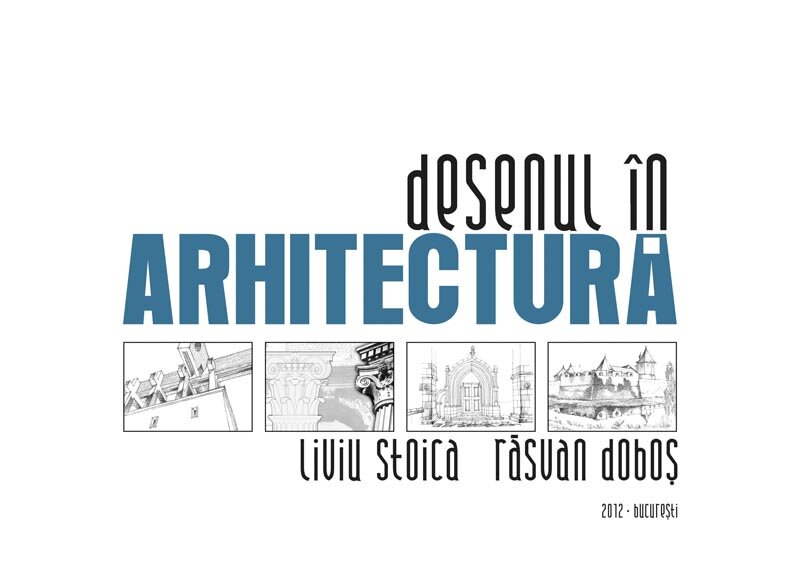
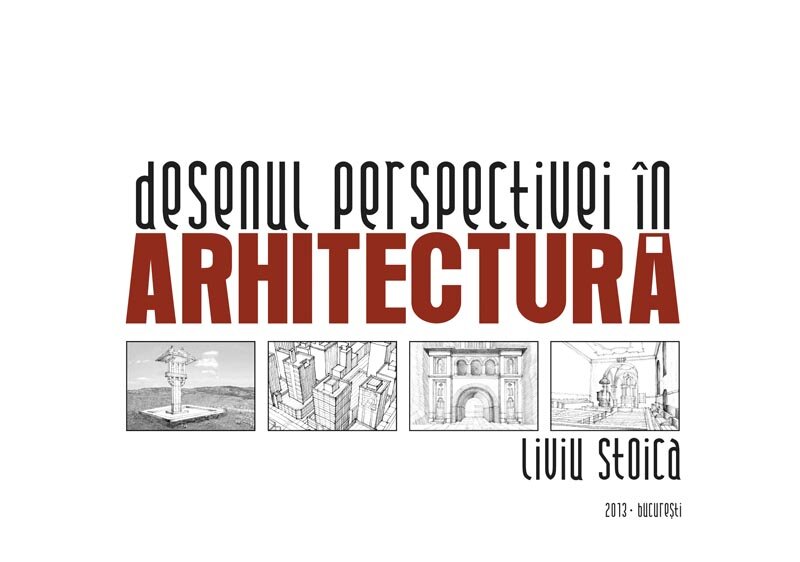
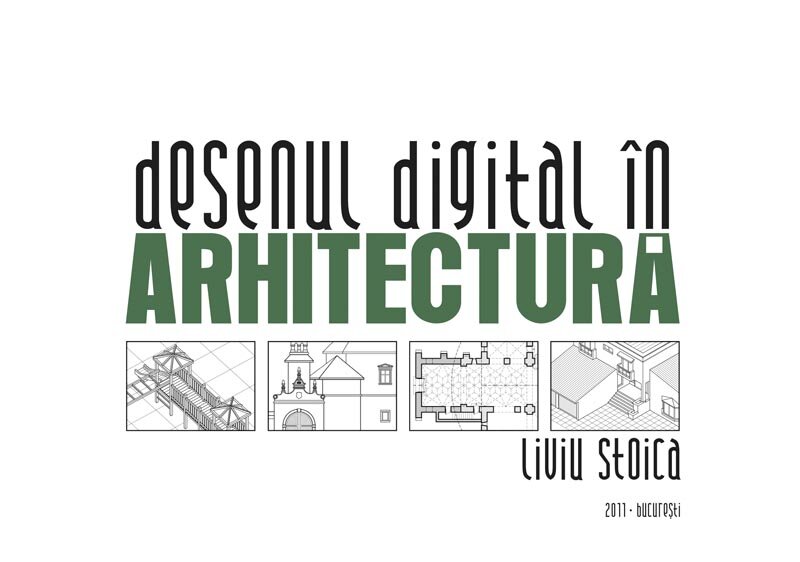
The examples presented in the books 'Drawing in Architecture', 'Perspective Drawing in Architecture' and 'Digital Drawing in Architecture' present personal approaches to drawing.
The eclectic material has been accumulated over many years of work and has been chosen to reflect as wide a range of concerns as possible. The examples from different historical periods and geographical areas show that drawing can be local as well as global, that it can be the product of the conditions of the moment or that it can be universal in scope. Despite the new approaches and trends generated by technological changes, I believe that the importance of drawing has remained broadly the same from the Egyptians, Greeks and Romans to the present day.
Epilogue
It is said that a digital drawing can be seen but not felt. The gestures by which we draw lines on paper give hand-drawn art the degree of personalization and expressiveness that computers, at least for now, fail to do. It is interesting to note the results of some analyses which show that the vast majority of contemporary architects produce preliminary sketches in the traditional hand-drawn manner, although they utilize the advantages of the introduction of digital technology in the design process stages.
There are many who consider the digital age to be just a passing trend, a fashion. Contrary to them, I believe that we are witnessing profound, structural changes, redefinition of design methods and spatial perception. Looking to the future, I am convinced that our actions and their effects are pioneering, that we are explorers, participants, but also witnesses of what we call the digital revolution in its infancy.
The digital age marks the beginning of a new era and imposes new concepts, principles, theories and approaches. Its development will profoundly influence not only architectural design but the entire value system of humanity.