
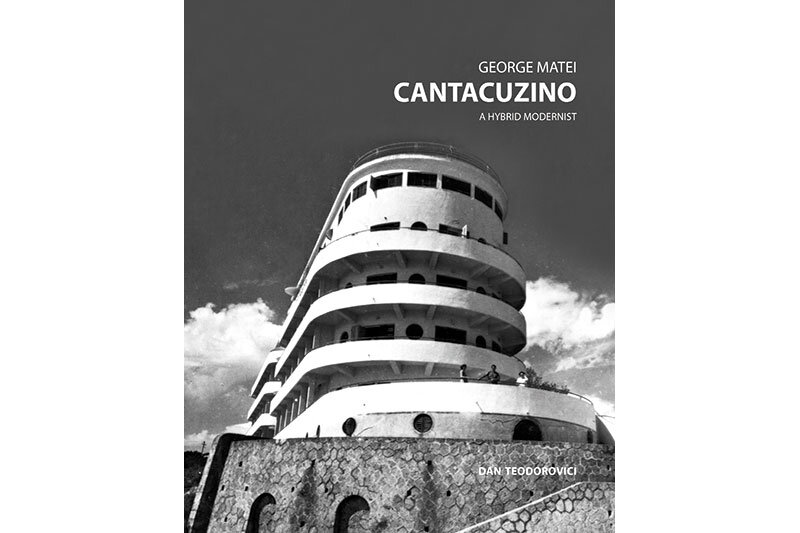
George Matei Cantacuzino a Hybrid Modernist. Dan Teodorovici
"There are traditionalists, modernists and others. In the latter category are those architects who believe that it is necessary to find a balance on the foundations of the classical disciplines, without disregarding any of the modern themes and without turning their backs on tradition."
G. M. Cantacuzino, Points of View (1947)1
At first sight the attitude sketched in this quotation seems banal. In fact, it is a challenge, being not only reasonable but difficult to realize. This attitude, named by the architect and public intellectual G. M. Cantacuzino (1899-1960) the classical attitude, is one of the subjects of the monograph George Matei Cantacuzino - a Hybrid Modernist, which appeared in January 2014, with the support of the Romanian Union of Architects, at the Ernst Wasmuth Publishing House in Tübingen/Berlin.
The book accompanies the exhibition with the same title, this double cultural project being the first monographic presentation of a Romanian architect on a European level. The project is based on the doctoral thesis G. M. Cantacuzino - Dialogik zwischen Tradition und Moderne (G. M. Cantacuzino - Dialogic between Tradition and Modernism), completed by the author in 2010 at the Faculty of Architecture and Urbanism of the University of Stuttgart.
The exhibition was premiered at the Weissenhof Gallery of Architecture in Stuttgart (February 9-April 8, 2012, announced by Arhitectura), then at the Consulate General of Romania Gallery in Munich (November 23, 2012-January 24, 2013) and the Architekturschaufenster Gallery in Karlsruhe (June 13-July 5, 2013). Future venues will probably be the Roman Cultural Institute in London and the Museum of Architecture of the Technical University Berlin.
The book is the first monograph on a Romanian architect published by a world-renowned publishing house. Founded in 1872 in Berlin, the Ernst Wasmuth Publishing House has remained one of the leading independent publishers of architecture, art, design and archaeology in Germany. Notable publications include, for example, the portfolio that made the American architect Frank Lloyd Wright famous in Europe (1910)2.
The monograph George Matei Cantacuzino - a Hybrid Modernist is composed of three parts: an intellectual biography, a study in architectural theory of the classical attitude and the addendum. It includes, in addition to bibliographical apparatus and other references, a list of architectural projects, essays translated into English, reproductions of watercolors and paintings, and a tabular biography of the architect.
The book processes previously unpublished documents and information from personal and public archives in England and Romania, from discussions and correspondence with former students or friends of the architect, as well as his personal correspondence. This aspect will certainly be of interest not only to the educated and mature public, but also to those studying architecture in Romania, who, so far, know Cantacuzino's work mainly from the monograph written by art historian Mirela Duculescu in 2010 and the biography published in 2011 by Ion Mihai Cantacuzino3. G. M. Cantacuzino is, unfortunately, known only to a small circle of specialists.
Given the era of extremes in which he lived, his intellectual integrity is remarkable. It is based on the classical attitude with which the architect sought to link modernism with tradition and aesthetics with ethics.
Born in 1899, he belongs to the second generation of modernists, which includes Alvar Aalto, Josef Frank and Mart Stam. An independent-minded architect, he was not shy to criticize some of the extremes of modernism. He studied architecture at the École des Beaux-Arts in Paris (1920-'29), starting in the studio of Gustave Umbdenstock (1866-1940), one of Le Corbusier's most bitter enemies. In 1923 he opted for the studio run by two liberal professors who would become his mentors at the École: the architectural historian Georges Gromort (1870-1961) and the architect Roger-Henri Expert (1882-1955). Expert was also a member of the progressive Groupe des Architectes Modernes, formed in 1922 around Tony Garnier, Auguste Perret and Henri Sauvage. It is very likely that the ethos of this group, to combine modernism with French classicism, strongly influenced the young G. M. Cantacuzino. In Romania he became "[le] chef incontesté de la jeune école d'architecture"4, an important man of culture and public intellectual. To this day he is regarded as the most important architectural theorist in Romania. He was also a painter, chief architect of the CFR, the first Romanian correspondent of the magazine L'Architecture d'Aujourd'hui, honorary corresponding member of the Royal Institute of British Architects, honorary citizen of New York City (together with Octav Doicescu) and a liberal politician. His liberal stance was disavowed during both the fascist and communist periods, and Cantacuzino suffered years of imprisonment, surviving on the fringes of society until his premature death in Iași in 1960.
George Matei Cantacuzino - a Hybrid Modernist seeks to situate his work and attitude in a broad architectural, cultural, economic and political context in Romania and Europe. This study strives to discover the fulcrums of his cultural and ethical attitude. The book shows how the classical attitude materializes, in the words of Gilles Deleuze, along multiple "lines of actualization or of differentiation"5. Deleuze used this method in his study of the work of Henri Bergson (1859-1941), the philosopher who profoundly influenced the thinking of the Romanian cosmopolitan architect.
Fascinated by the élan vital described by Bergson6, Cantacuzino was skeptical about any labeling of historical epochs, refusing to apply the notion of style to the dynamism of artistic creation. In his own architectural work, he was preoccupied on the one hand with Palladianism and on the other with attempts to synthesize modernism, Romanian architectural traditions and classicism. Perhaps the key to interpreting this approach - which is profoundly contemporary - is the classical attitudethat permeates and unites his entire architectural and essayistic oeuvre.
Finally, the monograph sketches the architect's artistic and intellectual family: from Vitruvius via Andrea Palladio and Karl Friedrich Schinkel to Auguste Perret and Adolf Loos; from Heinrich Wölfflin, Jean Cocteau and Georges Gromort to Rudolf Wittkower and Sir Ernst Gombrich; from Plotinus via Henri Bergson to Ludwig Wittgenstein and Albert Camus; from Michel de Montaigne via Johann Wolfgang von Goethe to Rainer Maria Rilke, Paul Valéry and T. S. Eliot. This way of discovering "the springs that feed the river of his thought"7 seems all the more legitimate in that the architect himself mentions it in a 1958 letter to his daughter Marie-Lyse:
"Each of us, moreover, creates our Parnas, our spiritual family, the only family we choose... or who knows, perhaps they choose us... these friends situated outside time"8.
Author
Dan Teodorovici, born in Brasov in 1972, is an architect and curator. He lives and works in Stuttgart/Germany. He studied architecture and urbanism at the University of Stuttgart (1993-2000), where he was assistant at the department of urbanism (2003-2009). In 2010 he defended his PhD thesis on G. M. Cantacuzino, which was awarded summa cum laude.
NOTES:
1. G. M. Cantacuzino, Viewpoints. In: Despre o estetică a reconstrucției. București: Paideia, 2001 (Cartea românească 1947), pp. 40-41.
2. Ausgeführte Bauten und Entwürfe von Frank Lloyd Wright / Studies and executed by Frank Lloyd Wright. Verlag Ernst Wasmuth A.-G., Berlin 1910.
3. Mirela Duculescu, George Matei Cantacuzino (1899-1960). Arhitectura ca temă agândirii / Architecture as a subject of thought. București: SIMETRIA, 2010.
Jean Michel Cantacuzène, Une vie en Roumanie. De la Belle Époque à la République populaire 1899-1960. Paris : L'Harmattan, 2011. Romanian version. De la Belle Epoque la Republica populară. 1899-1960. Ed. Fides, 2012.
4. Paul Morand, Bucharest. Paris: Plon, 1990 (1935), p. 293.
5. Gilles Deleuze, Bergsonisme. New York: Zone Books, 1988, p. 3.
6. Henri Bergson, L'évolution créatrice. Paris 1907.
7. A. Maurois, introduction to: Alain, Mars or the truth about war. London etc.: Jonathan Cape 1930, p. 17. Original edition Mars ou la guerre jugée. Paris 1921.
8. G. M. Cantacuzino, letter to Marie-Lyse Cantacuzino-Ruhemann, Iași, December 25, 1958 (Cantacuzino family archives, London).