
Romanian Architects and Political Detention 1944-1964. A book-event
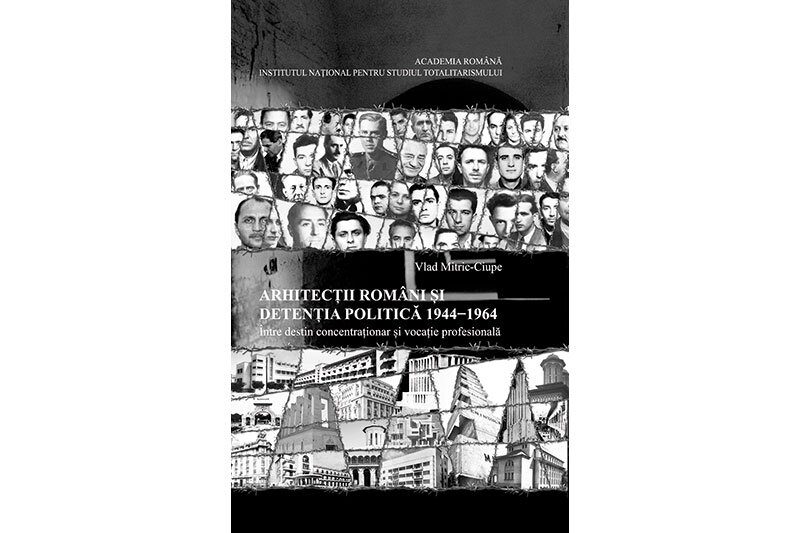
I hasten, for your immediate clarification, to give you the subtitle of this volume recently published by the National Institute for the Study of Totalitarianism: "Between concentration destiny and professional vocation". This is because clarity is one of the essential attributes of language, and the fact that this book is an unprecedented publishing event is what I want to emphasize from the outset. I have read, since 1990, memoirs and diaries of former political prisoners in Romania, I ran in my heart in 1995 to meet Elisabeta Rizea at the Stavropoleos Church and to listen to her for a few hours, to be shaken forever afterwards, I watched Lucia Hossu-Longin's program, Memorialul durerii, trying, as a child brought up under communism, to understand as well as possible the recent history that I had learned at school, which was completely different from what was beginning to reveal itself to me after 1990.
And I have the privilege, after 24 years of reading dozens of volumes of subjective literature, to find myself in front of a monumental book by the architect Vlad Mitric-Ciupe, an exhaustive work that brings together in its pages the destinies of all the Romanian architects who endured political imprisonment from 1944 to 1964, with one exception from this period, namely the architect Ion Fiștioc, arrested in 1987, who is also a visual artist, a man I met in the early 1990s, when he exhibited at the Bucharest Art Galleries. The exceptional merit of the author resides in the gathering together in the same basket of a huge amount of documentary material that he has covered in thousands of hours of studying the archives and interviewing survivors or their descendants, an extraordinary body of text being these unpublished testimonies. "The present study starts from this undeniable state of affairs: the insufficient (re)knowledge of the architects' relationship with the communist regime - especially in its first decades. Steps have been taken, including the valuable contributions of Professor Augustin Ioan, the memoirs of the architects Gheorghe Leahu and Ioan Mircea Enescu, the exceptional initiative of the doctor-architect Curea Viorica, the reminiscences in dialogue of the former chief architect of the Capital, Alexandru Budișteanu, the research of the pro-foesor Ana Maria Zahariade, the recent very consistent analysis of Mr. Alexandru Panaitescu and others. However, although the repressive dimension of communism has been evoked, the subject of the tragedy that some members of the guild went through is only thinly touched upon, and there are, of course, explanations for this. By conducting a survey of our profession, the results of which confirmed the initial hypothesis - the extremely low level of knowledge about architects convicted for political reasons between 1944 and 1964 - the opportunity to launch a study, the scale and scope of which we could not initially have suspected, was almost self-evident," the author confesses in his introductory essay. However, what Vlad Mitric-Ciupe does not say, and I believe this is due solely to his ultra-elegant discretion, is what an extraordinary effort it took to set up this study. But our author, himself an architect, was determined to make this effort, being acutely aware that he is producing a pioneering work, one without which nothing on this subject could ever be written in our country. No one could venture to approach the subject without consulting the volume I have chosen to present to you this time. That is because, in the field, this book is already sine qua non. "We have chosen to detail 75 cases, since the other situations are still unclear, pending access to the personal files in the C.N.S.S.A.S. archives. Someone said at one point that the study we are proposing would be important if we succeeded in identifying architects who opposed communism through their work. In the end, we stick to the original idea - it was not through their work that architects were able to resist or protest, but they did so in many other forms, the whole spectrum of which we detail through the 75 cases. It was also striking to note their diversity, in terms of age, gender and professional qualifications (pupils, students, diplomats), and even ethnicity, if we think of architects of Hungarian, Jewish, German, Italian and Aromanian origin, all of whom share the fate of the Romanians of majority-Romanian origin. The same logic also applies to the various legal frameworks for those sentenced, their imprisonment through administrative internment and the pressures to which they were subjected after their release. This broad spectrum led us to analyze all 75 situations, considering that each one is a piece of a larger puzzle that we wanted to put together", continues the author.
The statements made during the terrible investigations by some of the great names of Romanian architecture in the first half of the 20th century, masters to whom we owe the architectural configuration of the capital and beyond, names such as Prince G.M. Cantacuzino, Constantin Iotzu, Eugen Botez, Constantin Joja, Ion D. Enescu, Arghir Culina, if I stop here with the enumeration. And I will stop because Vlad Mitric-Ciupe has structured his work by periodizing it and including all the architects who were arrested and sentenced in each of the years 1944-1964. Thus, we will find a mini-chapter dedicated to each architect, including the biography, the reason for the arrest, which is of course a pseudonym, the statements that the arrested person was forced to give to the investigators under conditions that are described at length in the interviews that the author has taken with survivors and relatives of the disappeared, sometimes statements and notes by the investigators, the text of the sentence and extracts, where appropriate and where there was documentary material, from memoirs written long after the liberation, i.e. when it was certain that they could be written, because these people were pursued by the Securitate step by step until 1989. The abuse of the newly established regime in Romania against these artists whose profession began, immediately after 1944, to be regarded as characterized by decadence, is unquestionable, manifested not only by the imposition of the Soviet trend in architecture, but, in a truly atrocious manner, by the arrest and imprisonment of some of the leading figures of Romanian architecture. Vlad Mitric-Ciupe's book tells us about the destinies of these architects (and not only), an event-book and a document-book at the same time, containing rich excerpts from the C.N.S.S.A.S. archives and an extraordinarily generous illustration for each case presented. The author-architect's endeavor is one that I ask you to allow me to give a standing ovation and to bow before, both because, by reading his book, which is one that you can only go through by heart, I was able to reconstruct for myself an enriched reconstruction of an era in which information on the fate of architects and architecture of that period in general was very scarce and disparate, found in the memoirs of writers who were political prisoners during the same period and who had architects in their family or among their friends.
Romanian architects and political imprisonment 1944-1964. Between concentration destiny and professional vocation
Author - Vlad Mitric-Ciupe
National Institute
for the Study of Totalitarianism
ISBN - 978-973-7861-58-0
Year of publication - 2013
Number of pages - 560
Format - 17x24
Preface - prof. dr. dr. arh. Sorin Vasilescu
Closing speech - prof. dr. Radu Ciuceanu
The volume can be purchased at the National Institute for the Study of Totalitarianism, str. Arh. Grigore Cerchez, nr. 16, sector 1, Bucharest, from the headquarters of the Romanian Union of Architects, as well as from the Cărturești network and the Mihai Eminescu Bookshop in Bucharest.