
"Invisible Gardens" Cluj - Mănăștur
The contemporary structure of the Romanian city is articulated on a ubiquitous component of functionalist urbanism, modernist in origin, which was the product of a large-scale external decision from the political arena, and not the result of an organic development of the city. Thus, it became the source of at least three major problems specific to this type of urbanism: the sterilization of spaces and the distancing of the inhabitant from the public space; the impermeability to criticism of the model within the country; at the level of subjective perception, a strong negative association, due to the imposed exercise and the lack of continuity of the urban fabric.
In Cluj-Napoca, using the opportunities of the prospect of becoming European Capital in 2021 and the administration's offer to turn part of the local budget into a participatory budget, in 2013 several groups of architects, artists and civil society actors started (independently or in tandem) to tackle the problem of the periphery, focusing on one of the largest such neighborhoods in Romania, Mănăștur. This, in a context of upward growth in Cluj, where the central area has successfully established itself as a culturally and economically vibrant pole with a strong identity.
At present, the demography of Mănăștur is very diverse and dynamic, ranging from the elderly to young families and a substantial number of students (attracted by cheap rents and amenities). If, in terms of utilities, the neighborhood is developing spontaneously in a substantial way, the organization of the space on the basis of any strategy, as well as the presence of culture in the public space, leaves much to be desired.
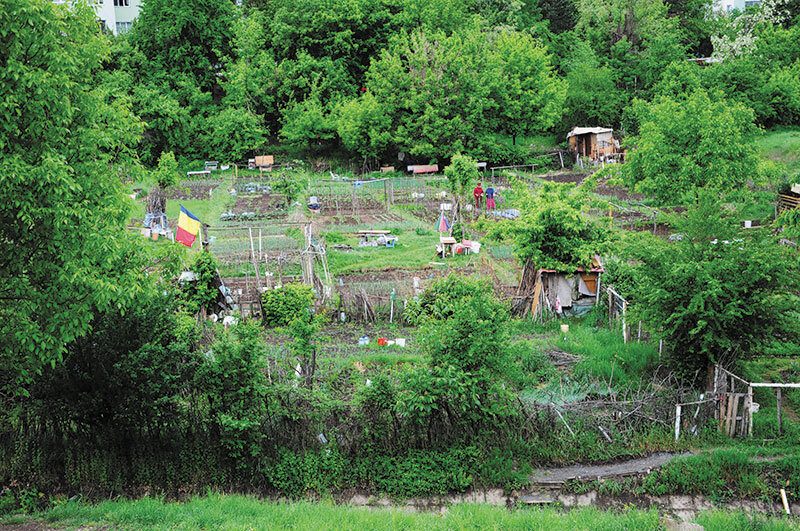
The first to get directly involved were Colectiv A from the Paintbrush Factory. Working in the northern part of Mănășturului, on the edge of the forest, where there is a large, inconsistently landscaped green space and the gardens of the inhabitants of Mănăștur along a stream, Colectiv A proposes new urban and cultural approaches in the form of social and artistic interventions in public space1. In tandem with the "Landscape Choreography" cultural project in three European cities (Taranto-IT, Cottbus-GE, Cluj-RO - www.landscapechoreography.eu), they have adopted the green area and created urban gardens and community meeting spaces, coupled with cultural activities and workshops on various themes. This is how "La Terenuri" (www.la-terenuri.colectiva.ro) came to life, a project joined by a number of interventions and events: Cluj Days, Architecture Days, TIFF.
The project "Verdeața Isteață Isteață" (Gelu Puscaș, Oana Burlă, Mădălina Leș, Paula Tripon, Camelia Maria Poliec - landarchs.com/verdea-istea-de-mntur-interview) came to meet the administrative initiative "Adopt a green space " - which offers companies the opportunity to improve their image by taking custody, landscaping and maintenance of public green spaces in Cluj. The group adopted a green strip at the tram stop by Calvaria Church, the cornerstone of Mănăștur. Architects together with landscapers and farmers have grown vegetables and greenery here, in the center of a vast car intersection with a suspension bridge, roundabout and tram line, in discreet contrast to the flat tufts of any standard landscaping. In turn, the information board, not unusual in such cases, contains, instead of author information, some poetic advice on "how to build a community together".
The recent project "Urban Food Stories" (Iulia Hurducaș, Alexandru Fleșeriu, Eszter Péter - www.oar.squarespace.com/galerie-castigatori-durban/), which won the competition for the Romanian Pavilion at the UIA, Durban in 2014, aimed to highlight the local specificity of urban gardens, agriculture that can be done in the city, not only in the village. Through the personal stories of small farmers, such as those from Mănăștur, the authenticity of these neighborhoods came to light, on the one hand, and on the other hand, the need of the inhabitants to get closer to the land. Urban gardens may be transitory, occupying spaces momentarily free from real estate pressures and adopted by the community, but their temporal inconsistency makes them all the more valuable and worth cherishing.
The project "A Dialogue" (Simona Or-Munteanu, Ligia Andreica - www.undialog.wordpress.com), also started in 2013, proposes a qualitative research to find a number of key elements to improve the perception of the Mănăștur neighborhood. Three perspectives were taken into account: the history of the place, the offer of public space and the inhabitants' projections of the space in the neighborhood and in the immediate vicinity. The results of the research will be made available to the administration (with which a constructive dialog has already been entered into) and will be the starting point for a second future part of the project, to develop some experimental micro-interventions, with the possibility of making them permanent.
This amount of concentrated effort, we hope, will bring us a little closer to the community of Mănăștur in finding the right and realistic solutions for an urban space, whose energy and vitality goes far beyond the narrow confines of the rectangular and gray facades that the built environment offers.
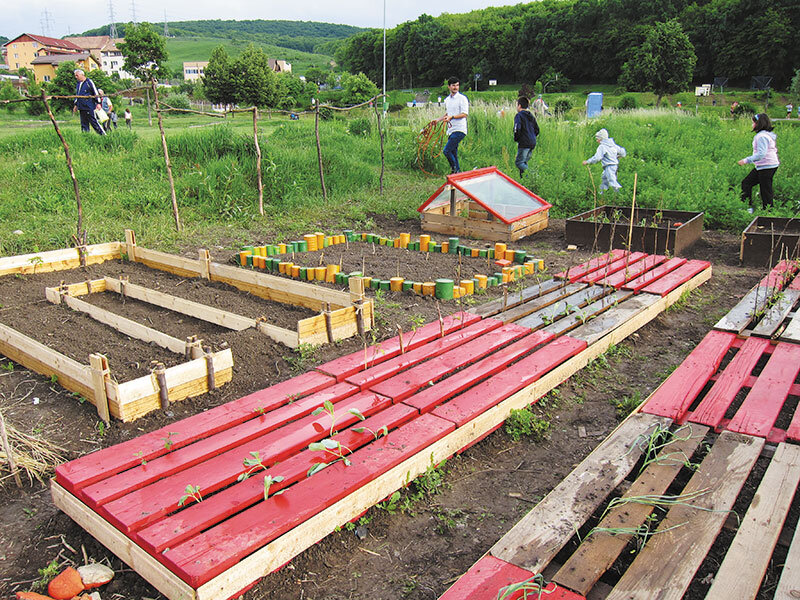
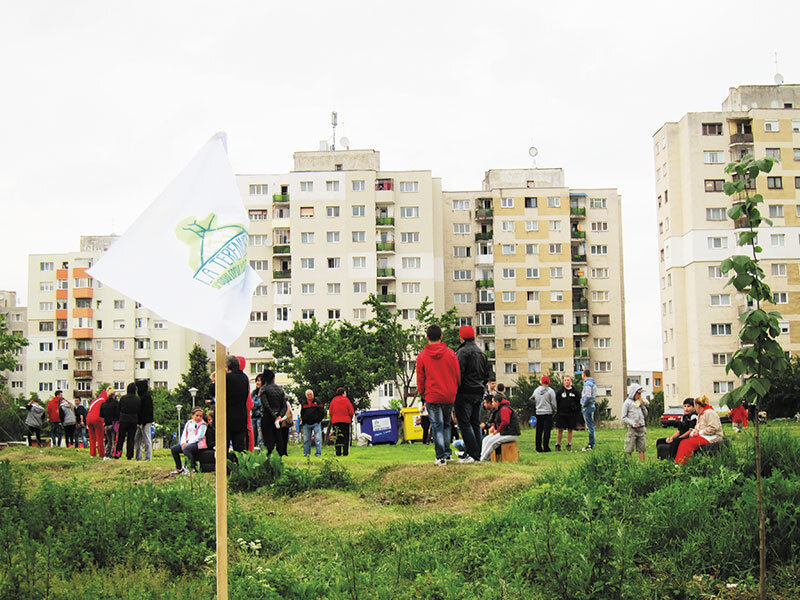
Photo:
Monica Moroșanu
Simona Or-Munteanu