
Leaving the barracks: model dwellings for soldiers in the Drumul Sării Parcel - Firing Range (1914-1941)
From 1912 onwards, the Communal Society for Eftine Housing entered into a series of collaborations with various state institutions in order to build social housing for civil servants. Thus, the Society's architects designed individual housing plots grouped in complexes such as Grivița, Prelungirea Dorobanți or R.M.S. - Grant, partly following the principles of the garden city for the C.F.R, the Ministry of Finance or the Ministry of War. This is also the case of the Drumul Sării - Poligonul de Tragere (Drumul Sării - Firing Range) Parcel, whose construction was intended to meet the housing needs of the military, a large social class in Bucharest at the beginning of the century. The article will analyze the stages of the construction of this parcel, the architectural changes adopted by the designers, as well as the way in which the current inhabitants of the parcel relate to the history of the neighborhood.
The myth of the neighborhood's construction and history in the archives
The construction of social housing neighborhoods by and for foreigners is one of the recurring memories shared by the residents of the low-cost housing estates, testimonies that we have recorded in various subdivisions, such as Fabrica de Chibrituri, Șerban Vodă or on Lânăriei Street. The Drumul Sării neighborhood is no exception either, built, according to the testimony of the current residents, either for Soviet officers at the end of the Second World War, or for British or German officers during the First World War. Their narrative varies according to their age or the period of their move to the neighborhood. With only one exception, that of a resident of the Culcer Street blocks, who told us the story of this neighborhood truthfully, the other residents rework themes they have heard from older residents without questioning the sources, in many cases contradictory. In this way, the inhabitants create an alternative history of the neighborhood, foregrounding the presence of strangers, in some cases this evidence is based on a fact or event also recorded in the archives. Without disputing the accuracy of the oral testimonies, the archival documents provide a broader perspective.
The presence in this neighborhood of various military institutions favored the construction of housing, the percentage of military in the population of Bucharest in the first half of the twentieth century was 3% of the population, most of them living in barracks. Around 1914, the Ministry of War decided to build housing - primarily for senior officers (for whom housing was designed and built in the Ana Davila housing estate), probably in the streets of Lăzureanu Barracks - in conjunction with the Communal Society for Eftine Housing - Bucharest. At the same time, at the request of the Ministry of War, the Communal Society is designing a new plot, near the camp of the Mihai Viteazul Regiment and the Trageriers' Polygon. In this area, delimited by the streets Drumul Sării - Constantin Marinescu - Octav Băncilă - Lt. aviator Gheorghe Caranda, the company built about 120 houses, mostly duplexes, totaling over 300 individual dwellings, some of these houses were even designed with four individual apartments under the same roof. The evolution of the construction of the houses on this plot indicates three styles that the Communal Society for Eternal Housing experimented with from its foundation until the end of the Second World War, which we will detail below.
The architects of the first two stages
The building campaign begins in 1914, when the Higher Technical Council of the Ministry of Public Works approves the plans submitted by the Society with some modifications1. The subdivision plans of 1921 show that the Society had built 27 semi-detached dwellings (i.e. 54 detached dwellings) since 1914. In July, the Society submitted plans for the construction of ten type B (semi-detached) buildings, with a plan drawn up and signed by the architect D. Mohor before the war, and arch. Fr. Rainer signed the subdivision plan in 1921. The authorization issued a month later allowed the construction of the buildings, but only nine of them are shown on the subdivision plan. Overlaying the 1921 map with a contemporary one, we see that only eight buildings still exist. The ninth has either never been built or has been demolished; it was located on the site of the present gas station.
Type B designed by architect D. Mohor had a symmetrical composition: it consisted of two rooms on the ground floor for each dwelling, separate chimneys, the roof was covered with tiles. We would be inclined to believe that the dwellings are tributary to the Neo-Romanesque style that the Society partially appropriated, but economic reasons led to the adoption of a simplified style, with the composition lacking elements typical of the Neo-Romanesque style.
From a town-planning point of view, the land between Negel St. and Salt Road seemed to be able to support the construction of two rows of houses back to back, the first three houses facing Negel St., and the buildings facing Salt Road. The plan was abandoned and the strip dedicated to them was later developed as green space. The planners opted to add two larger buildings in order to make efficient use of the space between the streets, but this too was abandoned.
In June 1915, the Nomenclature Commission proposed to the Communal Council that the streets be named after the aviators Negel and Caranda, "to commemorate the aviator officers who contributed to the Romanian military aviation and lost their lives in flight"2, and the proposal was accepted. The Commission also confirms that, "in this neighborhood, the Eftine Housing Society is building housing for the military and is located in a military region"3.
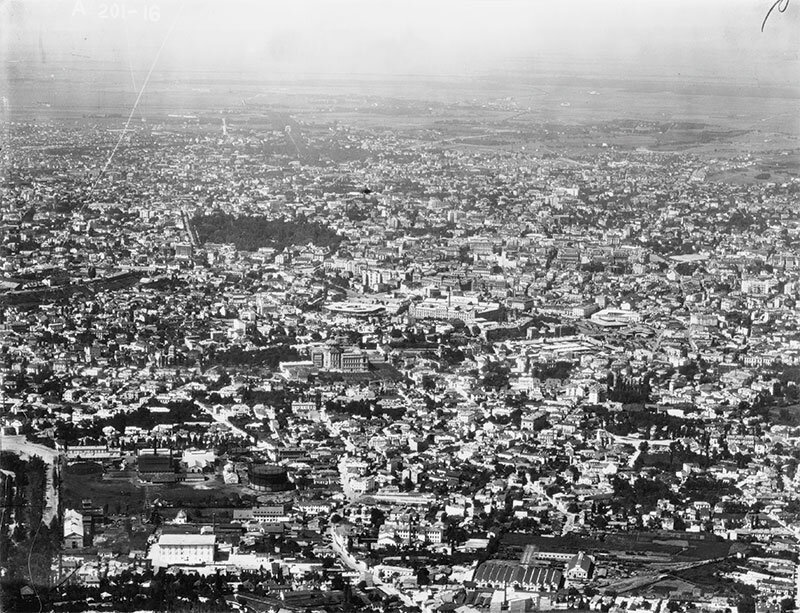
An aerial photograph from 1927 and the graph published by Cincinat Sfințescu in his article in Urbanism (1933) confirm the construction of this lot of 35 double dwellings (27 in 1914 and 8 in 1921).
Read the full text in issue 3 / 2014 of Arhitectura magazine
NOTES:
1 ANR-A.N.I.C., MLP Fond - Higher Technical Council, Meeting of July 18, 1914.
2 PMB, Public Administration Department, Archive Service, Administrative Acts, PMB Technical Fund, File 320/1915, tab 3.
3 Idem.