
Ruxi Sacalis: Most probably, I would answer the challenge
Gabriela Târlie: Who is Ruxandra Sacaliș and what does she do?
Ruxandra Sacaliș: She studied architecture and tries to create living spaces and enchanted objects that make our everyday life more beautiful.
G.T.: What does design mean to you?
R.S.: A way of exploring materials so that they form an environment where people feel at home on planet earth.
G.T.: If you could change the curricula of universities that teach design, what would you include? What would you take out?
R.S.: From what I've observed, universities have different teaching strategies and each institution is exploring and looking for new teaching pedagogies.
What would I suggest? Opportunities that are as diverse and varied as possible that allow the student to come into direct contact with the materials, to experiment, to be a sort of Robinson Crusoe discovering the world and recreating it, to learn to control the evolution of a project from idea to final product. I also believe that a minimal training in entrepreneurship is essential, because the real world is not only about creation and smoky objects, but also about dealing with producers, press, customers, etc.
G.T.: What are your expectations for this year's Milan International Furniture Fair?
R.S.: To be honest, I didn't know exactly what to expect, as it was my first experience of this kind. I signed up with the idea of opening a window through which I could see design on an international and global scale and, in this way, also see where we fit in the world.
G.T.: Why do you think it's important for a product designer to participate in an international fair?
R.S.: First of all for the exposure and the opportunity to meet different people, from manufacturers to designers from all over the world. Secondly for understanding his place in the international design market, which can help him a lot to evolve as a designer and motivate him in his work.
G.T.: You premiered several objects in Milan in April. What feedback did you get?
R.S.: Yes, indeed, among the new objects were the Bring us together table and the Light.paper lamps. Most people were attracted by the lamps and the stool. Some were interested in the story behind the lamps, others in the technique of making them, and most were pleasantly surprised to discover that the lampshade of the Light.paper lamps is made of paper.
G.T.: You won a special award for the Chamotte collection. How did it come about?
R.S.: The collection came about in response to the framework theme of the Salone Satellite Award, where they wanted an object/accessory for the bathroom or kitchen. In addition, this edition of Salone Satellite focused on natural materials, ceramics being one of them, and I had been flirting with the idea of creating a ceramic object for my kitchen for some time. The Salone Satellite Award brief was a good pretext to put things into practice.
G.T.: What has changed since you came back from Milan and what projects are you working on at the moment?
R.S.: I think mainly something has changed in my relationship with the world in general and with myself in particular as a designer. For now, many lessons from Milan are somewhere at the subliminal level of the subconscious, where I hope they will take root; personally, I think that after formal schooling, life learning, the school of life, is the most important; so I am currently trying to "dabble", to catch and fix new forms and produce new prototypes.
G.T.: How do you integrate notions such as ecology, sustainability, innovation, ergonomics in your projects?
R.S.: The objects that I have created so far are made of natural and sustainable materials, such as wood, which has the quality to age gracefully, to live with several generations and to become, with time, an object charged with archaic semifictions, myth and fairytale.
In terms of innovation, with the collection I have realized I try to bring the sensitivity of traditional craftsmanship into contemporary language. In addition, the objects are meant to be used in everyday life, and therefore to enrich the environment we live in, to be useful.
G.T.: What would you do if you were given the task of designing trash bins at bus stops?
R.S.: Most likely, I would respond to the challenge.
Stories of home collection
Stories of home is a collection inspired by traditional Romanian homes, as it "is based on my interest in traditional culture, but also on my childhood memories of spaces, ambience and stories. I tried to explore and bring the craftsmanship and wisdom of the artisan into contemporary design. In traditional culture, the objects used by the farmer were an extension of his body, mind and soul; they were part of his "cosmos". Therefore, the objects in this collection are intended to be used in everyday life, and so they will acquire and pass on family stories and traditions."
Chamotte
Materials:
ceramic
Dimensions:
fruit bowl Ø 300 mm, H 30 mm
small bowl Ø 120 mm, H 80 mm
tall bowl Ø 90 mm, H 230 mm
cylindrical bowl Ø 120 mm, H 180 mm
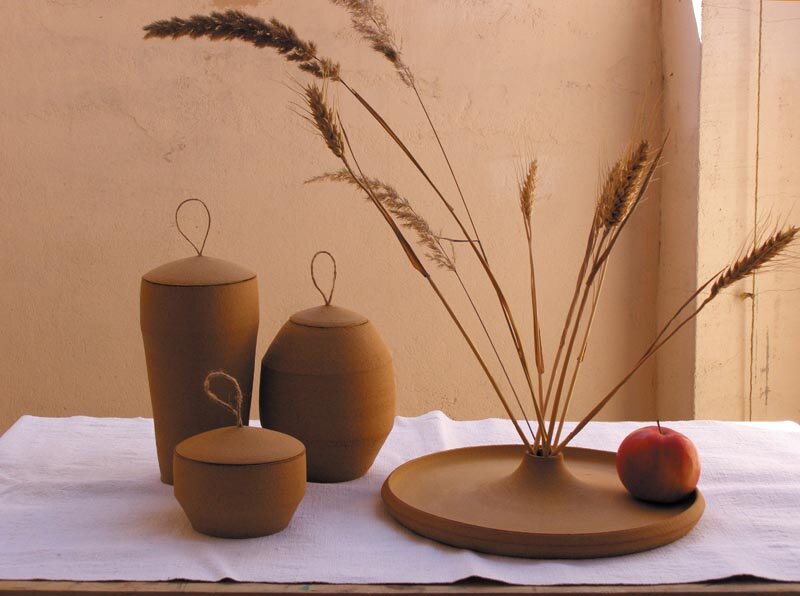
Clay pots and shamot for use in the kitchen - awarded a mention at Salone Satellite Milano
The current design project explores the functional and aesthetic properties of a mixture of clay and chamotte powder, which needs only a firing process, in order to create objects that are suitable for storing liquid or solid food and for everyday use. Shamot powder helps reduce shrinkage on drying and firing and gives hardness to the final product. The object does not need a second firing or glazing process. In addition, its rough characteristics make it attractive to the sense of touch.
The Chamotte collection consists of 3 food containers and a fruit bowl/flower vase. The latter has a double function: it is a fruit bowl and a flower vase, with a large base designed to catch the petals that fall off.
Thanks to ceramic artist Mihai Sturza, who helped produce the Chamotte prototype.
tri.foi
Chair
Materials:
oak
Dimensions:
Large: W 500 x D 500 x H 450 mm;
Small: L340 x D 320 x H 315 mm
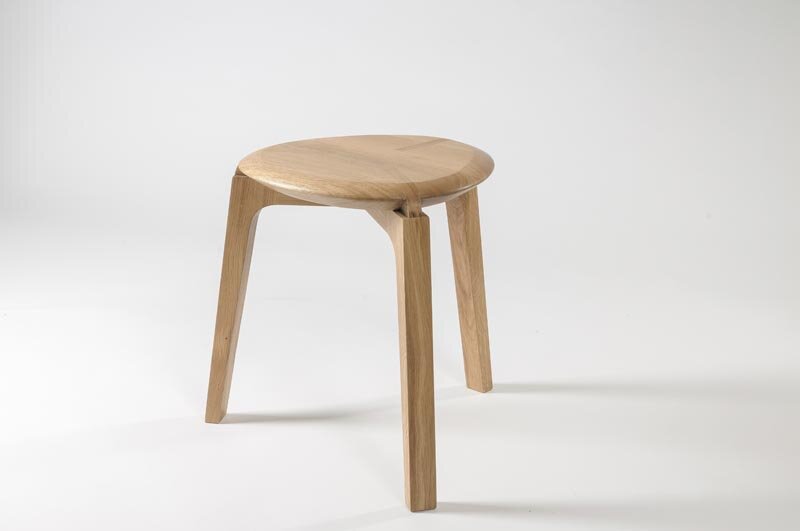
tri.foi is a simple wooden chair that explores rural culture and, in particular, traditional wooden objects. The object is a reference to the three-legged peasant stool that, in most parts of Romania, accompanied the hearth-side table that gathered the family around it. The tri.foi chair attempts to explore the balance of the relationship between function, construction and craftsmanship, but seeks contemporary ways of reinterpretation through its wooden joints and form. Like the peasant chair, the structure is minimal and is meant to be visible while also becoming the characteristic decorative element.
Bring us together
Low coffee table
Materials:
Oak
Dimensions:
Ø 600 mm, H 320 mm
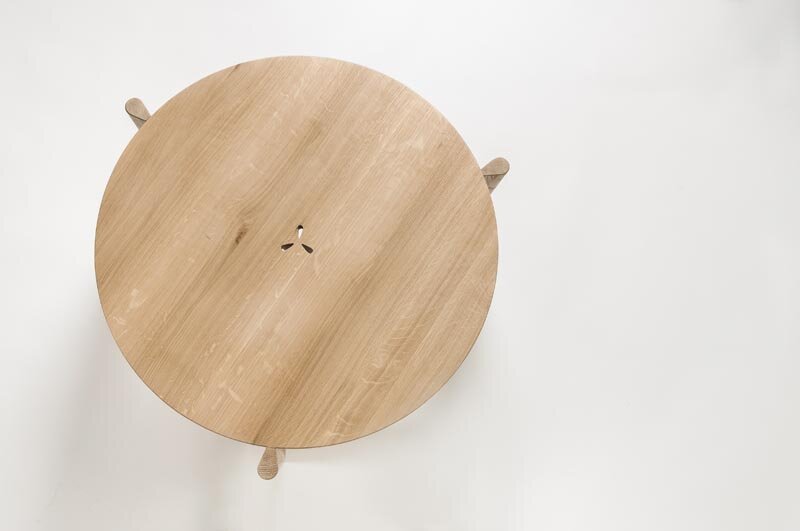
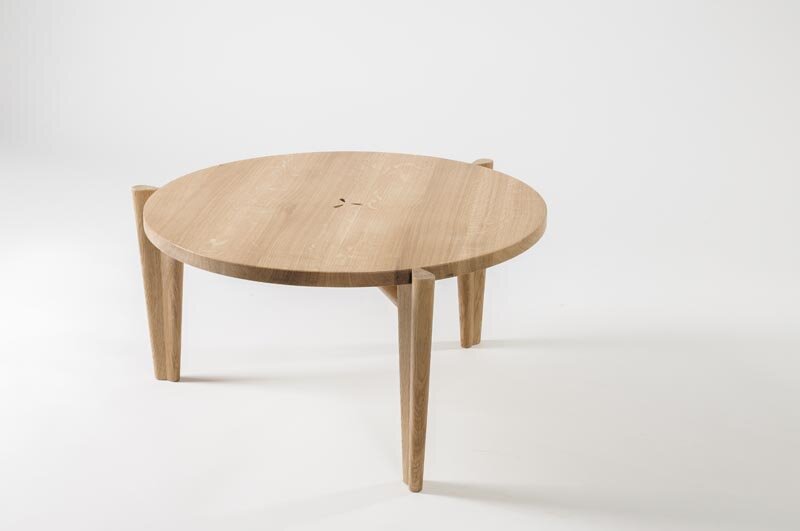
Bring us together is a low coffee table with decorative patterns reminiscent of traditional flower petal motifs.
Light.paper
Lighting
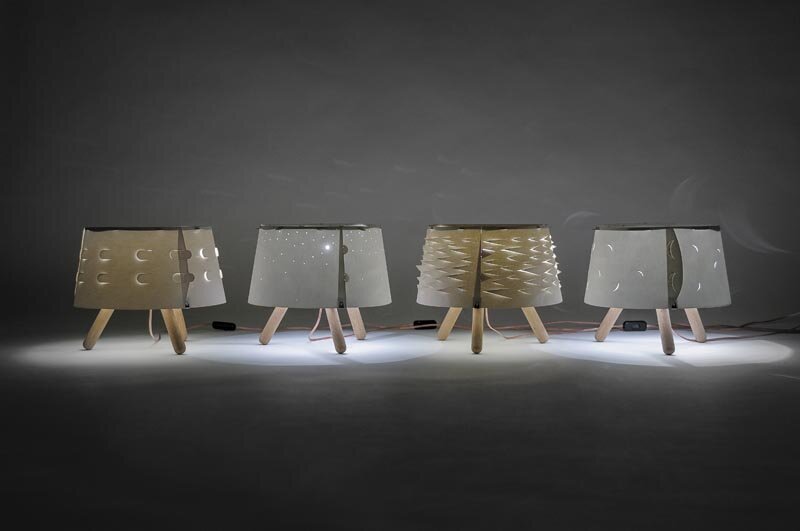
Materials:
Oak wood, paper and metal clips
Dimensions:
Ø 330 mm, H 270 mm
Pendant lamp:
Ø 270 mm
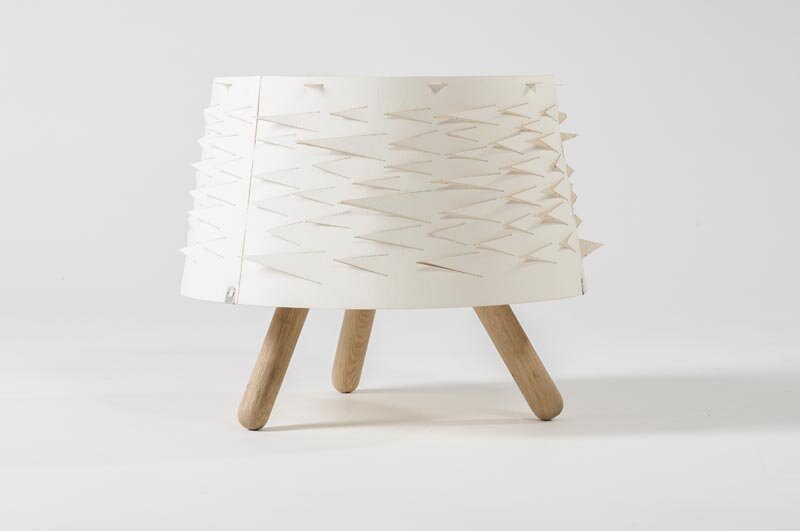
Light.paper is a decorative desk lamp that emphasizes the filtering qualities of the paper lampshade, clamped to the wooden frame. The lampshade gently filters light for a smooth atmosphere. Its shape is defined by the use of paper joints. Several decorative patterns are available for different artistic effects.
A Light.paper pendant lamp version is also available.
Submarine
Storage boxes
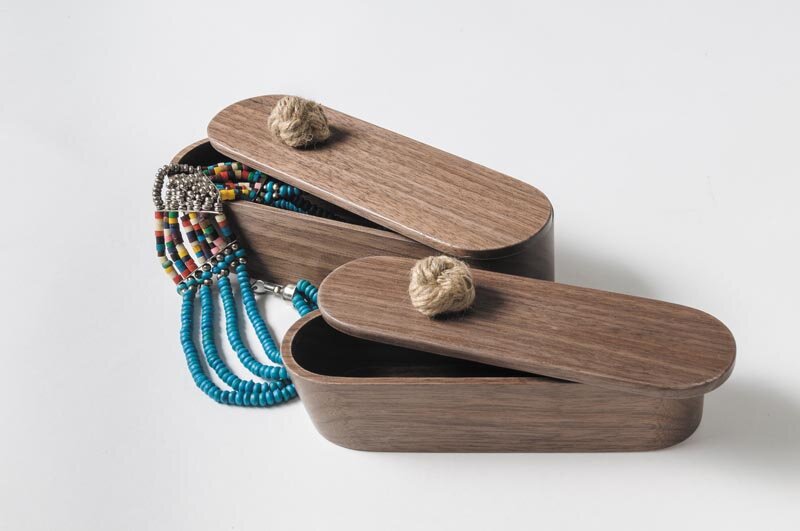
Materials:
walnut, hemp string
Dimensions:
Large: W 200 x D 60 x H 50 mm
Small: W 170 x D 51 x H 42 mm
Using the contrast between the smooth finish of the solid dark walnut wood and the roughness of the beige hemp handle, the Submarine appeals to the user's sense of touch and offers a new approach to storing everyday items.