
SMFoF Uncovering the Factory in Nature
Diploma project: SMFoF Uncovering the Factory in Nature
Stud. arch.: Ioana-Corina Giurgiu
Supervisors: Enric Ruiz Geli, Pablo Ros, Felix Fassbinder
Architectural Association School of Architecture, London, 2014, Foster+Partners Award for Sustainability and Infrastructure
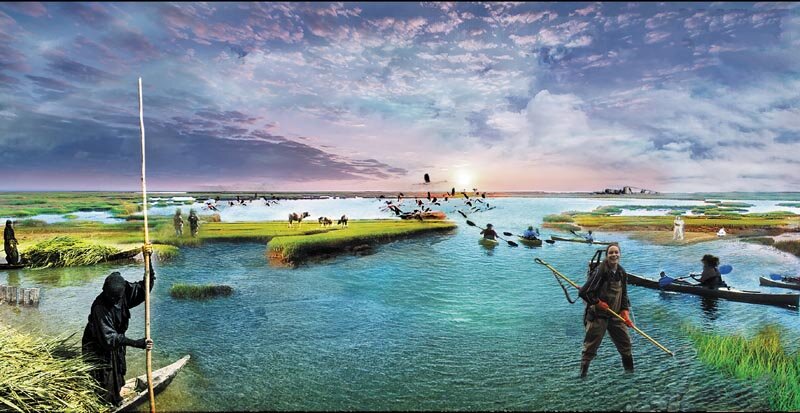
The project addresses the relationship between the environment and human activities undertaken at the industrial level, interrogating the current direction of development of sustainable factories. Based on the case study of a maritime marsh in the Gulf of Gabes (Tunisia), the proposal develops the idea of a factory model in which the production processes as well as much of the factory infrastructure and structure are parts of the natural ecosystem of the marsh. Thus, the scenario of fully integrating the environment into human activities and vice versa underlines a potential new direction in the development of the Factory of the Future (FoF) concept, one of the topics addressed by the European Commission as a 2020 target.
The FoF concept is defined by the European Commission by identifying crucial objectives that will affect the design of future industries. These objectives are based on the study of the effects and problems observed so far in the evolution of industry. Since the 19th century, industrial machines have increased in size and range of applications, gradually replacing human operators. These successive industrial revolutions underpin today's fully industrialized social system in which the value associated with an entity is measured by its industrial applicability.
The European objectives for the period 2020-2050 identify two vital issues for the design of industrial facilities: eliminating the negative environmental impact of industry and integrating technologies accessible to less skilled users into production lines. These two aspects are therefore the key points of the approach presented in the thesis.
Nature as industry
In terms of ecological factors, the paper starts from the 2002 manifesto Cradle to Cradle: Remaking the way we make things, published by Michael Braungart and William McDonough, which set a new precedent for the approach to industrial site design. Cradle to Cradle emphasizes that reducing the industrial environmental footprint is not enough and that these sites need to be rethought as closed systems based on the total recycling of materials used in the production process. In other words, Braungart's argument is that of a factory emulating an ecosystem.
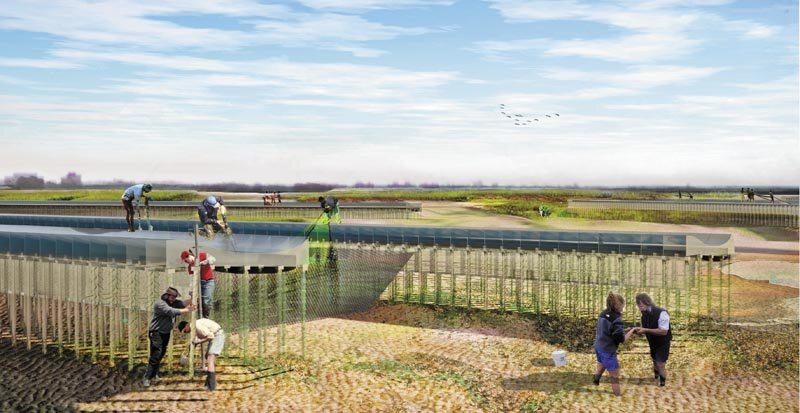
SMFoF takes this idea one step further by almost totally eliminating artificial imitation of these processes, using natural processes to produce various materials such as drinking water, fertilizers, bio-fuels, food and food supplements otherwise obtained by industry.
Using the chemical processes of the endemic species Spartina Alterniflora, a type of halophyte grass that excretes a nutrient-rich salt from its leaves, natural fertilizers are obtained by dissolving this salt in an aqueous solution. In addition, using the natural process of evaporation and condensation of water at the sea surface, the littoral zone components capture solar distilled water. At the same time, by their structure, these components accelerate sediment deposition, using the tidal effect to trigger the marsh accretion process, thus achieving a proportional increase in the industrial area.
For processes that require the growth and harvesting of a species (for food, food supplements and bio-fuels), endemic systems based on symbiotic relationships between species are used. For example, the pairing of shrimp and scallop species is a common process in current aquaculture and has the advantage of reducing the need to treat the aqueous waste of the system. By introducing a third species (Salicornia - in the dry zone and green algae - in the aquatic zone), the proposal achieves a closed system, where the waste from the shrimp farm becomes nutrients for the shellfish and Salicornia or green algae cultures.
It is therefore possible to integrate the environment into industrial and thus economic activities, forming a partnership between industry and nature.

Read the full text in issue 3/2014 of Arhitectura magazine