
The Crown Estate - Carol I's model institution 130 years on
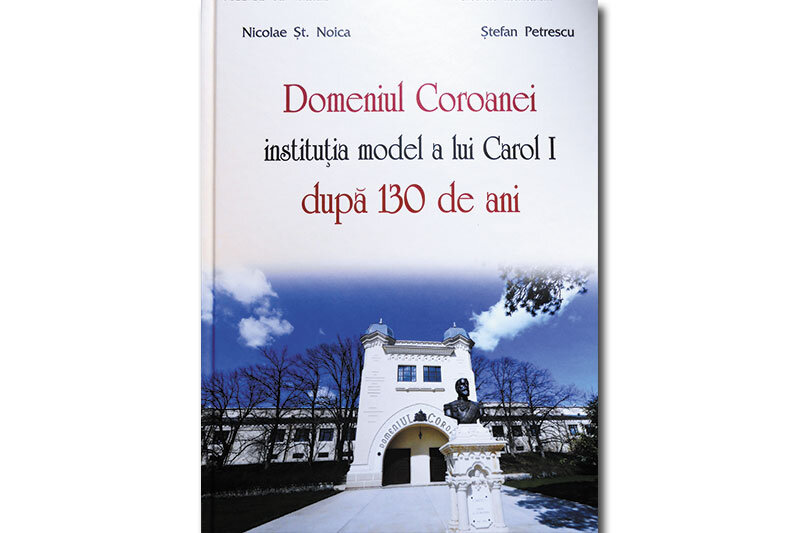
This book presents the history of the institution during the six decades of its existence, from the reign of King Carol I until its abolition by the communists. The authors, the engineer Nicolae Noica, a specialist in the history of Romanian construction, and the historian Ștefan Petrescu, an analyst of 19th-century Romanian-Greek relations, have succeeded through interdisciplinary research to provide a comprehensive picture of an institution that left its mark on the development of modern Romanian agriculture.
The research is based to a large extent on the holdings of the Administration of the Crown Domain at the National Archives, which contain hundreds of files with valuable information on staff and farms, photographs and building plans.
The book is structured in eight chapters which present the main aspects of the organization and functioning of this institution.
The institution was established in 1884 with the aim of providing the King with the necessary income to cover the expenses of protocol and representation of the Crown. The Crown domain comprised 12 agricultural and forestry estates, located in Oltenia, Muntenia and Moldavia, in the plains, hills and mountains, covering an area of over one hundred thousand hectares.
In a country with a predominantly agrarian economy, the Domeniul Coroanei institution played a decisive role in promoting and spreading technological innovations and methods of land exploitation. The Crown Estate was a model institution for both large landowners and peasants. It was also involved in the development of rural communities, supporting education and private initiative.
In the chapters dealing with the organization of the institution, the farms and the means of production, as well as in the penultimate chapter, which presents the social and charitable activities, Stefan Petrescu sketches the personalities of the administrators, agronomists and forestry engineers, as well as some common officials, who in one way or another gave life to the institution to which they dedicated their entire professional careers.
In order to ensure the efficient functioning of the institution, the administrators of the Crown Domain initiated an extensive building program, erecting administrative palaces, staff housing, stables, stables, wine cellars, wine cellars, mills, workshops, warehouses, factories, as well as churches, schools and other cultural establishments for the villagers of the domains. In order to improve the daily life of the inhabitants, the Administration of the Crown Domain drew up a regulation for the construction of peasant houses. Nicolae Noica takes a foray into the world of builders, focusing on some remarkable personalities such as Nae G. Andrei Făgădău, Ion N. Socolescu, Ștefan G. Făgădău, Joseph I. Exner, Jean Pompilian, etc. The book contains an impressive number of illustrations, estate and building plans. Nicolae Noica writes an important page in the history of Romanian architecture. In the chapter on the financial evolution of the Crown Estate, Noica shows the share of building expenditure in the annual budgets. The book concludes with a brief history of the Segarcea estate, presented as a bridge between the past and the future. The final objective of this research is to organize a museum of the Domeniul Coroanei in Segarcea, today owned by Mihai Anghel.
Authors:
Nicolae Șt. Noica
Ștefan Petrescu
Publisher:
Vremea 2014