
The Romanian Railway Project (1842-1916) - Toader Popescu
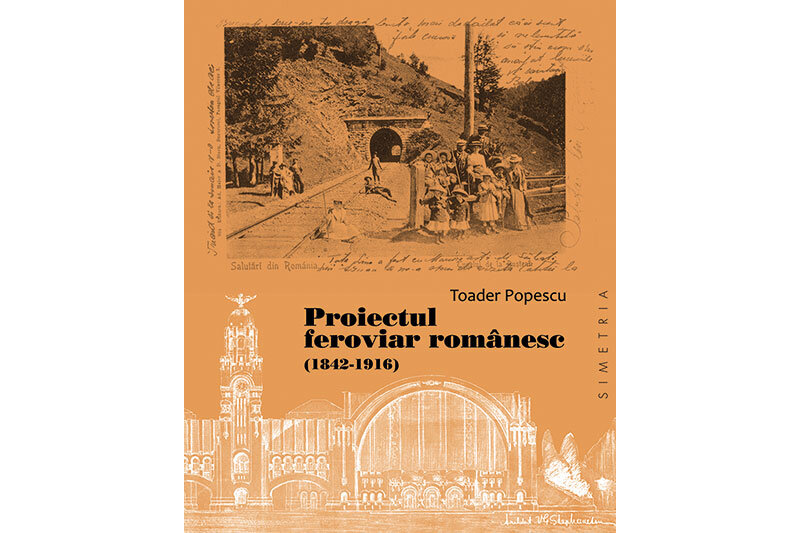
București: Simetria Publishing House, 2014
The era of Cuza and Carol I is one of profound changes in Romanian history. Over the course of just a few generations, Romanian society in general, and the city in particular, were torn out of a certain historical lethargy and thrown, almost forcibly, into the whirlpool of modernity. In this context, the railway becomes the cause and symbol of an extremely intense and rapid process. It is an engine of development without which many of the historical changes in the territory, cities and urban life would not have been possible, and without whose research they could not have been properly and fully understood.
The volume aims to establish the place of the railway in the vast and highly heterogeneous picture of the modernization phenomenon. Such a perspective is of twofold interest: on the one hand, it explores in a broader context the springs and mechanisms that underpinned the Romanian railway project, thus proposing a new grid for its interpretation, and on the other hand, it enriches the understanding of a complex historical period, which is marked by the assumption and implementation of a modernizing discourse.
Moreover, we strongly believe that modernization in "marginal" cases (both geographically and culturally), such as Romania, is strongly conditioned by the decisions and vision of small groups of people (or, at the limit, individuals) who, in the fortunate case, manage to catalyze the energies of the "silent majority". We have chosen to subsume these coherent and perennial efforts under the heading of the railway project. Its integration into the great modernizing project of the Romanian society at the end of the 19th and the beginning of the 20th century is the main stake of the book.
Thus, we try to integrate the railway project into the general coordinates of modernization and to place it within the specific patterns of the phenomenon in Romania, as postulated by several historians and theorists over time. We aim to demonstrate, therefore, that the railway project began with an attempt to mechanically copy the Western experience, followed, in the mature phase, by the conscious construction of a discourse, a doctrine and specific practices at all levels.
The object of the research is the spatial and cultural hypostases that the railway project takes on. Thus, we are interested in the territory, the city and the station, firstly, as physical and functional forms that shape and are shaped by the railroad and, secondly, as cultural manifestations of a society on the threshold of modernity.