Rehabilitation of public spaces in the historic center of Timisoara
At the beginning of 2013 Arhitectura magazine publishes in its special issue dedicated to Timisoara the projects for the rehabilitation of squares and streets in the Cetate district, projects realized by Serban Sturdza, Radu Mihailescu and Studio Arca team. Meanwhile, Libertatii Square has lost its trees overnight, without this being foreseen in the approved projects.
The consultation of the population is only taking place now. https://apps.facebook.com/my-polls/kugawo?from=admin_wall&__mref=message_bubble.
We thus report the situation of public space, urban planning projects, architects, but also the architecture of public space, in one of the reference cities of Romania.
Comments are yours.
We republish below, in its entirety, the article published in Arhitectura magazine, special issue Timișoara
PRODIT srlȘerban Sturdza Mihai Șulea Zsofia Gagyi
BIA RADU MIHĂILESCURadu Mihăilescu Laurențiu Bălu
STUDIO ARCA srlLuminița Pascu Mihaela Rusulețu
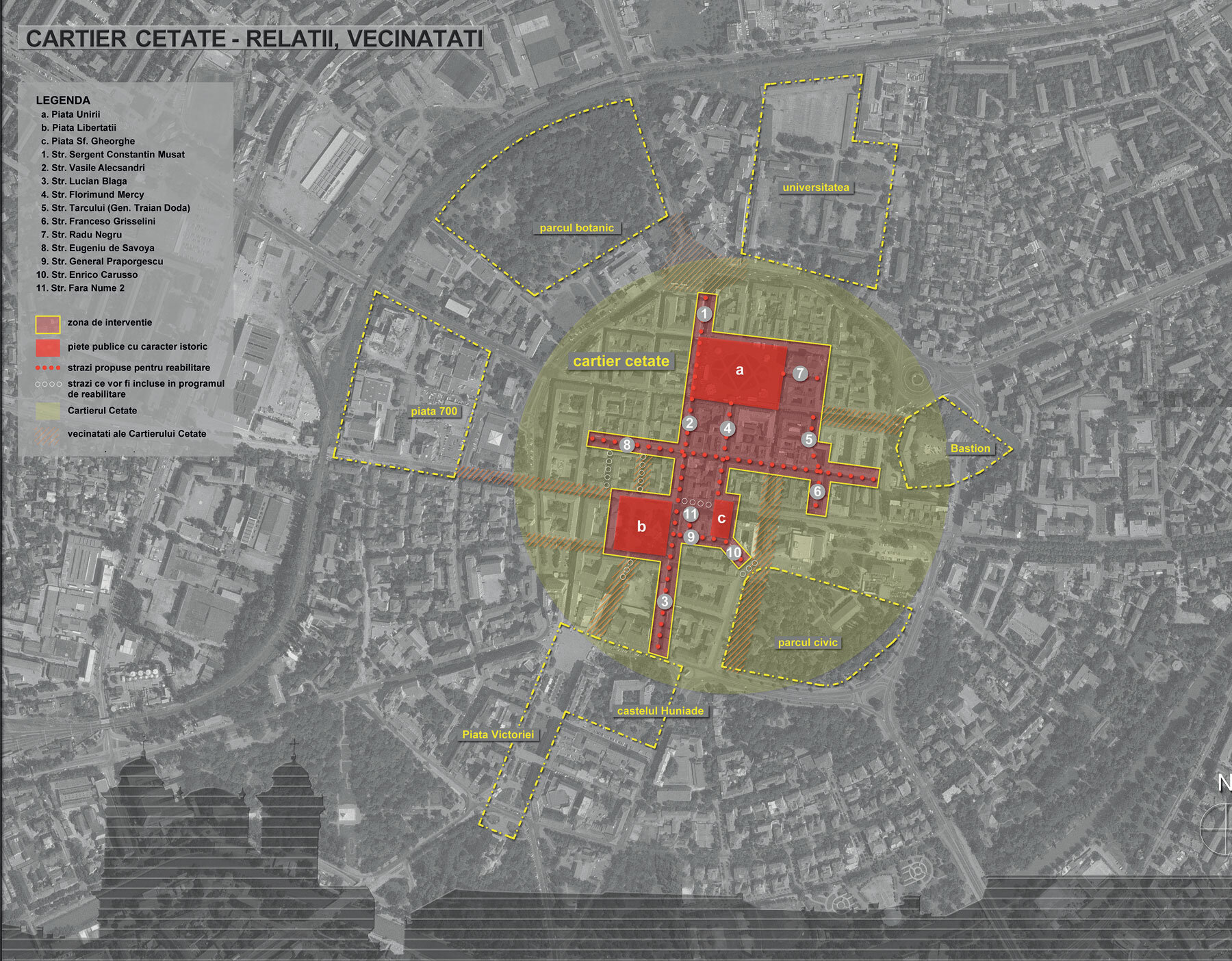
The investment developed by Timisoara City Hall with EU funding aims to rehabilitate a public area in the Cetate Neighborhood consisting of Unirii Square, Libertății Square, St. George Square, Țarcului Square and 10 streets. The proposed interventions aim to resurface the pavements, replace street furniture and public lighting, extend the green space and rehabilitate the technical and public utilities infrastructure.
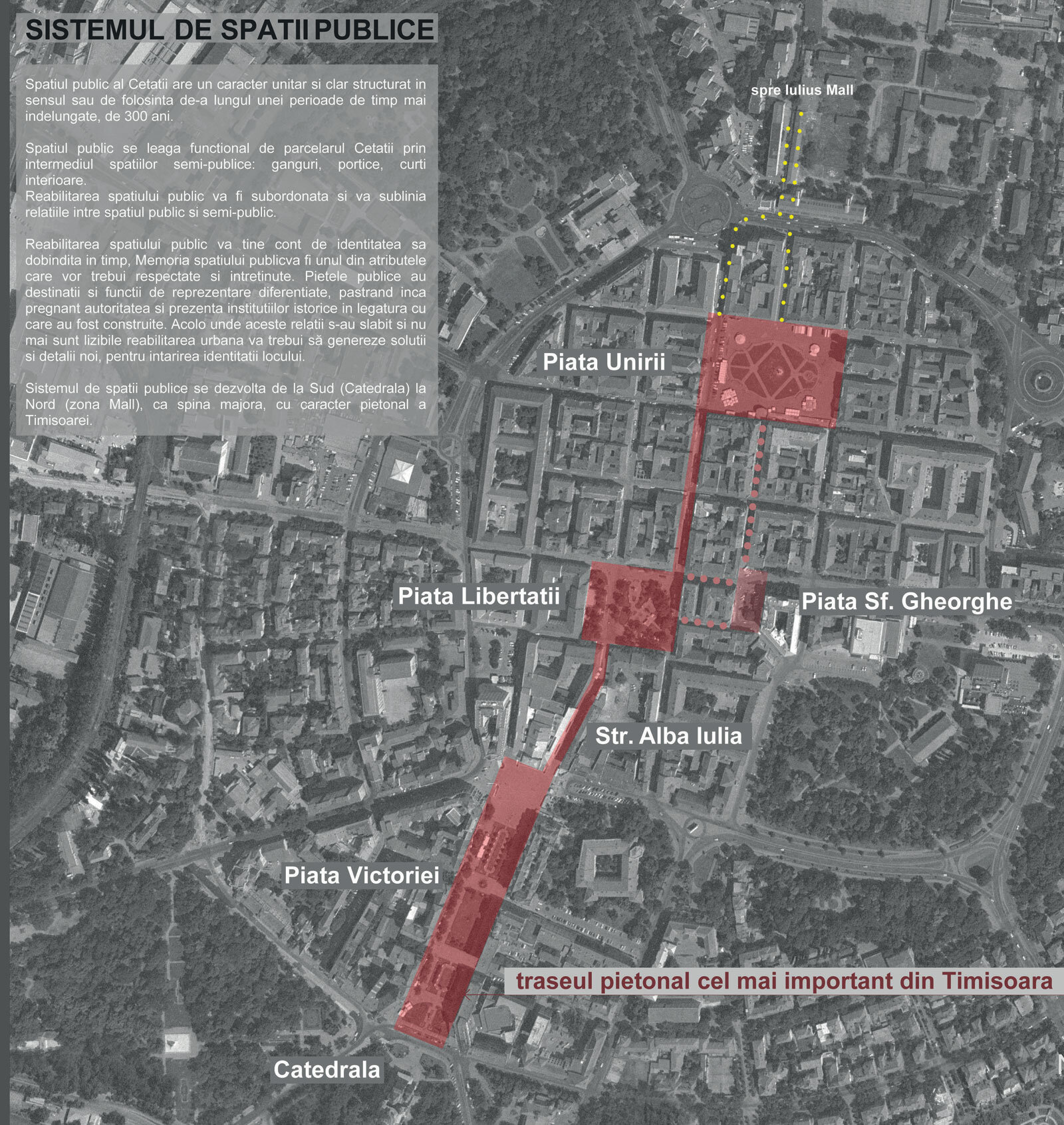
This project continues a policy of extending the public space and consolidating it from south to north by linking the historic squares and a system of connecting streets. The process is a historical one, developed somewhat steadily and reinforced by the urban planning regulations for the Citadel area, which are still in operation.
At the same time it is necessary to accept a characteristic fact of the city linked to its evolution over time: both the historical neighborhoods (Iosefin, Traian) and the recently developed areas (the student district or the mall area) have formed their own public spaces with specific characteristics, their own identities and well-defined functional links with their neighborhoods. Within this complex network of public spaces, those in the Cetate district have a major representational character and, from this point of view, best represent historic Timișoara and its position within European cities.
The proposed architectural and urban planning solution is based on guiding principles designed to ensure the authenticity and identity of the urban spaces undergoing rehabilitation:
The architectural solution is integrated into the period of the site's construction
The public space of the Citadel has a unitary and clearly structured character in its sense of use over 300 years. The urban model used was 'made on the drawing board' and generated a system of public spaces - streets and squares with well-defined uses, logically linked to the plot system and clearly separated from the neighborhoods by a strong and highly sophisticated defensive system. This characteristic of the public space clearly individualizes it from the other public spaces in Timișoara and is a characteristic that the proposed rehabilitation project respects and reinforces.
The public space perceived in this way is functionally linked to the Citadel's plot through gangways, arcades and inner courtyards. The links between the public and semi-public spaces functionally and expressively enrich the known routes and represent an identity asset for the whole ensemble. The redevelopment will subordinate and emphasize the relationships between the public and semi-public spaces.
The rehabilitation of the public space will take into account its identity acquired over time, to which the city's inhabitants are attached and which they assume. The memory of public space will be one of the attributes to be respected and maintained.
The squares have different uses and functions of representation, while still retaining the authority and presence of the historical institutions in connection with which they were built. Where these relationships are no longer emphasized, urban regeneration will generate new solutions and details to strengthen the identity of the place. Stylistically, the proposed solutions are consistent with the characteristics of the adjacent buildings. In the proposed pavement design, special attention is paid to the relationship with the fronts of the buildings, according to their importance in the urban fabric, both as an architectural object and as a representative function.
Neighborhood relations
- Relationship between the historic center and the rest of the city
After the defortification of the Cetate district, the relations between its urban fabric and its neighborhoods were intensified and, progressively, the free space left for military maneuver was built up more and more densely up to the limits of the citadel, defined today by the first ring road. Today, in the immediate vicinity, outside this ring, major urban development is taking place, involving the restoration of links between the Citadel district and these areas. Among these urban areas under development, which will involve strengthening the relationship with the system of public spaces of the Cetate district, we mention:
In Square 700, office facilities and their appurtenances are being developed, which will bring a significant influx of people.
The Botanic Park will, over time, have a rehabilitation program that will connect it more easily with its neighborhoods, especially with Mărăști Square and the Cetate district.
The university campus, which is envisaged to the north of the Citadel, will have to include in its development program a north-south pedestrian route, which will naturally and quickly link the urban pole in the north, defined by the mall and adjacent facilities, to the Cetate district in the south. In this way, the development of the public pedestrian route through the interior of the university area will be able to create a cultural axis as an extension of the north-south pedestrian system already developed in Cetate. The university area and this route that crosses it are an integral part of the guiding principle for the organization of pedestrian spaces in the centre of Timișoara and should be a requirement for the University Development Plan.
The Bastion area, currently undergoing redevelopment, will increase the interest for a proper connection with the Union Square and the pedestrianized street system.
To the south, the Parcul ("civic park") with the former sports hall, which is part of the Citadel district morphologically, will need to have a strong link developed along the north-south street to the Union Square.
The Corso area (Victory Square) and the Huniade Castle, which are not part of the current study, but represent the southern end of the large pedestrian axis under development.
The six mentioned areas will emphasize the importance of the Cetate neighborhood and will generate opportunities and conflicts at the same time. It is worth mentioning the need for the city administration to impose additional parking areas in each of these neighborhoods, so that the elimination of car traffic and pedestrianization of some streets in the Cetate does not cause imbalances and discomfort for citizens.
- Relations between public space and green space
Historically, the Citadel was organized on military principles. Public space had rationales accordingly and as such its expression was mineral. Green space was accepted in the courtyards. As the neighborhood was defortified and there was a mixture of functions, between those specific to the Citadel and the rest of the city, public space increased its range of addressability and, with this, landscaping emerged. These were conventional, borrowing processes from urban space types completely different from the Citadel. For this reason, in most cases, they were inappropriately positioned and had questionable solutions.
An overall conception of green spaces questions whether it would not be more correct to lift them from the ground surface. The operation is done by removing the lawns and replacing them by planting suitable trees. The environmental regulations in force can be complied with provided that this solution is accepted, which may be questionable in other cases. In this way we could have a type of lawn treatment in the Union Square, leaving the frontages visible from any point, and a type of tree treatment in the other historic squares. Along streets currently without trees, this feature should be maintained.
There is, however, one concession that could be made to green space, along the lines of the model found in the historic area of Brussels: tiny nests of topsoil protected by ironwork and attached to the facades in the burlap area, from which decorative clumps of hanging plants rise up to the upper floors. It is a matter of ambiance, which will personalize the urban space only in certain cases.
- The relationship between the riverside population and visitors
The redevelopment of the public space will use balanced solutions so as not to discourage the comfort of riverside residents at the expense of the growing flow of tourists. An essential condition for the success of the project will be the preservation of housing and housing in the Cetate district. Otherwise, the artificial character of the developments will slowly but surely destroy the identity of these spaces.
- Public-private relationship
The public - private relationship will be a subject of management that will offer solutions convenient for both parties, in favor of the development of generous exchanges between citizens and also of the increase of urban comfort.
Liberty Square
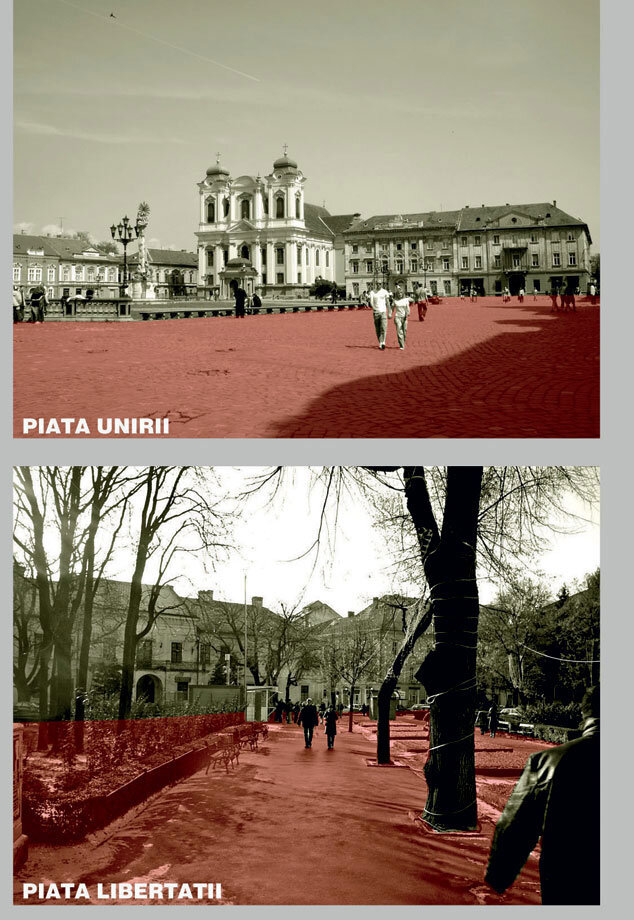
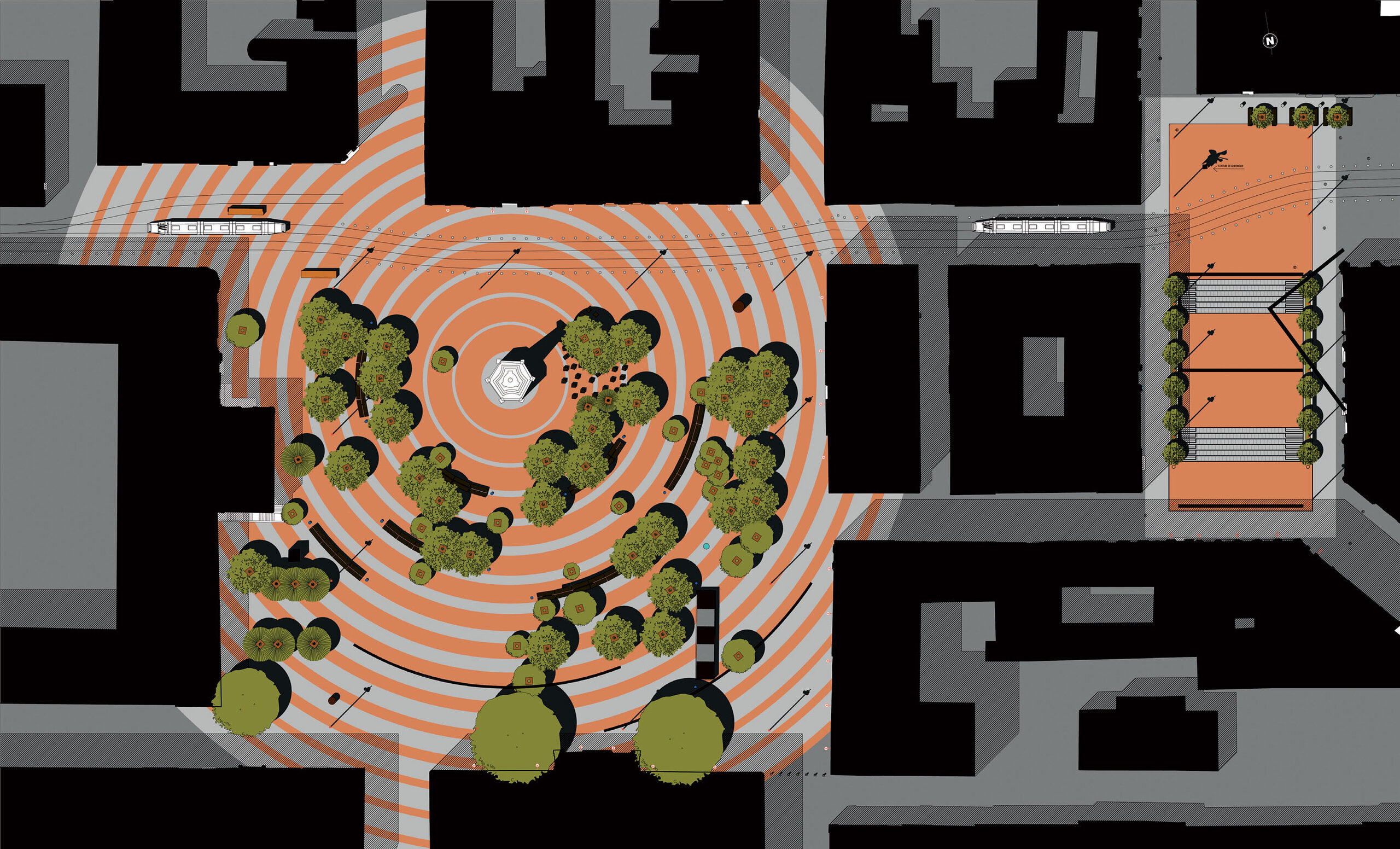
The former parade square and place of representation of the Comenduirii (the military leadership of the Timișoara Citadel) had a military representative character. Its compositional clarity and relations with the neighborhoods were justified by this function. Its later redevelopment diminished the compositional relationships between the square area and the military buildings or the old town hall. Its development was generated by the imposition of the diagonal route of the tram line and then, progressively, by a series of conjunctural and confusing landscaping in which the relationship between the square and the defined building frontages was lost.
In this case, the rehabilitation of the public space will require the restoration of the coherence of the pavement and its continuity, keeping a single dominant object - the monument placed in the axis of the former town hall. The solution will not diminish the existing vegetation area, but will raise it off the ground. The lawn will be replaced with additional planting of trees, complementing the existing ones, so that pedestrian circulation will allow much freer paths without losing the shady areas that provide comfort. The balance of green space areas will be equivalent, but the square will retain the minerality it had when it was designed.
The compositional center for the pavement design is the statue at the axis of the former town hall building. Alternating concentric circles of alternating light and dark colored paving will cancel out the diagonal direction of the tram lines and the myriad conflicts generated by the routes in the square. The relationship between building frontages and the surrounding pavement is also emphasized. Street furniture will have a modern but restrained design and use natural materials. Plastic and aluminum will be eliminated from the list of materials used. Signage systems to mark various historic monuments or events will be made of durable materials and will be an important part of the urban composition.
St. George's Square
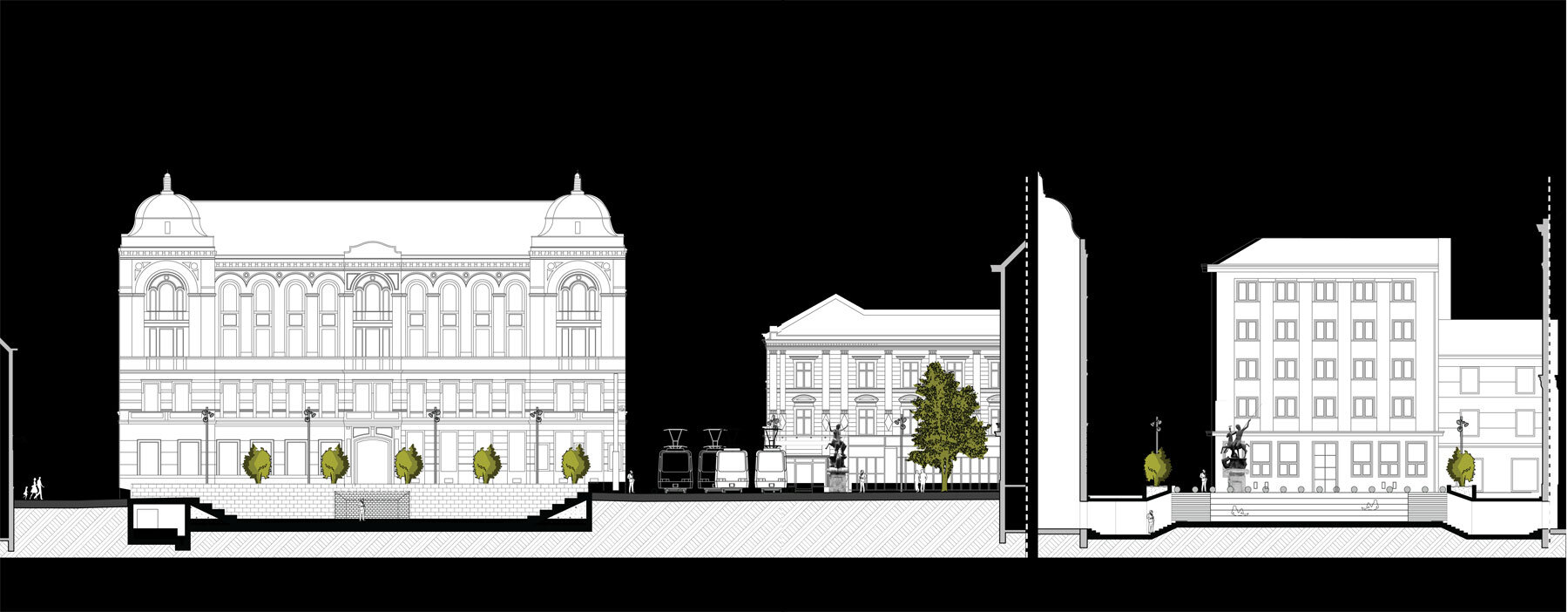
Will be remodeled to correlate the treatment of its paving and functions with the size of the existing frontages. Thus, its perception as a distinct urbanistic entity will radically change the quality of the urban space. It should be noted that the square is currently perceived as an alveolus, half its real size. It is also incidentally home to a trafo post which is then masked by successive punctual projects of green spaces or the remarkable statue of St. George. The rehabilitation of the space will double its surface area by unifying the pavement, removing car traffic, repositioning the statue of St. George. The tram route will be integrated into the proposed pavement. The green space will be reorganized without loss of surface area by planting trees. This will ensure a convenient and natural relationship with Union Square, through the link defined by Mercy Street.
Through the proposed development, by partially submerging the square at an intermediate level between that of the sidewalk and that of the cellars, a functional connection will be made with the large, as yet unused, but highly attractive, basement areas in the buildings on the perimeter of the square. At the same time, the monumental architecture of these buildings will be able to be admired from below the level of the footprint, which will increase their importance in the overall perception. The square will be able to accommodate new functions of a cultural nature (open-air concerts), thanks to the steps and additional safety and equipment for this type of performance.
Union Square
The former Dom Square will retain its traditional representational character. The refurbishment makes corrections to the west side, to unify the paving to the west front of the Serbian Church and Vicarage.
Union Square is the largest historic square in the Cetate district. It has been geometrically modeled since 1733. The dimensions in plan are 150 x 110 m, with the longitudinal axis running east-west, and an area of 17,060 square meters. Being the administrative square of the Citadel, it grouped within its perimeter a series of representative buildings, starting with the Governor's Palace, today the Timișoara Art Museum, the Catholic Dome, the Serbian Orthodox Church, all of which are on the list of historical monuments, the Serbian Vicariate, inns and shops. The square was used for public gatherings and fairs for farmers, cattle breeders and craftsmen from outside the town. That is why it was paved with stone throughout, with a bulge towards the center. After the end of the plague epidemic in 1733, Deschamp, the garrison doctor, erected a commemorative column in the center of the town, with scenes from the epidemic inscribed on the plinth, at the top of which is a statue of the Virgin Mary, the patroness of the Citadel, surrounded by statues of four martyred saints, Rochus, Sebastian, Bartholomew and John of Nepomuk. In the course of time, first a cistern with healing water appeared, then a fountain very close to where it stands today.
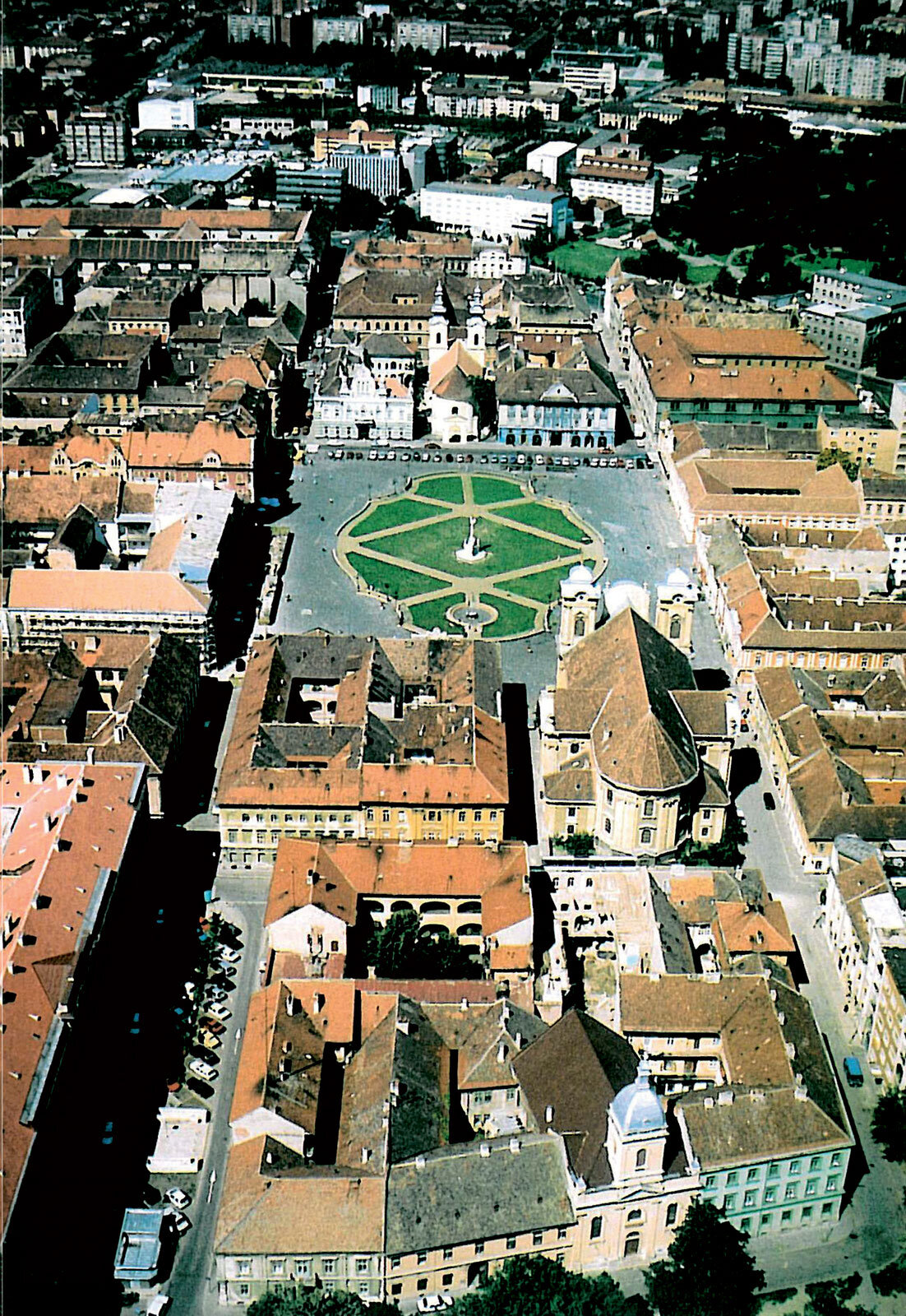
In 1964 the municipality decided to modernize the square. It dug it up, lowering the level by about 1.50 meters and turned it into a park with rectangular paths made of the yellow clinker with which it had been paved. From an urban planning point of view this was a mistake. The sinking of the elevation completely changed the perception of the group of buildings bordering the square, robbing it of its scale and monumentality.
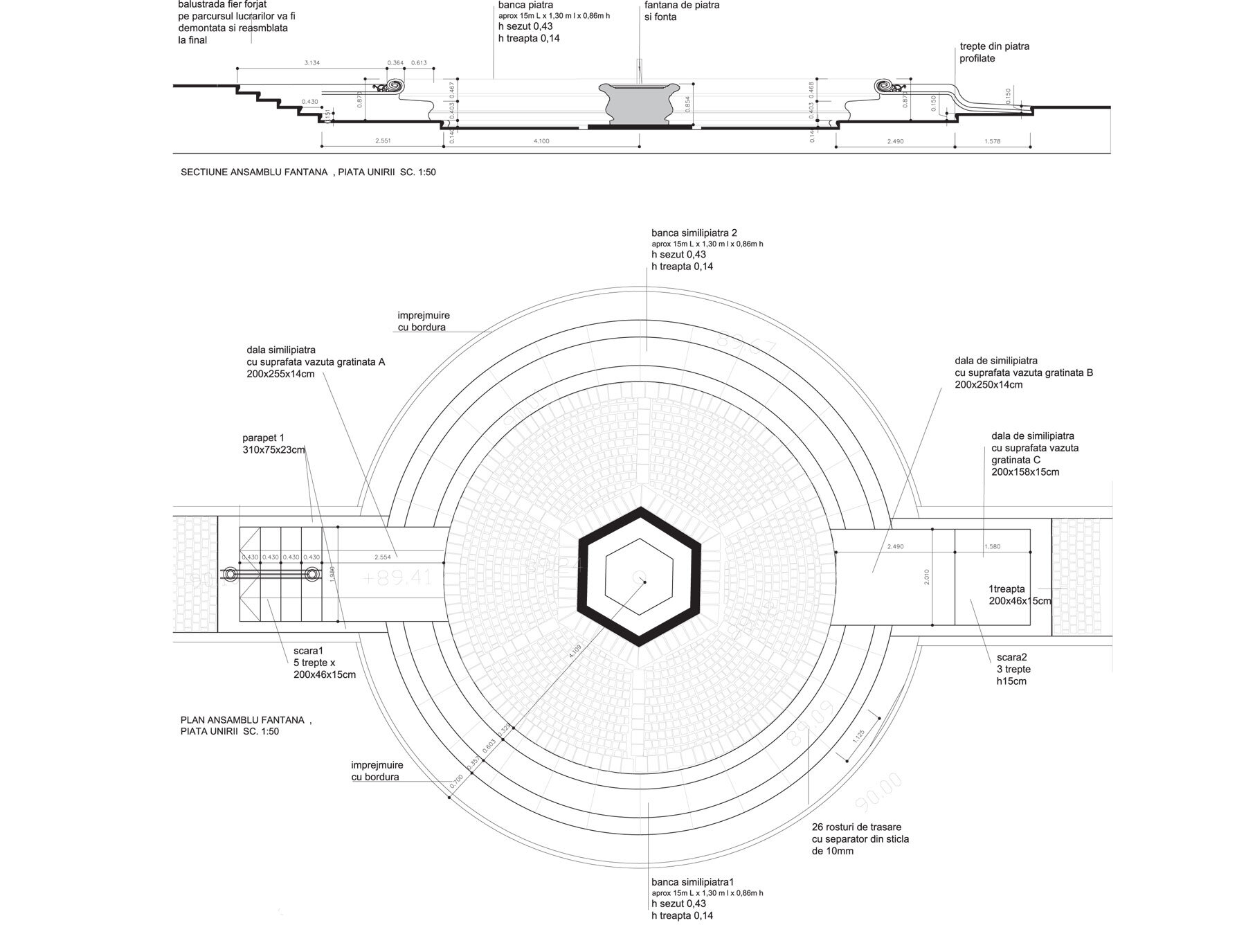
In 1988, a new urban planning project restored the square to its original appearance, and even more, it reworked the reclaimed clinker to create a baroque design for the alleyways surrounding the green space. The statue is enhanced on this occasion. Another borehole was drilled nearby for the fountain, which had been filled in. A place was chosen on the longitudinal axis of the square in alignment with the statue. The body of the fountain, made of white marble, with a bronze spout and three dolphins at the ends, was placed on a circular platform a few steps below the curvature of the square, surrounded by benches made of combed imitation stone. The curved contour of the alleys is bordered by segments of benches made of imitation stone alternating with parapets with balustrades also made of imitation stone and pilasters supporting cast-iron lighting poles and wrought-iron lamps. Also made of wrought iron were the handrails for the descent to the fountain, the protective railings of the statue and the protective railings of the underground sanitary unit, diametrically opposite the fountain, towards the west side of the square, along the same axis of symmetry with the fountain and the statue. The rest of the paving of the square was made with gray basalt calupi, marking on the diagonals 4 circles with a diameter of 16 m in which the paving stones are arranged in a circular pattern. The rest of the paving stones were laid in diagonal fields arranged in a peacock's tail. In this paving, in the axis of the square coming from Mercy Street, a stone inscribed with the map of the city was placed on the three important squares: Unirii, Libertății and St. George's, which has become a symbol enjoyed by tourists. This led us to the proposal to "sow" all over the historic center of the city inscribed stones depicting important events or characters who have brought fame to Timișoara. It was remarkable that, at the same time as the pavement was restored, the facades were revitalized, bringing out the richness of the details and colours of the past. An important gesture in restoring the overall balance was the decision to create a new facade for the building at no. 3, then occupied by the headquarters of the Timișoara Construction Trust, a baroque building, which had been elevated several times over time and had become a typical example of 1950-60 architecture. The use of details and ornaments existing on neighboring buildings happily completed the image of the square.
The square is being restored as it was conceived in 1988 and completed with the pedestrianization of the west side of the carriageway in front of the Serbian Church. The restoration work will require resurfacing the paving stones and completing them using the existing material. The wear of the existing paving stones, their texture and dimensions give a touch of authenticity that a new paving cannot provide. For this reason, the additions will still be made with pavers reclaimed from other areas. The very good quality yellow clinker, used piecemeal, will be reused and, where it is missing, will be supplemented with similar pieces. It should be noted that this material has a strong identity value, being used in many central European Romanian, Hungarian and Austrian cities, so its removal would be a loss.
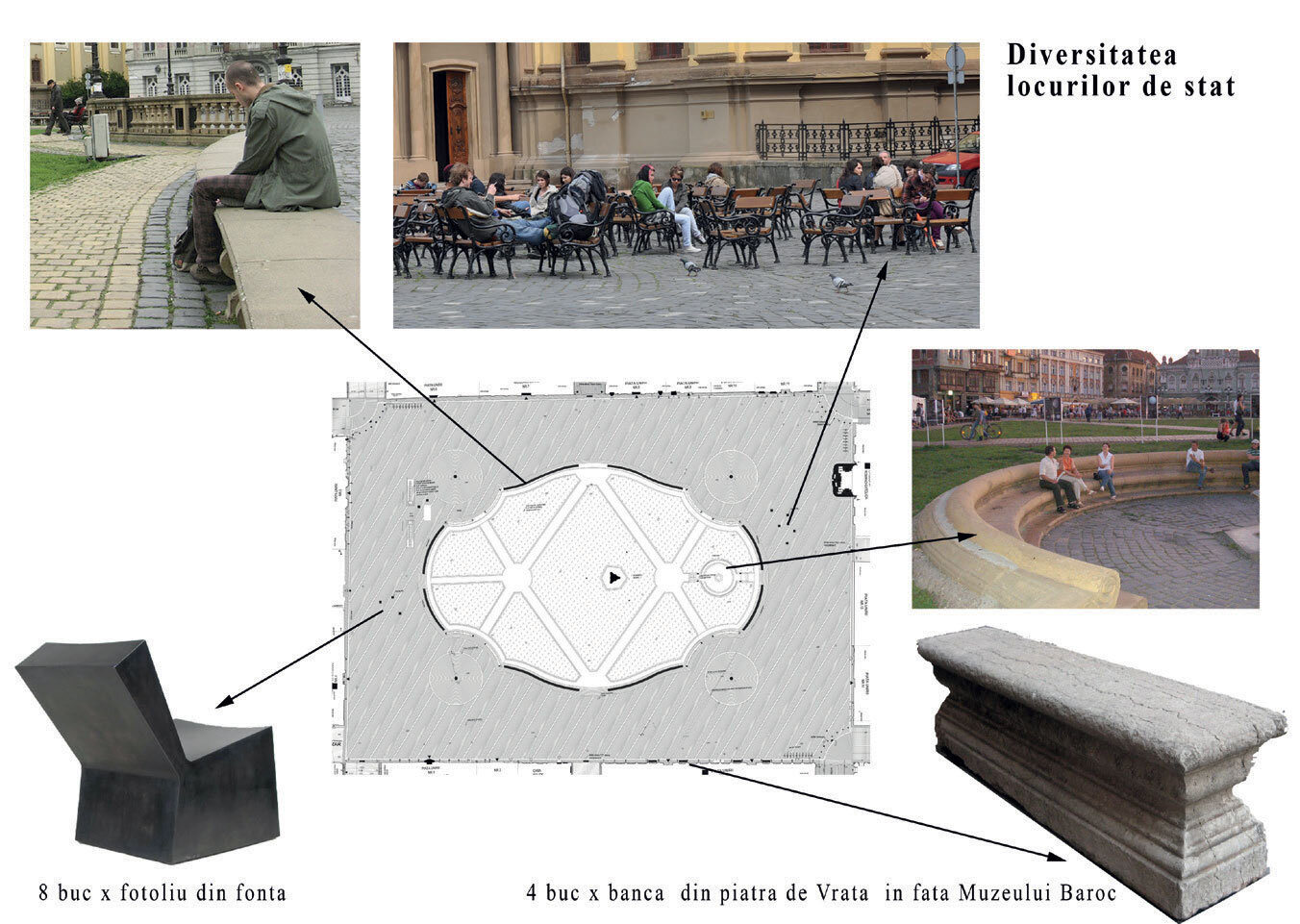
The Unirii Square will keep the current design of the pavement, which has a diagonal direction and was generated by the access to the Dom and the main gate of the Baroque Palace. The overall composition emphasizes two elements: the statue placed on the bombament of the square and the sunken fountain. The two landmarks are surrounded by an ensemble of benches, balustrades and lighting fixtures which form the outline of the green lawn. This ensemble will function in a self-contained composition, leaving a randomly organized space between its edges and the building fronts. Within this space, four zones of equal importance can be defined, marked by a circular design and which will be energized to provide consumers with different services depending on the season.
The pavement marks each entrance to the inner courtyard of the buildings on the contour by laying stones. The western frontage will have a pavement treatment that correlates with the access to the Serbian Church, Vicarage and the building at No. 5. The decorative elements - benches, balustrades, kerbs, mineral water fountain - will be restored. The square will be equipped with an appropriate infrastructure for the new entertainment demands. The current green space will be rehabilitated and transformed, as originally conceived, into an environmental ensemble of the "urban fountain" type. It will be equipped with equidistantly placed and unitarily controlled spray nozzles so that the maintenance of the lawn will be a visual spectacle and at the same time climatically control the square's ambience.
Market Square
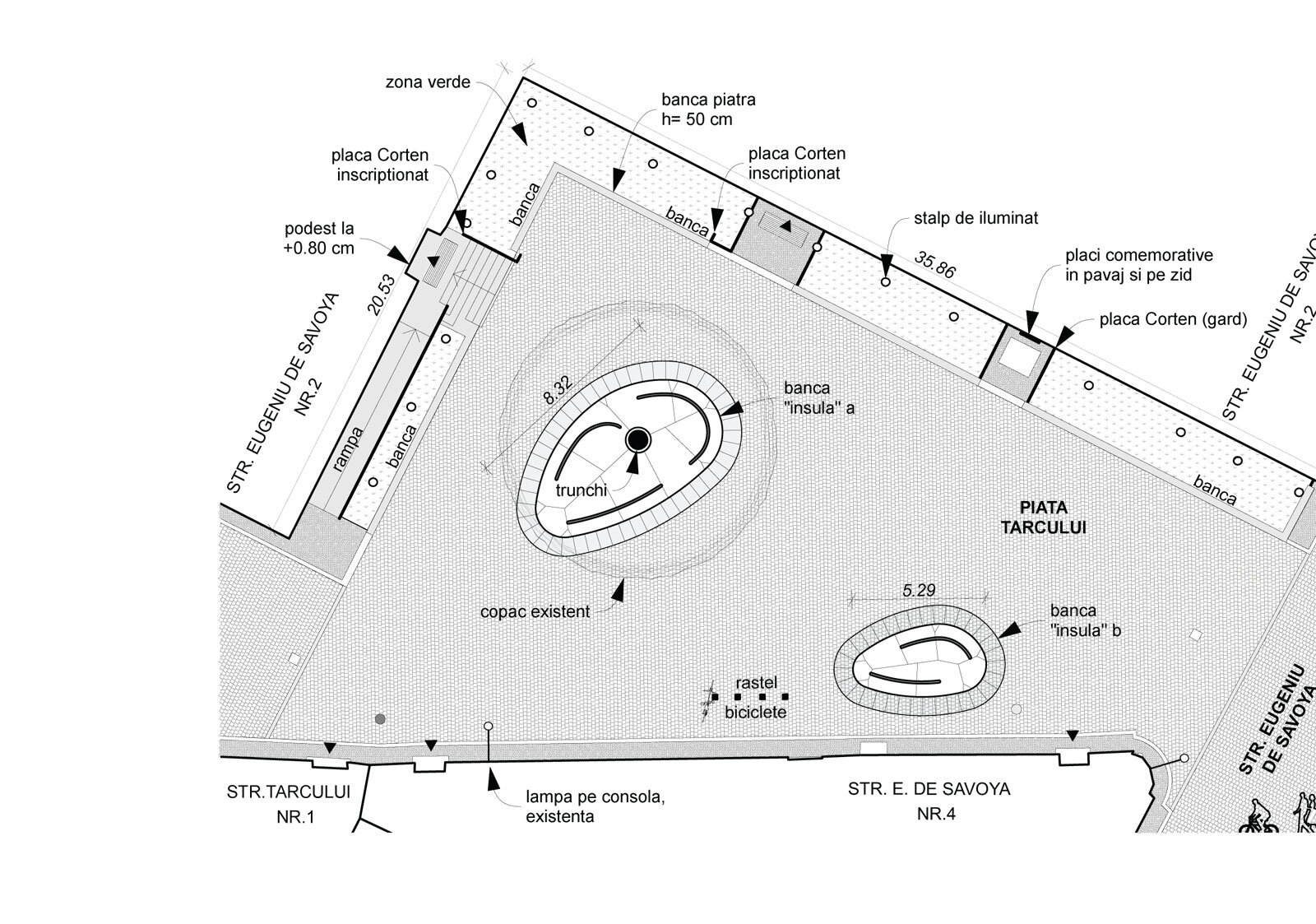
Due to the atypical geometry and the south-facing alcove generated by the Dicasterial Palace frontages, the space has a remarkable but untapped potential.
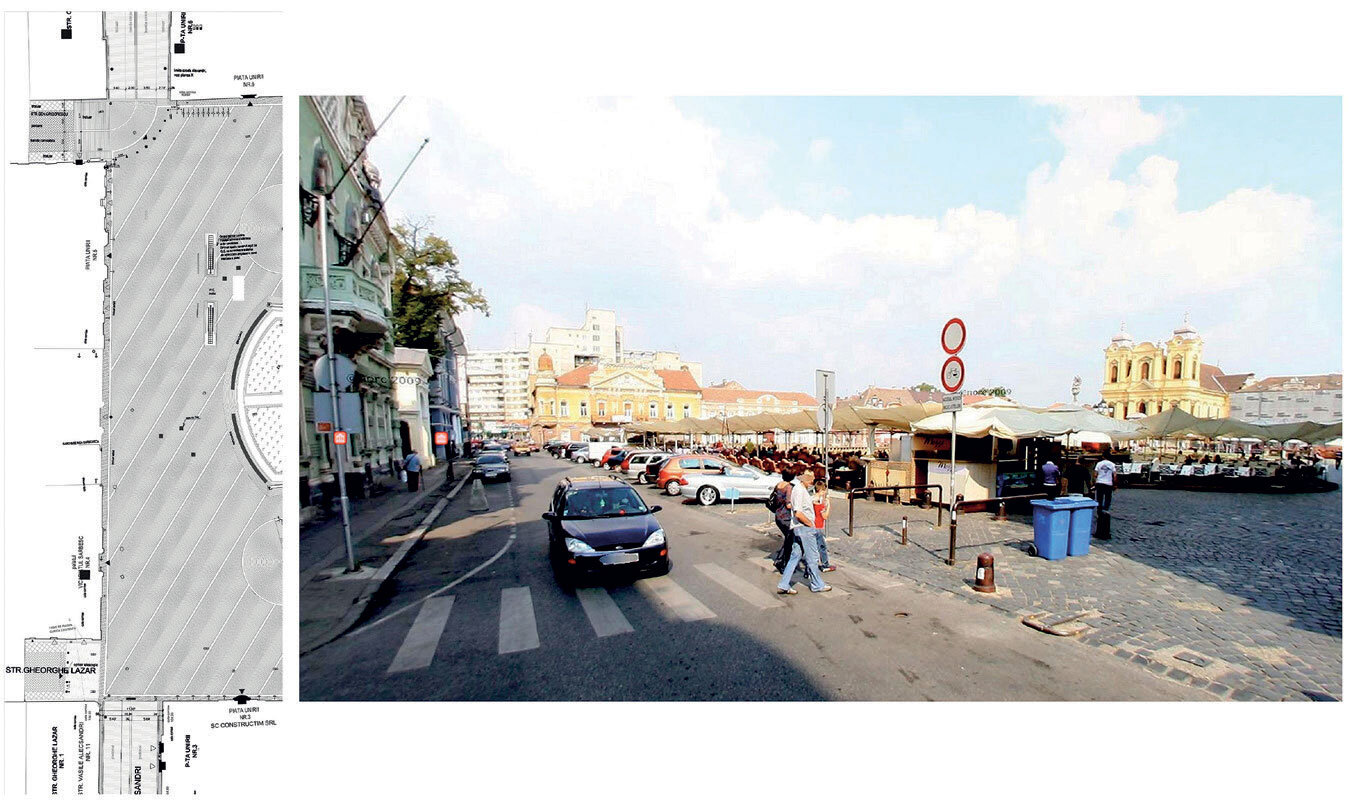
The street will be rehabilitated by unifying the paving and placing a public monument next to the existing tree. The character of the space will be reinforced by its relationship to the entrances to the Dicasterial Palace building and the use of the spaces at the side of the other buildings, all in relation to the professional services offered by the court (notary's offices, lawyers, multiplication center).
10 streets
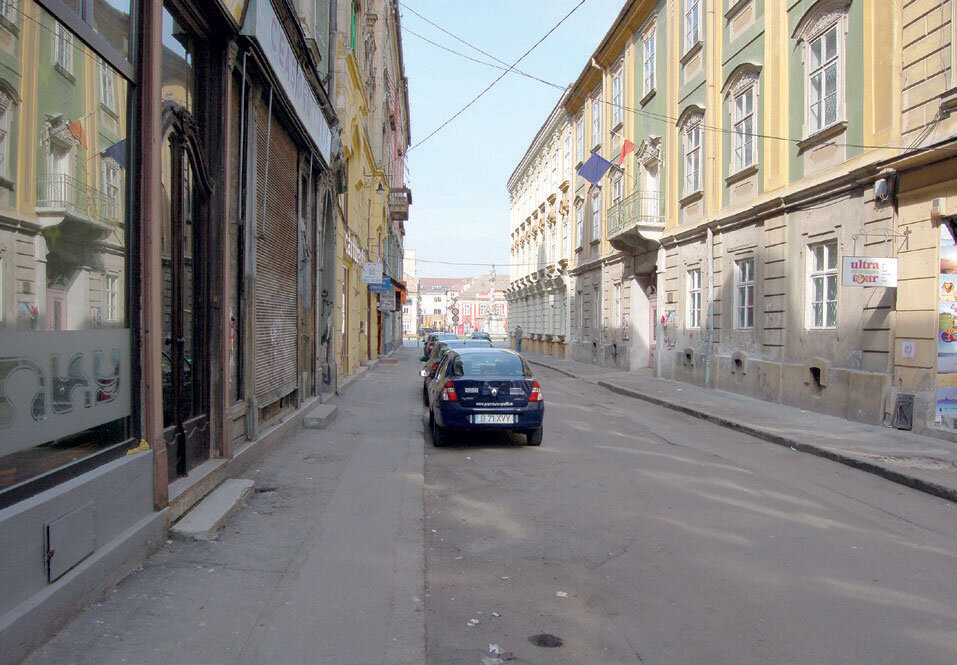
The proposals at street level are aimed at three levels of intervention: underground level by rehabilitating the technical and utilities infrastructure (water supply and sewerage, electricity supply, natural gas supply and heating, electrical installations for public lighting and telecommunications sewerage), vertical waterproofing of basements, paving and facades. The whole area of the Cetate Neighborhood has been designed to be pedestrianized and the proposed pavement surface is a continuous pavement without unevenness. On the streets where vehicular traffic will still be possible, the demarcation between the roadway, parking area and sidewalks will be made by natural stone curbs that take up a small height difference between the roadway and the sidewalk of 2.5 cm. The uniform texture of the pavement will ensure a unified perception of the street space and at the same time freedom of movement.
The paving proposed for most streets can be divided into two types:
- Cubic stone paving, 6x6x6 cm in size, dark grey/black, basalt or similar, intended to provide a connecting area between sidewalks and house frontages, taking up in its thickness (30-50 cm) the recesses of the frontages, the steps of ground floor entrances and the recessed gangway entrances.
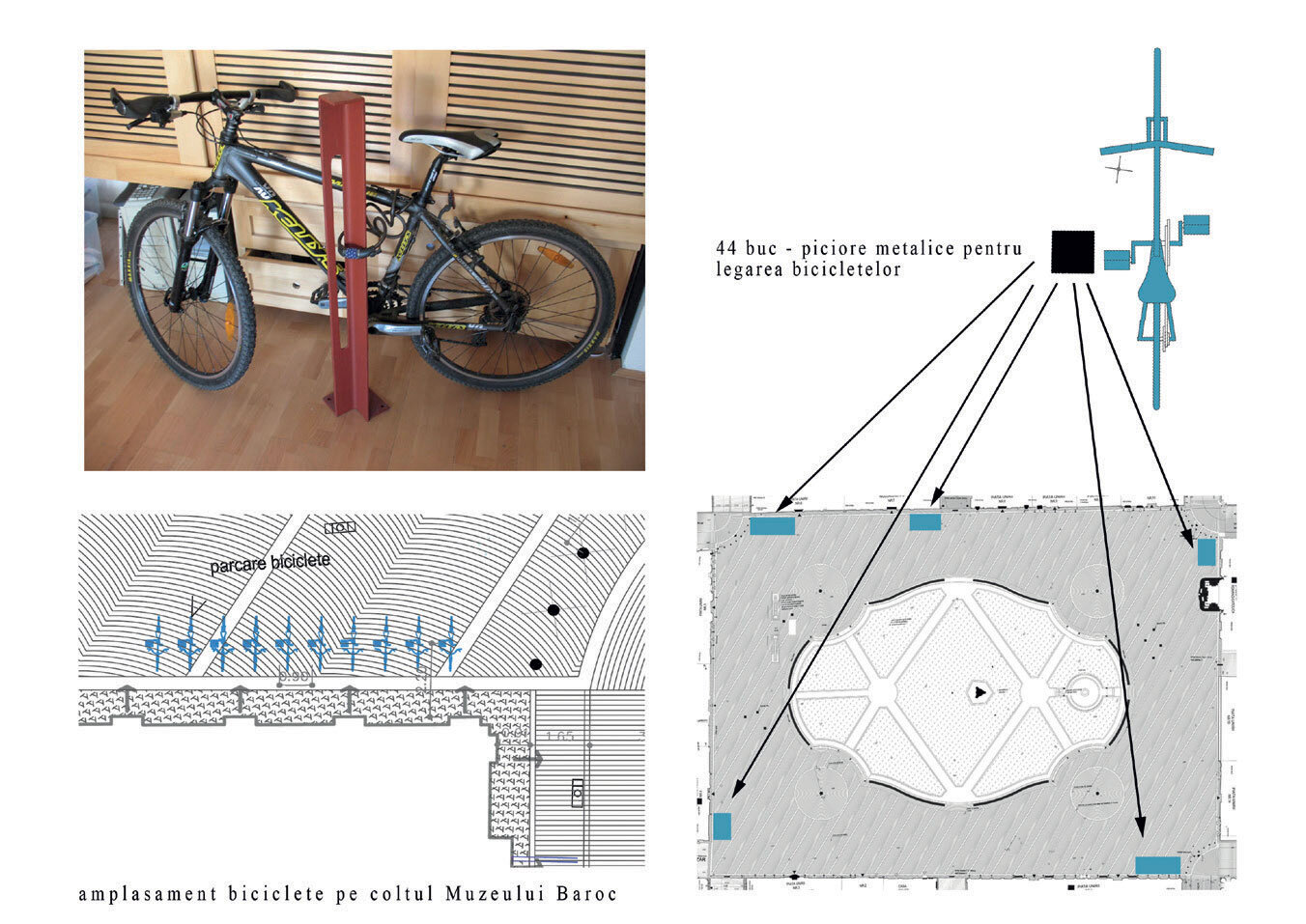
- paving of basaltic cubic stone reclaimed from other locations with variable dimensions (12-18 cm) or new cubic stone with dimensions of 12x12x12 cm, dark grey/black, basalt or similar. The stones shall be laid in successive courses, with the direction perpendicular to the direction of the center gutter (relatively parallel to the street alignment), with staggered joints, and shall cover the entire street surface. The pavement will support the street furniture: litter bins, info boards, benches, bicycle racks, signs, planters, etc. Their placement will be in relation to the facades and functions of the houses.
The street is a mineral element but may have areas of greenery. In the area where the pavement connects with the plane of the facades, in certain locations, 30x30 cm planters will be placed for plants that grow in relation to the facade elements. The memory of the public space will be one of the attributes to be respected and maintained. Representative buildings will be marked in the pavement by special stone or bronze pieces with information about the houses, their owners over time, historical functions. In addition, certain streets and places will be personalized by the presence of urban art objects designed to enliven the proposed pedestrian routes. The concept for this category of objects will be established by an artist and can be based on themes deeply rooted in the city's history: the name of a place (square, gate, etc.), a house, a description of a historical function of a building and its identification over time, the coat of arms of Timișoara in different historical periods, the coat of arms of a local family, drawings of landmark buildings in the Cetate, figures of historical characters (e.g. Ormos, Preyer, Mercy, etc.).
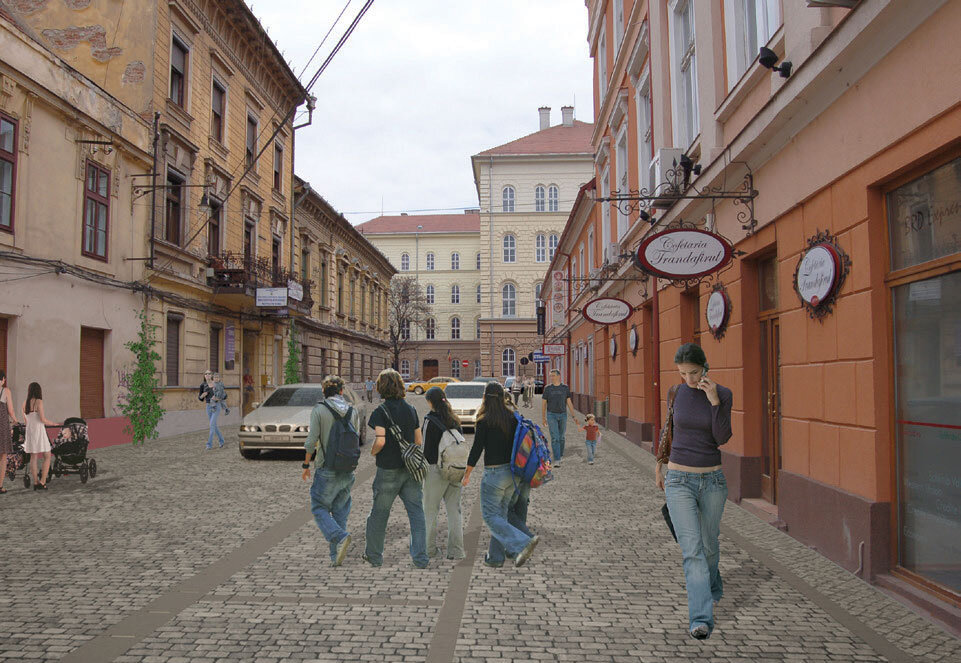
Certain streets and places will also be personalized by the presence of urban art objects designed to enliven the proposed pedestrian routes. Three of these are human-scale figures and will be positioned at pavement level, without a raised plinth, and the fourth is a scale model of the Timișoara Citadel.
The proposals aim to preserve the identity and image of the Cetate neighborhood. Thus, the caps positioned in the pavement (valve, water and sewage, water meter and sewage connection, manholes, hydrants, telecommunications, electrical) are personalized and have a special design. Three types of covers are proposed: cast cast-iron, resistant to vehicular traffic; covers made of a metal frame in which cubic stones are set in a design that fits in with the general design of the pavement; or herringbone covers.
The works affecting the facades include street lighting, a system of metal anchors on Mercy and Vasile Alecsandri streets, street nameplates and metal gratings around the gutters to support the planting.
The streets will have discreet lighting. For most of the streets to be rehabilitated, a lighting system already present in the Cetate district has been chosen - parietal lighting fixtures supported by metal brackets fixed into the facades.
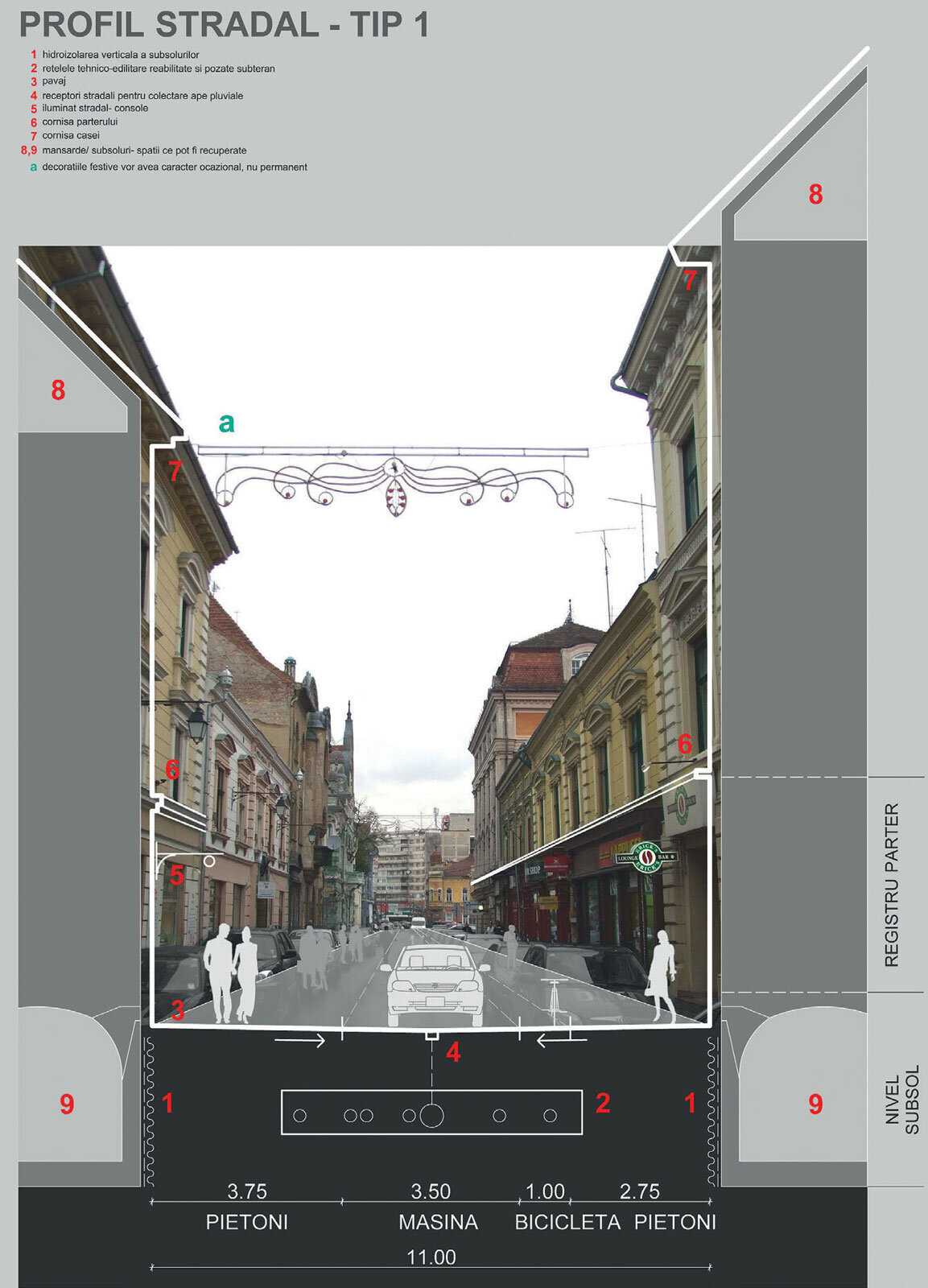
For the ten streets that are part of the urban rehabilitation plan, three types of cross-sectional profile have been chosen, characteristic of the importance, position or predominant function of that street.
Type 1 cross-sectional profile - car traffic with a parking area on one side and sidewalks adjacent to both fronts, with variable widths: Mussat, Blaga, Griselini, E. de Savoya (partially).
Transversal profile type 2 - pedestrian street with limited access by car: Alecsandri, Tarcului, Radu Negru, Nameless, Praporgescu, Carusso, E. de Savoya (partially).
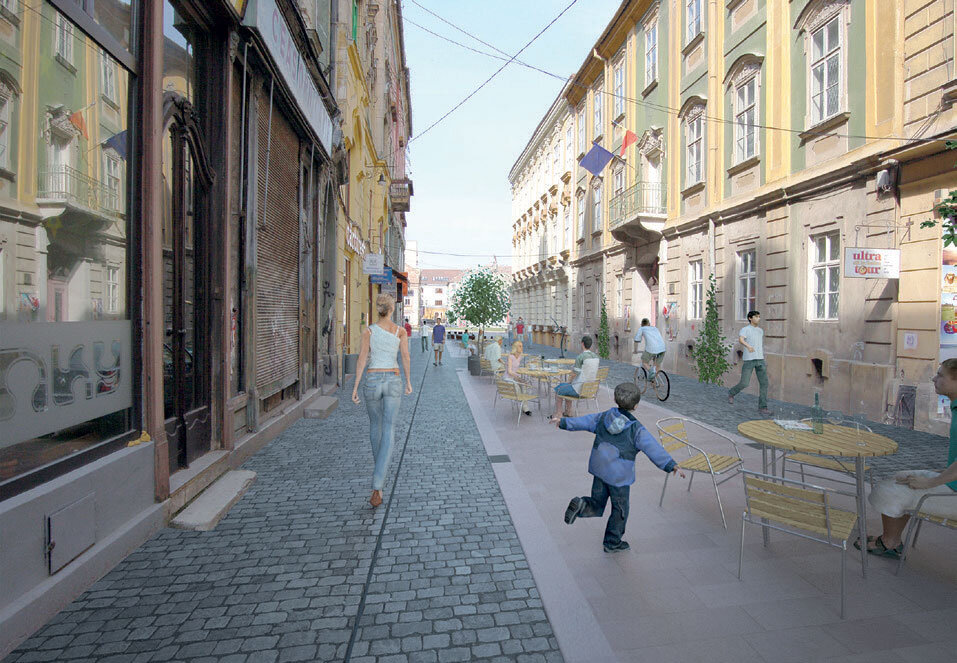
Transversal profile type 3 - pedestrian street with a variable street prospect between 8.40-9.40 m, with a median area designed for terraces and adjacent pedestrian traffic lanes, limited car access: Mercy Street.
Cycling is permitted on all street types.
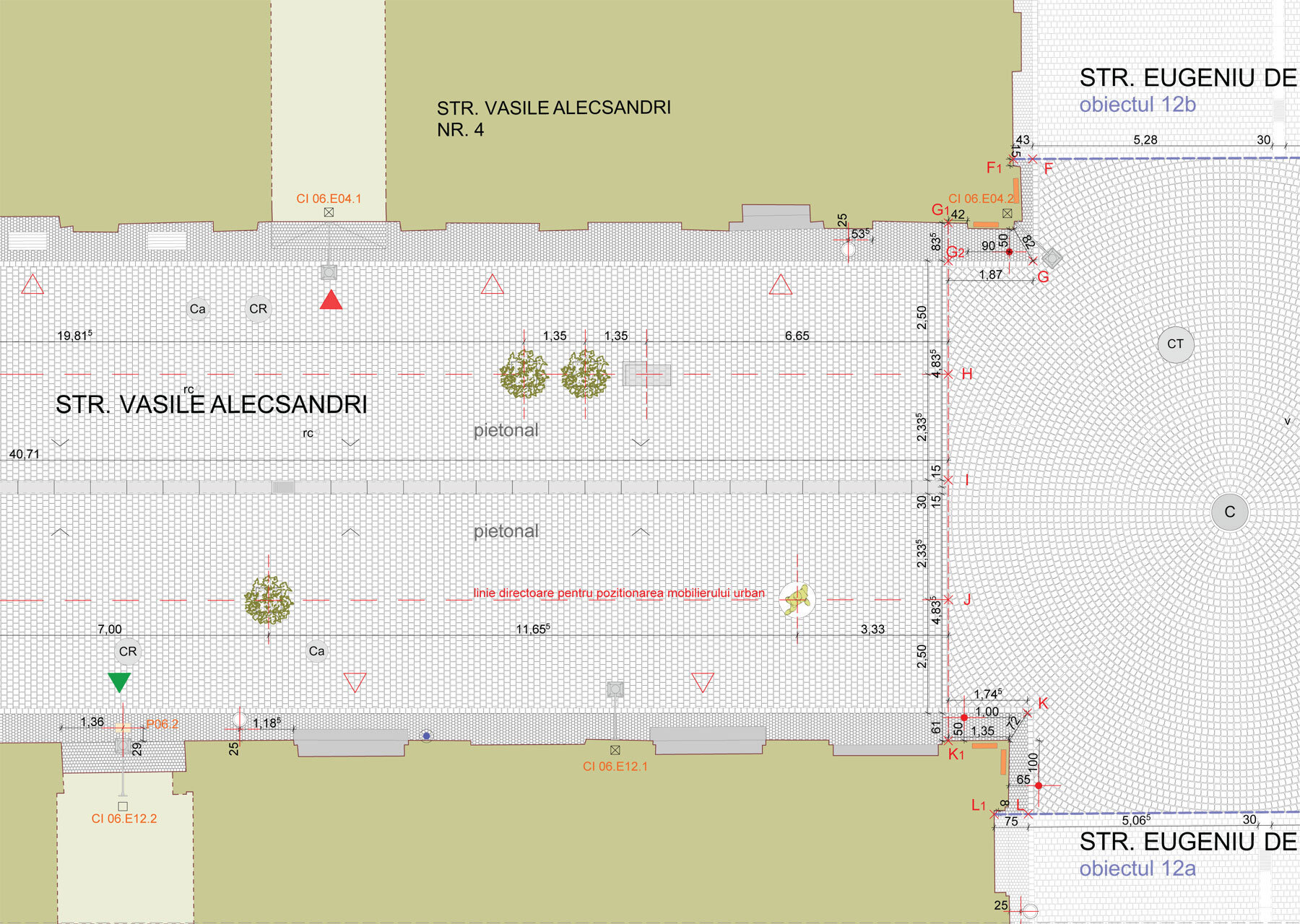
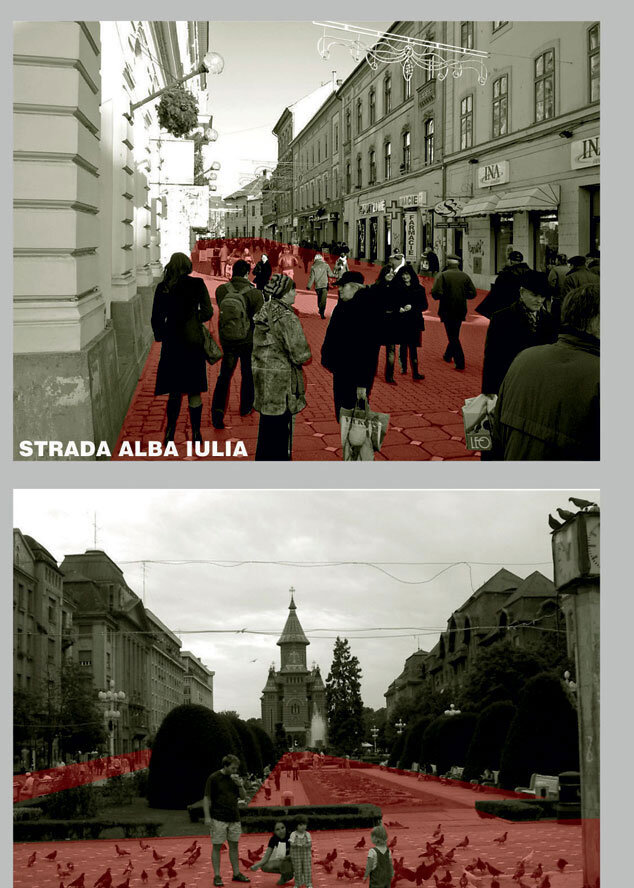
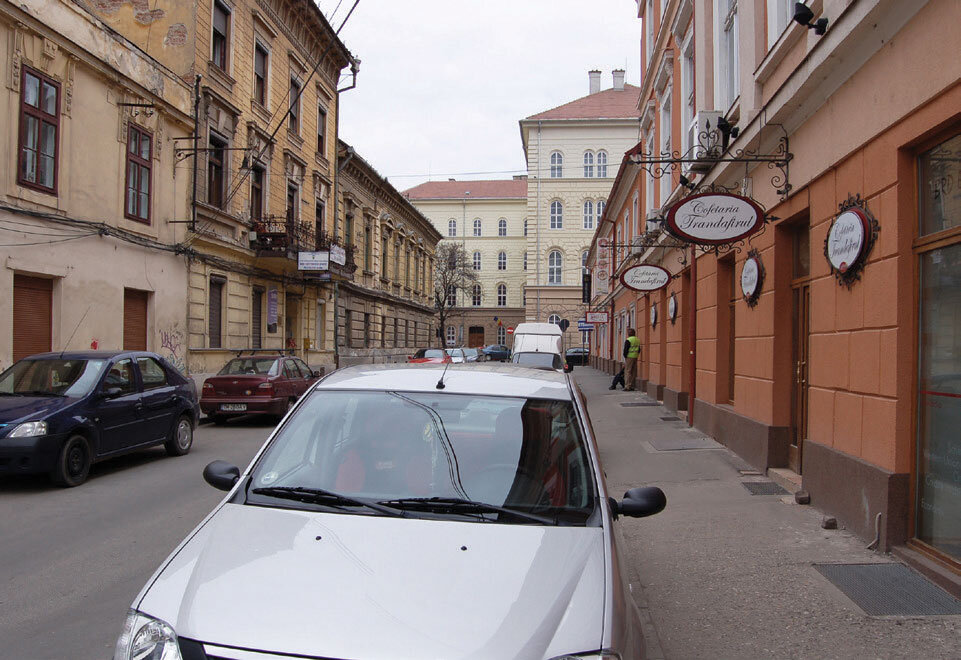
Among the 10 streets that are the subject of the project there are some that, although they fit into the typologies described above, receive specific attributes of their particular character through the proposals made: Vasile Alecsandri Street and Florimund Mercy Street. At present, Vasile Alecsandri is a street with transit traffic that is part of the vertical axis of the Cetate District, which crosses the Cetate in a N-S direction. The street is an integral part of the most important pedestrian route of the city: Opera Square - Alba Iulia Street - Libertății Square - Vasile Alecsandri Street - Unirii Square. The street profile is composed of a centrally positioned car traffic lane, two left-right parking lanes and two sidewalks located near the front of the buildings, on either side of the roadway. The materials used to finish the roadway and sidewalks (asphalt, concrete pavers, concrete curbs) are inappropriate to the historic character of the street and are in an advanced state of deterioration. Street lighting is provided by cantilever luminaires mounted on building facades. The festive lighting has been given a permanent character over time by its uninterrupted presence on the street. There is no vegetation at street level. It has a pronounced commercial character through the various public functions (trade, services) located on the ground floor of the houses.
The rehabilitation of Vasile Alecsandri Street implies the assumption of its role as an integral part of the most important pedestrian route of the city (Opera Square - Alba Iulia Street - Libertății Square - Alecsandri Street - Unirii Square). The commercial character of the street will be supported by its pedestrianization through the large flow of pedestrians who will feel encouraged to transit this urban space. The location of the street furniture will be related to the buildings that form the frontages and will structure the street profile in a pedestrian circulation area located in the median and lateral areas, interacting with the functions that furnish the sides of the houses (shop windows, display, terraces, etc.).
The intersection of V. Alecsandri and E. de Savoya has a particular design - the 12x12x12 cm cubic stone strings are arranged in a circular pattern around a detail element (a custom-made channel cover) placed in the center of gravity of the intersection.
As part of the proposed interventions on the facades of Vasile Alecsandri Street, in addition to the parietal lighting fixtures, metal 'anchors' will be installed. Their role will be to support the fastening system (cables) for various temporary arrangements of the air space (festive lighting, urban cultural events: festivals, etc.).
Florimund Mercy Street is divided into two dead-end segments (Union Square - Eugeniu de Savoya and Eugeniu de Savoya - St. Gheorghe) which do not allow through traffic, the street having more of a parking role. It connects Union Square and St. Gheorghe Square at pedestrian level. The street has a pronounced cultural character thanks to the Banat Museum, the Cărturești, Humanitas and Adevărul bookshops and the Baroque Palace.
The scenario of the rehabilitation of Mercy Street implies to emphasize the cultural character acquired by this street due to the presence of the museums, the three bookshops and the cultural street activities it hosts, as well as to emphasize the link between Unirii Square and St. Gheorghe Square. Mercy Street acquires a special character and, consequently, will be given a special definition of paving by 'laying a carpet' of larger stone slabs that occupies the median area and acts as a support for terraces or other urban activities. The configuration of the median pavement takes into account the logic of the buildings that form the frontages (gates, gang entrances, a facade event - the Baroque Palace showcase). In these interruptions are marked by the presence of "signs" in the pavement (manhole covers, inscribed stones, etc.) information about where you are.
The special character of the street is also emphasized by differentiating the type of lighting. This will be provided by luminaires supported by cables anchored in the plane of the facades.
The rehabilitation of the public spaces in the historic center of Timișoara envisages solutions that lead to the perception of the works as an intervention in a complex but unitary whole, integrating, at the same time, a series of details that can particularize each representative place, in a direct relationship with the existing architectural elements. The project, on the basis of the default procedures generated by the Community funding, is currently at the tendering stage, and once the construction firm has been chosen, the works will start.