
Urban Food Stories, Romanian stand at the UIA Congress, Durban, 2014
URBAN FOOD STORIES, our response to the theme ARCHITECTURE OTHERWHERE, proposed by the organizers of the UIA Congress 2014 in Durban, South Africa, was an opportunity to approach the city from a different perspective than the one that the architectural profession has given us. We tried to look for architecture elsewhere than in the "play of volumes under the light" as Le Corbusier defined it, elsewhere and only where it intersects with the everyday experience of urban spaces, which has inspired many architects to follow in the footsteps of Michel de Certeau and Henri Lefebvre in urban intervention at the micro scale. We have found it where the urban dweller feeds, where the city meets the territory that partially supports it. We are talking about partial support because the links between the Romanian city and the surrounding territory are increasingly fragile, under the threat of industrial agriculture and global distributors, for whom place means only cheap resources. We were already familiar with several local initiatives, having been involved in the "Peasant's Box" program and closely following the "Flying Markets" and "On the Grounds" initiatives. So we were quick to think of others and, because they seemed disparate, we decided to present them in the form of several stories. The fact that we discovered similar initiatives in Durban gave us more confidence in tackling such a marginal theme in relation to built architecture. Winning the competition organized by the Romanian Order of Architects gave us another impetus, but the real confirmation would only come in Durban.
As well as furnishing the stand, the concept for the stand included presenting the stories in multiple media - text, photography and video. So the team was expanded with members skilled in producing what was initially proposed. Throughout the months of preparation and collecting the stories, we collaborated with Liviu Rațiu, who filmed and assembled the interviews in their final form, Oana Bența, who translated our texts into English, and Dan Burzo, who designed our website urbanfoodstories.ro. In addition, Gabriela Szasz and Vlad Marchidanu helped us with the filming in Bucharest.
That's how we got started on the stories we were going to collect. We researched on the internet, consulting websites of the initiatives we had in our sights or articles written about them, sent e-mails, made phone calls to establish contacts, met the actors of the stories for discussions, set up meetings for video interviews. Most of the featured initiatives are from Cluj, the city we live in and know to some extent and the networks that infuse it. Some of them were already close to us, others we discovered along the way. This is what happened with the story of the people of Soca, which we found hidden in another story. Mr Gyurka, who is involved in the Peasant's Box program, is also part of the community of the inhabitants of Hoște, a community of urban farmers who have been supplying the city with fresh produce since the 15th century. Moreover, during the course of our research, we glimpsed the links between the different initiatives, which were not visible at the beginning of the project, and we came to the conclusion that they all knew each other, including between Cluj and Bucharest. So we came to see how the stories presented make up an ecology of practices that brings together people, biological resources, land and farming practices. An ecology of practices that, despite the threat of the global food market, resists, in other words is resilient.
Arriving in Durban after a journey with two plane stopovers, we were anxious to see how everything we had planned over the past months materialized. In the first few days we saw for ourselves why Durban is otherwhere, a city composed of the realities and characters of different cultures: with a visible face to the cosmopolitan world, with Africa's longest and most popular beach, The Golden Mile, behind which the complex city extends, woven of very different neighborhoods of ethnic and social groups. Everything I had previously researched and known about the different aspects of the Urban Food Stories project was confirmed on the spot. Near the exhibition center there was an office building that had a roof terrace transformed into an urban garden, and in front of the Durban City Hall the vegetation was made up of food plants. Thus, we hoped that the Romanian stand would have a public interested and initiated in the proposed theme.
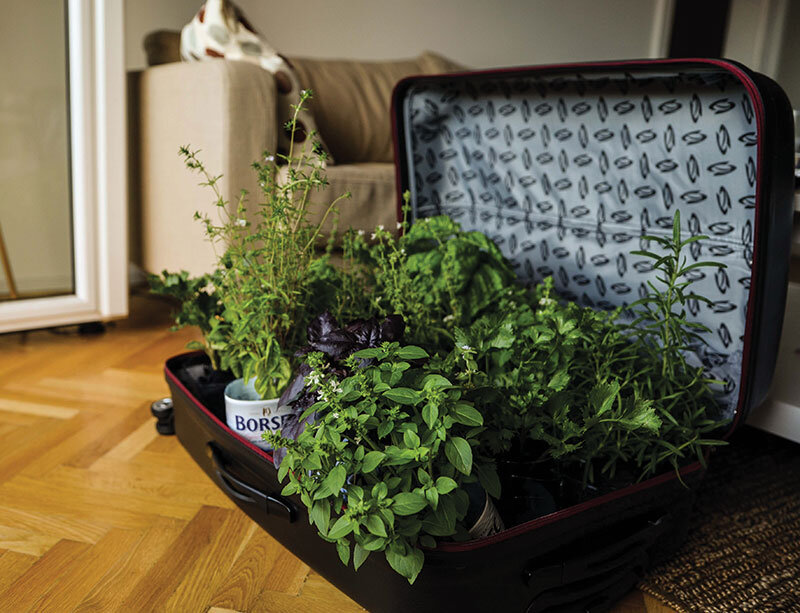
For the material composition of the pavilion, the big challenge was the geographical distance where the event took place. The stand was conceived as a connecting space composed of seating pallets arranged on two sides, inviting the viewer to watch the material and have informal discussions about it. In addition, the pallets formed a garden of edible plants brought from Romania to be displayed and, why not, consumed by visitors. The documentary film was shown on three superimposed screens rented from the organizers. Pallets were also purchased from a local supplier. The difficult part was transporting the native plants safely. For this we used recycled 5-liter PET bottles, which were cut in half and the plants were placed inside, with their roots wrapped in a moistened fabric. The journey took a little over 24 hours, but the method worked, the plants coped with the journey without damage or drying out.
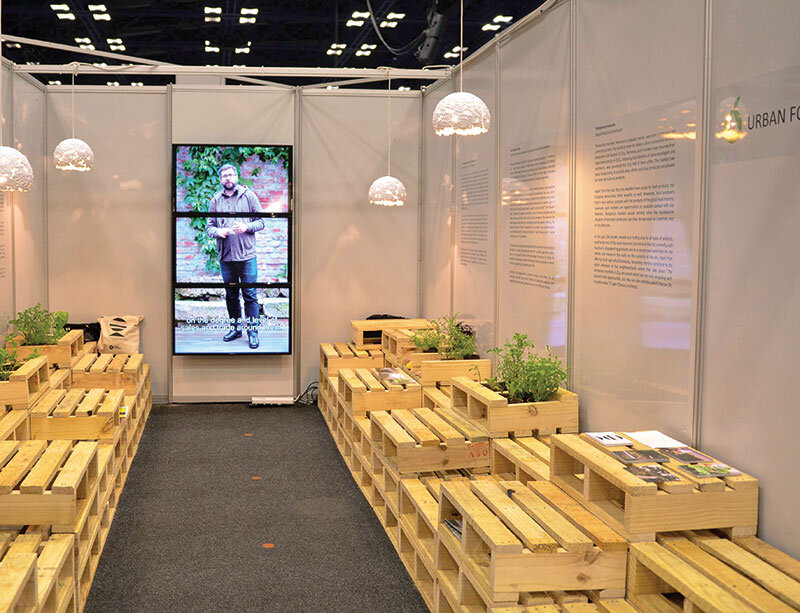
The assembly had to be done in two working days, the first day being reserved for the organizers to set up the stand partitions. We can say that it was the most challenging period because of the unknown and the time lags. We had to follow the assembly and correct the building process on the fly. Verbal communication with the assembly team proved to be much more helpful than trusting that the home drawing would be executed ad-literam.
For the garden we relied on the local soil, which we had heard was very fertile, the local saying being: "If you stick a pencil in the ground, a tree will grow out of it". The problem was that it was not sold in the same way as in Romania, in DIY stores. We had to improvise, so we dug out two ground nets in the evening from the green space behind the hotel. Although it was sandy, the plants adapted easily and kept their shape throughout the event.
We had to adapt to a style of working that doesn't strictly adhere to the deadlines imposed by the project, but which is effective, and by the time of the presentation everything was completed. The first satisfaction was that the pavilion was realized exactly as it was proposed in the competition phase, which surprised us considering the long way from an idea to the technical project and then to the built product.
As soon as the pavilion was set up, we waited anxiously to see if the public would understand why we were presenting at the Romanian stand a theme marginally related to architecture, but encouraged by the proposed theme of the expo-conference. Our concerns turned out to be unfounded. Among the stands of other countries and organizations, the Urban Food Stories stand functioned as a green oasis, both physically and ideologically, by drawing the visitors' attention to an atypical topic. We were surprised by how many visitors from different parts of the world were interested and familiar with the presented topic, sharing with us their experiences about their own projects and initiatives with similar themes. From home we had already planned to contact some local organizations in Durban working on similar projects. So, on one of the days of the exhibition we managed to meet the three young activists Delwyn, Sean and Shiva, with whom we exchanged ideas about food sovereignty both in Romania and South Africa. We talked about the "generic" Romanian modern city, which is increasingly physically and ideationally disconnected from the place of food production, and they presented the ethnic and social issues of food-producing land ownership, unresolved to this day since the end of apartheid.
After the closing of the event, the exhibition was dismantled in practically less than three hours. We arrived in Durban and built the stand out of what had fit into three suitcases and pallets ordered from a local manufacturer, intending to go home with the empty suitcases. What was left of the stand we left behind for the three young activists: the pallets, the plants and the light fixtures made from recycled materials. A few weeks later they sent us pictures of their stand at another exhibition, built from our pallets. We still keep in touch via social media. The postcards spread easily among visitors and we hope they have reached as many parts of the world as possible.
Romania's stand at the UIA Congress Durban 2014 was published in "Arhitectura" magazine, issue 3/2014.
photo: Alexandru FLEȘERIU, Iulia HURDUCAȘ, Péter ESZTER