Diploma project: Reconversion of Filaret Railway Station - Museum of Science and Technology, Bucharest
Student: Andrei LEONTE
Faculty of Architecture "G. M. Cantacuzino", Iași
The project deals with a series of complex themes of architecture: urban regeneration, revitalization of heritage buildings, the relationship between the urban implant and the existing background and urban public space.
Filaret Station, full of history and significance, offers generous spaces that could form the nucleus of a complex to house a Science and Technology Museum.
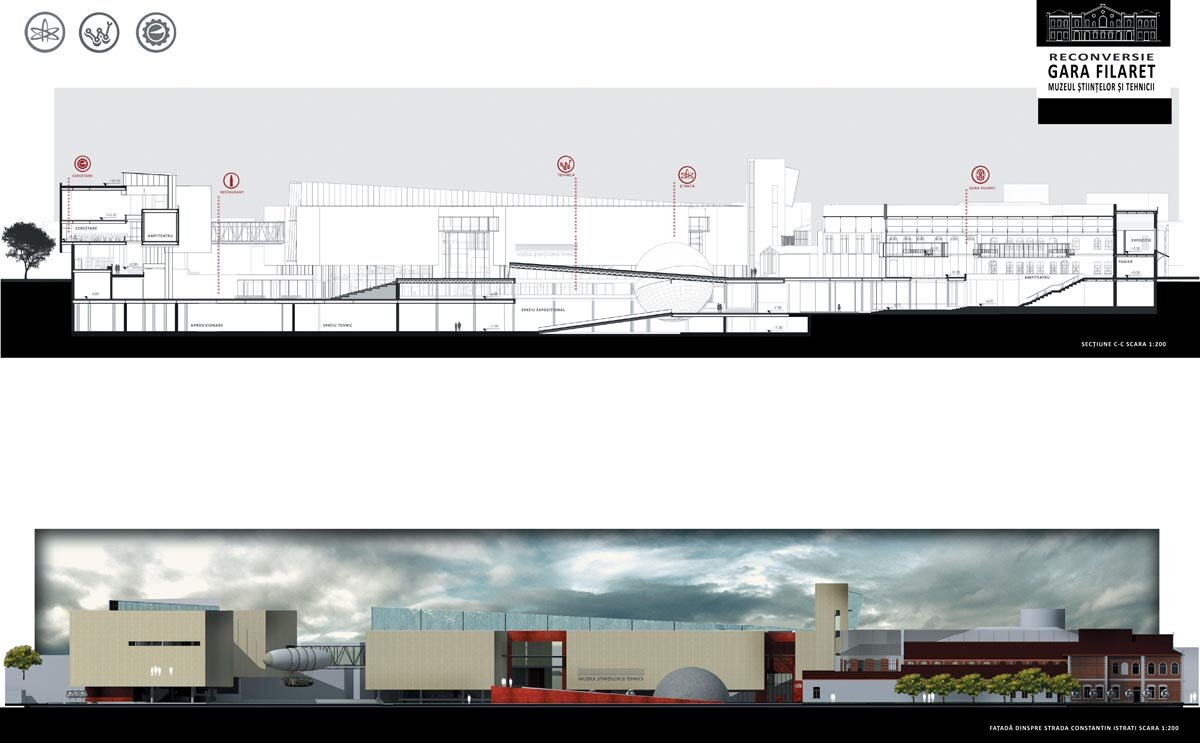
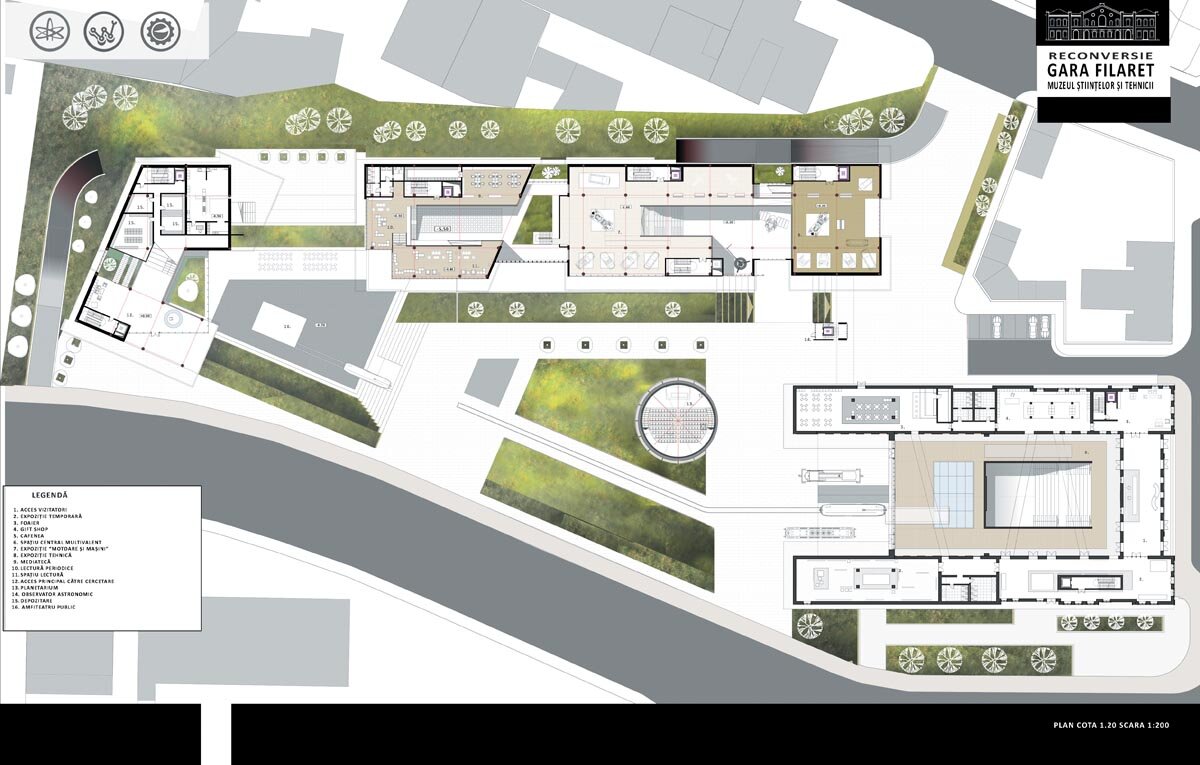
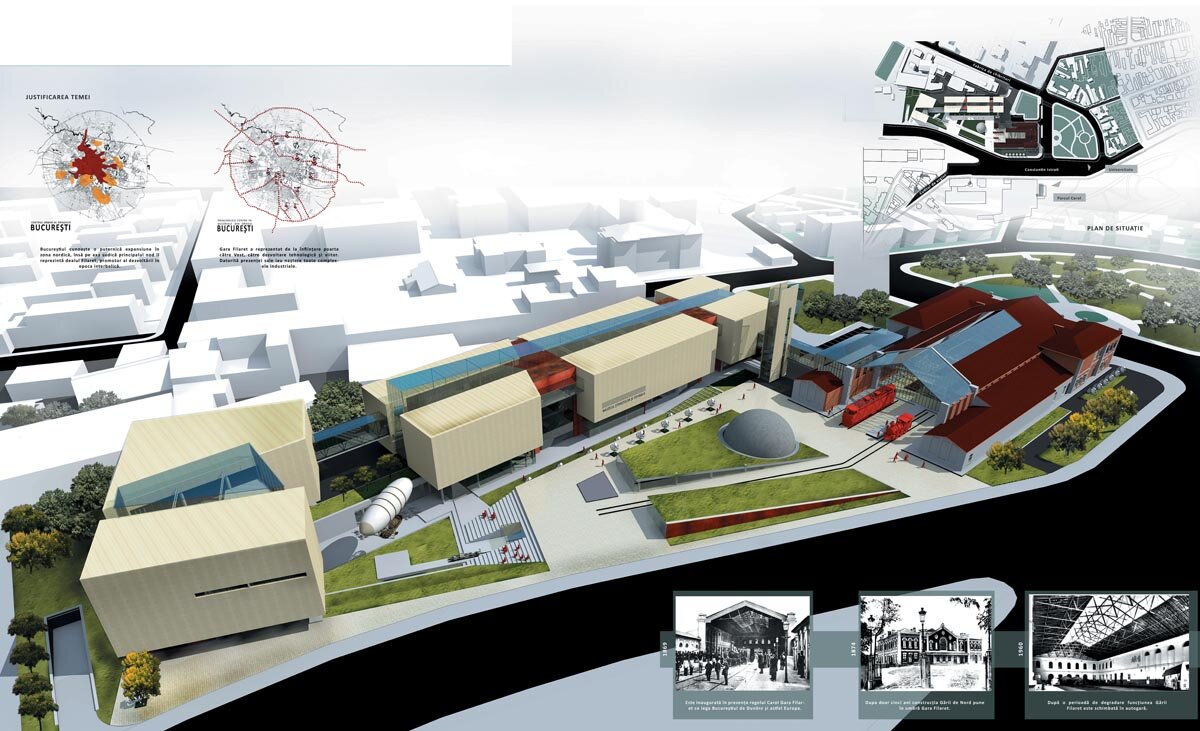
The composition of the ensemble is subordinate to the major axes defined, on the one hand, by the direction of development of the station's volume and, on the other hand, by the major circulation which limits the site to the east.
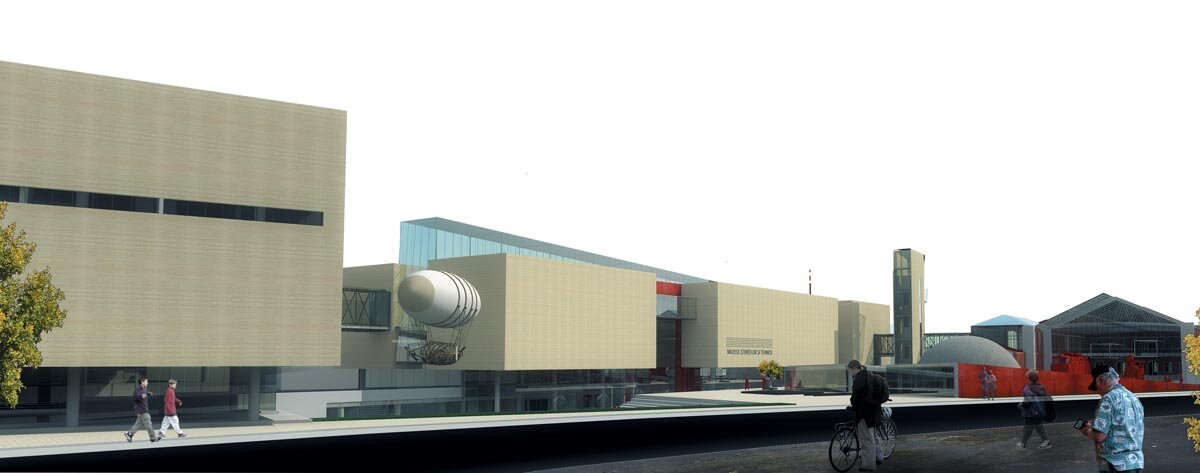
Two major volumes are proposed within the ensemble, one parallel to the station, developed linearly in the secondary plan, and the other a massive volume which ends the ensemble to the south, parallel to the major circulation. The main volumes are articulated by secondary volumes which ensure the flow of traffic. The three main volumes define an urban space made up of two squares at different levels, open onto the main artery.
The main access to the museum is from the Filaret square, through the ground floor of the existing building in the central space of the station which housed the end of the lines and the platforms. Enclosed by a large glass wall, it becomes the major reception, information and distribution space to the temporary exhibition spaces in the existing building, as well as a starting point for the museum itinerary. The extension of the covering planes of the central space beyond the glazed plane directs the interior space towards the exterior exhibition space and creates an intermediate space favorable for exhibitions.
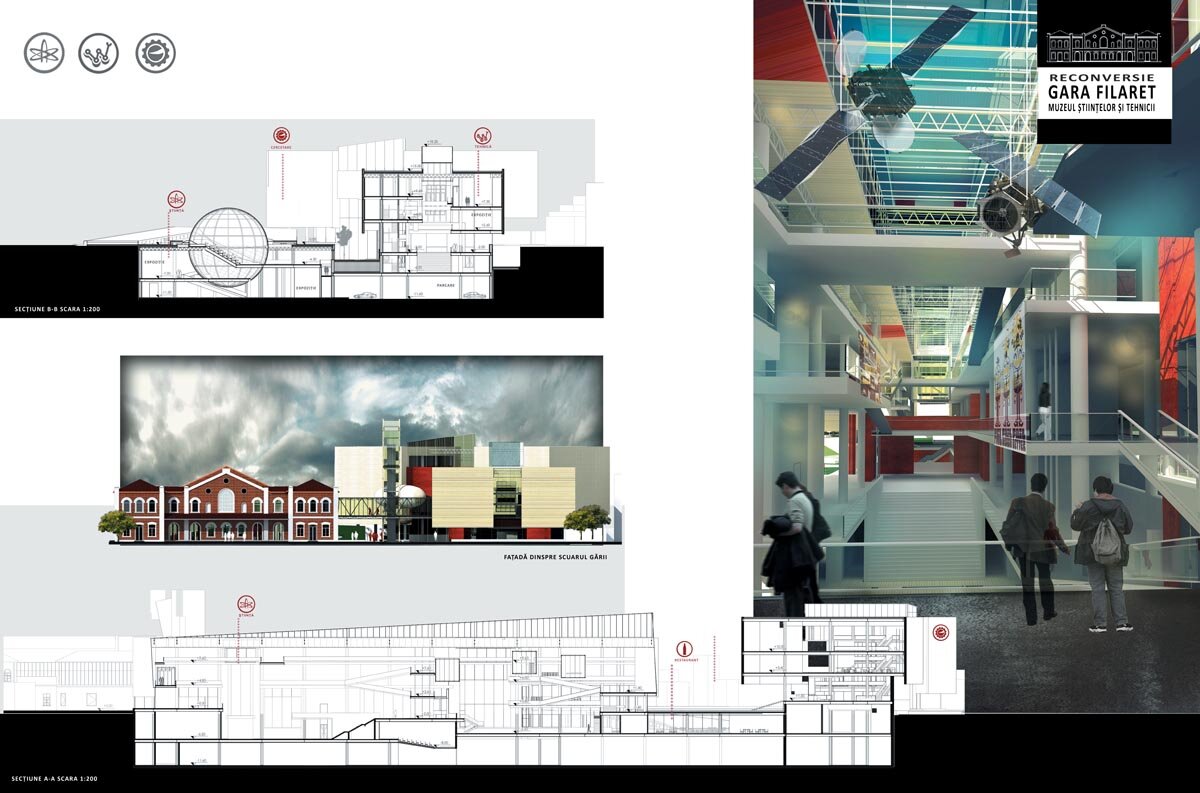
From the central space, the museum path descends generously at a lower level into spaces intended for the planetarium and exhibition, as well as for circulation towards the new museum volume. Developed on either side of a zenithally illuminated linear space, the museum is organized on staggered planes, providing a return route to the main station space.
The second volume, comprising information, research and administration spaces, is open on the basement level to an open-air exhibition courtyard, towards which an amphitheater, food and beverage spaces and a circulation axis from the lower exhibition level are oriented.
The composition of the ensemble, the general volumetry, the moderate architecture proposed for the new buildings and the interventions on the existing building can be considered as correct and possible solutions to the chosen theme.
supervisor: head of works arh. Daniel Vișan