
Enchanting views.
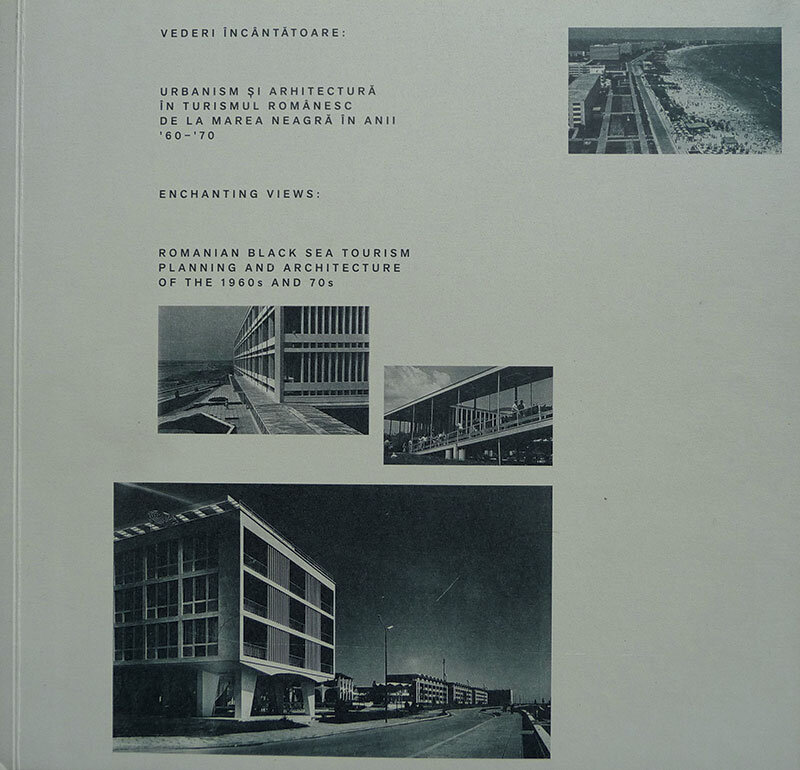
Urbanism and architecture in Romanian Black Sea tourism in the 1960s and 1970s
Authors: Alina Șerban, Kalliopi Dimou, Sorin Istudor (ed.)
Publisher: pepluspatru Association, Bucharest, 2015
The mechanics of seaside happiness
The volume complements the exhibition of the same name that took place at Sala Dalles in Bucharest in October-November 2014. It is not, however, an exhibition catalog, but a collective volume of critical history, written by reputed authors from diverse backgrounds, which I believe will henceforth be considered a reference in documenting the subject. And the subject is fascinating: it is the happiest juxtaposition of communist architecture in Romania.
Whether we are talking about the "ephemeral myth of the seaside"1, as A.M. Zahariade, or about "a reality for millions of people in the Soviet Bloc"2, as J. Maxim observes, both the myth and the reality of this architecture concern a very specific kind of happiness, that of "modern man":
"The modern man's pleasure / To travel.
Modern man's desire / To know.
The modern man's interest / To make the most of his free time".
We read this motto, printed large on two pages, at the very beginning. But we also read it in the last cliché in N. Ilfoveanu's photographic reportage3, which concludes the grouping on the Romanian seaside: on a faded billboard in Eforie Nord, below the almost faded advertisement with the exhortation "Visit the restaurant...". In this single image is, in fact, the essence of the whole evolution of the Romanian seaside, from the formula of the new man's ideals of modernity, to petty and vulgar commercialization and, finally, to indifference and abandonment. So we understand that, in the long perspective of time, the enunciation of a universal ideal was eventually perfectly interchangeable with a commercial advertisement of some kind. Here is something interesting to observe about how collective happiness is translated into reality. Taken as a whole, what the volume does is to rigorously explain, and thus demythologize, the mechanics of that happiness.
I would note at the outset the book's editorial structure and subject matter. The first word is given by the editors (and curators of the exhibition), who state their intention to place the seaside project in a broader social, political and geographical context. There are nine articles on the Romanian coastline and three on other Black Sea coastlines. The first three articles (Carmen Popescu, Irina Băncescu and Juliana Maxim) talk about the urban and architectural project of the Romanian coastline as a whole (and it is interesting to see how it is possible to write in three distinct ways, with different perspectives, about exactly the same thing). The next one (Irina Tulbure) is also about urbanism and architecture, but focused on the architect Cezar Lăzărescu. Then follows an article on monumental art integrated with architecture (Magda Predescu), on the regime's tourism policy (Adelina Ștefan), on real people and social perspective (Claude Karnoouh) and on propaganda documentaries (Adina Brădeanu). Finally, a photo report is wordlessly telling about the state of seaside architecture today (Nicu Ilfoveanu). Three articles on neighboring developments on the Black Sea cover Bulgaria (Elke Beyer and Anke Hagemann), the USSR (Olga Kazakova) and Turkey (T. Elvan Altan). The last word goes to the afterword by Ana Maria Zahariade, who analyzes the very articles in the volume. Finally, the quality of the book design, by Radu Manelici, is also noteworthy.
One of the ideas repeatedly asserted in many articles is the exceptionality of the seaside project in the context of Romanian communist architecture. Chronologically, the development took place between 1952-19734, i.e. it coincided broadly with the "Thaw" period, which partly explains the fact that architects enjoyed a freedom that they did not have before or after.
The uniqueness of the Romanian coastal project is relativized, however, by its setting in the context of other coastlines on the Black Sea and even in the western Mediterranean at the same period (parallels with coastal developments in Languedoc-Roussillon appear in several articles). The most similar to the Romanian coastal project is the Bulgarian one, to the extent that, from the West, the two appear as a single entity, as I. Băncescu5 notes. C. Popescu finds similarities with so many and so diverse examples of Western modernism that he can state that some of the ideas of Romanian coastal architecture are taken "directly from Western practice"6. Finally, C. Karnoouh places the Romanian coast in the wider context of the history of European socialism, demonstrating that the ideas applied here do not even belong to the communists; they only systematized them "more dogmatically and bureaucratically"7.
Another idea that is mentioned in several articles is that of "mechanics", that the seaside project was conceived as a machinistic device that produces automatic and determined effects. It is, first and foremost, a staging of skillfully directed modernist compositions and "devices", a "mechanics of the gaze", a "visual mechanics", argues C. Popescu8. Images of the seaside promote "mechanisms of mass consumption", J. Maxim also observes. She also speaks of "pedagogical vacations"9, which aim to automatically educate the new socialist man through the instrument of the modern setting, for a new holiday sociability, designed to replace the traditional religious and family-based vacation habits. Finally, the communists' tourism policy is described by A. Ștefan as a dynamic and efficient "institutional mechanism"10.
This architectural machine is typically modernist. Moreover, the seaside is the flagship project of post-war Romanian modernism. It is a 'decomplexed and optimistic modernism'11, as C. Popescu writes, but one that is still 'silent' and unnamed, as I. Băncescu observes, because it has not been accompanied by a theoretical debate, and instead of 'modernism' other words are used, such as 'simple, rational, sincere, new'12. This does not prevent it from being a veritable laboratory for new technologies and modernist "stylistic markers"13, as J. Maxim puts it. She places the seaside project in direct relation to the other major achievements of communist modernism, the large housing estates of the 1960s, noting the undeniable influence that the image of the seaside had on them, from the urban structure to the architectural details. From an artistic point of view, M. Predescu also makes the novel observation, made in relation to the way in which the architect Ion Mircea Enescu considers concrete, that it is a "poverist"modernism14. Lastly, C. Karnoouh is less taken in by the "enchanting" aesthetics of modernism and sees the raw side of the modernization of the coastline, in Romania as elsewhere in Europe: the ecosystems of the seaside have been irreparably destroyed and "the Black Sea coast has been disfigured"15.
The observation made by almost all the articles is the small capitalist turn of the communist seaside, the shift of interest from producing new people to producing money from foreign tourists. As A. Ștefan observes, after the mid-1960s the social character of tourism was lost in favor of a leisure tourism; even the official discourse replaces "working people" with "citizens"16. Thus, says Karnoouh, the seaside effectively contributed to a shift in mentalities towards the modernity of the 'consumer society', and hence to the formation of a 'middle class', the very class that would overthrow the regime in the years to come17.
Karnoouh is, moreover, the only one to talk in his chapter about the real people, the beneficiaries of the seaside, a subject that is less obvious than it might seem. For, although it is part of a period of "humanization of architecture"18, the seaside project is more readily addressed to modern man as a generic utopia. The communist state "offered" vacations "to the masses"19. However, emphasizes Karnoouh, seaside holidays were not for all Romanians. A whole class, not negligible in number, the peasants, did not, in fact, have access to seaside bliss; even the workers were few in number; most of those who successfully evaded the "country vacation" were civil servants, technical professionals, teachers, etc. As for foreign tourists, they immediately noticed the lack of "seaside urbanity" in the services on the Romanian coast20.
Indeed, as the editors-curators intended, the "enchanting views" analyzed here do not turn into a "nostalgia factory"21. The real people did not quite fit the mechanism to which architecture has become complicit. This is most directly demonstrated by N. Ilfoveanu's photographs, which today show us modern seaside architecture without people, abandoned and swallowed up (literally) by vegetation; people are on the sand or in the water.
Notes:
1 Ana Maria Zahariade, "On the ephemeral myth of the Romanian seaside", p. 250.
2 Juliana Maxim, "Enchanting Views. Politici ale seducției la începuturile turismului de litoral din România socialistă", p. 71.
3 Nicu Ilfoveanu, 'Litoral 2013-2014', p. 204.
4 Ana Maria Zahariade, p. 251.
5 Irina Băncescu, "The Communist Project of the Romanian Seaside. Architecture between political constraints and mass tourism in the post-war European context", p. 61.
6 Carmen Popescu, "O mecanică eficace: litoralul românesc în anii socialismului", p. 21, p. 36.
7 Claude Karnoouh, 'From the particular to the general, or how communist Romania confirmed its integration into world capitalism through the vast social and then tourist project of urbanizing the Black Sea coast', p. 149.
8 C. Popescu, pp. 34-35.
9 J. Maxim, p. 83.
10 A. M. Zahariade, p. 254.
11 C. Popescu, p. 23.
12 I. Băncescu, p. 46.
13 J. Maxim, p. 81.
14 Magda Predescu, "Arhitectura și arta monumentală pe litoralul românesc în perioada "Dezghețului" politicului. Development of the Costinești Youth Camp (1970-1972)", p. 117.
15 Claude Karnoouh, p. 157.
16 Adina Ștefan, 'From "working people" to "citizens": individual tourism, tourism "by choice". Politicile turistice în România anilor 1960-1970', p. 128
17 C. Karnoouh, p. 156.
18 C. Popescu, p. 23.
19 C. Karnoouh, p. 150.
20 Ibid, p. 154.
21 Kalliopi Dimou, Sorin Istudor, Alina Șerban, "Introduction", p. 9.