
Raum Garden The place that's always changing, and us with it...
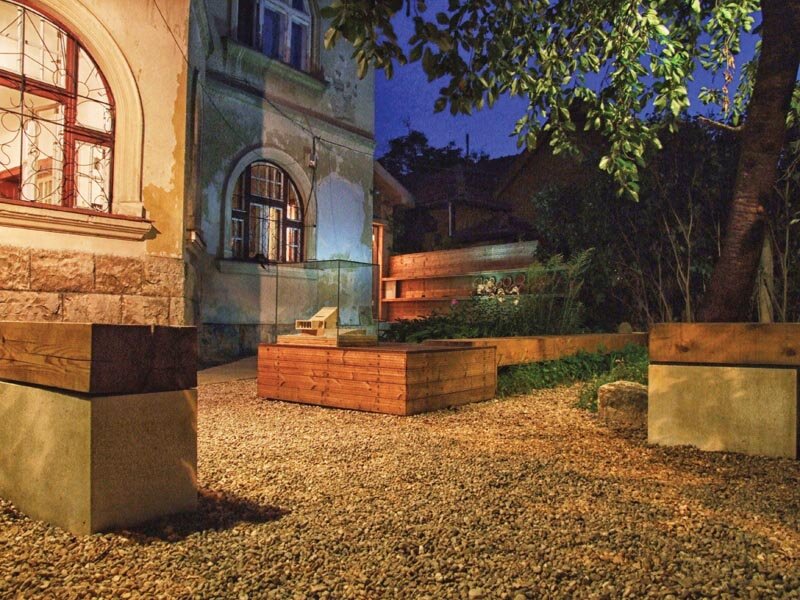
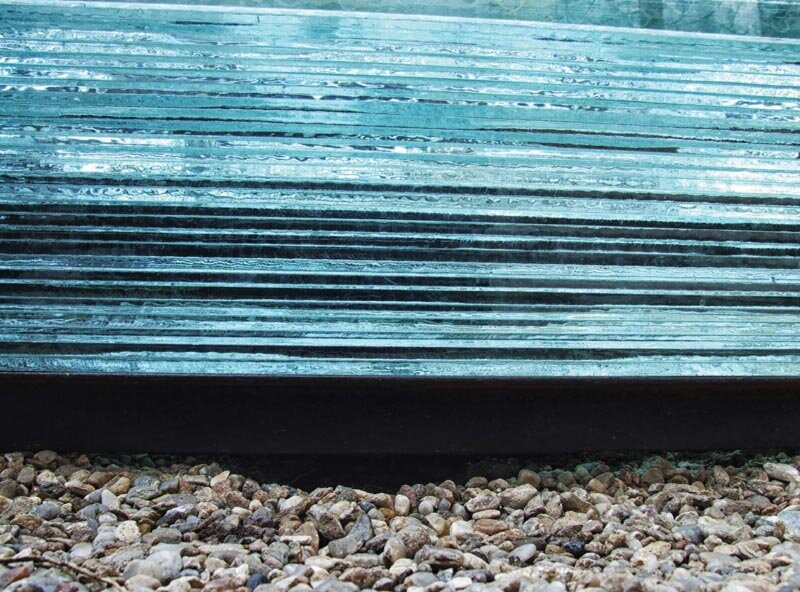
Behind the hustle and bustle of the street space, in a residential part of the city, lurks a place in front of an old house, announced by a glass gate, which you might pass by without noticing it because of its discreet presence. This is due to the qualities of the glass, which takes on the materiality of the place through its transparency, receiving light and color, something that was sought by the office team, whose intervention slowly and unnoticed inserts itself into the urban fabric. The courtyard reveals itself only to those who seek it out on purpose, to those who look for it beyond people's fences and street posters. All things seem to fall into place in the courtyard, the mineralization of the land by the use of fine gravel and limestone is covered by abundant vegetation and tall, old trees that create a world of their own, an impression of detachment from the rest of the city. This feeling is heightened by the presence of models and personal objects, the courtyard being the result of our vision of the world, the place "where we share our search with others".
The first objective proposed in the design of the courtyard was to obtain an extension of the interior space, where the workspace is, the exterior becoming a complement, especially during the warm season, a place for the team to relax, a place to meet clients, a place to rest, play and contemplate the things of the earth, a space for architects, clients, passers-by, other people, at the permeable boundary between public and private space.
The garden is seen by us, its 'inhabitants', as a play space, an experimental theater where we use less usual materials, which we have reused under the filter of our thoughts. The place becomes the host of an experiment with objects and materials already present on site and with others that will appear in the future, everything is constantly changing according to the place, the condition, the opportunities, new materials. Those currently in use come from several sources: left over from the site - recycled waste glass, stones, pieces of wood and materials received from elsewhere: donations of monolithic limestone, used in configurations given by the site and their dimensions as they were made available.
"Playing with materials" is a foundation of out-of-office practice that helps us to use materials appropriately and at the same time educates passers-by, clients to see something other than what they read in the usual magazines. By being exposed to the elements and not protecting them, one can observe how materials behave, how they are assembled and how they withstand the sequence of events, things that are learned and applied in projects. The garden is the place where time makes its presence felt, for better and for worse.
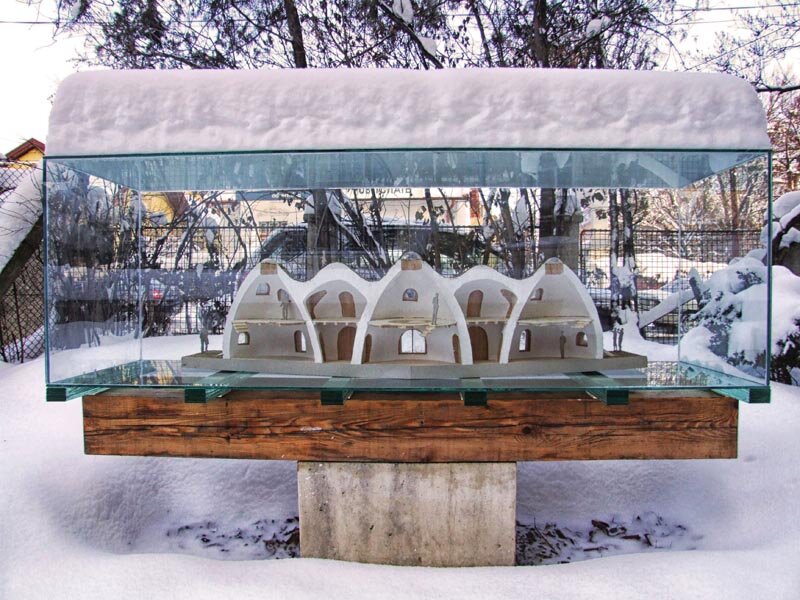
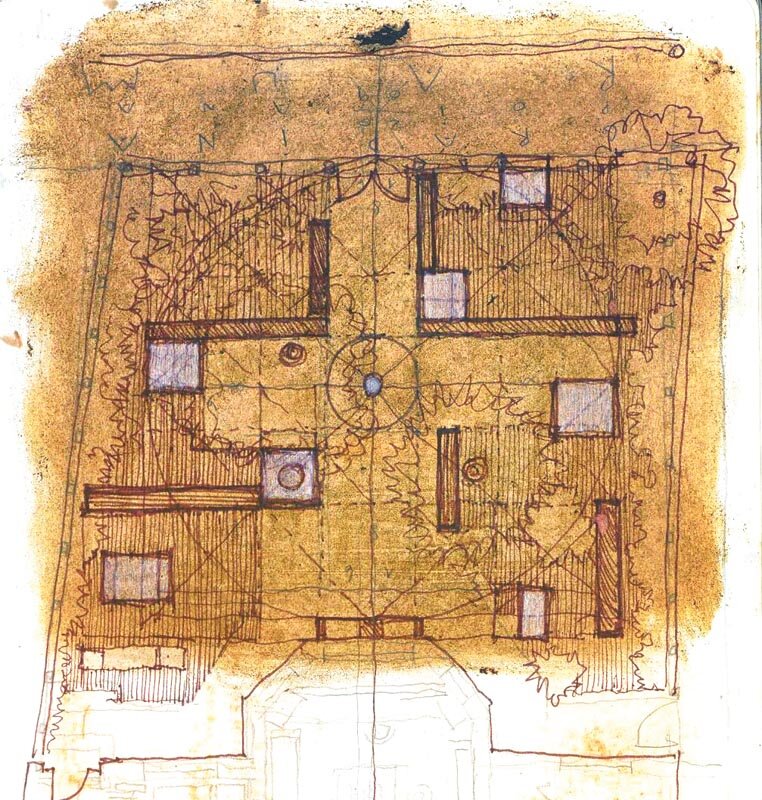
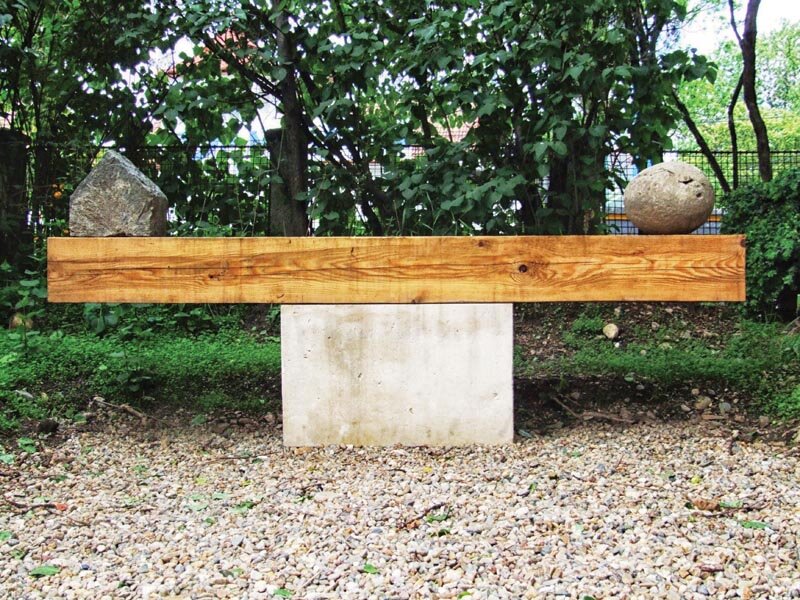
Through combinations of textures and adaptations of material we have obtained several different types of furniture: fixtures for displaying models, a planter, seating benches and a gate, which due to their considerable weight cannot be moved easily. The benches are made of large pieces of white limestone that form the main base, on top of which a piece of solid wood has been placed to provide comfortable seating and at the same time protect the stone from the weather, which would normally deteriorate under the action of rain and snow. The planter is a massive element that demarcates the entrance to the office, forcing you to walk around it, and forms a separating layer from the space of the street to the intimate space of the home. An atypical element that marks the entrance to the garden is the entrance gate which we wanted to be a combination of old and new, in harmony with the old house, with the garden, but at the same time able to speak of the period we are now in terms of the technology used. It is made of a salvaged frame of scrap iron, in a silvery color, on which time has left its mark, elements that constitute the main support for the bonded glass that is the solid part of the gate. The dual element of the gate is given by the way it reacts to the environment depending on the light: from the street it metamorphoses with the surrounding environment and you hardly notice it, while inside the courtyard it becomes the main feature of interest due to the strong light it receives from outside. An unusual detail of the gate is the use of a stone as a doorknob, which from the outside announces the minerality of the space and comes into direct contact with people's senses through touch.
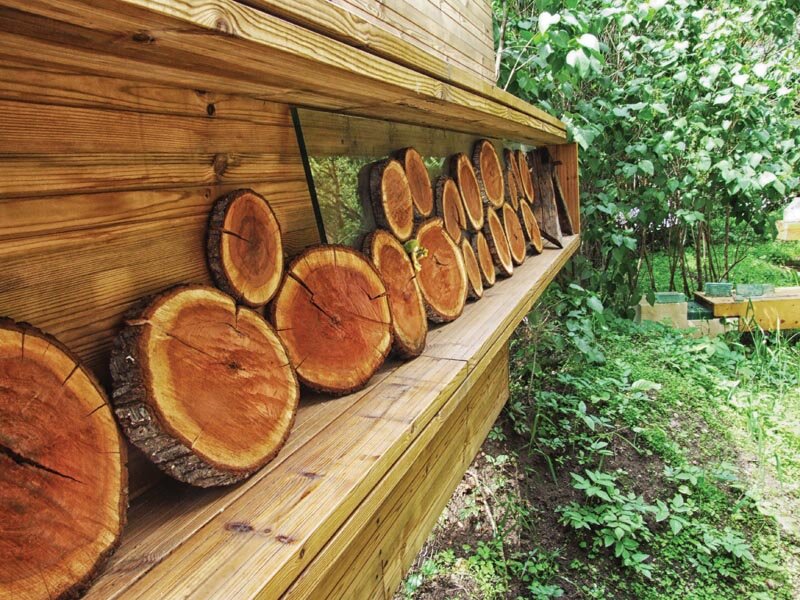
Another place where we tried to see how the materials behave is a small courtyard, hidden in the back, which has a tree inside, where we experimented with different horizontal and vertical wooden elements, wooden objects, letting the humidity and vegetation make their presence felt without trying to stop them to see how the material behaves.
A final use of the garden, arising out of the needs of the office, is to store models that could no longer fit in the workspace due to their sheer numbers, which we preferred to display and show to people. In this way, the models were taken out into the garden and protected by enclosing them in a glass box, which ensures good visibility but also protects them from snow and humidity. The base of the glass boxes is made of limestone or pieces of glass glued together. The display of models and other objects: wood carvings, stone, the abundance of plants and the presence of the 12 cats that live next to the garden personalize the place, give it a specific atmosphere and a sense of identity.
The garden is the building site of our own thoughts where we concretize our quests, the place of contemplation, of the dialogue of matter with time, where the passing of the years is felt, the place of our quests, which is always changing and we with it, the place where we try to find a comprehensive sense of the world.
Location: 4 Octavian Goga Street, Cluj-Napoca
Architecture Authors: Alexandru Mociran, Alexandru Stoica, Radu Mărginean, Horațiu Dicoi, Virgil Mihuț, Vlad Cărăbaș, Andrei Köves, Horațiu Răcășan, Gabriel Răcășan
Structures: dr. ing. Dan Turda