
Housing as an urban function
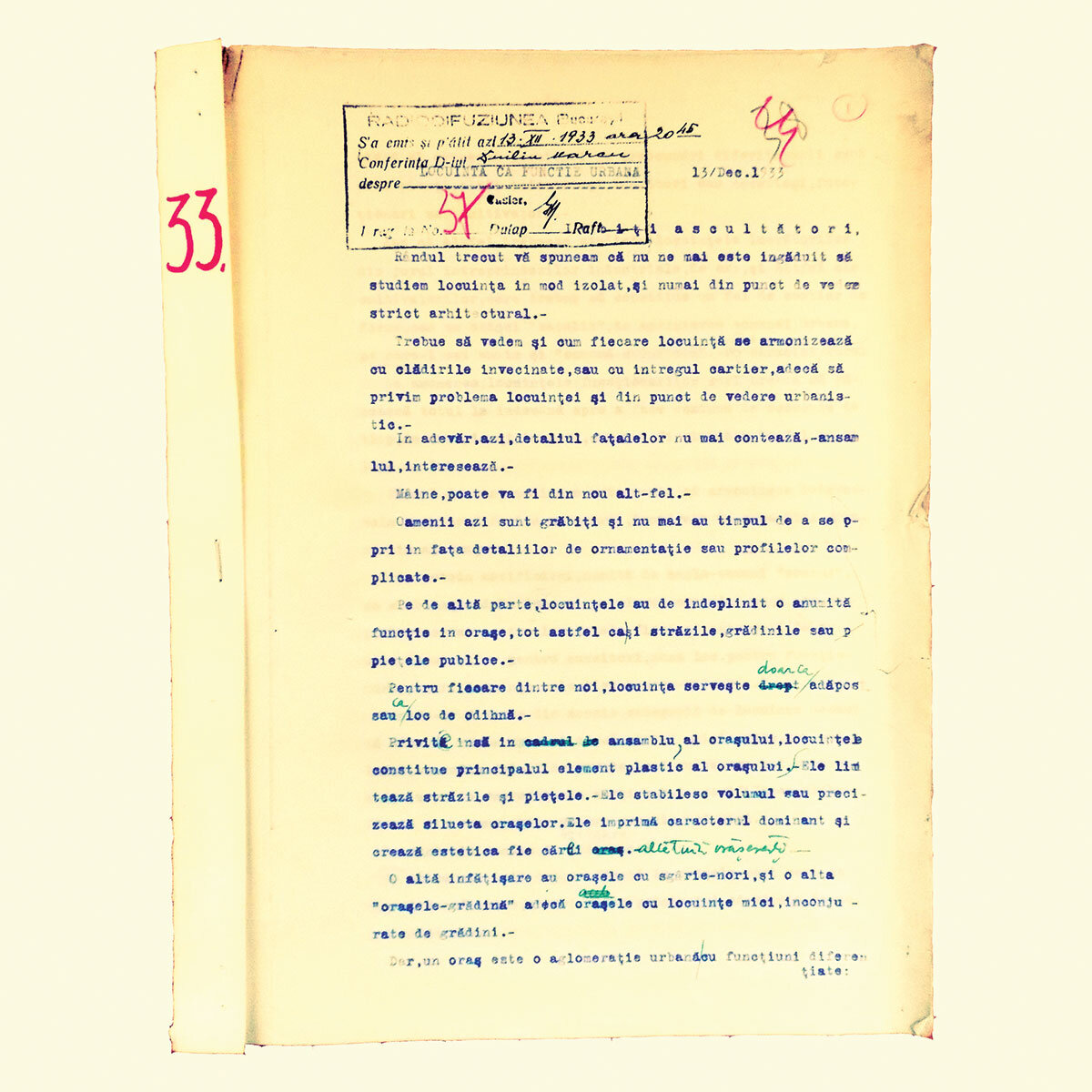
Dear listeners,
Last time1 we told you that we are no longer allowed to study housing in isolation, and only from a strictly architectural point of view. We must also see how each dwelling harmonizes with its neighbors or with the whole neighborhood, and we must look at the problem of housing from an urban planning point of view.
In fact, today, it's no longer the detail of the facades that counts - it's the whole that matters. Tomorrow it may be different again. People today are in a hurry and don't have the time to stop in front of ornamental details or complicated profiles. On the other hand, houses have a certain function to fulfill in cities, just like streets, gardens or public squares.
For each of us, housing is simply a shelter or a resting place. But seen in the city as a whole, housing is the city's main plastic element. - They define streets and squares. - They determine the volume or outline of cities. They shape the dominant character and create the aesthetics of any city.
Cities with skyscrapers look one thing, cities with small dwellings surrounded by gardens another. But a city is an urban agglomeration with differentiated functions:
That is, it groups together inhabitants with different occupations: some are merchants, others industrialists, laborers or craftsmen, clerks or cultivators. So, for example, the dwellings of the workers around industrial enterprises, and those of the cultivators, should be studied in different ways, and they should constitute a sort of farm district, or a "satellite" town, close to the urban commune, which we also call a "suburban commune" - having a semi-rural character.
Likewise, the housing of civil servants who had to find everything at hand in order to maximize savings in time, energy and cost - cannot be studied in the same way as luxury villas.
The systematization plan is designed to harmonize the interests of these different categories, within the urban ensemble of the city. The zoning method, known in Anglo-Saxon parlance as "zoning", is used to establish from the outset on the city plan the area or space reserved for housing in each category. E.g.: workers' housing zone, civil servants' housing zone, collective housing zone, etc.
Since each of these categories of housing requires its own special arrangements, i.e.: narrower or wider streets, - certain types of paving, - more or fewer storeys, certain areas of courtyards, etc., - zoning must be done in advance, even for smaller towns. Are they not nuclei of future large towns?
All the more so in the large cities, which are constantly developing, sometimes even causing real building disasters.
The population of the capital, for example, which in 1824 was 100,000, today stands at 750,000. Between 1810 and 1910, that's 100 years: Paris has gone from 600 000 inhabitants - to 3 000 000, London from 600 000 inhabitants - to 7 000 000, Berlin from 180 000 inhabitants - to 3 350 000, New-York from 60 000 inhabitants to 4 500 000. Population growth in Bucharest is 5% a year, in Paris about 8%, in Berlin 34% and in Rome 37%.
But our cities are constantly expanding, not so much because of the increase in the number of inhabitants as because of the desire to live alone in a secluded house surrounded by gardens or cultural facilities. In our country, the population of cities, which represents barely 20% of the country's population, has actually fallen in the last 5 years, from 3 600 000 to 3 520 000 inhabitants. And yet our cities are still expanding! The explanation is as I said: the desire of every inhabitant, however poor, to be the owner of an isolated villa, as we see especially in England in those "garden cities". This system has also been tried out in other countries: Germany, Holland, Poland, Austria and so on, and it has been found that detached housing is an expensive solution.
Can we Romanians, with such a low standard of living, afford a continuous expansion of cities, in order to let all city dwellers live in villas or isolated houses? And at least if this solution had national advantages!
But as you may have noticed, these dwellings often lack the most basic comforts. - Some don't even have toilets, - or bathrooms. - The walls are made of planks. The roofing is mostly tarpaper. In general we see shantytowns, shabby villas, built on streets without pavement, without sidewalks, without sewage, constituting squalid neighborhoods where, in poor hygienic conditions, the children of the next generation are raised, born and develop.
In 1899, the capital of the country had 70 inhabitants per hectare - today the municipality still has barely 97, with a minimum of 20 in some neighborhoods. Cluj has 60 - Timisoara, Sibiu, Brasov -. Smaller towns are worse off. Târgoviște has barely 37 and in general the average in our cities is 40 inhabitants per hectare, i.e. barely 4 dwellings per hectare of land for a single family.
But urban planning teaches us that we should have a minimum of 160 inhabitants per hectare, i.e. at least 40 houses for one family, and that we can go up to 300 inhabitants per hectare on average. That explains why Paris has a density of 333 places. In foreign countries, even in the modern neighborhoods with 1-2 storey dwellings that have been built in recent years in Zurich, Utrecht, Basel, Stockholm, Rotterdam, Haarlem, Cologne, etc., densities of 230-450 inhabitants per hectare have been accepted. In the case of multi-storey dwellings, they go up to 2000.
Our Bucharest, as the 1930 census data show, has barely 120 places. per ha, which is an average density, which is far too low! Our cities are 3-4 times bigger than necessary! The consequence of their expansion and the spread of housing is that: the cost of building works (i.e. pavements, sidewalks, sewage, electric lighting, etc.) for each owner is far too high, and for the city, which has to bear only half of the expenses, - far exceeds its financial means.
Sibiu estimated that it would have had to spend 280 000 000 lei to pave and canalize the 463 000 square meters of new streets imposed on it by the land parcels created as a result of the agrarian reform!
In most of the housing areas that were created in the old kingdom, or in the other regions, - following the law for the expropriation of demobilized soldiers, no sewerage, lighting or paving works have been carried out and will not be carried out, since this is impossible for the budget of the cities, whose surface area is far too large for their financial resources and even for their administrative capacity!
What can we say of the appearance of these dwellings which, especially in the annexed territories, are intended to have a historical role and to mark the new times!
Social, national and town-planning errors have been and continue to be committed. - And we owe it to all those who are listening to us tonight to say that today's generation bears a heavy responsibility towards future generations for the spread of housing over too large an area and the incessant expansion of the urban sprawl!
And now, my dear listeners, I suspect the question you would like to ask me: what is the solution here?
To this I will answer with another question. And that is: "Is it possible that the rural, now city-dweller, should not consent to any sacrifice in the interests of the community?". Is it possible to keep the same types of isolated housing surrounded by gardens in towns as in villages?
Nowadays, when the old families of landowners or wealthy families have been able to adapt themselves to the new living conditions, living in small apartments in multi-storey buildings, in which one often finds more comfort than in isolated villas, - can we not demand the same sacrifices, or the same proof of a frugal life or of collective discipline from the officials, workers or small renters? This discipline, imposed or consented to, this abdication of the individual for the benefit of the collective, is called urban spirit, and without it our cities cannot be organized. In our country, with such a low standard of living, a major reform of housing, seen as an urban function, is needed. For this, a new mentality must be formed.
Public opinion is duty bound to demand of the municipal administrations that the area of our cities should be as small as possible. This is the only way to have the ideal dwelling, i.e. the one that avoids any waste of time, energy, money and land. In return, the value of land in the central districts of cities would increase, and as a consequence the owners would have to build high up.
It should be known that the establishment of the numerous neighborhoods of demobilized civil servants, to whom the city halls have sold large tracts of land at unreasonably low prices, has depreciated the value of all central land. The municipal administrations must see to it that the following measures are taken in the old neighborhoods - as far as possible - and in the new neighborhoods of all-in-one housing:
1. To shrink to a maximum of 150-200 square meters, the area of the lots for housing, narrowing the frontages to 10 and even 5 meters. Buildings should be placed closer to each other, forming rows, as seen in some towns and communes in Transylvania.
2. To reduce the surface area of the streets, which generally take up 30-50% of the total surface area of our neighborhoods, giving 12-15% in the neighborhoods of wealthy dwellings, and a maximum of 20% in those with luxury villas.
3. To reduce the width of residential streets from 12 meters, as is the case here, to 6 and even 5 meters (for one-way streets), - of course, the houses must be set back from the street.
By these methods the surface area of housing areas can be reduced to 1/2 or even 1/4 if only one storey were added, - and the surface area of streets would be reduced by 75%. Building work, the cost of which we all bear, would cost only a quarter of what it does today!
4. Finally, in each city, centers should be set up with buildings as high as possible, surrounded by open spaces, with 6-7-10 floors, for commercial houses, houses of report, offices and administration buildings, that is to say, - a kind of civic center, around a large square, - where you could find all the services of the state, county and municipality grouped in the same building, without wasting time on distances.
With these means one would obtain the three great advantages so necessary to town compositions, viz:
1. It would decongest the traffic in the city center.
2. It would increase density in the city center.
3. It would increase the areas planted, ensuring better hygiene and aesthetics.
This reform is about to be accomplished in all countries. My limited time does not permit me to give too many examples. The French prefer individual housing (as we do), but reports show that in big cities, housing is only built in 6-7 storey buildings. Even in small provincial towns - because of the high cost - they have given up individual housing and are building only collective housing. In Holland, worker and civil servant colonies are only being built outside the cities. In Austria, especially in Vienna, where the housing problem has been a state preoccupation, and where since 1923-1930 (7 years) 43 000 dwellings have been built, most of them 5-6 storeys high. There is very common there a type of building with 1700 dwellings, in which 6 800 people live in the best conditions of comfort and hygiene and at a very affordable price. Finally, in the Soviet Union, under the five-year plan, the construction of 400 new towns with a fixed density and housing capacity of 50 000 inhabitants each has been started; the housing areas in these towns include: communal institutions, housing areas and special children's neighborhoods. In the immediate vicinity are the park zone, the sports grounds zone and the agricultural zone, which includes: Soviet dairy fields, fruit gardens and vegetable fields. Each zone has different types of housing and a different density per hectare. The principles I have outlined have been applied in these towns. The latest statistical data show that in all the cities of the Soviet Union the number of one-story buildings has fallen from 55% to 38% since 1929, the number of two-story buildings has risen from 40% to 50%, and the number of three-story buildings from 3% to 11%.
From the above, we have proved - I hope - that Romanian housing is a formula for profligate people and not exactly good housekeepers, because it is a luxury solution applied to poor people. That is why I was saying that a great reform must be started, to which we are all called upon to contribute: the systematization of our cities, and as soon as possible. The great cities, the vital cells of nations, the laboratories from which the noblest manifestations of human thought must germinate, are often unusable. They paralyze our work. They waste time, energy and money. Our duty is to transform them, so that housing can fulfill its urban function and its social role, which is so important that the King of England, chairing the London Housing Council a few years ago, was able to say the following words with which we end:
If we would cultivate a healthy race, it can only be done in healthy dwellings. If we are to reduce infant mortality and destroy tuberculosis, the first essential is to improve housing conditions. If we want to combat drink and crime successfully, we must favor decent and sanitary housing. Finally, if we want to turn idleness into contentment and peace, the provision of good housing will be one of the most powerful agents to bring about this change.
Duiliu Marcu presented "Housing as an urban function" on the program Radio University - Aesthetics and Urban Planning on December 13, 1933, 8:45 p.m., SRR Archive, file 17/1933, 9 files.
NOTES:
1 Duiliu Marcu, "Despre aspecte noui ale problema locuințelor", broadcast Universitatea Radio - Estetică și Urbanistică, November 8, 1933, 8.45 p.m., SRR Archive, file 16/1933, 11 files with the author's own citation.
Duiliu Marcu (1885-1966)
Born in Calafat, Duiliu Marcu came from a modest family. In 1905 he decided to attend the School of Architecture in the capital, and in 1906 he went to Paris to study at the School of Fine Arts. He returned in 1912 with the title of architect diplomat of the French government. In addition to his buildings, Duiliu Marcu also worked at the Academy of Architecture in Bucharest, where he was a professor from 1929-1957. Between 1952 and 1966 he was president of the Romanian Union of Architects, and since 1955 he has been a full member of the Romanian Academy.
Among his works in the neo-Romanesque style are: the Dr. A. Dobrovici (1919 and 1922-1925, Bd. Lascăr Catargiu, nr. 40), the Polytechnic School (1923), the Polytechnic Dormitory in Timișoara (1924), the Pavilion at the International Exhibition in Barcelona (1929). He is certainly better known for his modern architecture: the CFR Ministry of Transport (1936-1946, Bd. Dinicu Golescu nr. 38), the Kretzulescu Building (co-author, 1936, Calea Victoriei, nr. 45), the Athénée Palace Hotel (transformation, 1925-1927; new wing 1938-1939, Str. Episcopiei 1-3), the residential buildings (1935-1937, Str. Știrbei Vodă, nr. 17, 18-20), the T. Ficșinescu (1934-1935, Str. Știrbei Vodă, nr. 92), Ministry of Economy (1934-1941, Calea Victoriei, nr. 152), Romanian Academy - reading rooms and offices (1936-1938, Calea Victoriei, nr. 125), Constantin M. Vasilescu House (1915-1916 and 1920-1925, Bd. Lascăr Catargiu, nr. 54), Casa de Credit și Asigurări a Magistraților (1935-1937, Bd. Magheru, nr. 22-24), N. Tabacovici Building (1934-1935, Str. Tudor Arghezi, nr. 16), Popovici-Mezin Building (1937-1938, Str. Italiană, nr. 25), Military Academy Building (1937-1939), Romanian Government Headquarters in Victoriei Square (1937), etc.