
Sebeș 2.0 - about forgotten places
One of the phenomena that I find fascinating is the evolution of forgotten and found objects, of a stray toy from ten years ago, of a rusting car wreck merging with the greenery around it in the owner's garden, of buildings and spaces left to live free once, shall we say, they have outlived the functional role for which they were created.
In this category fall many objects of defensive architectural heritage that we have as a country, which, unfortunately, in most cases are simply forgotten, becoming, in the current socio-political and economic context, the unwanted child that requires a lot of attention and, certainly, a thorough re-education to get back in line with the world. I say re-education because it is a terminology laden with negative connotations, but which, at the end of the day, means nothing other than a reprogramming of what is left to bring to light what once represented something or to bring to the stage and to reanimate argumentatively and sustainably a lost object in search of a new identity.
These are the premises with which we started a package of practices together with students from the Faculty of Architecture and Urbanism of Timisoara in the city of Sebeș. The practices, supported with the help of the Sebeș City Hall and GISAS Association, aim, in the long term, to present viable, theoretical alternatives and to attract citizens to participate actively and in an informed way in the urban and social shaping of the city. Through the results of the studies, we want to encourage the inhabitants to understand, accept and promote natural, current and anchored in the realities of the city development directions to be followed in order to capitalize and exploit the value of the existing built environment.
The main reason for initiating this approach is the physically visible dematerialization of the walls of the fortress of Sebeș and, often, the interventions out of place in the Protected Areas or their immediate vicinity, areas whose marking remains, unfortunately, in archived files or plates on the walls of the town hall.
We are trying to make the population aware of the latent potential waiting quietly "in the back garden" for better times by presenting beneficial alternatives in which, theoretically, we apply current rules and intervene strategically, minimally.
In order to achieve this result we have chosen as a method the exhibition of project-studies and the conference with public debate on the chosen topics. Working within the UPT, we found the factors that would support the accommodation and food expenses for a group of students with whom to objectively study and analyze the areas of implantation and to conceive development strategies in the chosen points, relying on a three-part phasing, according to the chosen analysis criteria: existing-intervention-forecasted result.
Just as creating a precedent or making an example attracts controversial reactions of which a small percentage may follow the situation created, we tried, through what we had, as a virtual-theoretical intervention, to anticipate, depending on the results of the analysis of the existing situation, a concrete result anchored in reality.
This workshop in Sebeș is in its second year and, this time, one of the study themes is the promotion, repersonalization and social reactivation of a space/object whose identity has been lost. The study area is represented by a section of the fortification wall of the city, a heritage element long stripped of its original functional role. Nowadays, it represents strictly a boundary left to depreciate with the passage of time.
The architectural element became accessible with the demolition of the Progress Cinema, whose inner courtyard bordered it. The site of the summer garden was asphalted, making it a necessary parking lot in terms of utility, but questionable in terms of location, which was also one of the main reasons for choosing this site as a study objective.
The first stage was the on-site study to understand the context, the built background, its strengths or weaknesses, basically all the social or built factors that, with a minimal, justified intervention, could provide a better solution to the existing problems or conflicts.
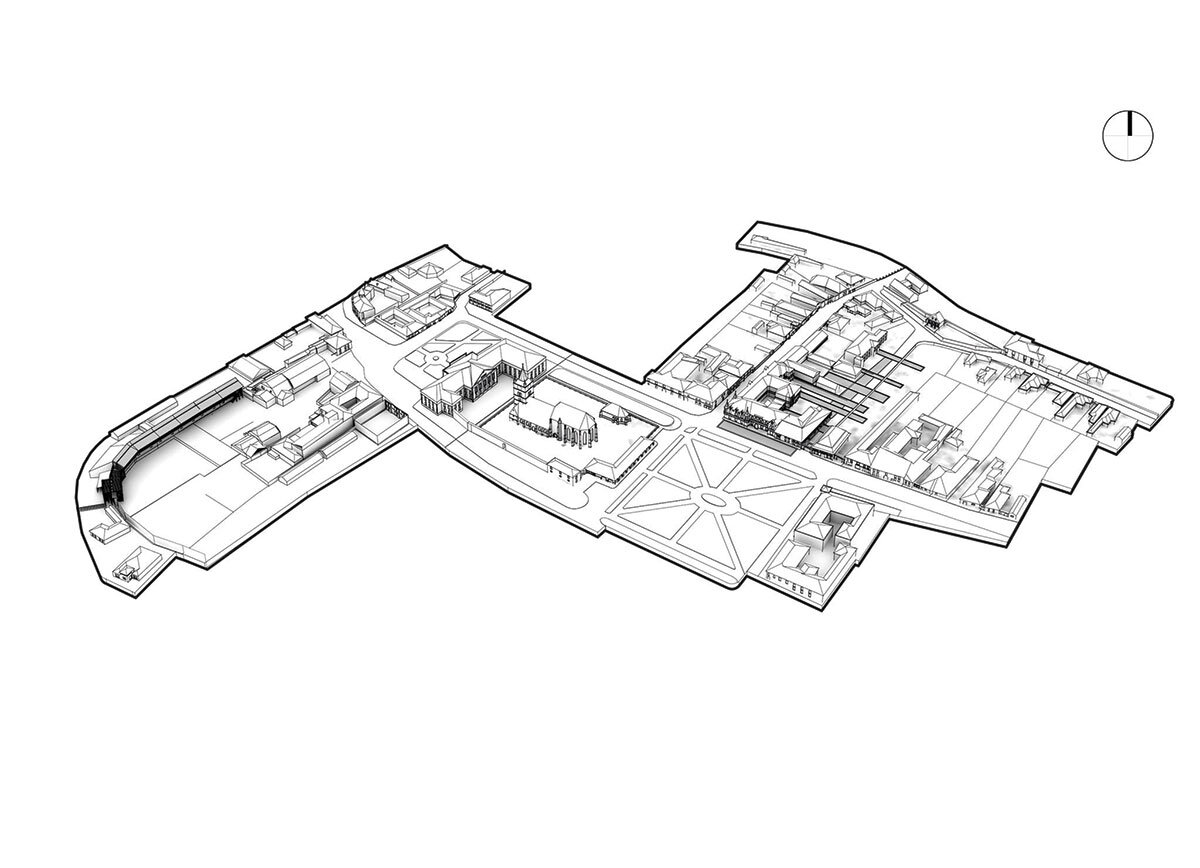
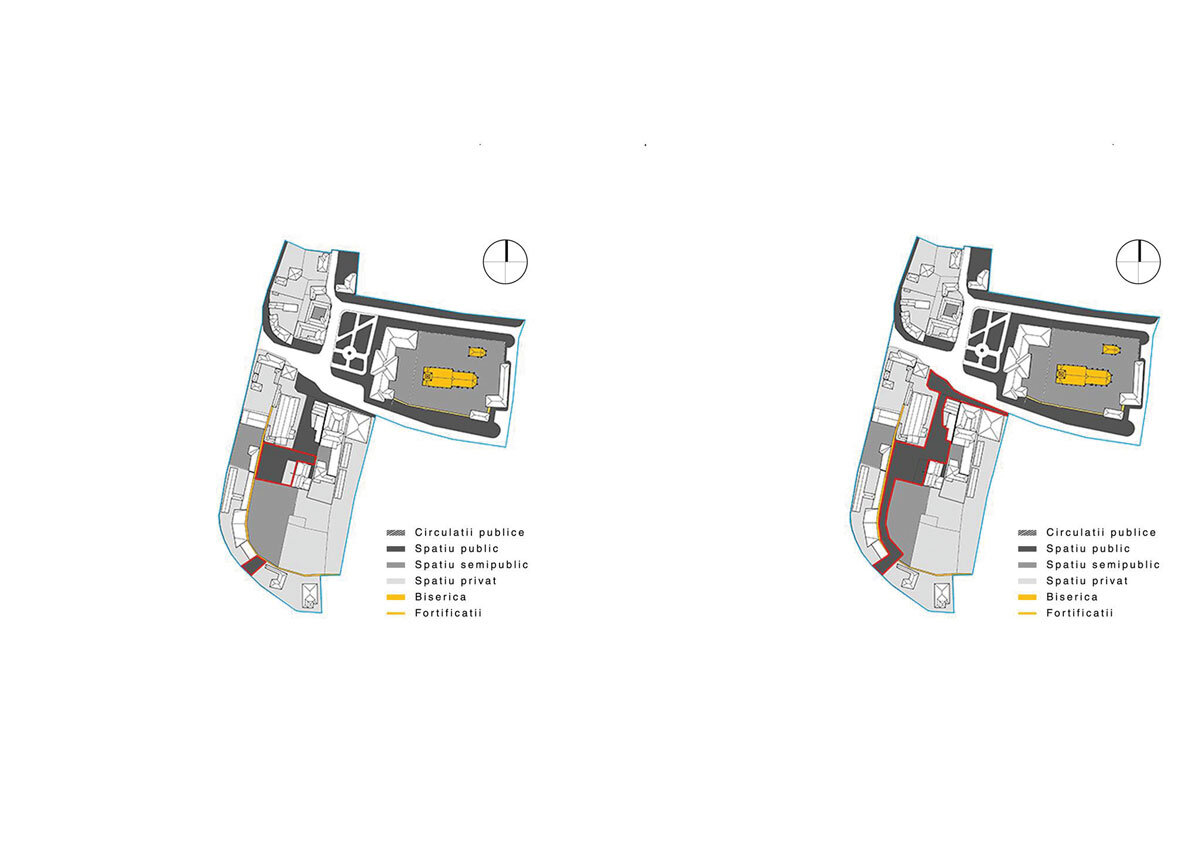
The study of the existing started from the delimitation of an area of influence of the spatial element and, once the contour was chosen, analysis criteria were used, starting from the legal regime of the land, the location of green spaces and the links between them, the height regime of the buildings, noise, textures and chromaticity and, above all, car and pedestrian traffic.
The useful conclusions were given by the pedestrian circulation, which for the whole southern part of the city (the direction of Dorin Pavel Street - mixed traffic), in terms of accessibility of the center, requires a large detour for both access routes (through the western gate of the fortress or Bistrei Street in the southeast). A continuation of the pedestrian route along the Dorin Pavel Street would optimize things, directly and immediately offering greater comfort to pedestrians.
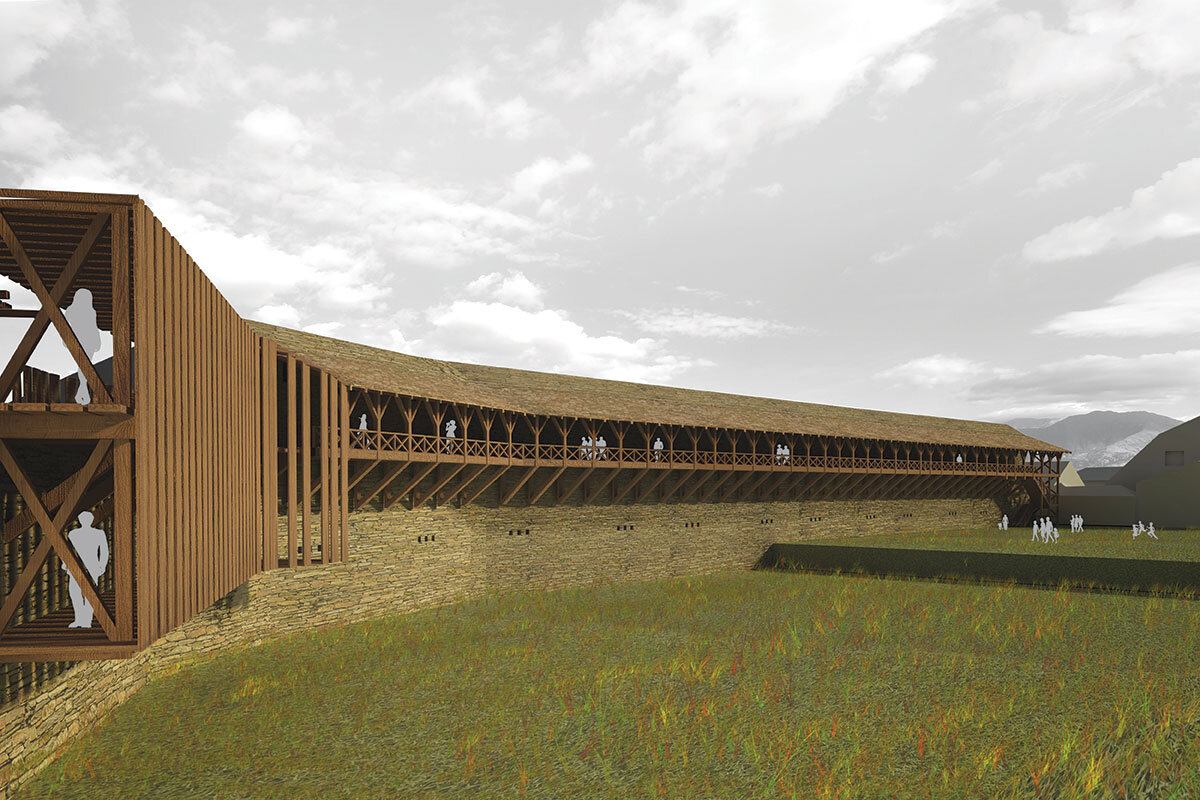
Another important element resulting from the height regime study was a certain permissiveness of the fortification wall. The crenellations are partially demolished up to the level of the punctual metazei, so that the introduction of a crossing element over the wall would not alter its overall profile.
The location of such a crossing resulted from the analysis of the legal situation of the land in the study area. Thus, we have exactly the situation necessary for a potential implementation of a pedestrian link in the direction explained above.
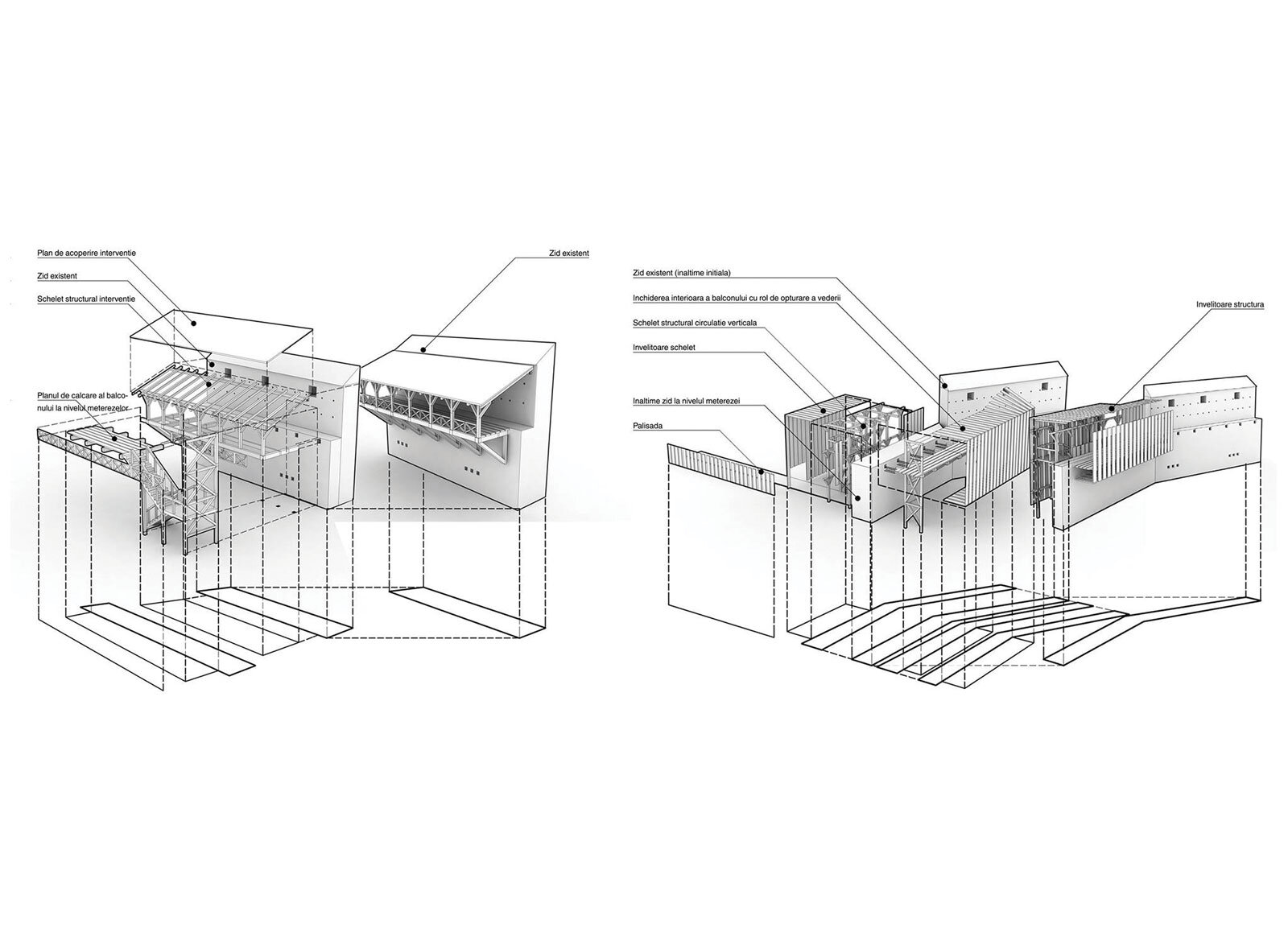
The accessibility of the wall and from the outside of the fortress will be intervened, in parallel with the reconstruction of the route from the ramparts. The route in question will be made through a wooden replica of the defensive structure, with a descent into the public area, currently asphalted. These two directions will bring the pedestrian routes in two juxtaposed points, separated only by the former fortification. Its initial role as a boundary and as a current unstructured space will be overcome by the implementation of a vertical circulation, independent and articulated in relation to the heritage object, not overshadowing it, but on the contrary exploiting the image through the different points of visualization.
Once "in the citadel", the route on the ramparts will have the direct role of creating a relaxed, positive, personality-framed setting that will certainly enhance the social role of the area. The newly-created identity will attract suitable, site-appropriate and socially justified functions to the protected areas behind the walls, as opposed to the existing parking.
Sebeș is considered one of the towns with the biggest investments in the country, with the KronoSpan or Mercedes Combinatul KronoSpan and Mercedes putting the small town on the Romanian map. We can take into account that it is a city that will be located at the intersection of two highways, A1 and A3, towards Cluj. However, it is a city in which, although unemployment is zero, it lacks the energy and dynamism that should come with the above-mentioned factors and, above all, a clear picture of the road to be followed in order to have, in the long term, a sustainable development.
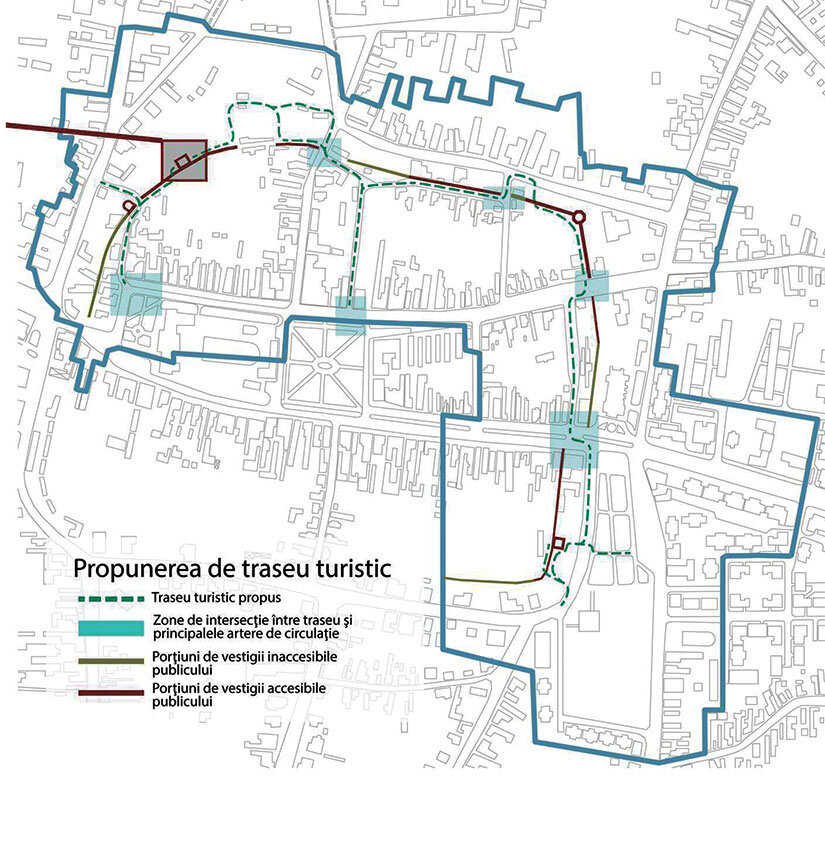
What I have always found interesting is the freezing in time even of the center which has not undergone major interventions, being very well preserved, the interventions being minor and superficial. In this "numb" context, the idea of doing something that would attract people and appeal to that hidden, participatory side initially aroused the community's distrust in the continuity of the initiative: "There have been others, and nothing has been chosen...".
In the second year, already the interest aroused was greater and was followed by a slightly surprised but confident attitude in finding quick development solutions in order not to lose the wave of interest. Together with the Town Planning Commission of the Sebeș City Hall, they are trying to promote the development of the idea of pedestrianization of the city center and the implementation of projects with European funding in this regard, by encouraging a working group to promote a development plan for the city center and the protection zone, following the example of neighboring cities Alba Iulia and Sibiu.
This is happening against the background of the preparation, as studies, of a new package of architectural practices, the participation of students from the Faculty of History in Cluj and the contacting of the Faculty of Arts in Timișoara, Fashion Design section, for their involvement in the realization of other workshops in parallel with those already initiated.