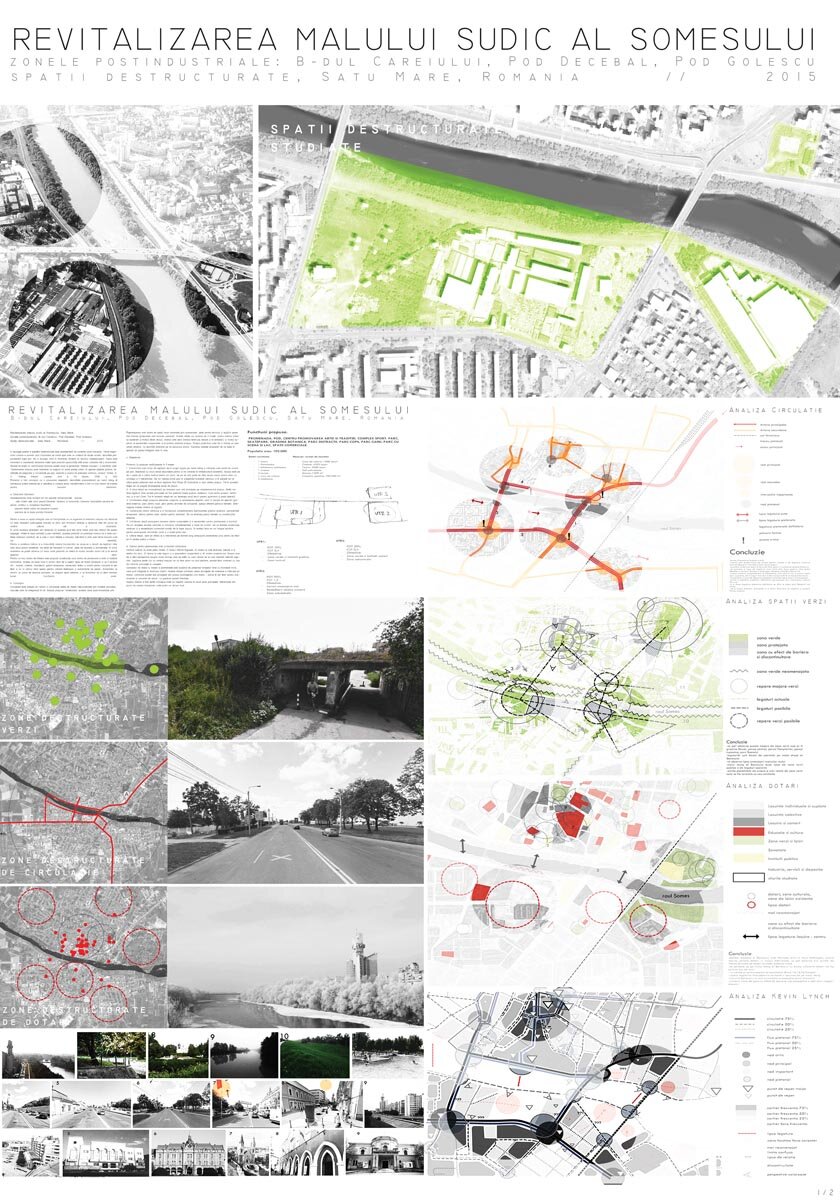
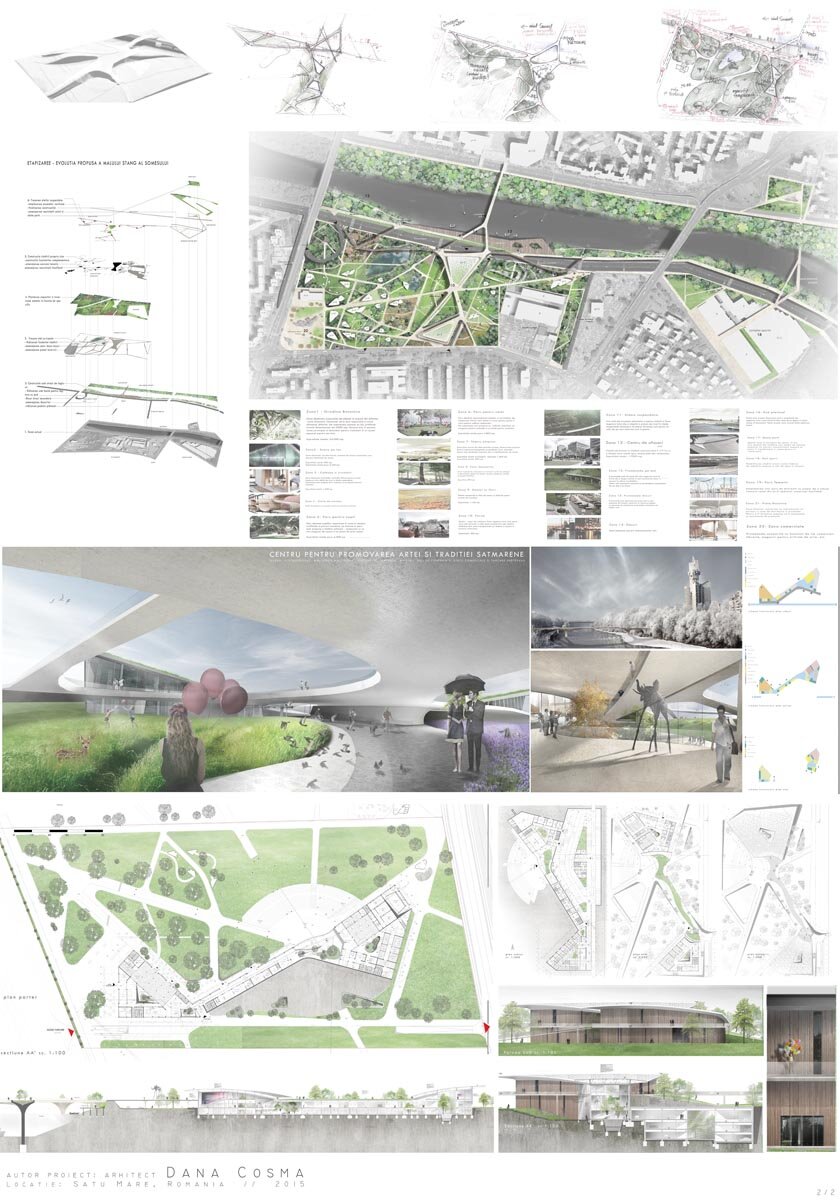
Revitalization of the south bank of the Someș river, Satu Mare - Post-industrial areas: Bd. Careiului, Decebal Bridge, Golescu Bridge
A particular typology of destructured spaces is represented by the post-industrial context. The theme of urban regeneration of post-industrial areas on the waterfront is a recent subject of study, mainly developed after the 1980s in Europe, but in Romania it remains an undiscovered territory. The topic is necessary and important because the waterfront presents both socio-cultural and economic opportunities. The study shows that capitalizing on the waterfront can lead to the creation of the "facade of the city", its identity.
"Those who will manage the post-industrial city will ensure that the urban landscape, in particular its public spaces, exhibition facilities and water-based conventions, provide a scene of continuous human animation."1
The project has been conceived as a phased proposal, developed predominantly on the left bank of the Someș river, with the intention to enhance and heal the area, transforming it into a new center of interest for the inhabitants of the city of Sătmăreni.
a. General Description
The site consists of three dysfunctional parcels, viz:
the site between the two bridges Decebal and Golescu and Bulevardul Careiului (excluding the church plot, the cemetery and the Kaufland complex);
the former Light Industry Factory;
the plot at the foot of the Decebal Bridge.
In order to have an integrated space that functions as an organism within the city, we have observed that it is necessary to extend the city to the shore through diverse and attractive functions, both culturally and economically.
After studying the analysis, we observed that there are three key areas that give the effect of segregated space. Located in the central and pericentral area, they have a high potential to restore the quality of the built environment, to create a new facade of the city, bringing to the fore the theme of a new identity.
In order to improve traffic flow and enhance the environment, a link road between the two existing bridges, new public transport stations, bicycle paths and promenades are proposed. After analysis, it can be seen that the south bank is lacking in both these facilities and green spaces.
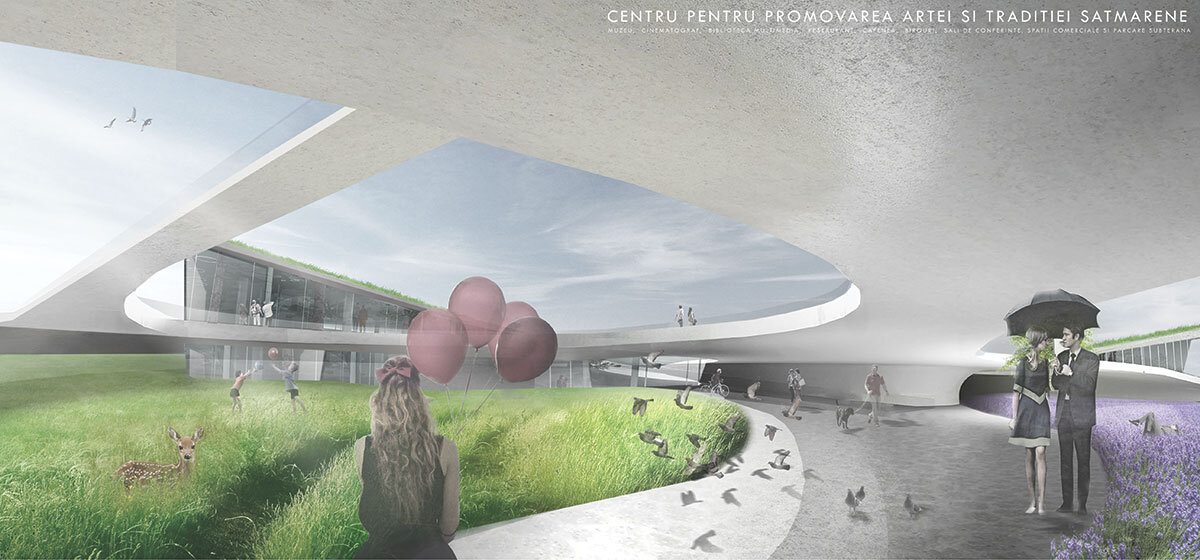
For a new center of interest it is proposed to build a center for the promotion of art and tradition of the region. It will be primarily intended to make up for the lack of necessary facilities and will consist of a museum, cinema, media library, temporary galleries, restaurant, theater and stage for open-air concerts and, last but not least, space for future festivals and seasonal events. The ensemble will become a main point of attraction, provide a pedestrian input and act as a necessary glue for the smooth functioning of the area.
b. Concept
The concept is taken from nature and pursues the idea of interconnected networks through sinuous, natural patterns that integrate into the site. The solution proposes to "heal" these post-industrial areas by developing a network of green spaces connected by promenades, cycle paths and links over the river Someș (proposed pedestrian-only bridge). These networks will operate on 3 levels: the lower level (underground and riverbed); the zero level (natural terrain and streets); the upper level (suspended walkways and the proposed pedestrian bridge). The aim of the project is to realize a dynamic urban park with attractive year-round activities. The success of this proposal will be based, in particular, on the degree of its integration into the city.
Read the full text in issue 6 / 2015 of Arhitectura magazine