Ernӧ Bartha and Maxim Dumitraș, between nature and human nature
Beyond the fact that they are both contemporaries - contemporaries of themselves, of us and, who knows, perhaps of our descendants - that they are artists, that they are creators, that they have a hallucinatory capacity to pursue their obsessions, reveries and convictions that beyond the diurnal horizon lies, barely camouflaged, the true reality, what else can bind Ernӧ Bartha and Maxim Dumitraș so deeply that it would lead an attentive viewer to a simultaneous perception? The answer is as simple and implacable as a guillotine: THE EARTH. Not the Earth as a cosmic object, as a lyrical vision would do well to assume, but the Earth as concrete matter, as substance, as amorphous and mysterious manifestation, from which water gushes, from which fire erupts, which breathes the steaming morning air, from which grass grows, which gives birth to and envelops life, which holds us and, when our time comes, calls us all back, protective and maternal. Both justify their lives and nourish their dreams from the fruits, the generosity and the infinite imagination of the earth, from its enormous energy to generate raw materials, ready-made forms and mental forms that patiently await their exit into the world.
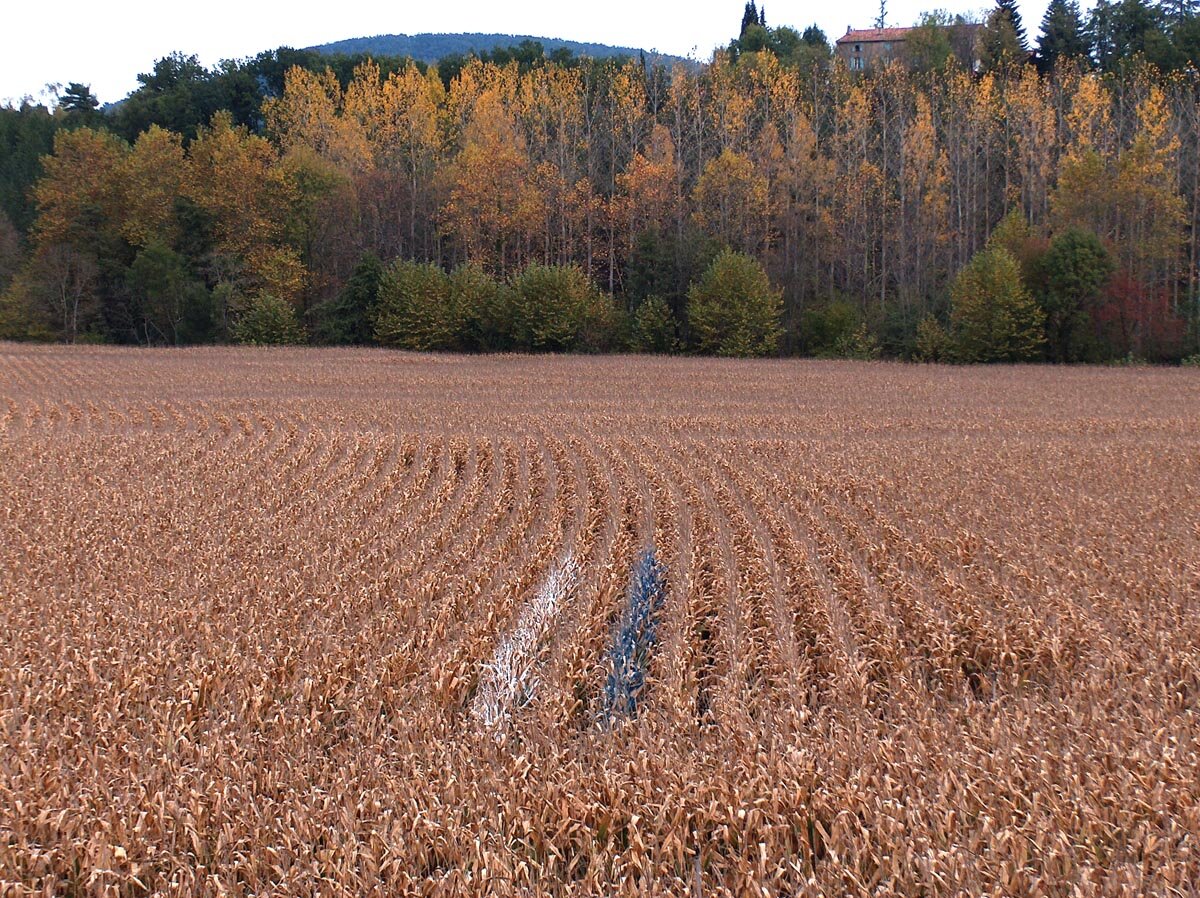
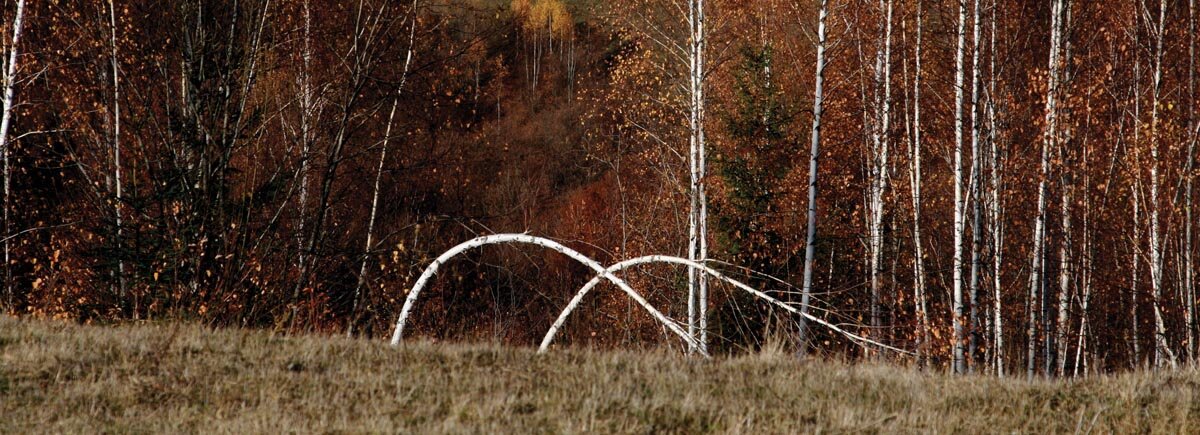
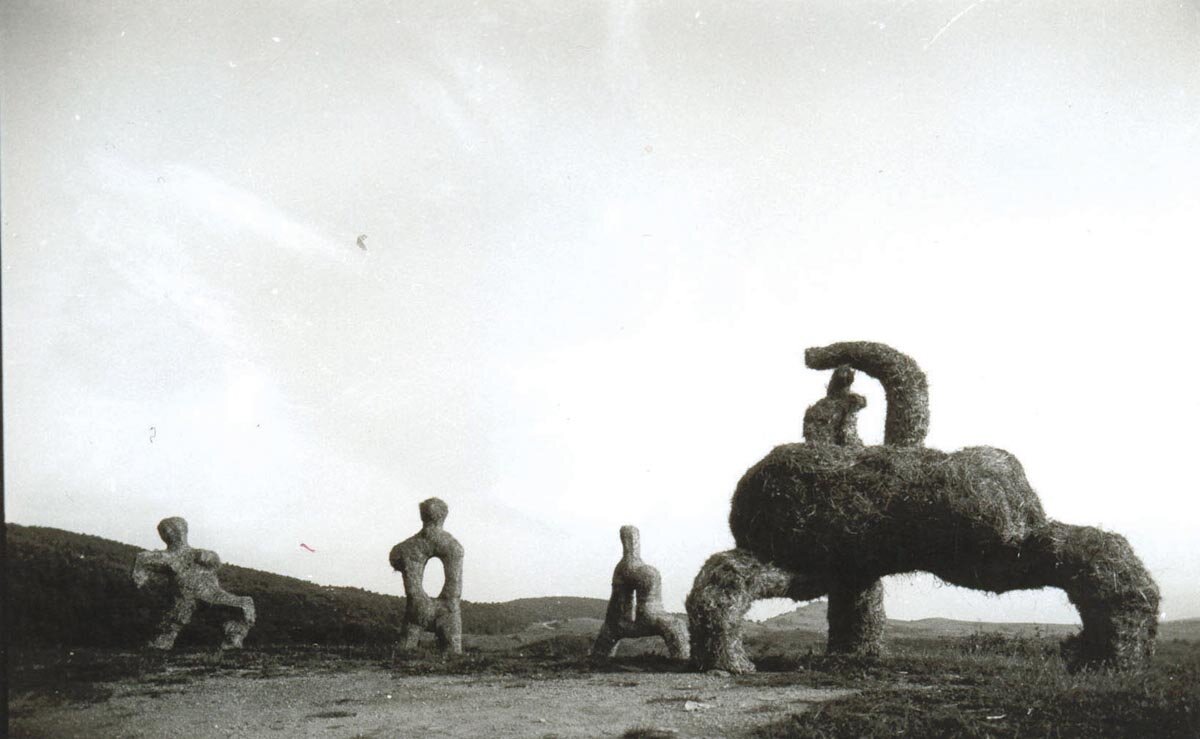
Ernӧ Bartha: even if he makes sculpture, he makes genre-specific, three-dimensional objects out of the most diverse materials and in the most unpredictable techniques, he is not, in fact, as we might be tempted to think, a sculptor, or not one like all the others. At once playful and serious, a playful and meditative spirit, at times a mustachioed histrion, a kind of lost-looking hussar or, if you like it better, an Austro-Hungarian gendarme fallen into contemplation, Bartha is fundamentally a creator of mental images, a repository of inner forms which he then takes out into the landscape, on hills, across glades, over water, because he can no longer withstand the pressure. And once externalized, these inner aggregations try to find their place, mimicking objectuality and skillfully camouflaging themselves in the most diverse substances.
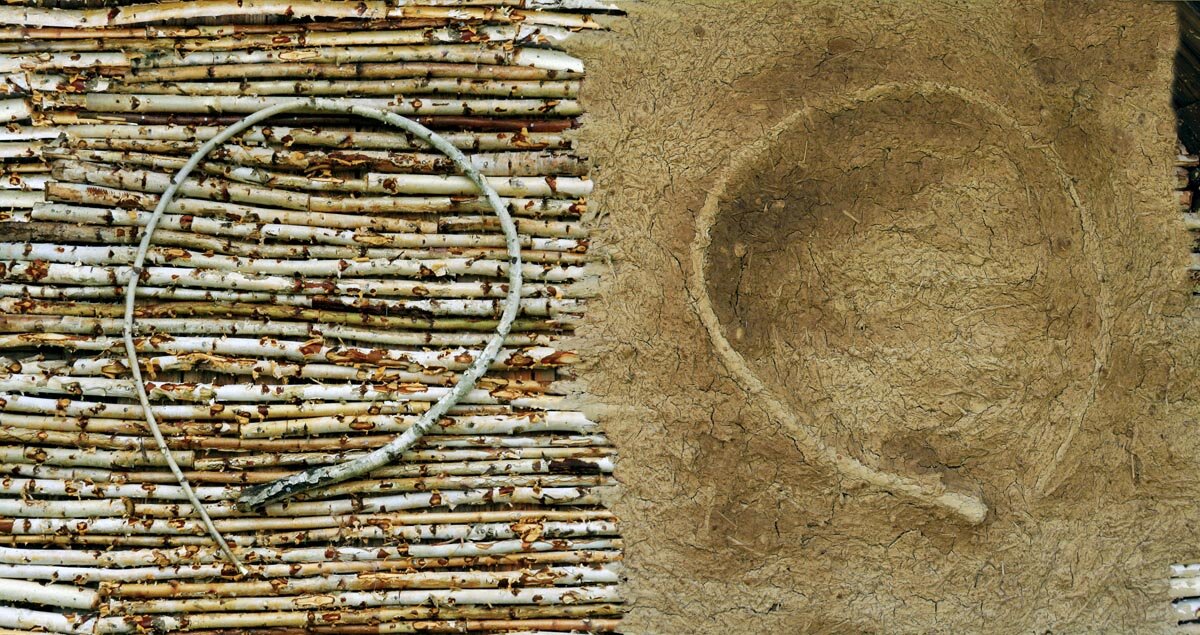
Maxim Dumitraș: Unusually, but not surprisingly, his path to art has the opposite direction to the usual one, in which the artistic option determines the acquisition and deepening of specific techniques, the instruction having, from this point of view, a predictable route. On the contrary, and this is essentially due to its organic links with the traditional world, it starts from the direct exploitation of ancient techniques which the stereotype of rural life has managed not only to preserve but also to keep alive to this day. But since techniques are both ways of perceiving and becoming aware of materials and acts of taking possession of them, and not abstractions, Maxim Dumitraș has also appropriated a long list of materials at the same time as he has learned these techniques. A list that has been enriched and diversified over time, until the idea of creation has come to cover, to the same extent, not only the material as substance, but also as latent form. In deepening this analysis, it is obligatory to point out another aspect, which is essential to the reading of an artistic approach, namely that specific materials and techniques are inseparable from a certain type of understanding of the environment and a certain dynamic of thought. But if an artist's plastic thinking is usually determined by working directly and effectively with the material, in Dumitraș's case it precedes, in a certain sense, the immediate experience, being a constitutive datum of the environment from which he comes. Thus, the mental projection on the technique and the material is an aprioric fact rather than the natural consequence of a consummate exercise, which means that the sculptor's artistic vision is not so much a habitual cultural construction as a mandate he has taken on from successive generations of circumstantial and anonymous craftsmen.
Ernӧ Bartha :
frozen motion,
cosmic dance,
huge gastropods,
disguising their lubricity in a kind of imponderable fossil,
bronze women,
their skin agitated by the smooth, baroque movements
of rodinian quivering fingers,
stone portraits,
of Greek beauty,
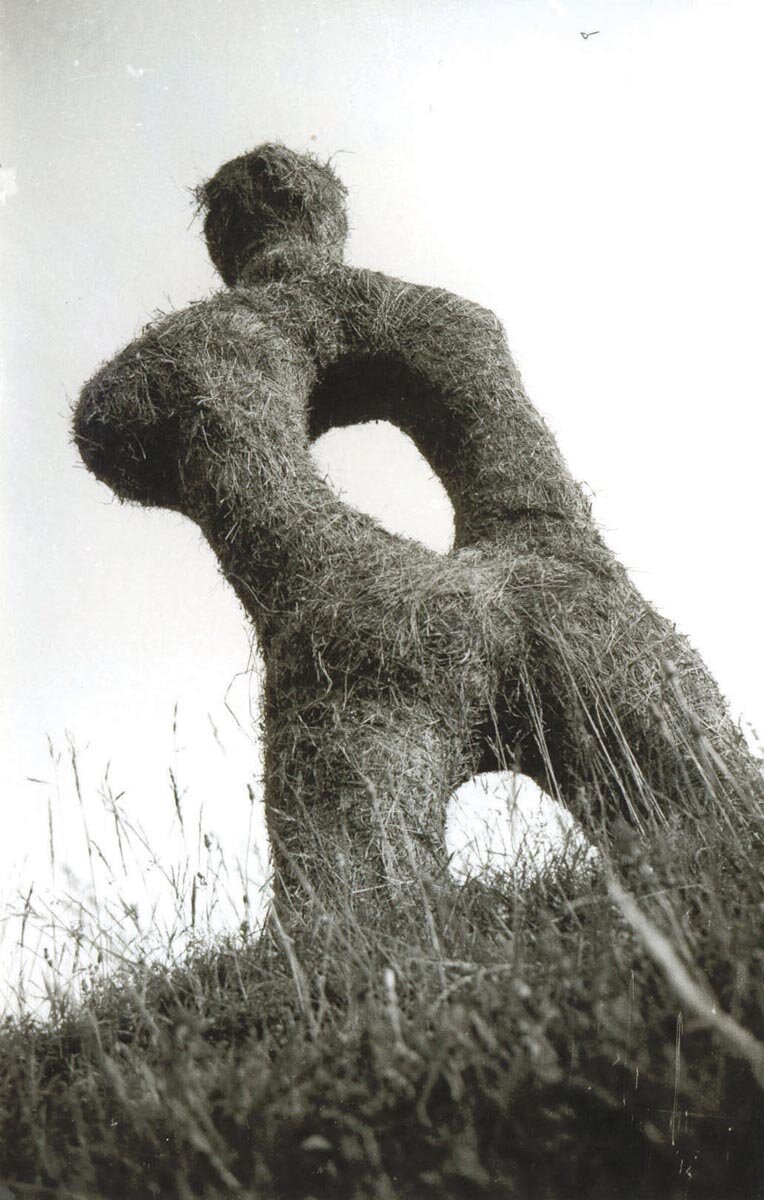
grass women,
with smooth tits and redundant buttocks,
towards which the phallic cannon are pointing,
promising great cannonades
with their open mouths,
the play of matter, of the elements -
the fire of bronze,
the honest nature of stone,
the silky fluidity of grass
and the aerial vibrations of dance
and the general state of flying and floating -
this is how, in the form of an untimely poem,
what Ernӧ Bartha offers us,
out of the modesty of not being too vulnerable under our gaze,
full of prejudices and stereotypes,
as sculpture.
Maxim Dumitraș: what the artist adds, however, to this broad and profound memoir is, on the one hand, the form as such, in itself, stripped of any predictable or assumed function, and, on the other hand, the form's self-consciousness, its assumption as a pure act of thought and sensibility. In other words, Maxim Dumitraș adds significance, meaning and message to archaic materials, techniques and, to a certain extent, forms, as he irretrievably empties them of the utility that made them possible, generated them and perpetuated them in their system of reference. The path on which the sculptor evolves, and which clearly individualizes him from what is currently happening in the art world, concerns the direct connection of active memory with the symbolic space of culture, and not the one in the opposite direction, which activates memory starting from the appropriation of cultural codes. Even if, at first glance, this aspect does not seem very important for defining the type of artist that Maxim Dumitraș is, but also for determining the direction in which his artistic thinking evolves, it is essential.
Ernӧ Bartha: in fact, he re-creates, playfully and with an indisputably erotic voluptuousness of touch, the elemental world, reinvents cosmic feeling, dreams megalithically, hesiodically breathes the emanations of the earth and throws grass into the sky. But the joy of vitality in the open air, the jubilation of the ample gesture, the ritual performance on a stage bordered only by hills, the horizon and the whims of the clouds are not just the interjections, onomatopoeia or the sharp sentences of a lonely man who has regained his freedom, and that's all. They are, implicitly, a warning, a sanction of our inability to live fully and of the hypocrisy of being, of existing, at the comfortable limit of precariousness.
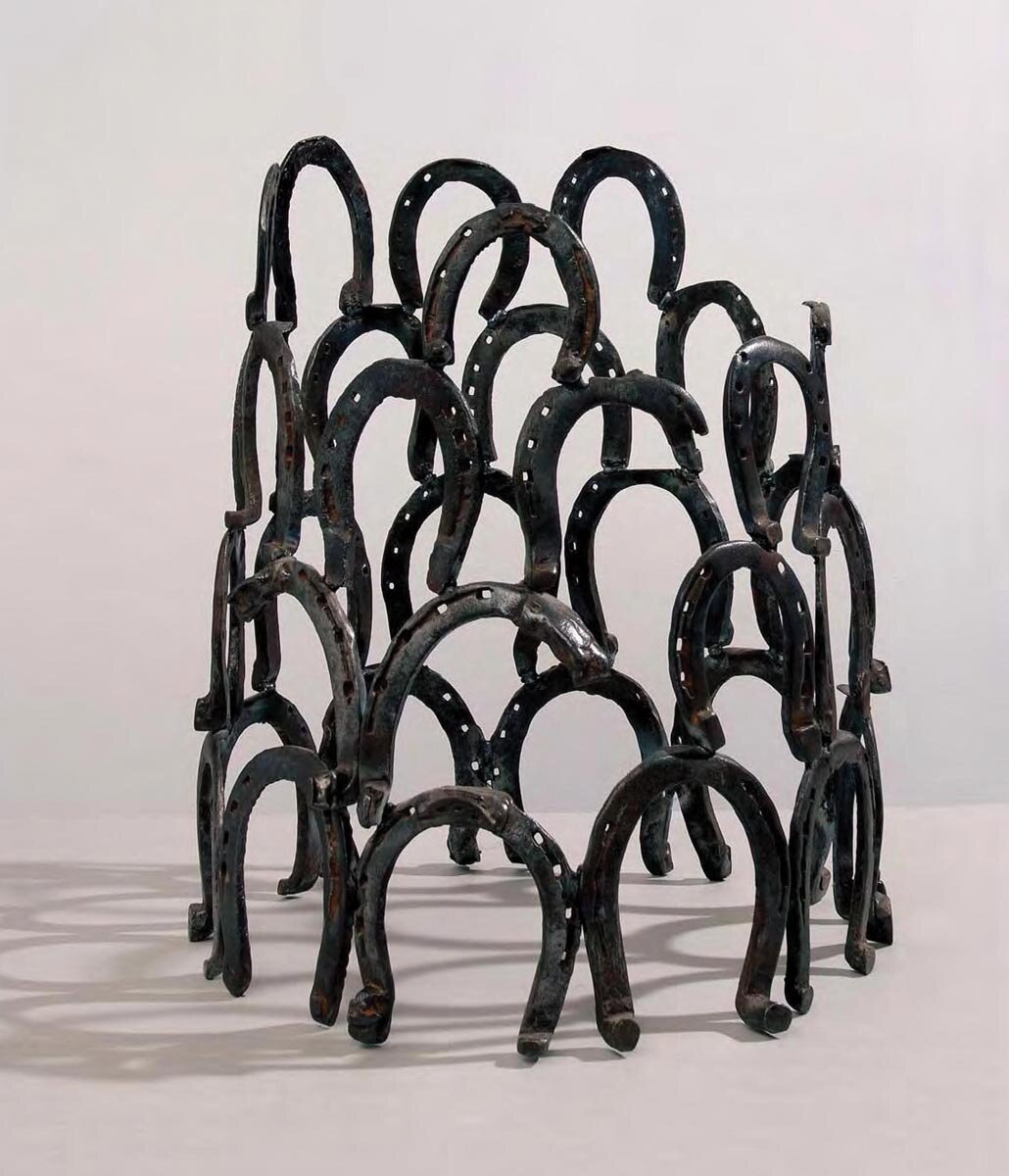
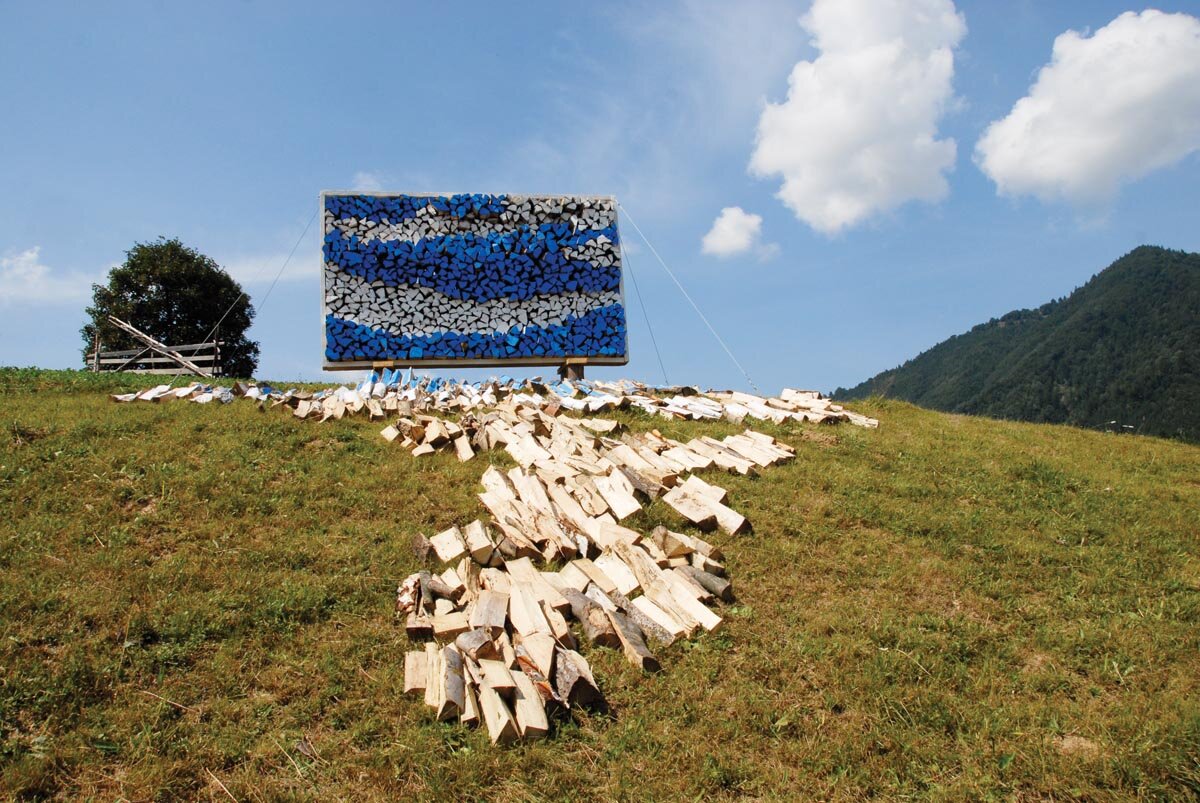
Maxim Dumitraș: the insistence on materials and techniques does not only imply them as realities in themselves, but it attempts to identify and emphasize the symbolic form and its plastic expressiveness, because certain material premises impose specific meanings and generate their own languages and codes. And it is precisely for this reason that in Maxim Dumitraș's sculpture there is a perfect relationship between the formal diversity and continuous refreshing of messages, on the one hand, and the range of materials and techniques he uses, on the other. In this perspective, the materials used from the beginning of his career to the present day are wood and stone, and the techniques are specific, of elimination, in other words, carving, but also assembly which, seen from the point of view of the dynamics of form, is one of addition. Not being a figurative sculptor, which proves once again that he instinctively places himself within a general philosophy and a way of understanding form of a traditional and Eastern Eastern type, modeling, par excellence a technique of addition and deeply linked to the concern for the figurative, is used quite sporadically and never to achieve established forms and predictable effects. Alongside stone and wood, another immemorial material, together with its irreducible technique, is significantly to be found in Maxim Dumitraș's sculpture, namely the braiding of wicker, sometimes bare, sometimes glued with earth.
Ernӧ Bartha: in a generous and full Cosmos, in the vicinity of the vitality of being and one step away from the gates of revelation, we live icily, puffing like a steam locomotive, we breathe stereotypically, without feeling the fresh air, and we pass crouched and disciplined, but alone, behind the bars that we ourselves reinforce every moment. From the rhythmic landscape of the hills, from the earth to the broad, uncertainly colored hay to the reflections of current civilization, Bartha's journey is about this, discursively and morally, and on the other plane, the capacity to dream, to imagine, to construct, to exorcise, to rejoice with melancholy, with a dose of sadness and a vague sense of vanity in the face of excess of civilization, his possibilities are endless. Because, that is, whereas the sculptor, or any artist who is docilely set in a particular genre and material and in whose vision the object exceeds and eliminates the inner form, has a narrow horizon and limited space, the creator, that is to say the one who sows and fertilizes reality with his wild inner forms, ready to be made into any material, perceives everything as something boundless and possible. And then you can wrap yourself, as in a protective aura, more with a mystical vibration than with the feeling of exhibition, in your own hair, grown wild, as only Avesalom and Samson have ever done, and you can sit down, yogin cross-legged, in the image of a dry and wooded Buddha, on the roof of your world at Vlaha, near Cluj, because, fortunately, you have something to see...
Maxim Dumitraș: under the impact of new experiences in the arts, mediated, in particular, by new technologies, and within a postmodern reading of reality and, in particular, of expression in relation to it, the sculptor has significantly expanded his interest in materials and techniques, on the one hand re-semanticizing the traditional area, on the other hand resorting to composite materials, purely technological in nature. The first category includes both raw, organic materials such as earth, vegetation, meat, wool, etc. and second-hand, ready-made materials such as toys made from glazed and fired pottery from traditional fairs. The second category includes metal with its assembly and welding techniques, basically additive techniques, but also composite materials, polymer resins, various dyes and highly elaborate finishing techniques, even to the point of calophilic. This short history of his interest in various materials and techniques is by no means a closed one, relevant only at the inventory level, but it is a history of forms and, by extension, a history of the work, because its dynamics is the very dynamics of Maxim Dumitraș's plastic thinking and of his entire philosophy of creation. The path from nature to culture and from tradition to technology is contained here with maximum rigor and remarkable accuracy.