
A short stop in the history of urban planning in Cluj
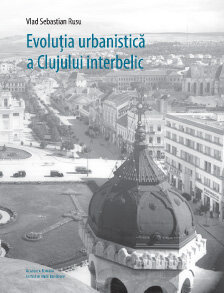
The urban development of interwar Cluj
Author: Vlad Sebastian RUSU
Romanian Academy Publishing House,
Center for Transylvanian Studies, 2015
The Urban Development of Interwar Cluj, author arh. Vlad Sebastian Rusu, is part of a rather limited series of studies that have addressed the problems of this millenary urban structure, although some publications in the field of the history of the city have also included considerations of the urbanization process1. This volume is a welcome contribution to defining a stage in the long series of metamorphoses that the city has undergone. Moreover, the evolution is traced on multiple levels (i.e. the implications of economic, social, cultural, political or administrative factors in the shaping of the functional-spatial structure) and in contexts such as regional, national or European, the result being the outcome of a long and well-documented research.
The structure of the volume, published in 2015, starts from the European context of the period 1918-1939, with its reflection in the new coordinates of the country, which became Great Romania, and continues with the presentation of the socio-economic and cultural aspects that defined the city in 1918 and their subsequent implications, the regulations considered necessary for a beneficial evolution, as well as the results (layout, functional areas, public spaces, morphology, etc.) that will characterize the city on the eve of the Second World War.
The author estimates that in the 21 years of the period considered in the study, during which the city expanded in area by about 80% and the population grew from 83,542 inhabitants in 1920 to 115,000 in 1938, the development of the urban structure was characterized "[...] by a certain sense of measure and order and by the absence of major discontinuities in the extension of the urban fabric, due to a natural articulation of the new areas of the city". But the scale of the real estate effort2 has not eliminated "[...] the hybrid character, determined by the rupture of scale due to the fragmented evolution of the built environment". In this process of becoming, the role of the administration was essential in ensuring a controlled development of the city, the author emphasizing that, although there was no "master plan" (the competition launched by the city hall in 1938 for the elaboration of such a plan was not completed), the construction of the built-up area, as well as the technical and infrastructural equipment, did not leave the control of the city hall, the actions being carried out through a series of regulations, such as those of 1923 or the regulations of the 1930s. The author details, for example, chapter by chapter, the "Building and Alignment Regulations", published in 1933, which regulate in detail the work in the field of construction, without forgetting the urban planning implications. The concern for controlled and 'planned' development is also reflected in the fact that in order to draw up this 'master plan', topographical surveys were carried out, which began in the 1920s and were completed in 1937. However, the resulting printed plan was not really put to good use until 1941-43, when an attempt was made to propose an urban concept. By way of a parenthesis, it is perhaps worth noting, by way of a point in time, that although France had long experience in city management, in the third decade of the 20th century not all cities had drawn up their so-called "plan for development, beautification and extension"3.
In several places, the study deals with the characterization of the phase, without giving any arguments that a certain "urban concept" was pursued during the 21 years, but I think that one can subscribe to the statement that there was "[...] a certain urban culture", born as early as the 19th century through the regulations adopted by the community.
Referring to the research approaches to define an identity of the inter-war city, after some references to the relationship between the built and the natural environment, to the concerns for the personalization of public spaces, such as the Mihai Viteazul and Avram Iancu squares, including the studies carried out between 1939-'43 , the argument mainly turns to architectural objects (a whole chapter) as the reference elements/symbols of the period. However, how did the structuring of urban form and composition stand out from the past through the rapid growth of the occupied space? Perhaps, to this end, the definition of certain stages, from an urban planning point of view, in the evolution of the urban structure from the medieval period to the present day would have allowed a clearer definition of the identity of the stage under study and, why not, a closer approach to what concerns us today, namely the 'vocation of the city'.
Returning to the author's concerns, namely that "the present study aimed to research and analyze for the first time the urban development of inter-war Cluj, highlighting historical, administrative, legislative and regulatory moments that have contributed significantly to its urban transformation over the 21 years [...]", I believe that the objective has been achieved, showing evidence of a rigorous and well-documented scientific approach that, together with other publications4, will become a significant contribution to the creation of a history of urban planning in Cluj and, including the Romanian one.
NOTES
1 Here are some works, in order of publication:
Buzea, O. (1939), Cluj 1919-1939; Hațieganu, A. (1949), Evoluția teritorială a orașului Cluj; Pascu, Ș., Pataki, I. and Popa, V. (1957), Cluj; Morariu, T. and Pascu, Ș. (1957), The urbanistic evolution of Cluj; Daicoviciu, C. (1962), Cluj; Benko, M. (1967), Urbanistic problems of Cluj in the first half of the 19th century ; Pascu, Ș. (1974), History of Cluj; Mirel, M. (1975), Contributions on the urbanistic development of Cluj in the first half of the 19th century; Negucioiu, A., Pompiliu, T. and Erdoiu, N. (1980), Cluj; Agachi, M. I. M. 2009), Clujul modern, urbanistic aspects.
2 The number of buildings increased from 5,600 in 1923 to 12,983 in 1939.
3 Jean-Louis Harouel, Histoire urbanisme, București: Editura Meridiane, 2001.
4 Mihaela Ioana Mirela Agachi, Clujul modern, aspecte urbanistice, Cluj: UT Press, 2009.