
Bucharest. Architecture - An annotated guide
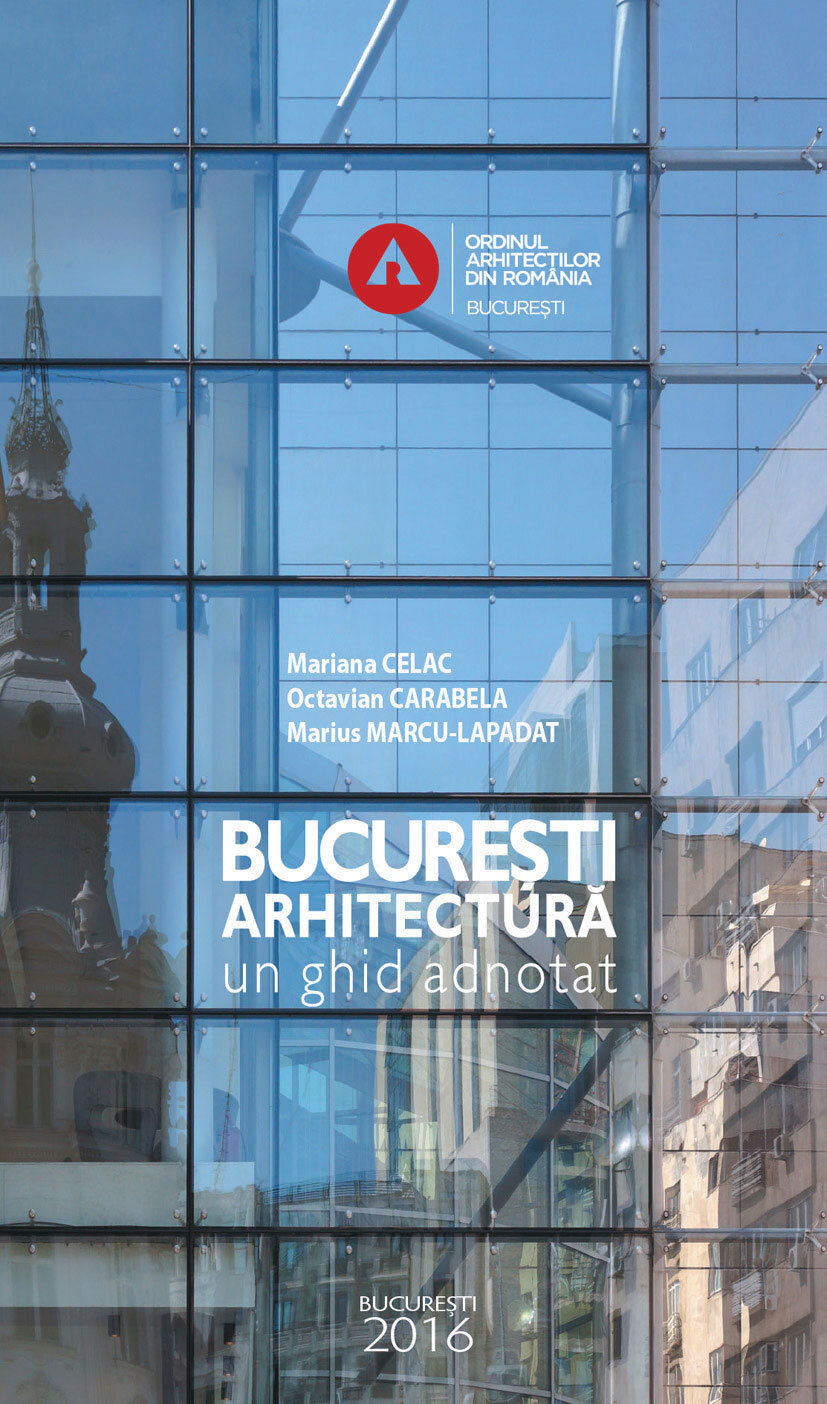
Mariana Celac, Octavian Carabela, Marius Marcu-Lapadat
Bucharest, OAR, 2016, 241 pages
More than ten years ago, the same team of authors published a volume similar in title, structure, content and urban research project(București. Architecture and modernity, an annotated guide, Simetria-Arcub, 2005) The "Annotated Guide" - a synthetic architectural topography of Bucharest, rigorously structured and, by the way it is presented, intended for a diverse reading public - proved to be a publishing success, and remains to this day an inspiring and inspiring resource for the architectural exploration of the city. It has therefore enjoyed two more successive print runs - nowadays nowhere to be found in bookshops.
This state of affairs alone would have justified the republication that we are reporting. We do so all the more so because the new book develops and surpasses in a number of respects the previous one.
The new version brings a greater volume of data: the architectural compendium of Bucharest, made up of annotated descriptions of buildings and urban spaces, is substantially enriched. Quite a few pieces missing from the first edition have been included and, above all, many new appearances in the urban landscape of Bucharest have been cataloged. Buildings erected in the last decade, creations by contemporary architects, as well as older places and buildings that were not initially included in the itinerary; thus, the approach of the first edition, which was eminently historical, is now largely urban anthropological: the city is no longer investigated as the result of a becoming, but in the very process of its unceasing becoming.
The phenomenological contextualization is also reflected in a significant structural change. While the 2005 guidebook ordered the places presented according to a chronological paradigm, the present one groups them topographically; the city is also interpreted through the filter of the authors' subjective geographies - assumed by them as some of an endless multitude of possible experiences of urban dwelling.
The indispensable historical perspective is concentrated in the few opening pages of the new edition. Intentionally succinct, the introduction states a well-known but seldom stated fact: "Most of what is still standing [...] cannot claim to be more than 150 years old". Seen in this perspective, the Guide is an inventory of almost all the architecture in Bucharest worthy of interest which, with the exception of relatively few archaeological remains and monuments of ecclesiastical architecture, has appeared in a time span of only six generations.
A first, synthetic part summarizes the chronology of the urban development of the Romanian capital in seven sequences delimited by major events. Each period has decisively marked the evolution of urban spaces and the coherence of its various components - or, on the contrary, has resulted in the unraveling of the historical fabric through large-scale interventions. The assumption of the status of capital of the Kingdom of Romania implied the emergence of industry, the implementation of the hygienic ideas of the time and the erection of the first public institutions. The first two decades of the 20th century were characterized by the articulation of neo-Romanesque architecture - as specific as it was similar to other similar trends in the rest of Europe - a model that flourished in the inter-war period, along with the emergence of the original architectural modernism of Bucharest. The 1947-1960 period bears the stamp of socialist realism, which was then replaced by the new modernism of 'victorious socialism' in the run-up to the 1977 earthquake. The devastation caused by the earthquake was the inspiration and pretext for the new political-administrative center, which was not built on the site of the buildings demolished by the earthquake, but on an arbitrarily chosen site, cut out of the city's historic fabric and demolished without discernment. Regime change, in turn, opened up a new direction in the city's development. The process is described lapidarly and precisely, leaving it to a later revisitation to draw conclusions that would still be premature today.
The historical introduction is followed, as a signal, by a list of buildings that have disappeared. Only the most representative ones are mentioned, the number of historic monuments and urban heritage sites destroyed by the goodwill exercised in the ninth decade of the last century or by the unscrupulousness of post-communist real estate projects being much greater.
Finally, a "How to use" precedes the guide itself: the authors explain how the 400 or so examples presented were chosen, the terminology used, and why four distinct categories appear: buildings, places, (unrealized) projects and happenings.
The area under investigation is divided into squares (labeled A to M) according to an established pattern. These are then traversed along subjective itineraries marked out by a succession of example cards. Their presentation is succinct, with historical and critical comments formulated clearly, almost dryly, in appropriate language, but unburdened by specialized jargon. Each example is illustrated with a single characteristic photograph.
The volume is supplemented by two alphabetical indexes: of places inventoried and of authors. There is, of course, a list of "readings about Bucharest", the names of the authors of the illustrations and source references for the illustrations taken from publications.
The new annotated guide to Bucharest architecture, beyond the mission it assumes and fulfills in an exemplary way, also indicates a different way of writing architecture. The balanced blend of history and criticism, the elegant avoidance of any bias, the precision of the information delivered in a minimal and coherent way make this book a second-rate guide: a primer for any author of architectural guides.