STUDIO DMTW: NeoTax - Utopia
Anul/Year: 2011Status: eVolo Skyscraper Competition 2011 / Honorable MentionTypology: utopia, skyscraper, mixed useTeam/Team & credits: Marc Anton Dahmen
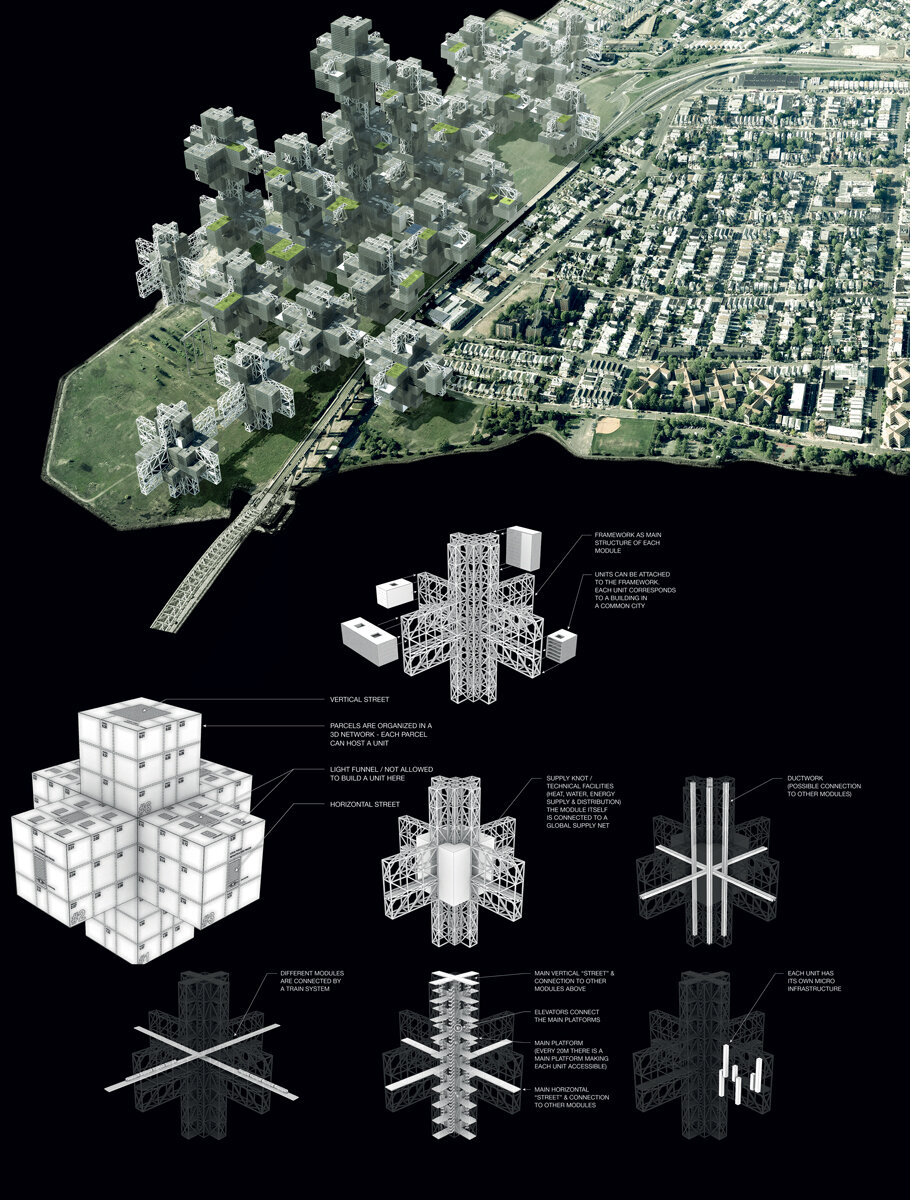
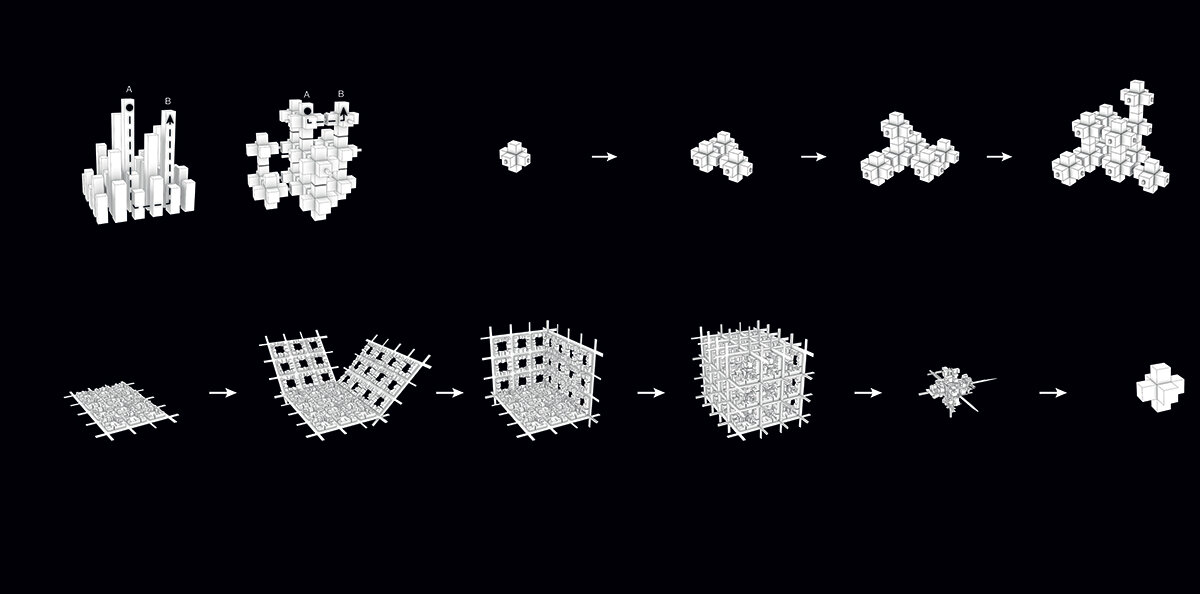
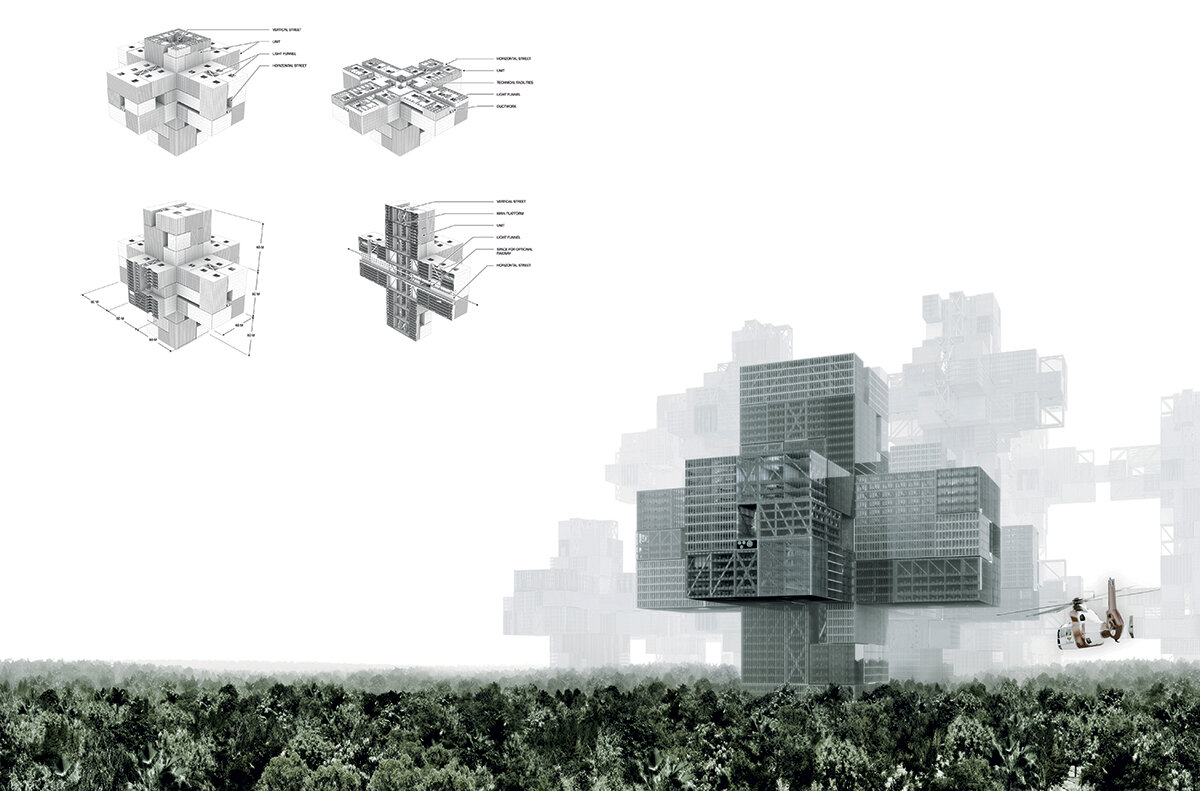
| NeoTax is a word coined from the Greek root "neo" (new) and "tax" (order).There have been many ideas in the past that addressed the problem of disconnecting skyscrapers. In fact, vertical vertices in a flat world create more terminus ends and long connecting paths while, in parallel, we lose surface area and interfere with the area of bio-ecological processes. In a world where the population is constantly growing, we are therefore faced with the problem of finding a way to densify the current urban environment further without degrading the surrounding environment. So, this project does not aim to create a single complex of buildings to solve these problems, but rather proposes the functionality of a three-dimensional infrastructure network organized in a horizontal and vertical street grid. A 3D grid infrastructure provides short connecting routes and higher urban density with better local communication and less social isolation through an active 3D street and an increased number of neighboring interfaces. It favors geodesic proximity like a cube maximizes the volume between all hyper-rectangles with a given area. Imagine that, in order to build your house, you can buy a plot of land in a city that has xyz coordinates instead of a regular address. Therefore, the grid design still allows individual variability for each plot owner. The network is based on a modular system in which each module can be viewed as a "quarter". It can grow by adding framework modules in the first stage, which can be colonized by related units (houses) in the second stage. Of course, increasing density would create a number of new problems, such as traffic and daylighting. In order to manage traffic and communication, it is important to reduce the infrastructure to a 3-stage organization. 1. global 3D macro-communication between different modules in the city; 2. infrastructure meso-scaling in each module that makes the units accessible; 3. infrastructure micro-scara in each unit. This type of structure also implies less dependence on specific terrain conditions and justifies more flexibility in the choice of location (forest, sea, desert, extension of a city, etc.). Condensing city land so as to allow habitation could therefore make a significant contribution to preventing wastage from our planet's limited surface area. As a result, it helps to minimize interference with the surface area in which bio-ecological systems take place. |
| NeoTax is a made-up word from the Greek roots "neo" (new) and "tax" (order).There have been many ideas in the past addressing the problem of disconnected skyscrapers. In fact, vertical peaks in a planar world create many dead ends and long connection paths while at the same time was-ting area and interfering with surface related bio-ecological processes. In a world of permanently growing population we therefore have to deal with the issue of finding a way to establish a higher urban density than presently encountered without degrading life environment. So this design does not aim at creating a single building complex to solve these problems but rather proposes the functionality of a network of a three-dimensional infrastructure organized in a horizontal and vertical street grid. A 3D-grid infrastructure offers short connection paths and higher urban density with better local communication and less social isolation through 3D-street live and a higher number of neighbor interfaces. It favors geodesiccloseness as a cube maximizes the volume among all hyper-rectangles with a given surface measure. Imagine that you can buy a plot in a city which has an xyz coordinate instead of a normal address to build your house on. Hence, designing the grid still leaves individual variability for each parcel owner. The network is based on a modular system where each module can be viewed as a "quarter". It can grow by adding framework modules in the first step which can be colonized by attaching units (houses) in the second step. Of course, increasing density would create a couple of new problems like traffic and natural illumination. To handle traffic and communication it is important to break down the infrastructure to a 3-scale organization. 1. The global 3d macro-communication between dif-ferent modules across the city; 2. The meso-scale infrastructure in each module which makes the units accessible; 3. The micro-scale infrastructure within each unit. This kind of structure entails also a decreased dependence on specific terrain conditions and warrants increased flexibility in choosing the location (forest, sea, desert, city extension etc.). Condensing the city plot in a livable manner could therefore be a significant contribution towards preventing the waste of our limited planet surface. As a consequence it helps minimizing interference with surface related bio-ecological systems. |