J.R.R. Tolkien versus Italo Calvino
|
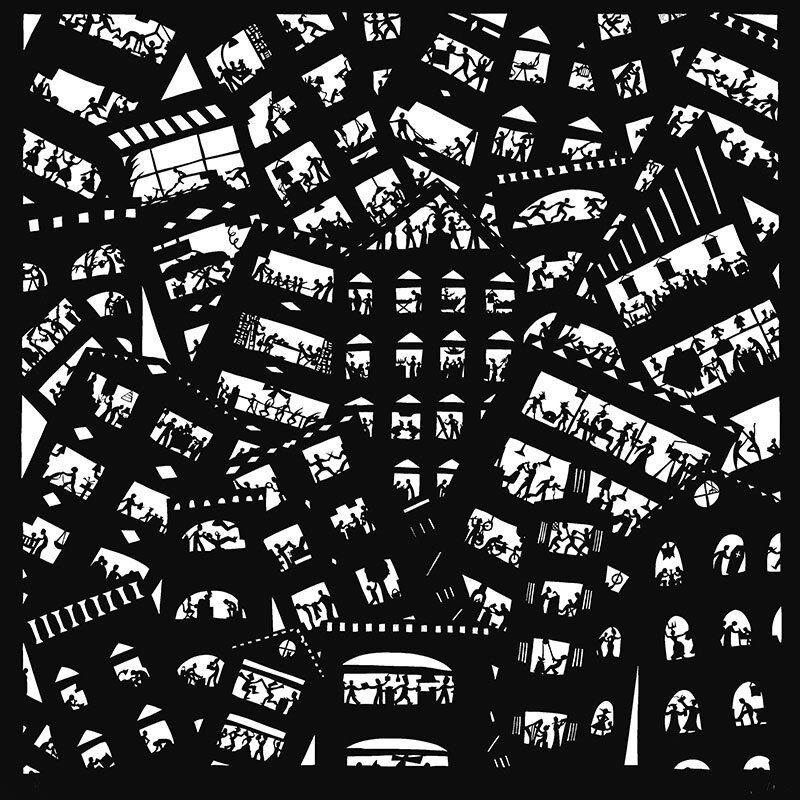
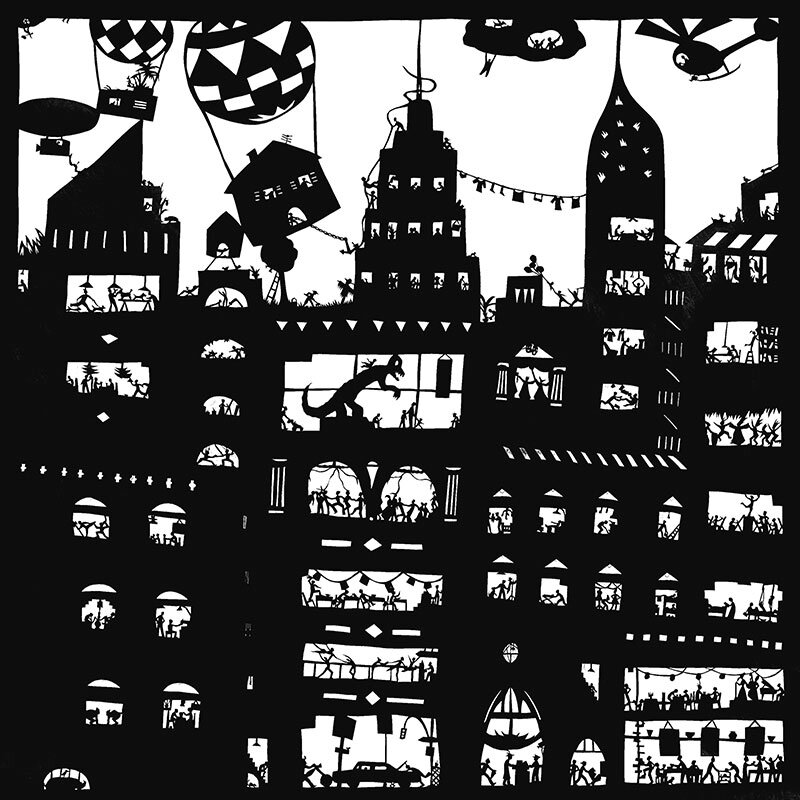
The author would like to thank the artist Beatrice Coron for her help in illustrating the article. WORKS: BEATRICE CORON PHOTOGRAPHS: ETIENNE FROSSARD
|
| IMAGINARYARCHITECTURAL HYPOSTASES |
| "The human mind is capable of creating images of things that do not exist in reality or are not present. We call "fantasy" the capacity to generate images and notions. But nowadays, the term "fantasy" has begun to be used (and not in common parlance, but even in professional jargon) in connection with something much higher than actual creation (applied to what used to be considered a product of the imagination) and has become a more concise formulation of what we used to call "creative power". It is an attempt which, I must confess, is intended to limit and at the same time distort the notion of 'creative imagination', giving it the meaning of 'the capacity to lend to imaginary creations a number of hidden real characteristics' (note: i.e., precisely what directs or induces the Second Belief)" - J.R. R. R. Tolkien... on Fairy Stories, "On Fairy Stories." Presented to Charles Williams, Clive Staples Lewis (ed.). Oxford University Press, London, 1947. |
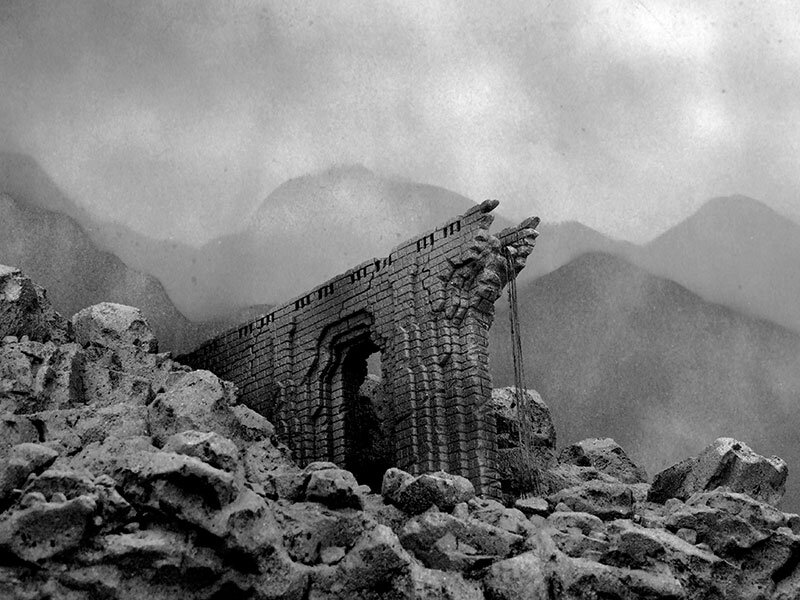
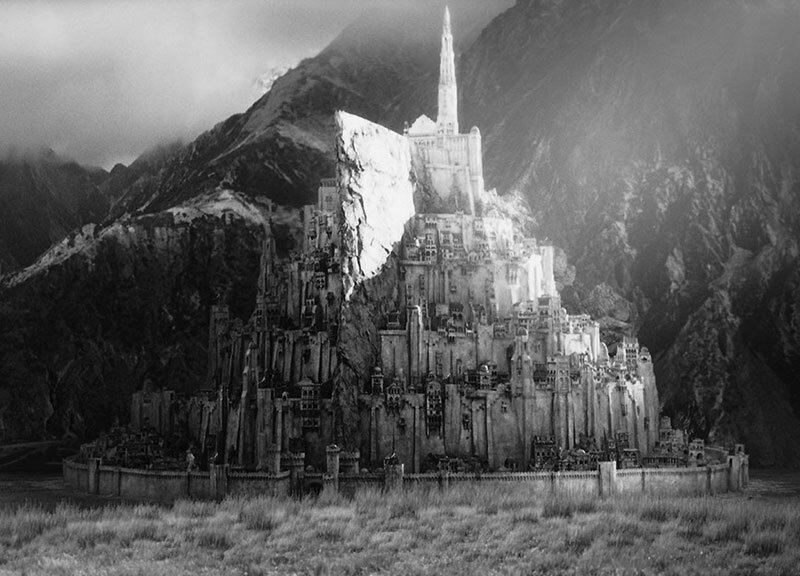
| THE ICONIC CONSTRUCTION BETWEEN THE HISTORICAL AND THE FANTASTIC DIMENSION "WHAT THE PAST AND THE FUTURE HAVE IN COMMON IS OUR IMAGINATION, WHICH CONJURES THEM..."1 (JUHANNI PALLASMAA) The imagined (imaginary) worlds construct architecture as an image of time between the reality of modern man's single identity and the multiple identities of postmodern man. The constructed framework of the stories is the scenography that contextualizes, induces the fantastic dimension, the visual stage that articulates the 'encounter between the world and the human mind'. It addresses the viewer through the sum of familiar, recognizable elements, through what we call tradition as the sum of specific features. Following the architectural imaginary process, we ask: what does the imagined building convey? What is the relationship between tradition and identity? ICONIC CONSTRUCTION AND THE HISTORICAL DIMENSION2 In the narrative context, the fantasy dimension of J. R. R. R. Tolkien's The Lord of The Rings trilogy3 is based on the projection of the "story" as an event in another historical time. The assimilation of the architectural styles of peoples, groups, is a formal projection, typical of the cinematic representation in LOTR4, which supports the scenographic character in the sense of framing and determination. Director Peter Jackson employs the iconic in the development of the architectural setting to amplify the epic conflict characteristic of Tolkien's fiction, with a clear preference for European stylistic determination. The four styles that transpire in the film version develop vernacular, naturalistic, grotesque and archaeological architectures respectively5, as Ernest Mathijs and Murray Pomerance note in From Hobbits to Hollywood: Essays on Peter Jackson's Lord of the Rings. "Tolkien's novel tends to construct the notion of magic in a much more fairy-tale-like manner than many of his genre successors. [...] in its interest in history, politics, war, and the hero-king, The Lord of the Rings owes more to the epic and the romantic than to the fairy tale."6 The form attached to function, in terms of the historical model, pervades the entire movie trilogy. What remains unchanged is, correctly, praxeologically, the building material that gives a geographically definable and, consequently, functional identity. The peaceful universe of the Shire is described through the vocabulary of the British vernacular. Comfort and domesticity transpire in the style of small-scale pastoral dwellings: bridges, water mills, houses developed on the ground floor or integrated into the relief of the hills. The interiors of Bilbo's house follow the same lines of the vernacular - minimal interiors, large horizontal spaces, circular voids. The filtered light of the interiors, the soft textures of wood and earth, all compete, with a strong telluric emphasis, in atmospheric determination. Complementing this, the woodland world of Rivendell and Lothlorien's Elves of Rivendell and Lothlorien is a stylistic reinterpretation of late 19th-century Art Nouveau in its cosmopolitan, Gothic-influenced form. Far from being an authentic mimicry, the vocabulary relies on the graphic-structure of the style, developing the idea of biomorphism - the houses are suspended on tree trunks. The filigree of the structures, the fluid language of the lines, the sinuous branches with which the buildings are clothed, all compete with the romantic camouflage and dematerialization typical of psychedelic naturalism and Art Nouveau. Antithetically, the evil becomes grotesque Gothic with its subterranean spaces, sharp angles and the coldness of the interiors in the multiple examples: Isengard, Mordor, Barad Dûr, Minas, Morgul, the Black Gate, the entrance to Mount Doom. The monumental is reinterpreted in a heavy and oppressive sense, chromatically amplified. In Midle Earth, the boundary between the natural and the fabricated dissolves in a tectonic gesture of pressure. Metal is the material on which an entire torturous aesthetic is built, reminiscent of G.'s series. B. Piranesi and the proto-mechanics of late Gothic. The metal mechanisms cinematically transpose the 19th century reaction to the material revolution, i.e. Tolkien's repulsion towards the cold material of the industrial revolution, similar to the negative reception of the Eiffel Tower in 1889. Heroic cities are identified with the volumetric elan, the white coloration of stone, assuming the vestiges of archaeological style. The architectural frames are clearly distinguished in two categories - stone and wooden (Nordic), with references to medieval monuments. The most Nordic, King Theoden's Rohan, belongs to the second category, with traditional Scandinavian (the 10th century Viking fortress of Trelleborg) and Anglo-Saxon influences7. Minas Tirith and Helm's Deep evoke Byzantine, Viking, Romanesque and early Gothic influences. We witness a double interpretation of the concentric Babel pattern, positively elongated, white, with a radially ordered planimetric geometry, and negatively, Gothic, aggressive, with an unfinished, under construction, seemingly chaotic structure. The amplification of the monumental follows the typical scheme of large movie scenes, in which fortresses are placed in isolation. The most spectacular construction, Minas Tirith is developed on the basis of the original description, "the equivalent of Rome or Ancient Byzantium"8, with a clear correspondence in the Babel model by Pieter Brueghel. Tolkien, for his part, described Minas Tirith as a fortress with seven concentric enclosures protected by defensive walls, developed in steps, with a single entrance, drawing inspiration from Herodotus' descriptions of fortified cities. The authors of the critical Urban Legend: Architecture in The Lord of the Rings, Steven Woodward and Kostis Kourelis, note in analyzing the sources behind LOTR: "Minas Tirith is fantastic architecture, a historicist wedding cake with an Italianate brightness. Every conceivable form from the Middle Ages to the Renaissance is stuffed into a city that rises pyramidally." In an apology for layered concentric composition, the vast majority of the models created are crowned by the representative building (the palace-church) at the highest pyramidal point, Minas Tirith and Edoras being no exception. In keeping with Alan Lee's archaeological style and drawings, Jackson recreates the interior of the palace-cathedral of Minas Tirith, reminiscent of the Church of San Lorenzo and the Cathedral of Siena9. The harmony and aesthetics of the early Italian Renaissance become the stylistic basis of the interior typology, an expression of the highest form of civilization. Complementarily, other expressions, such as the vernacular of the Shire and the Nordic architecture of Edoras, reflect a pure, authentic civilization on a familiar, intimate scale. Stylistic agglomeration frequently manifests itself in eclectic form, an exacerbation of representational value. The abundance of architectural forms no longer supports a route in the sense of the Delphi route, it becomes an aesthetic habit, typical of late 19th century eclecticism. P. Jackson's archaeological style translates history in the sense of the past, of aged materials, of the ruins of Osgiliath, with a direct reference to Piranesi and the romantic perception of the vestiges of Ancient Rome. Also in ruins, Mordor is the ultimate state of architecture in a precarious static equilibrium, with incomplete arches, an expression of Sauron's destructive force. The play of contrasts, of balanced, static and elongated styles, of the architecture of primary forms and clustered eclecticism, of light/dark chromatics contribute to the architectural typological definition by relation and respectively help the cinematographic coherence. The central part of the trilogy - The Two Towers - fails to recapture the same contrast and as such Jackson has been accused of a lack of depth in the patterns created. On the other hand, the architectural frameworks, as they emerge from Tolkien's literature, clearly reflect the indictment of ambitious building, the anti-industrial polemic and the reencounter with private spaciousness. The intimate scale exclusive to the Shire is missing from Jackson's cinematic interpretation of the Shire, in the sense that Minas Tirith is an empty city, devoid of inhabitants. The lack of depth of construction, of which the film version is accused, also lies in the strict determination of the four categories according to aesthetic considerations. On the other hand, stylistic coherence is translated into scale, material, color, specific determination, transforming the constructions into true typological units. The speculation of characteristics, their amplification, determines that iconic transformation that we also notice in the case of Las Vegas, where Jackson speculates the architectural image in the sense of that Yes isMore10 critically expressed by the contemporary architect Bjarke Ingels. |
| Read the full text in issue 2/2013 of Arhitectura magazine |
| Notes: 1. Pallasmaa, Juhani - The Embodied Image: Imagination and Imagery in Architecture (Architectural Design Primer), West Sussex: John Wiley & Sons, U.K., 2011. 2. Crișan, Ana Maria - excerpted and adapted from Anagram of Imaginary Architecture. Metamorphosis - reevaluating the temporal paradigm in architecture. PhD thesis, University of Architecture and Urbanism "Ion Mincu", Bucharest, 2012. 3. J(ohn) R(onald) R(euel) Tolkien - author of the monumental novel developed in a span of 12 years. The first editions appeared between 1954-1955: The Fellowship of The Ring: Being The First Part of The Lord of The Rings, George Allen & Unwin, London, 1954; The Two Towers: Being The Second Part of The Lord of The Rings, George Allen & Unwin, London, 1954; The Return of the King: Being The Third Part of The Lord of The Rings, George Allen & Unwin, London, 1955. Cf. the strictly editorial and marketing division, the volumes were considered a trilogy. 4. The Lord of the Rings: The Fellowship of the Ring, director: Peter Jackson, screenplay: Fran Walsh, Philippa Boyens, Peter Jackson, after a novel by: J.R.R. Tolkien, production: New Line Cinema, WingNut Films, The Saul Zaentz Company, 2001. Abbreviation: LOTR. 5. Cf. Mathijs, Ernest; Pomerance, Murray (ed) - From Hobbits to Hollywood: Essays on Peter Jackson's Lord of the Rings. New York, NY, and Amsterdam: Rodopi, 2006. 6. Haase, Donald (ed) - The Greenwood Encyclopedia Of Folktales And Fairy Tales, Greenwood Publishing Group, Inc, e-book, 2008, p. 977. 7. Woodward, Steven; Kourelis, Kostis - "Urban Legend: Architecture in The Lord of the Rings", From Hobbits to Hollywood: Essays on Peter Jackson's Lord of the Rings. Ernest Mathijs, and Murray Pomerance (ed), New York, NY, and Amsterdam: Rodopi, 2006. 8. Alan Lee, apud Steven Woodward and Kostis Kourelis, in "Urban Legend: Architecture in The Lord of the Rings", cf. Ernest Mathijs, and Murray Pomerance. (ed), From Hobbits to Hollywood: Essays on Peter Jackson's Lord of the Rings. New York, NY, and Amsterdam: Rodopi, 2006. 9. According to the stylistic observations of Steven Woodward and Kostis Kourelis in "Urban Legend: Architecture in The Lord of the Rings," From Hobbits to Hollywood: Essays on Peter Jackson's Lord of the Rings. Ernest Mathijs, and Murray Pomerance (ed), New York, NY, and Amsterdam: Rodopi, 2006. 10. Ingels, Bjarke - Yes Is More: An Archicomic on Architectural Evolution, Köln: Evergreen, 2009. |
| Works can be found at: http://www.beatricecoron.com/ InvisibleCities.html Next Solo Exhibition: "Stories in a Thousand Cuts" - Ridgefield, CT Watershed Gallery, 2013 Group Exhibitions: "The ART of Storytelling: Tall Tales, Whoppers & TRUTH!" - American Visionary Art Museum, Baltimore, 2013 "Above the Din: Unstructured Conversations" - New Bedford, Massachusetts, 2013 "Shadow and Light: Contemporary Papercuts" - Tinney Contemporary, Nashville, Tennessee, 2013 "Papercuts"- Eleanor D. Wilson Museum, Roanoke, Virginia, 2013 "Festival Textile 2013" - Rosny-sur-Seine, France, 2013 "The First Cut"- Djanogly Art Gallery, Nottingham, UK, 2013 Galleries: Muriel Guépin gallery, 83 Orchard Street, Manhattan Tabla Rasa, Gallery 224 48th Street, Brooklyn Recent publications featuring Beatrice Coron art: "Art Fragments 4" <http://www.magcloud.com/browse/issue/397689> "Playing with Paper" <http://books.google.com/books/ about/Playing_with_Paper.html? id=nzIq7HBNkvQC>"1000 Artists' Books" <http://www.hamiltonbook.com/ Art-Books/1000-artists-books-exploring-the-book-as-art>"Paperworks 1" by Sandu publishing Art & Métiers du Livre n°291<http://www.art-metiers- du-livre.com> TED : "Stories cut from Paper " http://www.ted.com/talks/ beatrice_coron_stories_cut_from_paper.htmlAnimation trailer: "Daily Battles" <http://www.youtube.com/ watch?v=6goUp45k-Lk> Upcoming workshops and talks: Macalaster College, Minneapolis. April 17, 7- 8:30 p.m. <http://www.macalester.edu> Minnesota Center for Book Arts, Minneapolis. April 20-21<http://www.mnbookarts.org/workshops/ adult.html> ANE, Bennington, Vermont. July 27- August 3, 2013.<http://mart.massart.edu/ane> Denver Botanical Gardens, Colorado. Lecture November 6, November 8-10.<http://www.botanicgardens.org/ programs/classes/school-of-botanical-illustration> |
|
The author thanks artist Beatrice Coron for her kind support in illustrating the article. PAPER CUTTINGS: BEATRICE CORON PICTURE CREDITS: ETIENNE FROSSARD |
| THE IMAGINARY ARCHITECTURAL DEPICTIONS |
| "The human mind is capable of forming mental images of things not actually present. The faculty of conceiving the images is (or was) naturally called Imagination. But in recent times, in technical not normal language, Imagination has often been often held to be something higher than the mere image-making, ascribed to the operations of Fancy (a reduced and depreciatory form of the older word Fantasy); an attempt is thus made to restrict, I should say misapply, Imagination to "the power of giving to ideal creations the inner consistency of reality"." J.R.R. Tolkien "FANTASY", "On Fairy Stories" Presented to Charles Williams, Clive Staples Lewis (ed.). Oxford University Press, London, 1947 |
| THE ICONIC CONSTRUCTION BETWEEN THE HISTORICAL AND THE FANTASTIC DIMENSION "WHAT THE PAST AND THE FUTURE HAVE IN COMMON IS OUR IMAGINATION, WHICH CONJURES THEM..."1 (JUHANNI PALLASMAA) The imaginary worlds embody architecture as the image of time - a time captured in-between the reality of the unique identity of the modern human and his postmodern multiple definitions. The built frame of the tales is the scenery that contextualizes and induces a fantastic size; it is the visual landing that articulates "the encounter of the world and the human mind". It addresses the viewer through the sum of the familiar, recognizable elements, where the total amount of the specific features represents tradition. Watching the imaginary architectural process, we ask ourselves: what is the message of the imagined edifice? What is the ratio between tradition and identity? THE ICONIC CONSTRUCTION AND THE HISTORIC DIMENSION2 Under the narrative context, the fantastic dimension of J. R. R. R. Tolkien's3 trilogy The Lord of the Rings is based on the projection of the "plot" as a story from another historical time. The assimilation of peoples, groups, and architectural styles, is a formal projection, typical for the cinematographic representation from LOTR4, supporting the scenery character within frame limits and determination. Director Peter Jackson used the iconic architectural elaborate process in order to amplify the epic conflict characteristic in Tolkien's fiction, with a clear preference for the European stylistic determination. The four styles available in the cinematographic version develop the vernacular, naturalistic, grotesque and respectively archaeological architectures5, as Ernest Mathijs and Murray Pomerance remarked in From Hobbits to Hollywood: Essays on Peter Jackson's Lord of the Rings. "Tolkien's novel tends to construct more of a fairy-tale notion of the magical than do many of his successors in the genre. [...] Ultimately, in its interest in history, politics, war, and the hero-king, The Lord of the Rings owes more to the epic and the romance than it does to the fairy tale."6 In terms of history, the form attached to its function develops along the entire trilogy. Correctly, in terms of praxeology, the building material remains unchanged giving accordingly a geographically definable and functional identity. The peaceful universe of Shire is described by the British vernacular vocabulary. The comfort and the domestic atmosphere emerge from the pastoral habitat style implemented at a small-scale: bridges, water mills, developed on the ground floor or integrated into the landscape houses. The interiors of Bilbo's house are consistent to the same lines of the vernacular - minimal interiors, horizontal ample spaces, circular voids. The filtered light of the interiors, the soft textures of wood and Earth, all compete in determining the atmosphere with a strong telluric focus. Complementarily, Elves' universe in Rivendell and Lothlorien, located in the Woods, relies on the stylistic reinterpretation of the late19th century Art Nouveau, in its cosmopolitan Gothic-influenced form. Far from being an authentic mimicry, the vocabulary counts on the graphic-style structure, developing the idea of biomorphism - the houses are suspended on the tree-trunks. The filigree structures, the fluid language of the lines, the sinuous branches that dress up the buildings, concur towards the romantic conceal and the dematerialization specific for the psychedelic naturalism and Art Nouveau. Antithetically, the evil becomes the grotesque Gothic, with underground spaces, sharp angles and freezing interiors of so many examples: Isengard, Mordor, Barad Dûr, Minas Morgul, the Black Gate, the Mount Doom Entrance. The monumental is reinterpreted in terms of heavy and oppressive, chromatically boosted. In Middle Earth, the boundary between the natural and the manufactured dissolves into a tectonic oppressing gesture. A complete aesthetics, dedicated to torture and pain inflicting methods, is built based on Metal, recalling of G.B Piranesi's series and the late Gothic proto-mechanics. The metallic mechanisms cinematographically transpose the19th century reaction opposite to the revolution of the material, namely Tolkien's repulsion against the cold material of the industrial revolution, similar to the negative reception of the Eiffel Tower in 1889. The heroic cities identify with the volumetric displacement and the color of the white stone, assuming the remains of the archaeological style. The architectural frameworks are clearly distinguished in two categories - stone and wood (Nordic), with references to medieval monuments. The northernmost one, King Theoden's Rohan, belongs to the second category, with traditional Scandinavian influences (the Viking fortress in the10th century in Trelleborg) and Anglo-Saxon7. Minas Tirith and Helm's Deep evoke Byzantine, Viking, Roman and early Gothic influences. We are witnessing a double interpretation of the concentric model of Babel: positively soared, white, with a planimetric geometry in a radial arrangement, versus a negative, Gothic, aggressive, under construction, apparently chaotic structure. The monumental is amplified following the typical procedures used in vast cinematographic scenes, where citadels are located in isolation. The most spectacular construction, Minas Tirith, is developed on the basis of the original description, "the equivalent of Rome or Byzantium"8 with a clear correspondence in Babel, by Pieter Brueghel. Tolkien, in turn, described Minas Tirith as a fortress with seven concentric enclosures protected by defensive walls, developed in stages, with a single access entrance, drawing its inspiration from Herodotus depictions referring to the fortified cities. The authors of the critical essay Urban Legend: Architecture critics in The Lord of the Rings, Steven Woodward and Kostis Kourelis, remarked in analyzing the sources behind the LOTR: " Minas Tirith is a fantastic architecture, a historicist wedding cake, of an Italian limpidness. Any possible form, from the Middle Ages to the Renaissance, is pressed down in a town built up in a pyramidal way". In an apology to the concentric layered composition, the vast majority of the created models is completed in a maximum pyramidal point by the representative edifice: the Palace-Church; Minas Tirith and Edoras follow the same pattern. Consistent with the archaeological style and Alan Lee's drawings, Jackson recreates the Interior of the Palace-Cathedral of Minas Tirith through the reminiscences of San Lorenzo Church and the Cathedral of Siena9. In addition, other expressions such as the vernacular in Shire and the Nordic architecture of Edoras, reflect a pure, authentic civilization, to a family, intimate scale. The stylistic agglomeration manifests itself frequently in an eclectic form, as an exacerbation of the represented value. The abundance of the architectural forms no longer maintains a trail within the meaning of the journey from Delphi, it becomes an aesthetic practice, specific to the late19th century eclecticism. The archaeological style of P. Jackson translates the history in the sense of past time, of the aged materials, of the ruins of Osgiliath, with direct reference to Piranesi and the romantic perception of the vestiges of ancient Rome. All in ruins, Mordor is the latest condition of the architecture in a precarious, static equilibrium, with incomplete vaults, as the expression of Sauron's destructive force. The game of contrasts, the balanced, static and soared architectural styles fulfilled in the primary forms versus the amassed eclecticism, the dark-light color scheme, contribute to the typological definition of architecture through the report, and consequently help the cinematographic consistency. The middle part of the trilogy - The Two Towers - fails to resume the same contrast, and as such, Jackson was accused of lack of depth of the models created. On the other hand, the architectural frameworks, as specified by Tolkien in his literature, clearly reflect the accusation brought against ambitious constructions, the anti-industrial polemic, and the retrieve in the private spatiality. The exclusive intimate scale in Shire is missing from the point of view of Jackson's cinematographic interpretation, as Minas Tirith is an empty town, devoid of inhabitants. The lack of depth of the constructions, charged with the film version, resides in the strict determination of the four categories according to aesthetic considerations. On the other hand, the stylistic coherence translates into scale, material, color, specific determination, turning the buildings into real typological units. The characteristics are speculated and amplified, hence determining the iconic transformation noticed in Las Vegas case. Jackson speculates the architectural image following the Yes isMore10 concept that is critically expressed by the contemporary architect Bjarke Ingels. |
| Read the full text in the print magazine. |
| Notes: 1. Pallasmaa, Juhani - The Embodied Image: Imagination and Imagery in Architecture (Architectural Design Primer), West Sussex: John Wiley & Sons, U.K., 2011. 2. Crișan, Ana Maria - extracted and adapted from The Anagram of the Imaginary Architecture - Metamorphosis-Reassessment of the Temporal Paradigm on Architecture (Pd.D. Thesis) "Ion Mincu" Faculty of Architecture and Urbanism - Bucharest, Romania, 2012. 3. J(ohn) R (onald) R (euel) Tolkien - the author of a monumental novel written along 12 years. First editions were published between 1954-1955: The Fellowship of The Ring: Being The First Part of The Lord of The Rings, George Allen & Unwin, London, 1954; The Two Towers: Being The Second Part of The Lord of The Rings, George Allen & Unwin, London, 1954; The Return of the King: Being The Third Part of The Lord of The Rings, George Allen & Unwin, London, 1955. The volumes were considered a trilogy due to publishing and marketing policies. 4.The Lord of the Rings: The Fellowship of the Ring, director: Peter Jackson, script: Fran Walsh, Philippa Boyens, Peter Jackson, after a J.R.R.R. Tolkien's novel, production: New Line Cinema, WingNut Films, The Saul Zaentz Company, 2001. Abbreviation: LOTR. 5. As per Mathijs, Ernest; Pomerance, Murray (ed) - From Hobbits to Hollywood: Essays on Peter Jackson's Lord of the Rings. New York, NY, and Amsterdam: Rodopi, 2006. 6. Haase, Donald (ed) - The Greenwood Encyclopedia Of Folktales And Fairy Tales, Greenwood Publishing Group, Inc, e-book, 2008, p.977. 7. Woodward, Steven; Kourelis, Kostis - "Urban Legend: Architecture in The Lord of the Rings", From Hobbits to Hollywood: Essays on Peter Jackson's Lord of the Rings. Ernest Mathijs, and Murray Pomerance (ed), New York, NY, and Amsterdam: Rodopi, 2006. 8. Alan Lee, apud Steven Woodward and Kostis Kourelis, in "Urban Legend: Architecture in The Lord of the Rings", cf. Ernest Mathijs, and Murray Pomerance (ed), From Hobbits to Hollywood: Essays on Peter Jackson's Lord of the Rings. New York, NY, and Amsterdam: Rodopi, 2006. 9. As per Steven Woodward's and Kostis Kourelis' stylistic remarks in "Urban Legend: Architecture in The Lord of the Rings", From Hobbits to Hollywood: Essays on Peter Jackson's Lord of the Rings. Ernest Mathijs, and Murray Pomerance (ed), New York, NY, and Amsterdam: Rodopi, 2006. 10. Ingels, Bjarke - Yes Is More: An Archicomic on Architectural Evolution, Köln: Evergreen, 2009. |
|
Works can be found at: http://www.beatricecoron.com/ InvisibleCities.html Next Solo Exhibition: "Stories in a Thousand Cuts" - Ridgefield, CT Watershed Gallery, 2013 Group Exhibitions: "The ART of Storytelling: Tall Tales, Whoppers & TRUTH!" - American Visionary Art Museum, Baltimore, 2013 "Above the Din: Unstructured Conversations" - New Bedford, Massachussets, 2013 "Shadow and Light: Contemporary Papercuts" - Tinney Contemporary, Nashville, Tennessee, 2013 "Papercuts"- Eleanor D. Wilson Museum, Roanoke, Virginia, 2013 "Festival Textile 2013" - Rosny-sur-Seine, France, 2013 "The First Cut"- Djanogly Art Gallery, Nottingham, UK, 2013 Galleries: Muriel Guépin gallery, 83 Orchard Street, Manhattan Tabla Rasa, Gallery 224 48th Street, Brooklyn Recent publications featuring Beatrice Coron art: "Art Fragments 4" <http://www.magcloud.com/browse/issue/397689> "Playing with Paper" <http://books.google.com/books/ about/Playing_with_Paper.html? id=nzIq7HBNkvQC>"1000 Artists' Books" <http://www.hamiltonbook.com/ Art-Books/1000-artists-books-exploring-the-book-as-art>"Paperworks 1" by Sandu publishing Art & Métiers du Livre n°291<http://www.art-metiers- du-livre.com> TED : "Stories cut from Paper " http://www.ted.com/talks/ beatrice_coron_stories_cut_from_paper.htmlAnimation trailer: "Daily Battles" <http://www.youtube.com/ watch?v=6goUp45k-Lk> Upcoming workshops and talks: Macalaster College, Minneapolis. April 17, 7- 8:30 p.m. <http://www.macalester.edu> Minnesota Center for Book Arts, Minneapolis. April 20-21<http://www.mnbookarts.org/workshops/ adult.html> ANE, Bennington, Vermont. July 27- August 3, 2013.<http://mart.massart.edu/ane> Denver Botanical Gardens, Colorado. Lecture November 6, November 8-10.<http://www.botanicgardens.org/ programs/classes/school-of-botanical-illustration> |