
Haussmann, keeper of Paris
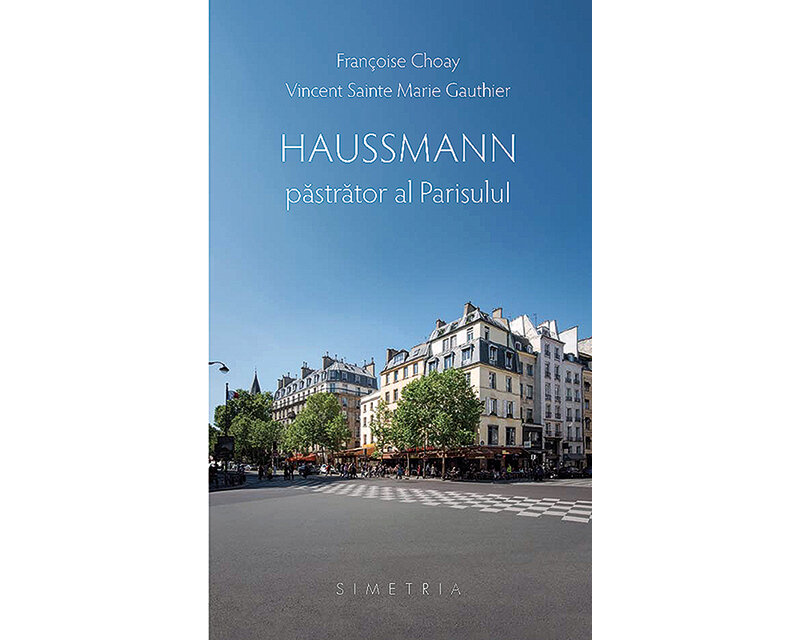
Authors: Françoise Choay, Vincent Sainte Marie Gauthier
Translation: Kázmér Kovács;
Edited by Mariana Celac
Simetria Publishing House, Bucharest, 2014
We owe to Mariana Celac and Kázmér Kovács the publication in Romanian of Françoise Choay's most recent book: Haussmann - Keeper of Paris, published in France in 2013 and co-authored with Vincent Sainte Marie Gauthier. The volume completes the series of translations by the same author, initiated by Kázmér Kovács a decade and a half ago: The Allegory of Heritage (Seuil, 1992; Symmetry, 1998), Urbanism - Utopias and Realities (Seuil, 1965; Symmetry, 2002), For an Anthropology of Space (Seuil, 2006; Urbanism, 2011) and Heritage at the Crossroads. Anthology of Struggle (Seuil, 2009; Ozalid, 2014).
Thanks to these translations, of exemplary quality, a significant part of the books written by Françoise Choay becomes known, in many of its nuances, to the Romanian reader. While the first two volumes complement each other by composing a critical history of the concepts and doctrines of European modernity, which are defining for the disciplinary area of heritage and urbanism, they are part of the author's fundamental work. The third volume, a collection of articles, shows the thematic openness of the author's concerns, highlighting "the emergence of spatial planning practices as a fundamental anthropological dimension"1, while the fourth volume brings together founding texts in the field of heritage, intended to support the "struggle for a new direction", which "is part of the same impetus directed against institutionalized confusions and for a new approach to our built environment, bringing together old, recent and future heritage"2 - as is her entire oeuvre.
The new publication, Haussmann - Preserver of Paris, is a work in which the author's major themes of reflection are combined, Haussmann's Parisian work illustrating "the dialectic between conservation, demolition and innovation that characterizes the life of cultures and their symbolic inscription in space and time" (p. 13). The Haussmann presented by Françoise Choay - discovered decades ago and studied in detail with Vincent Sainte Marie Gauthier for the publication of the complete Memoirs of the Baron3 - is neither the Haussmann who destroyed history, nor the Haussmann presented schematically as the "author" of one of the "models" of 19th century urbanism, but a much more complex personality.
Haussmann's vision of the transformation of Paris, and the method by which the Prefect achieved this feat, are the focal points of the volume Haussmann - Keeper of Paris. The title is polemical, given the negative charge that the career and work of Baron Georges-Eugène Haussmann still carries in France, but the publication of the volume is more than just a rehabilitation of the Baron in the eyes of lovers of old Paris. It is part of the main author's long-standing endeavor to present rationally the texts she considers fundamental to the history of cities and urban thought - short texts, for readers who cannot venture into the unabridged editions.
To restore to the public the importance of Haussmann's contribution to the construction of industrial-age Paris, which reshaped the city - spatially and socially - without losing its 'particular identity', the 'demonstration entrusted to the anthology' (p. 15) begins with biographical excerpts, then presents texts by or about Haussmann that are important for a detailed understanding of the systematic work initiated and conducted by the Prefect and his working method, continues with texts on the recognition of Haussmann's work, and concludes with a photographic sequence of the Boulevard Saint-Germain, which is considered to be edifying in terms of the effects of the interventions on the city.
Georges-Eugène Haussmann (1809-1891) was born into a Protestant family, originally from the old Electorate of Cologne, which had taken refuge in Alsace two hundred years earlier and settled in Paris after the Revolution. A law student interested in music and landscapes, differential calculus and geology, fencing, shooting and skating, swimming and horse-riding, drawing, medicine and poetry, he would pursue a career in administration. In 1831 he became secretary-general of the Prefecture of the Department of Vienna; he was appointed sub-prefect, then prefect in several departments and, in June 1853, prefect of the Seine for a period of 17 years. He was appointed to Paris at the same time as Napoleon III - proclaimed emperor in December 1852 - wanted to give a new direction to the Parisian administration. In his Memoirs, Haussmann was already convinced of the need to transform the city in order to accommodate a growing population, "a certain result, the inevitable consequence of the great railroad lines which were feverishly extended to the farthest provinces and, by junction with foreign ones, to the farthest reaches of Europe"4.
The achievements of his first years in office can be seen in the first technical text included in the anthology: the speech delivered by Mr. Dumas - senator and president of the City Council - at the meeting of October 28, 1859, before the promulgation of the law annexing the neighboring communes to the great city. Textul reprezintă, după autorii volumului, „o sinteză magistrală a sistemului de lucrări haussmanniene și constituie o apărare fără fisură a ansamblului principiilor aplicate de Prefect” (p. 41), prin simpla enumerare a intervențiilor realizate în 8 ani: ameliorarea legăturilor dintre Rive Droite și Rive Gauche, definitivarea marilor străpungeri urbane (Rue de Rivoli, Rue de Rennes, Bulevardul Saint-Germain ș.a.), massive building through private initiative, the creation of public gardens, squares and promenades (Bois de Boulogne, Champs-Élysées), the construction of the Halles Centrale, gas lighting, improvements to the water supply and sewerage systems.
Prefect Haussmann's speech on November 14, 1859, at the opening of the first meeting of the new City Council - the second technical text in the volume - shows his concern for development, territorial equipment and the extension of municipal services, as well as his less well-known concern for preserving the memory of the place in the process of urban reform. After 1859, the Prefecture of the Seine had been given wider powers following the extension of the city up to the fortified belt, and this allowed Haussmann "to link the city-center with the peri-urban villages: they would retain their physical identity, now equipped to Parisian standards" (p. 48).
The texts that follow complete the portrait of this model Parisian administration run with vision, speaking of welfare offices, churches, town halls and courthouses, barracks, primary schools, municipal architects, public finance, vocational education or drawing lessons in schools, suburban boulevards realized a century later or planted ring roads not yet realized, here, thinking and acting for posterity. If, for the president of the municipal council before 1859, quoted above, "the energetic canal of Asnières is, of all the monuments of Paris, the one which will perhaps carry the memory and testimony of its power the farthest down the centuries" (p. 44), understanding by this the major public importance of improving the building systems, Hausmann considers that "of all the great things done in Paris during the reign of the Emperor, the extension of the city limits is indeed the one whose memory will last the longest" (p. 49), which refers to the reform of the city in its new status - imperial - and its new status as "the universal home of Letters, Sciences and the Arts" (p. 79), which we inherit.
Alongside these two aspects, however, a third - less well known - is presented in the volume by Françoise Choay and Vincent Sainte Marie Gauthier. The Haussmannian project for a General History of Paris, launched in 1860, aimed to research, organize and publish documents relating to the history of the administration and topography of old Paris, as a complement to the great work of transforming the city. For Haussmann, the collection of monographs and documents (compiled by a special commission set up within the City Council) was a "new monument to the glory of the City" (p. 66).
This latter monument is perhaps the least known of those built by Haussmann - who appears, from the sum of his actions, as the restorer of Paris - the creator of a new urban identity. For this restoration, however, the small Parisian palace 'with courtyard and garden' in which Eugène de Haussmann was born had to be demolished, and this was done at his own behest.
Notes:
1 Françoise Choay, For an anthropology of space, Bucharest: "Biblioteca Urbanismul Serie Nouă", 2011 (2006), p. 13.
2 Françoise Choay, Patrimoniul la răscruce, București, Ozalid, 2015, p. 9-10.
3 Baron Haussmann, Mémoires, Édition intégrale, preceded by a general introduction by Françoise Choay and a technical introduction by Bernard Landau and Vincent Sainte Marie Gauthier, Paris: Seuil, 2000 (1890-1893), p. 1.208.
4 Baron Haussmann, Memoirs, op. cit., p. 455, p. 457.