
Housing and urban development
Housing and urban development
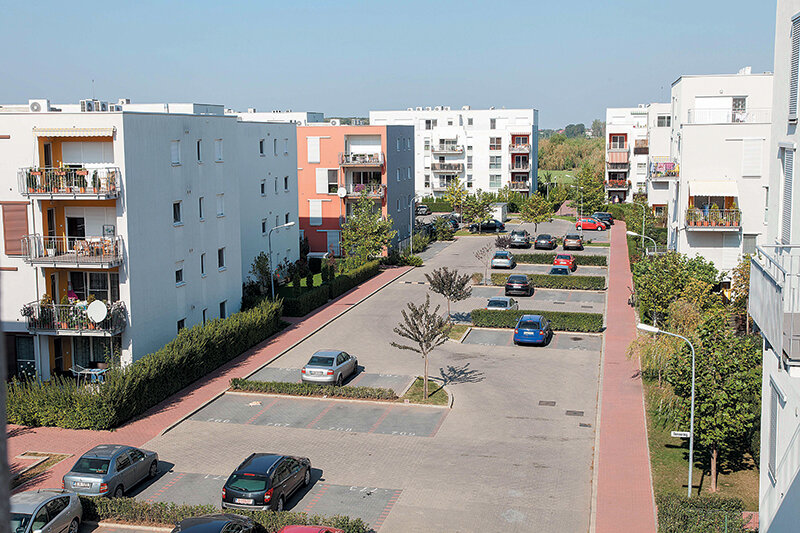
| in dialog with Michael ENGEL, Miruna GRIGORESCU, Simona MUNTEANU, Doina BUBULETE Urban development, although it refers to a spatial visualization, is primarily an economic concept, taking place when economic growth generates added value in areas such as culture, environment, housing or social protection. Sometimes, the phenomenon can be accompanied by the expansion of the city into the territory - economic activities locate on the major thoroughfares, new jobs are created, demand for housing increases and new residential developments appear on vacant land, but often things do not happen in this sequence. The expansion trends of Romanian cities in the last 25 years are more a phenomenon of suburbanization than a spatial expression of their development. They are more the result of a collective will to live in something other than the collective dwelling, multiplied by the low price of agricultural land (with all the costs of introducing it into the intravilan) and raised to the power of real estate speculation. Although they imply a certain degree of economic growth - translated by the new owners' ability to pay/borrow, they do not lead to, nor are they generated by, surplus value. At the other extreme, in many European cities (e.g. in the UK, the Netherlands, Germany, etc.) there is a trend towards redevelopment, with the regeneration of central areas, involving both a slight densification of housing and, above all, a renovation of the existing stock, accompanied by an increase in comfort and measures to improve the microclimate, green spaces and the services needed for quality of life. Urban development strategies in these cities are based on the concepts of sustainable development (focused on energy-saving and environmental protection policies), integrated development (in which housing programs are supported by public services and utilities programs as part of an integrated urban regeneration policy), smart cities, based on creativity and innovation, both in the field of economic activities and in mobility, recreation, housing and, in general, the use of existing resources - whether land, buildings, water or energy. This article aims to debate with a number of specialists - architects, urban planners, architects in administration - a theme related to the alternative supply of housing demand: suburbanization or redevelopment? A few points of view are set out below, in response to a series of questions that aim to critically address the relationship between housing development and urban development. 1. Are newly-built residential areas a more comfortable alternative to inner-city housing or what are the trends in Europe? 2. How is the supply of new housing materializing and what are the factors attracting buyers? 3. How will these areas evolve in the medium and long term and what will be the consequences for urban development? 4. What would be the role of the different urban actors in supporting redevelopment and what tools would be needed? |
| Read the full text in issue 2 / 2015 of Arhitectura Magazine |
| Urban development, although having a spatial dimension, is an economic concept, because it occurs when economic growth generates added value in the field of culture, environment, housing, and social protection. Housing development in Romania has followed in the last 25 years a suburbanization trend, which will have a strong impact on the long run on city development. The article launches a debate among four professionals - architects, planners from the private and public sector, on a topic linked to the alternative housing supply in terms of suburbanization and re-urbanization.Michael Engel, Miruna Grigorescu, Simona Munteanu and Doina Bubulete answer the following questions:1. Are the new residential areas a more comfortable alternative to the inner-city housing, or what are the trends in Europe?2. How do developers decide on housing supply, and which are the attraction factors for the buyers?3. How these new residential areas will evolve on medium and long term, and what will be the consequence on urban development? 4. What is the role of different urban actors in supporting re-urbanization, and which are the necessary instruments? Michael Engel is an architect, graduate of the Technical University in Dresden, having more than 10 years experience in urban development and rehabilitation of historic neighborhoods. Since 2010 he is the director of Heritas Foundation in Sibiu. Miruna Grigorescu is an architect, with a significant consultancy experience in urban development as part of IHS Romania office in Bucharest. Since 2008 she is project management co-ordinator in AFI Europe Romania. Simona Munteanu is an architect, PhD in urban planning, lecturer at the University of Architecture and Urban Planning "Ion Mincu" in Bucharest. Former chief-architect in Ploiesti during 1997-2012. Doina Bubulete is an architect, with more than 30 years experience in urban and regional planning. Former director in the Ministry of Public Works, Transport and Housing in 1996, and general director of Urban Proiect in the period 2002-2008. |
| Read the full text in the print magazine |