
"Green reCreation"/ N.O.D. - Baia Sprie
Since 2009, a strategy for the establishment of the protected area "Dealul Minei" in Baia Sprie has been pursued, through the creation of a theme park (industrial-geological) and the remodeling of public spaces that connect the mountain to the protected area of the old town center. The workshops have brought together multidisciplinary teams (architects, landscape architects, sociologists and geologists), with the aim of achieving a more complete picture of the existing situation and the possibilities for revitalization of the studied area.
The idea of holding workshops on such topics was welcomed by the city's inhabitants and local authorities. These initiatives have added value to the process of reconsidering the objectives and unifying them under the umbrella of the concept of a 'geological park' and, why not, a 'cultural landscape' with all its components: historical, traditional, industrial, natural-geological, social, etc.
In addition to carrying out urban and sociological studies, organizing the "Monumenta Nostra" symposia on the protection of cultural heritage and those on the protection of industrial heritage, the participants in the workshops wanted to interact with the inhabitants by creating objects that would draw attention to the existing urban space.
During the five editions so far, a number of ideas have been generated and translated into different strategies. Some of these have been finalized into projects for which funding has been sought. Some of these have subsequently been put into action by local authorities, such as a new park. The successful realization or materialization of some of the ideas discussed at the Workshop requires a long period of time and the involvement of all local stakeholders. Successful materialization of ideas is not about faithful implementation, but about ownership by the community and local government, even if the initial ideas will undergo a process of transformation during implementation.
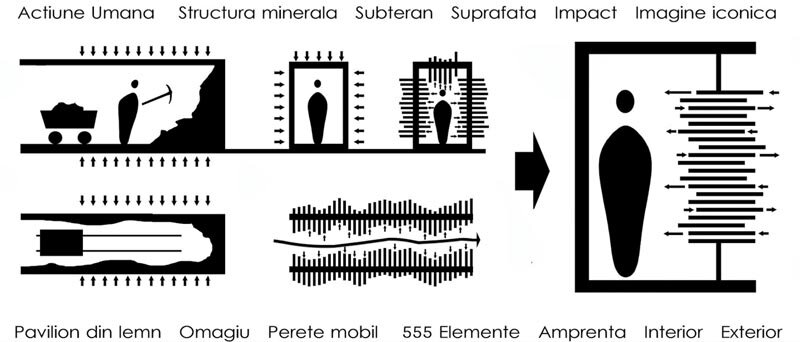
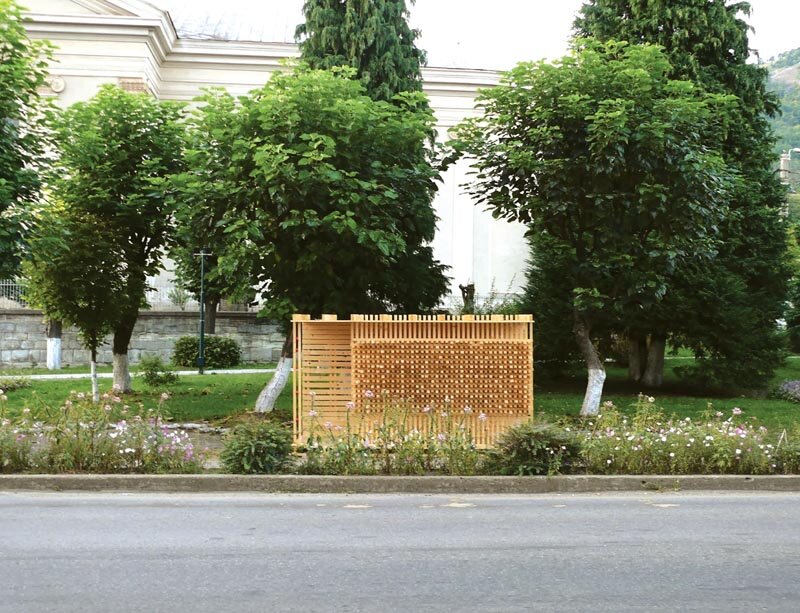
One of the possibilities to interact quickly with residents is to create temporary pavilions, which appear in the public space and convey a message to citizens, and then either disappear or transform. Such actions have taken place in the third and fourth editions of the Workshop, when the "temporary materialization" of ideas was raised. Thus, one of the teams [1] realized an object-manifest, located in the historical center of Baia-Sprie. Through this object, the team wanted to highlight the similarities between the underground (mine) and the above-ground (urban) space, by the fact that both are shaped by the contribution of the community. Thus, the object was conceived as a gallery with a wall-installation made of a series of movable modules, which offered the possibility of continuously shaping the space according to the wishes of the person who walks through it. If in the underground space is created due to the search for ore, as a result of a route modeled by the extraction of material, in the temporary gallery space is transformed as a result of the passer-by's state of mind. In this way, the space could be redefined by each user, which is a simple way of conveying the idea that a public space will only be successful if it is the result of community thinking and that it should be made in such a way that it offers the possibility of continuous adaptation to different situations. The object-manifest was made entirely out of fir wood - a local, easy-to-process material that suited the idea of temporality of the object created. For a year, this was the focal point for passers-by, during which time the material took on the imprint of time.
In the next edition, another team [2] from the Atelier reused the material to create pieces of urban furniture. The idea of realizing new design pieces from pre-existing wooden elements did not result from a logistical constraint, but rather was the result of an exercise of imagination, an attitude towards the life cycle of a material used for an object with a temporary function. In this case, over and above the material that was used is materiality as a basic principle of sustainability of the actions within the Atelier.
Another project [3] that was materialized in 2012 is a pavilion located in a clearing on the "Water Route" (studied in the first edition of the Atelier), in the immediate vicinity of historical industrial-mining remains. The pavilion has been conceived as an object that can be used by the community for leisure, given that the place where it is located is often used by locals for picnics. The pavilion has been made of traditional materials, the fir-wood structure sits on a stone plinth and the sloping roof was designed as a vegetable garden. It was all done with the help of volunteers from a local association. The construction was not conceived as a temporary object, but as a permanent object for the local community. Thanks to the materials used, it does not require much effort for maintenance. By placing this object a transfer of responsibility to the community has been realized. It is therefore to be expected that, over time, there will be a number of interventions. Although the green terrace was designed, it was not realized during the construction. For this reason we consider that the site has remained open and will be completed when the beneficiaries of the site feel it should be.

In addition to the projects outlined above, which have already materialized, there are a number of other proposed projects [4] which, although seemingly simple, have to travel the winding road of funding and implementation to be realized. We can say that there has been a positive reaction from the local authorities and the community to the projects proposed at the Green reCreation/N.O.D. Workshop, which gives us confidence that the other ideas will eventually materialize in one form or another.
Coordinators of the "Green reCreation" Workshop - Baia Sprie: arh. Futó Edmund Eugen, arh. Flaminiu Taloș, arh. Diana Taloș, arh. Anca Filipan, arh. Ionuț Filip.
Team N.O.D.: arh. Valentin Meteș, arh. Ruxandra Elena Moldovan, arh. Hanna Nistor.
[1] Manifest Object Design Team (2011):
coordinator: arh. Anca Filipan;
participants: stud.-arh. Mihai Tămășan, stud.-arh. Andrei Temian, stud.-arch. Simona Zinca, stud.-arch. Mirona Faloba;
photographers. Mihai Tămășan, stud.-arh. Simona Zinca, stud.-arh. Katerina Georgescu.
[2] Street furniture design team (2012):
coordinators: arch. Raul Timis, stud. arh. Teodora Ungurean, stud.-arh. Bianca Fanta;
participants: volunteers from Baia Mare Art High School: Tudor Udroiu, Andrada Pinte, Dan Săsăran, Carla Afrăsinei, Diana Cânța, Farago Zsolt, Ruxandra Vasile.
[3] Pavilion design team (2012):
coordinators: arch. Ruxandra Moldovan, arh. Alexandru Mociran, arh. Simona Mesaroș, arh. Adrian Leițoiu, arh. Hanna Bianca Nistor, landscape architect Hitter Timea;
participants: arh. Costi Bleotu, arh. Amalia Ignuța, arh. Dan Ungur, arh. Călin Bolovan, arh. Ion Avram, stud.-arh. Raluca Pop, stud.-arh. Cristina Costea, stud.-arh. Mara Sălăjan, stud. arh. Nicu Coșorenci, stud.-arch. George Blaga, stud.-arch. Florina Pantea, stud.-arch. Sebastian Scarlat; volunteers from Baia Mare Art High School: Diana Cocoșilă; "Blue Lake" Association.
[4] Projects on: www.tabaradecreatie.blogspot.com