
Exploring space blind: SenseAbility
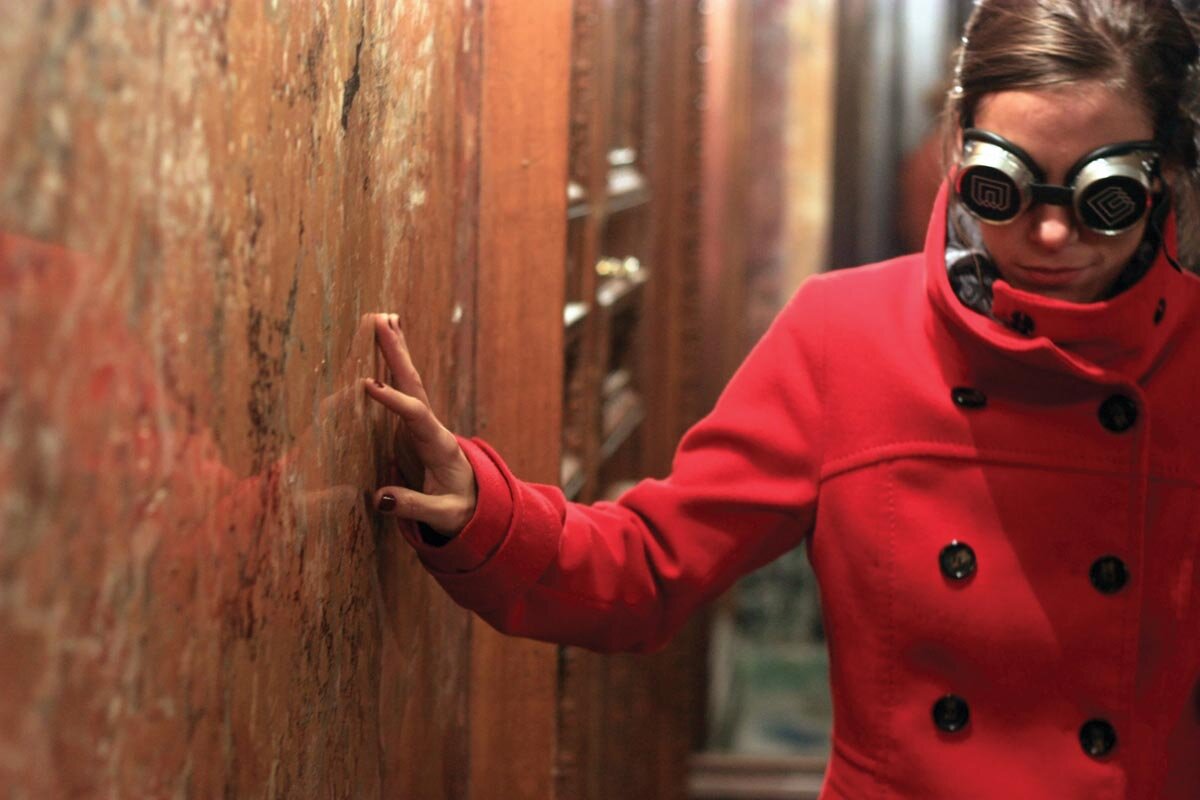
SenseAbility is an initiative about openness and development. Primarily towards the use of the other senses, in the absence of the visual, in interacting with space. Most sighted people's first encounter with space involves seeing it. But what if the rules of the game change a little, you close your eyes and try to discover it through your other senses? In the case of visually impaired people, this first encounter passes through other filters, from distance to nearness, from the whole to detail. The other senses are active and work together to decipher space, leading to a more detailed and intimate knowledge of it. Secondly, SenseAbility opens a channel of communication between people. I don't see you and you don't see me, but we are both walking through the same space with the same goal, to get to know it. Thus, there is a chance that we might accidentally meet and even help each other.
SenseAbility is a project initiated by the Association of Alternative Methods of Social Integration, AMAis for short. We are a group of young enthusiastic and full of ideas young people, mostly architects, who want to develop everyone's level of perception and awareness, amplifying the multi-sensory spatial qualities through different initiatives.
The first four SenseAbility events took place in the framework of the Bucharest Architecture Annual 2015 and involved two activities in different spaces in the city: Casa Mincu, Casa Monteoru and Casa Rosetti, over four weekends. In turn, each house hosted a series of tours and a building activity, both of which were carried out blind, with the help of special pairs of glasses provided by the AMAis team. Visitors, both visually impaired and sighted, had the opportunity to discover the space of each house through their other senses and to play, in teams, with a 1:10 scale model of an apartment, designing it to their liking.
Over the four weekends, 171 people went through the SenseAbility experience, people of different ages, different occupations, sighted or visually impaired. But they all had at least one thing in common - the openness with which they came to explore an unfamiliar space, in most cases. SenseAbility seems like a game, the rules are explained, you put on your glasses and start walking. You take one step, two, afraid or not, by nature, but eager to move on and discover. You start from a game, an experiment, but you come to realize how difficult it is to act without seeing in certain spaces. And you're not the only one. But you have the opportunity to talk about your experience and find out what others have been like. You ask questions and they are answered, not in theory, but from personal experience, perhaps even from the experience of a visually impaired person. You're curious to find out how they cope, how they find their way around, how they get their bearings, but all you have to do is communicate.
Through the events of the Architecture Annual, AMAis has succeeded in facilitating access for visually impaired people to a number of representative buildings. Furthermore, the participants were made aware of some of the problems that visually impaired people face in their relationship with space, and the conclusions drawn provide the basis for a study to develop the degree of accessibility of space.
SenseAbility started by exploring the space, but moved on to discovering the others who share the space with you. It's been an exchange of opinions, experiences and stories, all blind. And it will continue!