Interview with thatched roof craftsman Vicențiu Florian
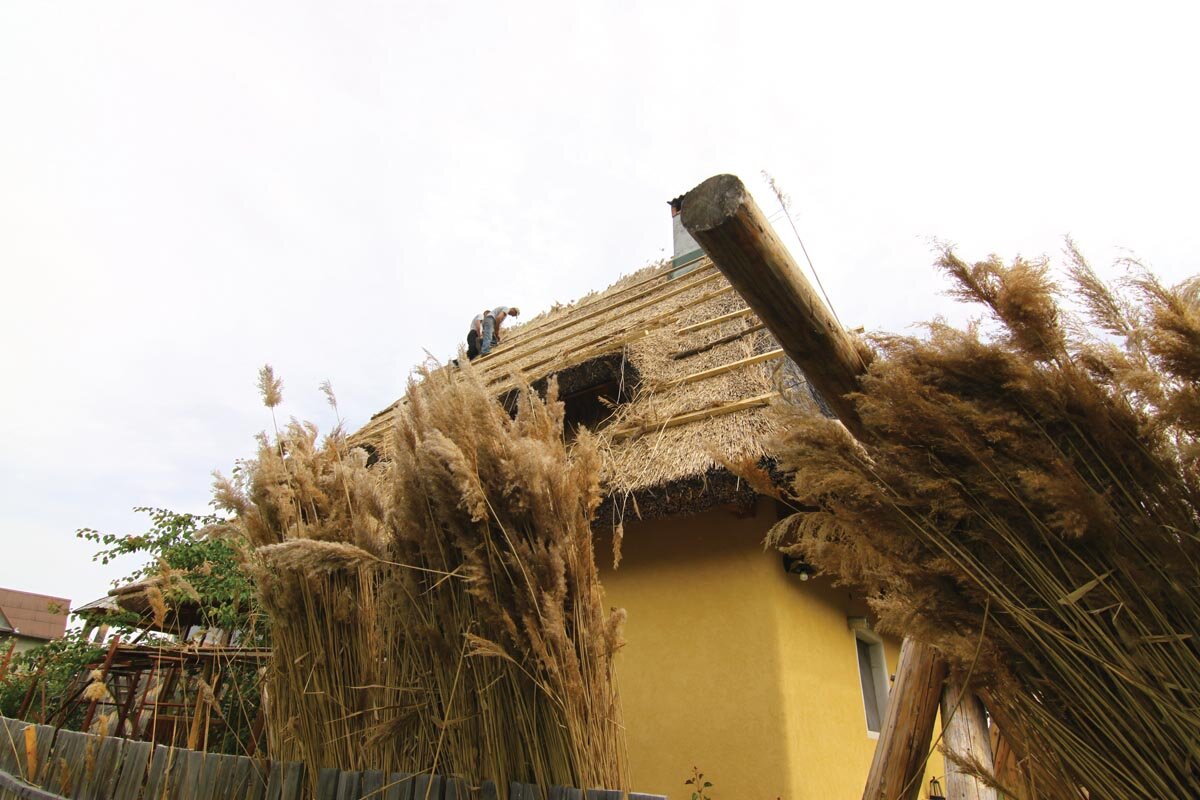
In Țara Lăpușului, there are many who make "history" that will never be written and there are few who write history that will remain in the archives. Tradition still plays an important role in the Romanian village world. There are places where modernity and luxury are not part of everyday life. The Lapus Country, known to the general public through the voice of Grigore Leșe, remains an isolated and picturesque land. Each settlement is part of the puzzle called Maramureș. The village of Dealul Corbului is part of the commune of Vima Mică. The old thatched hut, the 'găbănaș' (where food, cereals, pickles, jams used to be kept), the oven where bread is still baked on the hearth, are waiting for the visitor to get to know them.
"The ever charming thatched roofs of houses and sheds, omnipresent in the countryside until the beginning of the 20th century, and only present today in very small numbers in some isolated villages, could be brought back to the present thanks to the few but spirited craftsmen who continue to use the technique, but also thanks to some architects... who want to turn traditional architecture into an engine for the development of rural communities." (Sebastian Olaru, report of January 16, 2016, Agerpres)
An example that tradition is still preserved we received from the 37-year-old craftsman Vicențiu Florian, from Dealul Corbului, in love with his native places, who continues the craft of covering houses and sheds with straw, a craft he inherited from his father, since the time when he was a child and was his helper.
Since we (Ligia Bodea) also had a house to make, we came with business, to find out about the craftsman and his trade (in our part of the country, in Sălaj, there are too few thatched roofs, especially in museums). So, the first discussions turned into an interview with the craftsman from Dealul Corbului.
From whom did you learn the craft of thatching?
Vicențiu Florian: From my parents and from the people here in the village, there were a few people who used to cover with straw, when I was a child they used to do things like that and I learned from them.
Are there still people in the village who cover with straw?
V.F.: In the village, there are no more people who cover like that now, I can say that I am the only one, but there are a few guys I work with who know how and who will certainly continue this tradition.
What straw do you use: rye, wheat, barley?
V.F.: I use wheat straw, rye straw, oats are not suitable, they have a higher moisture content.
How do you thresh them?
V.F.: Manual would be best, there used to be a straw in the old days, they used to call it a chaff; the idea is to make very long straw, but generally large, wheat if it's very small you can't cover it, it has to be good, fine wheat.
How do you put them, scattered or in sheaves?
V.F.: They are laid scattered, it's a certain technique, where you trample the straw, you keep trampling the wheel and you go from the bottom, you walk on the eaves, you keep on rolling the wheel, all the time, to be at approximately the same level, to reach the top and not to make any difference.
How is the ridge, the eaves detailing done?
V.F.: The ridge or the top is ironed like this, until the angle is almost zero, and then you put some stakes, there's a certain technique there too, you have to know that otherwise you won't get it right. The straw is pressed well and then made from birch saplings up to 1 meter high, we call them gujbe, a twist that is caught behind the leech and placed from place to place. Otherwise, they simply sit on the legs, which are put up for stability.
Is the slope of the roof important?
V.F.: The slope, when the eaves are laid, must always have an outward slope, and there is a certain technique here, so that the water slides outwards all the time. The slope is the most important, because if you put a low slope, under 60 degrees, the resistance will be very low.
Do you do anything special to the roof: spikes, pods, wooden nails?
V.F.: The eaves are very important, and the straw must be laid at a certain angle, because if you lay them crooked they won't stand. You put wooden stakes at the top, wooden pegs from place to place and the sways are very important.
What kind of wood is used to make the roof?
V.F.: It's made from big birch branches, that's how people used to make them in our country. The birch is cut in winter, when the sap is down, because you can't do these things quickly, you have to think 1-2 years in advance, including the wood for the roof. The horns are made from oak, which is the best, but you can also make them from fir.
How long does it take to make a roof?
V.F.: It depends on the size of the construction, the diameter. The shingles being higher take more time to make the goz roof, as we call it, than in houses that have a lower roof, which are also smaller.
How long before the roof needs to be serviced?
V.F.: The maintenance is done quite often, the peak especially, after the new one is restored after a year, after the first winter after the roof is completed, it is done, it is a half-day or at most a one-day job for two people.
Who else asks you for thatched houses?
V.F.: Requests have been few in the past, but lately more and more people are calling because they want to thatch their houses.
Vicențiu Florian is optimistic. "For some they just repair the roofs of older houses, for others they make them new. And, because the work is going better and better, he has taken on two young apprentices from the village to carry on the craft of building thatched roofs, or 'goz' as they call them in the area."(Sebastian Olaru, report of January 16, 2016, Agerpres)
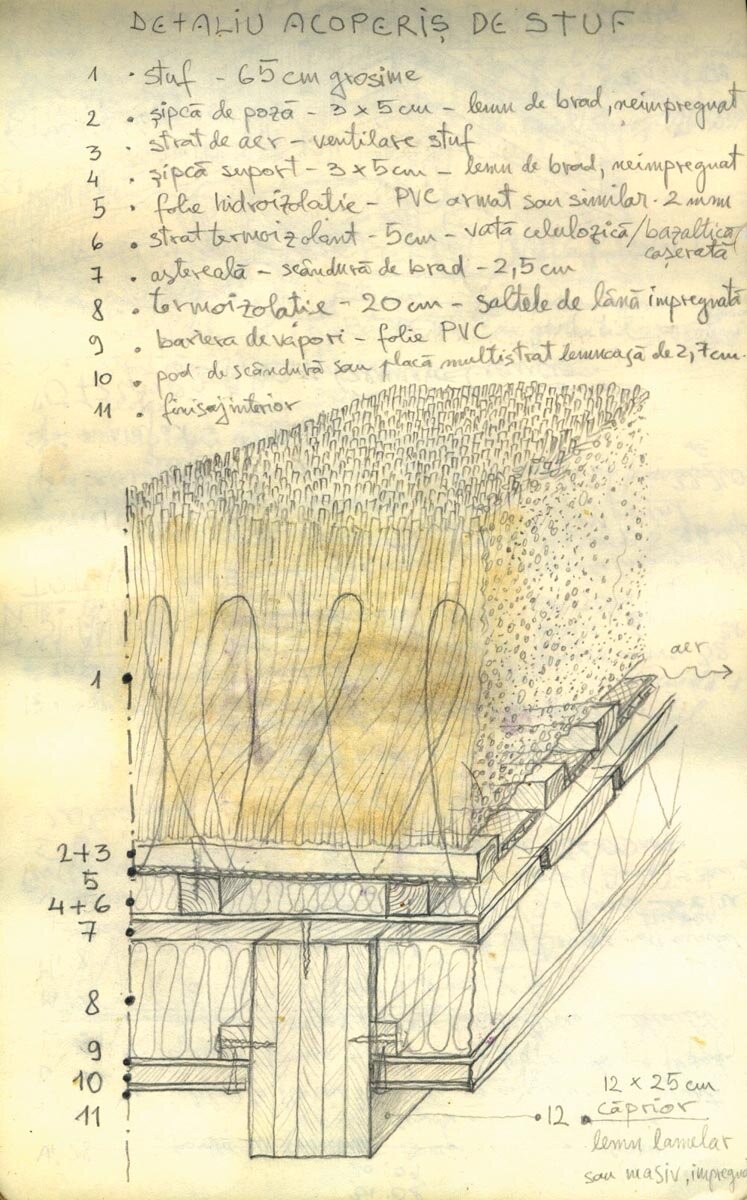
Details of thatched roofSketches arh. Horațiu Răcășan