
The project "Churches in the drought, problems, challenges
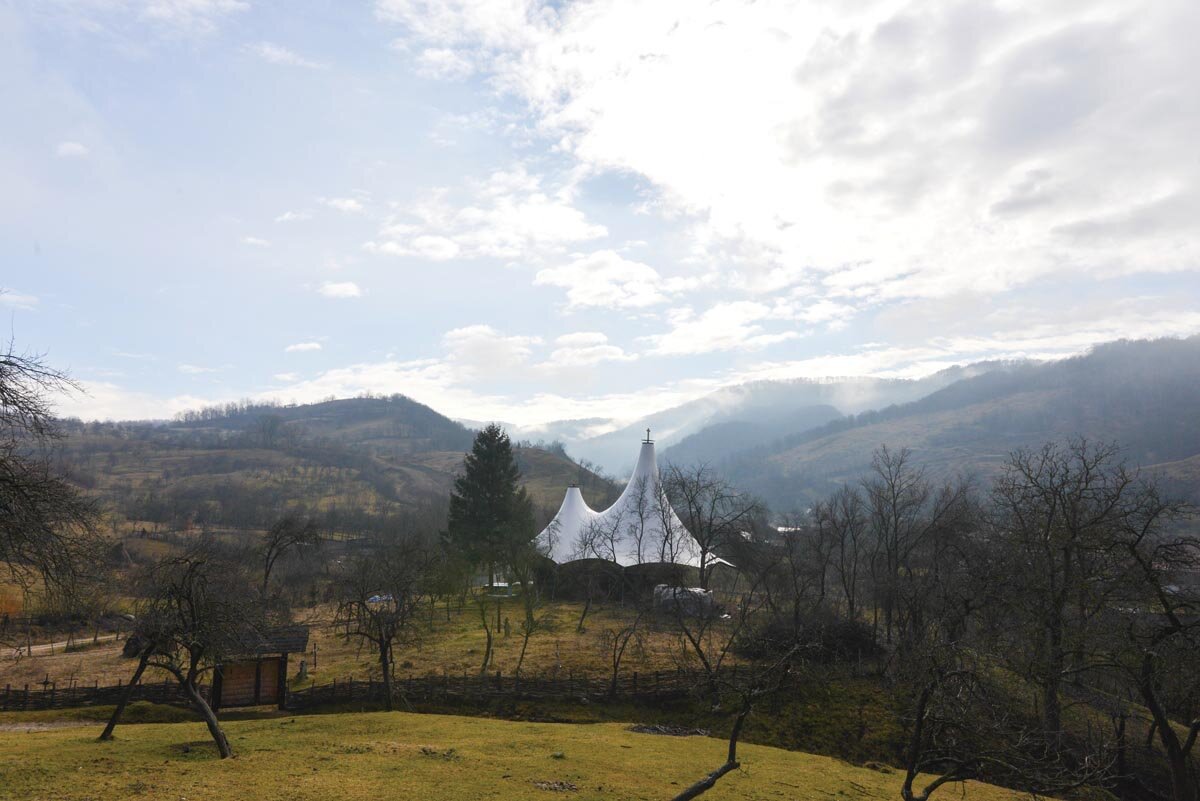
Started in 2014, the project "Biserici inlemnite" (Burial Churches ) has developed, marking the sustainable, practical character of the project Cemetery as an element in the evolution of the cultural landscape, of the Association of Landscape Architects of Romania (ASoP), which aimed to investigate from an interdisciplinary perspective the multiple valences of the rural cemeteries of the Banat region, the relationships they imply with the landscape, the community or the village. In 2013, rural Orthodox cemeteries in Banat were studied and the village of Crivina de Sus was chosen as a case study for the interdisciplinary understanding of the whole context of the cultural landscape, the village being part of the ethnographic area of Făget, the only one in Banat where examples of the old spatial-symbolic relationship of the church surrounded by the cemetery and the village are still preserved. Thus, since 2013, three summer practices were held with students and specialists from different fields related to the project (landscape, urban planning, architecture, anthropology, history, history, arts and theology), in which the landscape, the morphology of the settlements in the area, the architecture, the community were studied at different scales, resulting in a series of concrete proposals for landscape interventions, some of which have already been realized in the summer practices.
Possibly centered on the oldest wooden church in Banat, located in the village of Crivina de Sus - a hypothesis that the research team has yet to confirm following a dendrochronological study - the project "Biserici înlemnite" aims to bring back into use and to bring out of the shadows of history into which the last wooden churches in Banat have fallen in the last century. The process is one that aims not only to save the churches, but to help - what is nowadays called in European project parlance - sustainable development in the countryside. Emergency protection by covering, actual restoration, utilization, reintegration into community life are the major stages through which the wooden church dedicated to St. Paraschiva in Crivina de Sus, a village of about 200 inhabitants, classified as TM-II-m-A-06214 in the List of Historical Monuments, should pass.
The restoration project was intended to become a complete investigation and interdisciplinary understanding of a wooden monument through the voluntary involvement of specialists and the realization of all the necessary studies, in order to decide the strictly necessary interventions on the monument. For three years, interdisciplinary workshops were held in Crivina de Sus, which, among other things, aimed to study the church (traditional and photogrammetric survey and records for each wooden element of the church, study of the archives, studies of the parament and the pictorial layer, biological and structural expertise, dendrochronological analysis, interviews in the community, etc.).
However, until the restoration project, which we assume will be chronophagous, is finalized, the church, which is in a precarious state of preservation, needs to be protected by a scaffolding. Thus, in the first phase of the project, what has become a pilot project - the covering of the church with a tensioned membrane - was chosen. The decision to adopt this construction system was taken for a very pragmatic reason, following the analysis of four different construction system options: a classical timber frame with tongue and groove joints, a modular timber frame using metal connecting pieces, a load-bearing metal structure and a metal structure made to support a tensioned textile structure. All the advantages and disadvantages of these structures were analyzed in relation to the requirements of our objective, found in the design theme. Thus, the most conclusive factors were taken into account: cost, execution time, adaptability on the site (in the cemetery surrounding the church), protective capacity, possibility to work between the protective structure and the monument, adaptability and possibility to move to another church after the restoration (reuse), architectural image and environmental impact. The tensioned structure best met the majority of the needs established, taking into account the following aspects:
- the temporary structure must protect the monument until the future restoration of the church is completed;
- the structure must be easy to erect and dismantle and, once it has fulfilled its protective role, it must be able to be moved over other wooden churches, which it will also have to temporarily protect. For this, the surveys of the other wooden churches were consulted and the structure was sized so that it could be reused for most of those in the Făgetului and Ținutul Pădurenilor area;
- no traces of its presence will remain on the site after dismantling;
- this structure will not touch the wooden monument at any point, nor will it overlap the tombs surrounding the church;
- there will be enough space between this structure and the monument church to carry out the necessary studies for the implementation of the future restoration project and the future restoration work to be planned on the basis of the approved/authorized project;
- the provisional image of the protected church will not be visually aggressive.
(...)
Read the full text in issue 1 / 2016 of Arhitectura Magazine
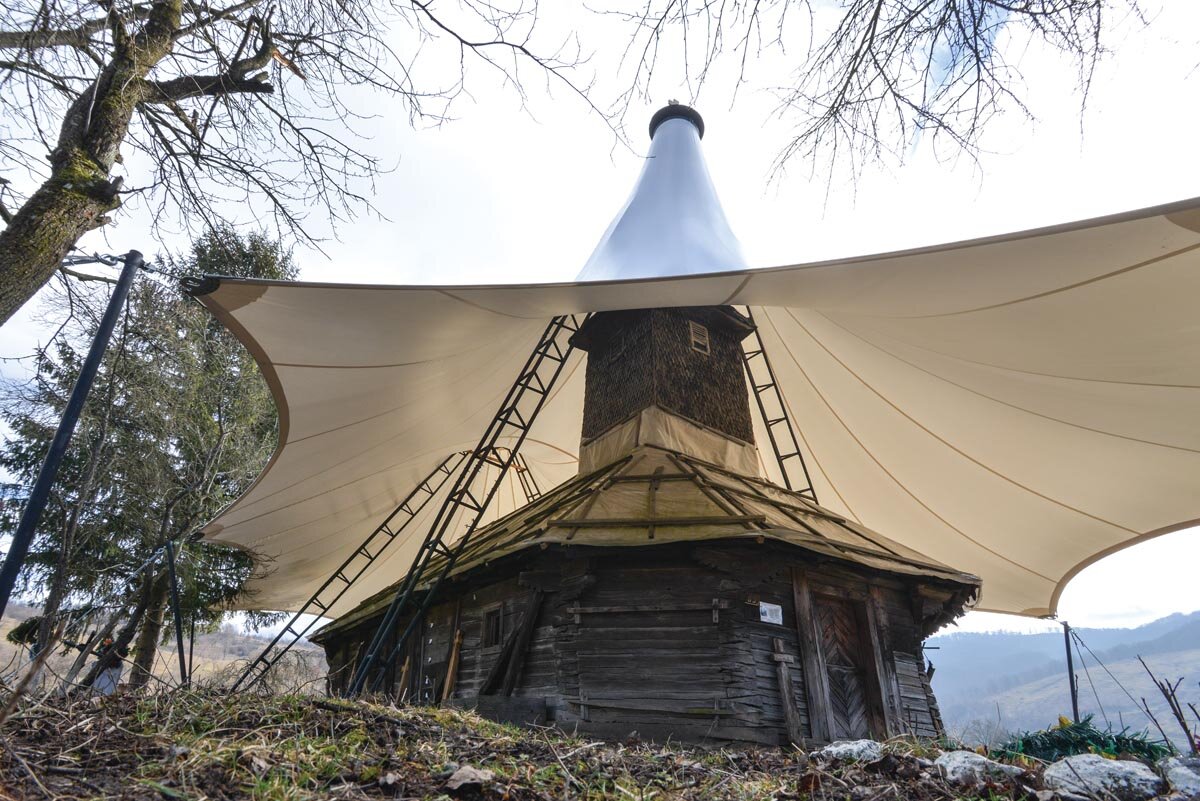
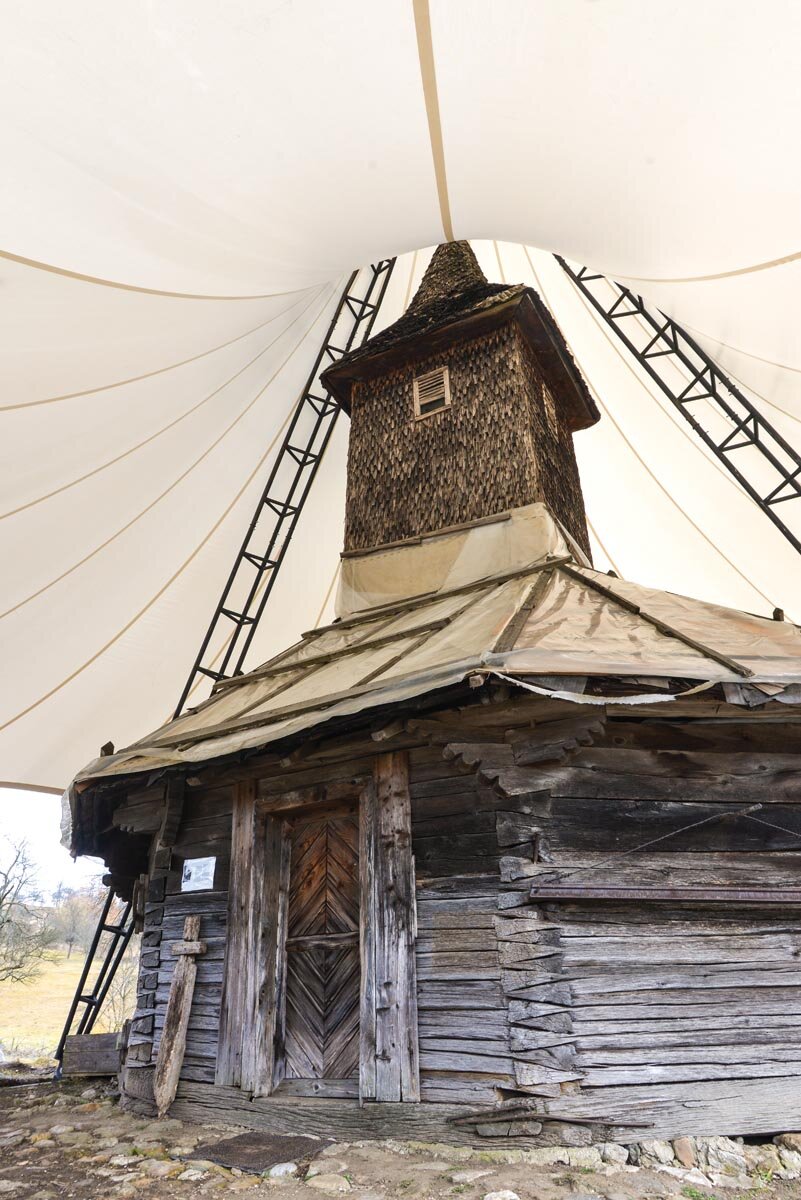
photo: Ovidiu MICȘA, Vladimir OBRADOVICI, Alina ADĂSCĂLIȚEI