
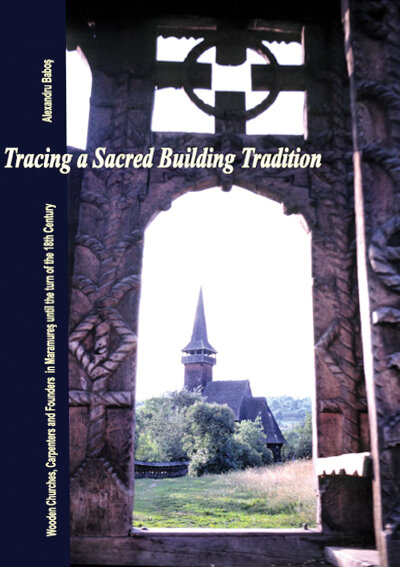
Tracing a Sacred Building Tradition. Wooden Churches, Carpenters and Founders in Maramureș until the turn of the 18th Century
(Tracing a Sacred Building Tradition. Wooden Churches, Carpenters and Founders in Maramureș until the turn of the 18th century)
author: Alexandru Baboș
Publisher: Lund University, 2004
The published volume is written in English, which makes it highly accessible - the electronic version has been downloaded in 20 countries, mainly Romania (31%) and Sweden (24%). The interest of Romanians in this document-book is noteworthy.
The 308-page work is overwhelmingly dense, every word counts and every sentence contains important information. Going down in history to the 14th century, the author traces the phenomenon of the construction of wooden churches in Maramureș until the end of the 18th century. Since the construction system, based mainly on wooden beams, is widespread in Europe, the interest in this book goes beyond the geographical area of Maramureș, and the information presented is new because the techniques of traditional carpentry have been kept alive in this area, thus providing practical justification for the theoretical research. The inclusion, in 1991, of eight of the wooden churches of Maramureș in the UNESCO World Heritage List reinforces the position of the traditional architecture of this area in the European built landscape. The journey of the researcher Alexandru Baboș in time is not simple, it involves all the factors involved in this process, explained in detail in the three parts of the work: the organization of village life in this period, the craftsmen and techniques used and the founders of the places of worship.
Alexandru Baboș has made a meticulous research, using all scientific means: from the field study including interviews, photographs, measurements, detailed surveys of the 42 churches existing in Maramureș (a third of those of 200 years ago), to the careful analysis of the work of today's carpenters and the careful search and study of documents in libraries and archives, both in the country and abroad (Ukraine, Hungary, Austria, Sweden). The dendrochronological dating was an endeavor initiated together with Professor Olafur Eggertsson from Lund University, which has provided clear evidence about the period when the wood used in construction was cut, clarifying or contradicting some information or myths, and which has remained the reference dating and is used routinely in all documents, studies and projects being developed today. Through his references, the author highlights researchers less cited today, who have produced important works for the architecture and history of Maramureș, such as Coriolan Petreanu, Radu Popa, Ioan Bârlea or Tit Bud. Through his entire approach, Alexandru Baboș places the Maramureș Region in a privileged position on the map of traditional wooden buildings in northeastern Europe.
The first chapter deals with vernacular architecture in Marmaureș, from the mass of which the wooden churches stand out, by their specific image, but also by the exceptional quality of the techniques of processing and assembling the wood. We first learn how society was stratified in rural communities, the role and power of local nobles. We learn how the ancient inhabitants of the Maramureș region built their own wooden houses, starting with the selection of trees from the forest, felling, transportation, processing and joining them together to make a dwelling. Compared to dwellings, the sacred spaces were built with excellence in mind: the best trees were chosen from neighboring forests and entrusted to the best craftsmen. Exceptional results were obtained in the ample dimensions of the spaces; in the technique of working the beams lengthwise so that the wall would be perfectly sealed and would not need other insulating materials; in the measures taken to avoid loss of vertical stability and flatness of the walls; in the variety of joints at the corners to ensure the stability of the construction; in the science of building strong roofs with a minimum of material.
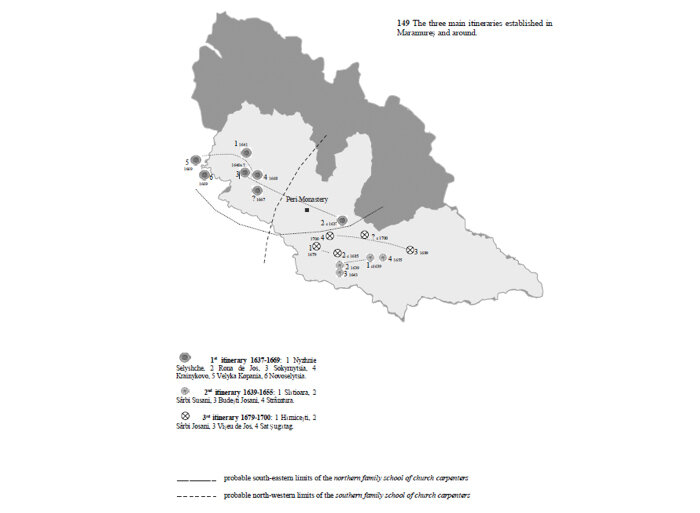
The second chapter is devoted to the master carpenters and their techniques, on the basis of which the most important teams of church builders were identified. They were able to erect a church without designing it, starting from the limitations of the lengths of wood and relying on proportions and the logical sequence of building stages, learned from their ancestors and refined by experience. Researching the construction system of churches, the techniques used and the specific fingerprints of each craftsman, Alexandru Baboș identified two schools (families) of church builders who worked intensively throughout the most prolific years for the churches of Maramureș, in the 17th century and the first half of the 18th century: one in Săliștea de Jos, which had its area of work predominantly in Maramureș north of the Tisa River, and for the villages to the south, a second school of craftsmen, located in the Izei Valley. Continuing his research, the author has identified three important itineraries of the craftsmen from the south of the Tisza River, deciphering distinctive marks, the way techniques were transferred from one generation to another or stolen from one team to another.
The founders of the churches of Maramureș are the subject of the third chapter, which analyzes how they reflect the social status and ambitions of local nobles in their struggle to retain their right to rule their lands in the face of pressure from the Hungarian Kingdom or the Habsburg Empire. The monasteries have a special place as spiritual and cultural centers for the area, although they were located far from human settlements. It was here that the first translations from the archaic Romanian language and the first writings on Romanian history were made. We understand that a church can have several founders; the most important one is the one who provides the land, but poor believers can also earn a good position in the pews and in the cemetery surrounding it, working with their own hands, together with their families, to build the church. At the same time, we also understand the notion of the patron of the church and his very important role in ensuring the functionality of the church over time through the continuous presence of a priest. Alexandru Baboș emphasizes the role of the founders in the conformity of churches through detailed justifications. It becomes evident that, since the most important founders came from noble families, as persons who belonged to the Eastern rite, but who were members of a Western-oriented nobility, this dual character was transferred to the churches through the Byzantine atmosphere inside and the bold image outside - all interpreted in the key of the local vernacular architecture.
Throughout the book, the author points out some open topics for future research, such as: dendrochronological dating and interpretation of the results, the carpenters and their itinerant teams, the route of these teams, the monasteries and their role in the spread of culture in the area...
The book is an invaluable source of information, both architectural, ethnographic and even historical. It is exciting and can be read like a novel! It's a pity that it is not translated into Romanian, we should be able to find it on the shelves of our bookstores and libraries, accessible to both professionals and the general public interested in history and art.