
Argument
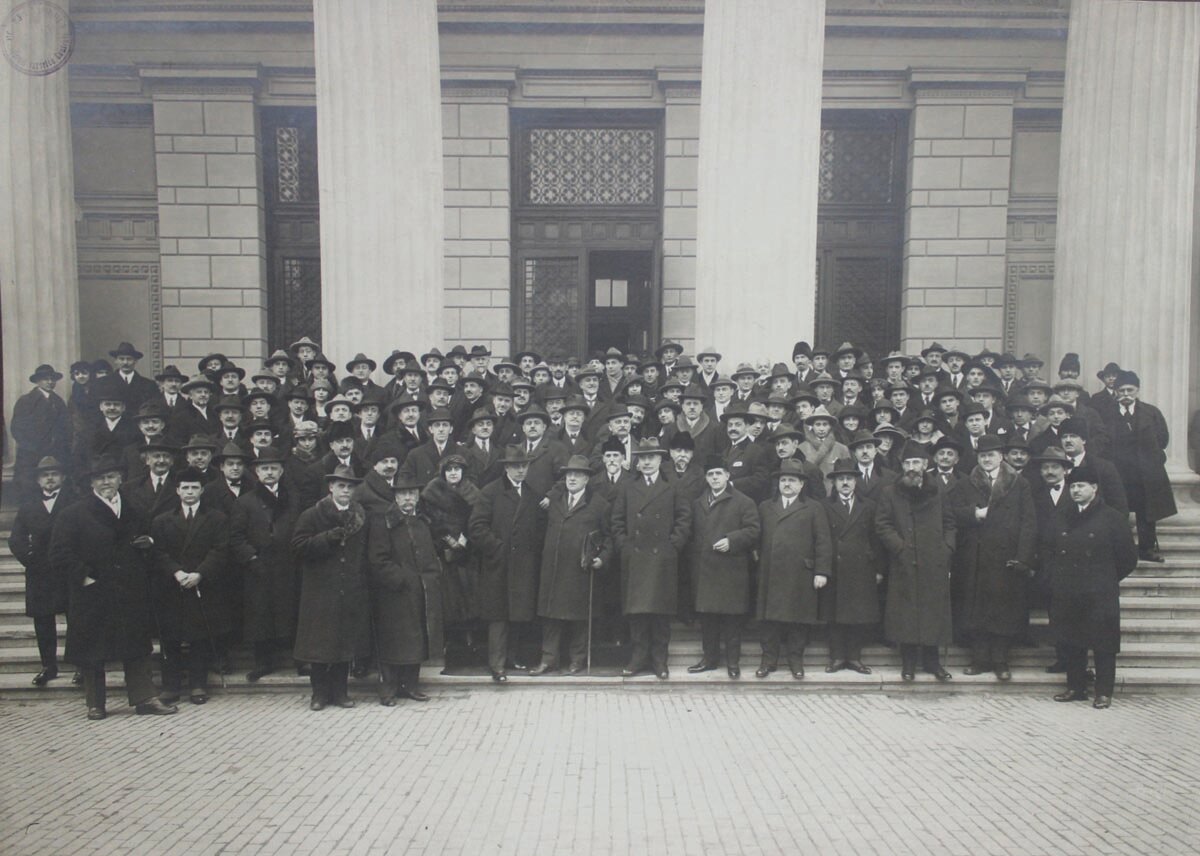
| On February 26, 2016 we celebrated the 125th anniversary of the founding of the Society of Romanian Architects. For the Romanian architects' guild it is almost a mythical date, probably one of the (very) few things really known about our professional organization. There have been periodic celebrations of the foundation of the Society. Not coincidentally, the first congress of architects was organized on February 25 and 26, 1916, celebrating the 25th anniversary of the SAR. On its semicentenary a substantial 1941 issue (No. 1) of the magazine "Arhitectura" honored both the Society itself and its protagonists - successive presidents or members who, over the years, have played an important role in the functioning and affirmation of the SAR in the professional environment and in the society as a whole. Important events were organized in 1991, on the Society's centenary, by the reborn Union of Romanian Architects: a large exhibition at Dalles Hall, entitled Romanian Architecture in the European Context, substantial conferences held by prominent personalities of our architecture and many distinguished guests from abroad, the realization of a homage medal, and the magazine "Arhitectura" dedicated a substantial double issue to the event - 3-4/1991. It was a clear sign of the desire of the architects and their professional organization to renew a thread of continuity that seemed broken and, on the other hand, to (re)assert our natural belonging to the European professional environment. This issue of "Arhitectura", with its thematic dossier dedicated to the 125th anniversary of the founding of the SAR, seems to be part of a not very long series of regular anniversaries when the profession and the general public remember the organization that, over the years, has ensured the recognition and affirmation of the profession, at least at national level. It was not our intention to produce an "anniversary", festive issue of the magazine, but, starting from the honorable age of the Society of Romanian Architects - Union of Romanian Architects - Union of Architects of the RPR/ RSR - Union of Romanian Architects (the three names that it has had, in time, our organization), to open a much broader perspective on an organization with a turbulent history, with ups and downs, but which has tried, regardless of the context in which it existed, to raise, affirm and maintain the important role of the architect in society. It is an organization with several beginnings; this particularity was given by the entire political, social and cultural context that characterizes, in fact, the entire modern history of Romania. The first one, in 18911, the Society of Romanian Architects, was the result of the will of a group of architects, which was officially recognized as a moral and legal person only in 1903. SAR disappeared in the upheavals (political and social upheavals) of the late 1940s. The second beginning can be considered as the organization, in December 1952, by decision of the then ruling bodies of the country, of the Union of Architects of the RPR/ RSR, subordinated to the state structures. After the important political changes of December 1989 and following the will of the architects (as in 1891), by Decree-Law no. 127/1990, the Union of Romanian Architects (current name) was recognized as the successor of the Society of Romanian Architects, as well as its independence from any state structure. These two new beginnings were built, perhaps contrary to appearances, to the greatest extent, each on the previous structures of the society, aspiring, more or less declaredly, to continuity. The Society of Romanian Architects and the Union of Romanian Architects played a key role in the emergence of two other associations; they thus generated, in turn, two new beginnings: in 1932, when the Corps of Romanian Architects was founded and, in 2001, when the law was passed establishing the Order of Romanian Architects, both resulting from the long-standing efforts of the two organizations (SAR and UAR) to recognize the diploma, the profession and to formalize the status of the architect, his cultural and social identity, as the only professional entitled to sign architectural projects. They were and still are complementary organizations, each with its own well-defined role for the profession, in a collegial and collaborative relationship, to which the same architects belonged and still belong.2 Starting from the recognition of this complexity of a history that has by no means been linear, an investigation of the overall role of the Society must take into account the different directions in which it has operated: from obtaining the recognition of the profession and the right of signature for architectural projects (a direction that was permanent, except in the post-war period, when the right of signature was implicitly granted to all UA members), to the constant interest in the protection of monuments, from the relations with the school of architecture, which the SAR itself created, to the often ignored presence at various international events, from the constitution and growth of its own patrimony (headquarters, library, photo library, etc.), to the encouragement of the cultural value of its projects and achievements through the prizes it has been awarded. Above and beyond all this, there is always a constant desire for a collegial, convivial meeting of architects, beyond the necessary exchange of views on architecture and the city. Before outlining how this thematic dossier, which offers a variety of perspectives on the subject but is inevitably limited to a limited number of pages, has been put together, a few clarifications are necessary. Firstly, its entire history has been considered, emphasizing the fact that the lively interest is the same for any of the historical periods so different, and therefore the whole evolution of our professional society is taken into account. The period between the emergence of the Union of Architects of the RPR in December 1952 and the political changes of the late 1980s has not been avoided in the second place. It is a period, respectively, a subject that has hardly ever been discussed in any detail to date. What is more, one might even say that it has been largely bypassed, like the entire period of the existence of the Union of Architects (1952-1989), for which there are, instead, numerous clichés, repeated time and again, according to which an entire 40-year period can only be condemned en bloc. This is perhaps a reflection of a predominantly (or exclusively) political perspective on the period and, implicitly, on the AU. On a closer and deeper look, it may turn out that the usual term of comparison - the inter-war "golden age" - in which the liberal profession and the professional organization of architects would have existed independently of any political interference of the time, may not be entirely accurate. An example, which may be an exception, no doubt, is that of the rapid change of the leadership of the SAR at the beginning of the short-lived Legionary government, which was immediately afterwards replaced by another, none of which resulted from elections by the SAR members. It was undoubtedly a political "order". This example may be singular, but political meddling is probably unavoidable in architecture and urbanism. The situation after 1950 is undoubtedly much different. At the same time, the existence of the Union of Architects, after its foundation in 1952, has been much more complex than a definitive and complete categorization as one totally subordinated to the political factor. We believe that a more nuanced perspective is necessary, in which the political factor, which is so powerful, is weighed against the professional factor and the evolution of the architectural profession in a period in which the whole world has undergone profound, immense transformations, and our profession has, as far as possible, followed this line. Finally, thirdly, it is clear that the organization(s) of architects belongs to the broad sphere of our architecture. Its history cannot be separated from the history of architecture; the links between them are among the most relevant, for they can point out to us ignored meanings, positions that are difficult to understand otherwise, reciprocal relationships in the case of certain directions of architecture or urbanism. It should also not be overlooked that there has always been a close link between a certain orientation of the society of architects towards one or another direction of Romanian architecture and its evolution; this is as evident as can be seen throughout the period, from the neo-Romanesque architecture promoted by the generation of architects who founded the SAR, to the National Biennials of Architecture of the last 24 years, which, through the prizes awarded, emphasize the quality of architecture and the entire built environment. On the other hand, the leadership of the association has, over the years, included leading personalities of our architecture, and their contribution to the good of the profession is not only reflected in the profile of the person, but also in the effects on the entire profession. In compiling the Thematic Dossier, the emphasis has been on the organization itself, with references to the architecture of successive eras being mentioned only in the background; its evolution is a more familiar subject, to be sure. What is essential in this context is a chronology that brings together the most important dates and events related to the life of our organization, from all periods of its existence, regardless of the (relatively) different names it has had over time. Some complementary information to the chronology suggests the wider internal framework within which, throughout these 125 years, the association has existed and functioned. It is, to the best of our knowledge, the first detailed chronology of its kind, covering with equal attention and interest all the very different periods through which the professional association of architects has passed. The prominent personalities of the SAR-UA RPR/ RSR-UAR - the successive presidents, sketched in brief sketches - are also present. Some of them have led the society for one year (as it was in the early days of the SAR, when the Statute required the annual collegial change), others have had several terms as president (Petre Antonescu, for example), others, finally, have been presidents of the organization for long periods (as was the case of Cezar Lăzărescu, for 14 years). Some have been and are unanimously recognized and appreciated for their contribution to the quality of Romania's built environment, other personalities are controversial enough, but without them our architecture and the role played by the association of architects cannot be understood. To all of them, however, we must recognize the merit of doing everything possible to ensure that the form of professional association takes its rightful place. A few details of particular periods or issues are intended to contribute to our knowledge and understanding of society in that era. The first, which concerns the period of existence of the SAR, is relevant to the way in which, gradually, a new association builds an identity, consolidates it with a maturity worthy of emphasizing, and opens its sphere of concerns quickly enough to almost everything that concerned the liberal practice of the profession and the architect's place in society. The second has a narrower focus: it analyzes the way in which the liberal profession was suddenly and radically directed towards that of the architect-salaried state employee in the design institutes which, gradually set up, each with its own specificity, constituted the only means of affirming architectural creation for about 40 years. A third considers the way in which the Union of Architects, through the prizes awarded to architects, aimed at signaling the quality (perhaps excellence) of the most relevant part of the architectural and urban planning production of the 1960-1980s. The post-1990 existence of the UAR is presented and commented on by the successive presidents of the organization, each of whom, in their own way, ensured the development and continuity of the initial intentions, which were largely the result of the architects' demands, expressed with great force and clarity during the hot period from December 1989 to January 1990. Apparently, this issue of the magazine could be considered an issue devoted exclusively to history. In reality we believe that, since it deals with the way the profession is organized, an ever dynamic one, with frequent and sometimes rapid changes, it is an occasion for reflection for the profession and our entire culture on the role that a self-conscious association can play, through its members, in determining the quality of the built environment. |
| NOTES: 1 The founding date is late enough compared to similar organizations that were established decades earlier, but is fully embedded in the domestic context that will be sketched inside the magazine: the famous Royal Institute of British Architects (RIBA) was founded in 1834, for example; in the same decade the first organization of architects and engineers in Switzerland was founded (1837). In several other countries, associations (and societies) of architects were founded in the 1860s and more numerous in the 1870s, including the Société des Architectes Diplômés par le Gouvernement in 1877, a French society well-known to Romanian architects and probably a model for Romanian society. 2 Nowadays, the scope of professional organizations has widened considerably, as a reflection of an often accentuated diversification and specialization of the profession, imposed by the evolution of society and of the profession itself, through the establishment of new associations. The most important are the Romanian Register of Urban Planners (RUR), in 2004, the Association of Interior Architects, in 1999, and architects specializing in the restoration of historical monuments are part of the National Union of Restorers of Historical Monuments (UNRMI), founded in 1991. However, the Union of Romanian Architects represents the permanence of this tradition of our entire profession, a tradition shaped by the overlapping of diverse eras, cultures, mentalities and personalities, which ultimately enriches our heritage. |
| On the26th of February 2016, we have celebrated 125 years since the establishment of the Society of Romanian Architects (SAR). For Romanian architects this is an almost mythical moment, perhaps one of the (very) few known facts about our organization. There have been periodic celebrations of the Society's establishment. Not by chance, the first SAR convention, celebrating 25 years of existence, was organized on the25th and26th of February 1916. For SAR's semicentenary, an extensive issue of Arhitectura (1/ 1941) paid homage to the Society itself as well as its protagonists - presidents and members who had a leading role in establishing SAR's status within the profession and society. Important festivities have also been organized for SAR's centenary in 1991 by the 'reborn' Union of Romanian Architects. A large exhibition entitled Romanian Architecture within the European Context was opened at Dalles Hall in Bucharest. Various conferences were held by prominent figures of Romanian architecture and esteemed guests from abroad. An honorary medal was also issued. Furthermore, Arhitectura dedicated a generous double issue to the event. This was a clear sign that architects and their organization intended to reconnect with their history and, at the same time, assert themselves in the European professional milieu. This special issue of Arhitectura, dedicated to SAR's 125-year celebration, is part of the not-so-long series of periodic celebrations that reminded architects and the general public about the role of the organization in acknowledging our profession, at least on a national level. However, it was not our intention to produce an anniversary issue. We wanted to use this opportunity to look from a broader perspective to the organization (later called Union of Architects of Socialist Republic of Romania and Union of Romanian Architects, respectively) that, despite its ups and downs, never ceased to promote and maintain the role of the architect in society. It is an organization that started anew several times due to the political, social and cultural context that characterized Romania's modern history. The first Society of Romanian Architects (SAR), dating from 18911, was formed by a group of architects and was not officially recognized until 1903. The Society ceased to exist in the tumultuous events of the late 1940s. Thus, the second beginning could be considered the creation of the state-run Union of Architects of Popular/ Socialist Republic of Romania (UA-RPR/ RSR) in December 1952. After the fall of communism in December 1989 and following architects' wish (as in 1891), the union, renamed Union of Architects of Romania (UAR), was acknowledged as the successor of the Society of Romanian Architects (SAR) and released from the authority of the state by the Decree-law 127/1990. Despite appearances, these two new beginnings were largely based on the previous structure of the society and aspired, more or less openly, to continuity. The Society of Romanian Architects (SAR) and the Union of Architects Romania (UAR), respectively, had a crucial role in the creation of two other associations, thus generating two other new beginnings: in 1932, when the Architects' Corps of Romania was born, and in 2001, when the Architects' Chamber of Romania was created by law. These organizations were the result of SAR's and UAR's relentless effort for the recognition of the diploma, of the profession, of advocating for the architect's status, social and cultural identity, as the only professional able to stamp a project. Both have been complementary organizations with a clearly defined purpose and have had good relationships with SAR and UAR, as their members were often the very same architects.2 In order to have an overview of the organization's significance, one must start from its sinuous history and investigate all the divergent directions it went into: from getting recognition of the profession and of the right to stamp the architectural projects (constant preoccupation with the exception of the post-Second World War period when all members of the Union were automatically licensed) to advocating for the preservation of the built heritage; from maintaining good relations with the school of architecture, which was created by the organization in the first place, to participating at numerous international cultural events (even though this was often ignored); from acquiring assets for the internal use such as the headquarters, the library and the photo library, to encouraging good quality architecture by offering awards. Above all these, there was architects' constant desire to gather in informal meetings, outside necessary professional debates over the architecture and the city. Before we proceed to outline the content of this issue, which could have easily expanded beyond this limited number of pages, some remarks are needed. First, the whole history of the organization has been taken into account, with the same interest for all its different time periods. Therefore, the whole evolution of the professional society has been taken into account.Thus, the period from 1952, when UA was created, until 1989 was not ignored, a topic that has been hardly covered by recent publications, not to say avoided. There are, however, clichés according to which this whole 40-year-long period can only be condemned. This is perhaps due to a predominantly (or exclusively) political perspective on this period and, implicitly, on UA. At a closer look, the presumed independence of the profession and the organization from political interferences during the so called 'golden age' between the two world wars might not be so correct. For instance, shortly after the Legionary Party took power, SAR's management changed twice within a short time and this was by no means the result of SAR's members' vote. It was no doubt an act of political interference. Even though this example might be singular, political interference in architecture and urban planning is probably hard to avoid. The situation after 1950 is obviously different. It would be too simple to say that the Union of Architects' activity was completely subordinated to the political agenda. We believe that a complete, objective assessment of this period must include not only the political factor, which was indeed very influential, but also the professional aspect. After all, this was a time when the architecture profession experienced profound transformations in the whole world and Romanian architects tried to follow this line as much as possible. Lastly, it is clear that the history of the organization(s) cannot be separated from the history of Romanian architecture at large. Looking at these altogether, one can discover forgotten meanings and understand unexplainable decisions and directions of Romanian architecture and urban planning. Also, one cannot ignore the relation between the organization's vision and the evolution of Romanian architecture. This is very well illustrated by the emergence of the Neo-Romanian architectural style following the impulse of the architects that created the Society of Romanian Architects and, more recently, by the National Architecture Biennial, which has rewarded good quality architecture over the last 24 years. What is more, the presidents of the organization have often been prominent figures of Romanian architecture that influenced not only the organization, but the whole profession. For this issue we have focused on the organization itself, leaving the references to the architecture of each particular time period in the background, as these are certainly better known. Thus, we have drawn a timeline of the most significant dates and events from the history of our organization, whatever its name was at the time. This is, as far as we know, the first attempt to include all the time periods of the organization into a detailed timeline. Also included are few facts about the prominent figures of the organization, namely presidents of the Society of Romanian Architects, the Union of Architects of RPR/ RSRUA, and the Union of Architects of Romania, respectively. Some of them have been in charge for only one year (as it was required by SAR's statute in its first years), others for longer periods of time (such as Cezar Lăzărescu for 14 years). Some also had several terms (Petre Antonescu, for instance). Some have been unanimously recognized for their contribution to the quality of the built environment in Romania, others more controversial, albeit essential for understanding the role of the organization in the history of Romanian architecture. Nevertheless, all must be appreciated for their effort to do their best for the organization in the given circumstances. Furthermore, some detailed information sheds light about the activity of the organization in certain periods of time. The first, covering SAR's existence is relevant for understanding how a young organization gradually builds up and consolidates an identity, opening up towards almost all aspects of the profession. The second has a narrower scope. It analyzes how the architecture practice suddenly and radically shifted from a liberal profession towards one in which architects became employees in state-owned enterprises, which were responsible for the architecture production for approximately 40 years. The third discusses how the Union of Architects (UA) stimulated good practice in architecture and urban planning through awards between the 1960s and 1980s. UAR's activity after 1990 is presented and commented by the presidents that were in charge of the organization, who ensured the continuity and development of the ideas and demands clearly expressed by architects in the troubled days between December 1989 and January 1990. One could see this issue of Arhitectura completely dedicated to history. However, we believe that looking back at the many and often rapid changes our profession experienced could be an opportunity for reflexion about the role of such an organization in influencing the quality of the built environment. English version by Alex Retegan |
| NOTES 1 SAR was founded rather late, compared to similar organizations from Europe such as the Royal Institute of British Architects (RIBA) in 1834, the Swiss Society of Engineers and Architects (SIA) in 1837 and the French Société des Architectes Diplômés par le Gouvernement in 1877. The delay can be explained by Romania's internal context, which will be further analysed throughout this issue. 2 Currently, the number of organizations is considerably larger due to the diversification and specialisation of the profession. Among the new organizations stand out the Romanian Register of Urban Planners, founded in 2004, the Romanian Interior Designer Association, created in 1999, and the National Union of Restorers of Historic Monuments of Romania, from 1991. Nevertheless, the Union of Architects of Romania stands for the continuity of our profession and the tradition shaped throughout different times, cultures and mentalities, which can only enrich our current heritage. |