Virginia Haret. Who Has Something to Say about that?

HOTELS IN BULGARIA
observed by Architect H. Delavrancea
1962

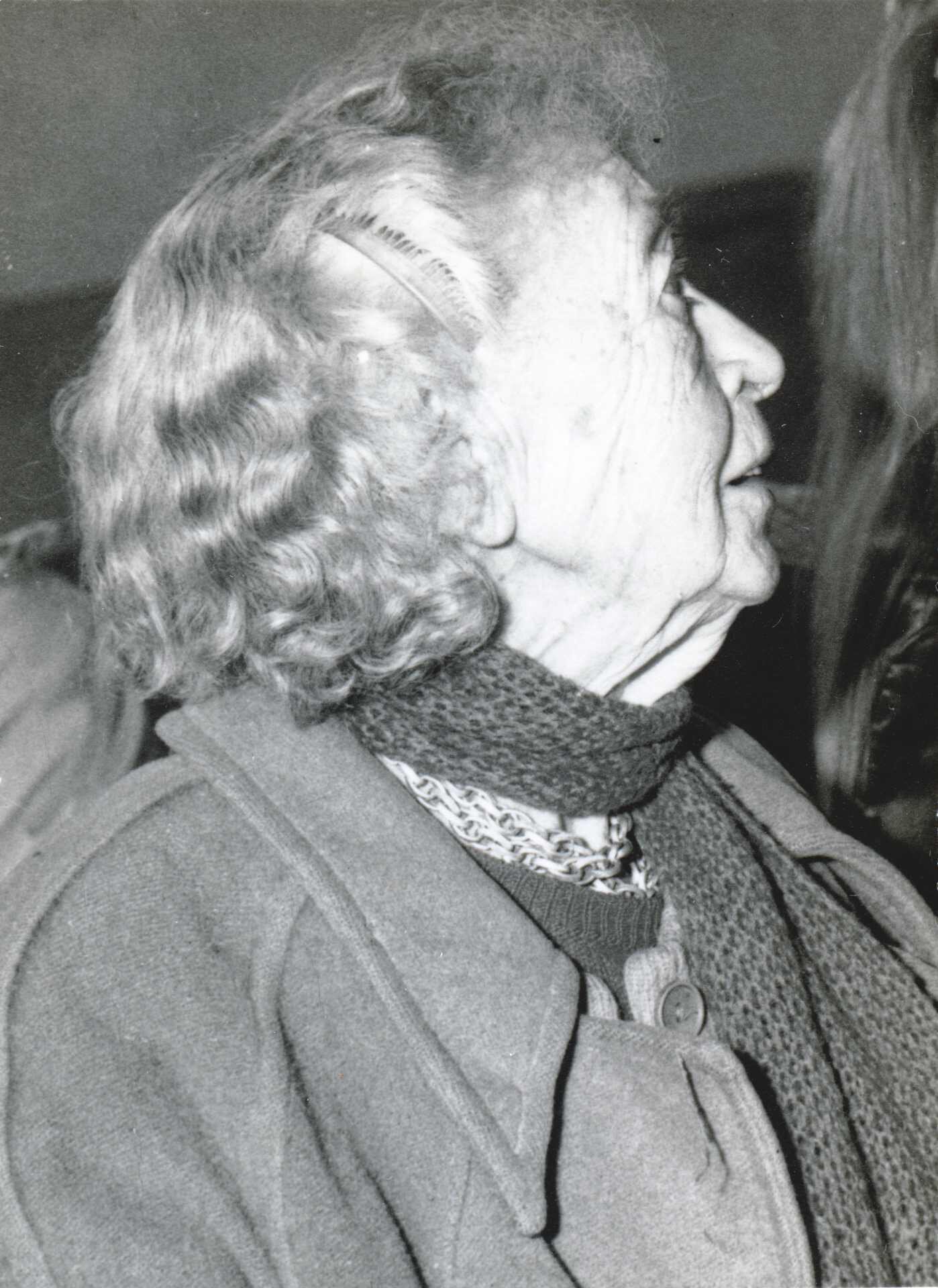
In 1962, Henrieta Delavrancea, together with a group of architects, took part in the excursion organized by UAR (through ONT Carpathi) to Bulgaria, an occasion on which H.D. wanted to revisit, after more than two decades, the works realized in Balchik during the interwar period.
In his article in Arhitectura 1/1988, Radu Patrulius wrote about this moment:
"For many years I had recognized in her a fierceness against snobbery in all its facets. She allowed herself the self-irony: '...In my youth, when I traveled through the picturesque corners of the country, I looked like the actress playing the Lady of the Camellias...'.
In June, 1962, only the sapphire of her eyes, which not only looked and deepened, but observed what was invisible to others, had kept the romantic air. The Union of Architects had brought us together in a group that traveled, in a short coach journey, through a country full of pleasant surprises: Bulgaria. In everything - as in her attire - our oldest lady stood apart from us. She carried her daily sketch pad in a satchel and didn't waste a minute to capture various local architectural patterns. One day, delaying us a halt, some confreres reproached him rather... sonorously. "- Barbarians!", was her retort, well-deserved by those with preoccupations centered on some shopping and oversleeping along the way. We were grateful, Victor Aslan and I, when, at the rest stop in Balchik, the author explained to us the "Mysterious" villa built for Ion Gesticone. Finally, she was a mature judge of "Romanianesque" at H. Delavrancea-Gibory, this resulting from genetic filiation, synthesized in the symbiosis with the Grigorescian prototype of the Inn of Orății and with her vocation as a mathematician."
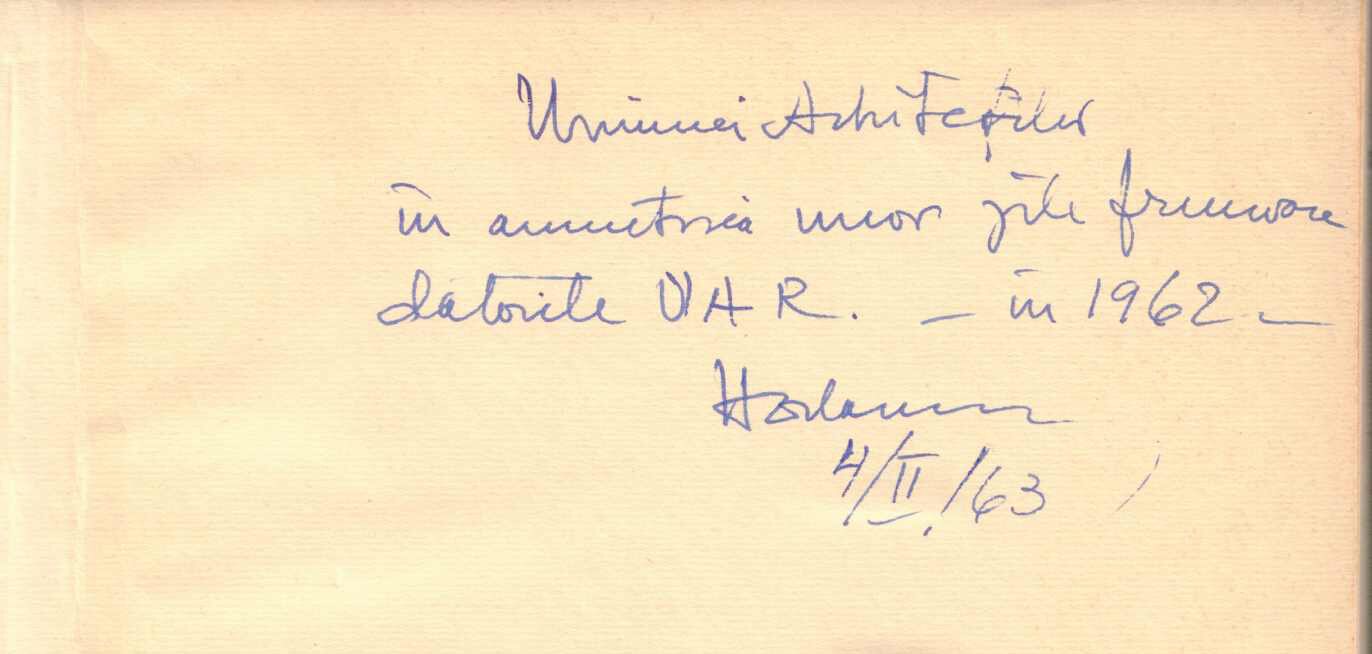
The text we publish below does not refer to Balchik, but only to the "Bulgarian-style" hotels visited in the cities included in the itinerary, "from Russe, Sofia and Plovdiv, all of Balkan-Tourism", which Henrieta Delavrancea comments on critically, but with immense goodwill and indulgence, although her rich portfolio to date (which far surpassed in architectural quality the hotels described in detail) might have justified a certain arrogance. He was 67 years old, with many remarkable achievements, but he could not contain his curiosity and interest in what he saw. Well-known for the free way in which she expressed her outspoken opinions and for her determination "against snobbery in all its facets", Mrs. Delavrancea revealed herself on her trip to Bulgaria as a conscientious, modest and well-behaved pupil, taking notes and sketching throughout the trip, paying attention to detail, observing "what was invisible to others", not shying away from learning something from everything. Moreover, out of duty to the organizers of the trip, she wrote this "activity report" to the Union of Architects, "in memory of some beautiful days owed to the UAR"1!
A model that is hard to follow today, when the achievements of Romanian architects are nowhere near the level of the hubris exhibited in the professional environment and in the public arena. (Maria Mănescu)

From my visit to Bulgaria, in good and pleasant conditions, but so fast and so little appropriate to the architectural mentality, as the trips are organized with the Carpathian National Tourist Office, I consider that one of the interesting issues to be highlighted is the architecture of "Hotels, with their Restaurants" for Travelers, Tourists, Tourists and Artists, in connection with "The Road" and "The Holiday". The Bulgarian architects know how to realize them for the purpose for which they are created and connect them with the nature, within which they design them.
Roads lead you, and Hotels welcome you.
They take you along beautiful roads, most of them paved, and well paved, through varied and picturesque landscapes, dotted with impressive settlements from all the most ancient epochs: Thracian, Roman, Byzantine, Turkish, post-war and even modern.
Each region offers its own characteristics in this mix, but the hand of man, his struggle for progress today, is strongly felt everywhere. On the roads, with wells and cisterns, with stone benches and shelters neatly designed and built for weary hikers. At the crossroads, signs of directions treated architecturally by small monuments in stone or concrete, clad in various ways, fancifully and expressively designed, variously and amusingly finished, sometimes with chosen materials, the direction sign added to the decorative element. At the dams, we were able to study the plans of the regions in architectural ensembles erected for the skill of the plan, in polished marble of various colors, the water being made of blue Venetian mosaic. In the evening, on some frequented roads, metal hemispheres, set in the asphalt of the road, with small electric bulbs in them, mark, lighted, the separation of the circuits; replaced in the wild mountains by "cat's eyes" both on the central - longitudinal route, and on the edge, in dangerous places.
The restaurants and the bars2 stop the traveler wherever the Bulgarian thinks it is worthwhile to interrupt his journey, for a view, a historical memorial, a dam turned into a sailing center, swimming or just for a rest. And what gets you thinking is not only the many historical memorials, for victories or liberations, but the fact that they erect monuments for defeats as well, so that they don't forget them.
When you arrive in cities, in seaside resorts, in the mountains, in remote and deserted places, hotels welcome you and they all have the same characteristic: they welcome you well, hospitable, clean, cheerful and civilized.
We are referring to those built in the new regime, which show the interest of today's architectural conception.
They are large, solidly built, well-finished, with bright windows open on to the landscape characteristic of each region to which they belong, or created by the hand of man. They have wide, welcoming hallways, well and adequately furnished, discreetly colored carpets, to create at first sight an intimate atmosphere, to which very often contribute whole walls of glass and exotic or specific plants of their country. The floors are made of solid marble or in various combinations and colors. The staircases, ascending to the rooms or to the restaurants, are also of marble, or reconstitute the same material, by various workings, from the most complicated to the simplest mosaic, carried to such perfection in execution as to transform it into an element of luxury. The main circulation doors are of iron or movable wood, with rich bronze handles. The banisters of the staircases are neatly executed on the basis of a fanciful conception, made of materials combined according to the taste of each architect, the emphasis being very often on brass or bronze, matt or glossy, in contrast with iron and plastic. The corridors are wide and paved like the entrance halls, and like these are partly carpeted, impeccably maintained, as is the whole hotel.
The rooms have an anteroom, toilets with all the necessary facilities: basin, WC, shower or bath. Sometimes the rooms are double, first a sitting room, then a bedroom. The lounge is designed in such a way that it can be used or easily converted into a sleeping room for tourists. The furniture is almost always made of polished or waxed solid wood in a simple, rustic style, which they patriotically call "Bulgarian style". Bright, cheerful, clean, flowery and tasteful decor accentuates its freshness. The windows vary with the style of the ages, bringing more and more light into the interiors as their architecture has evolved to today's updated style. Artificial light is discreetly realized, with glass lamps in varied and chosen patterns designed by the architect, each on a case-by-case basis.
As the standard of living rose in Bulgaria, the architect's mentality also evolved, and not only the seaside hotels, but also the city hotels, came to have loggias in all the rooms, separated from each other either by thin concrete walls or glass panels.
The restaurants in City Hotels are designed in a common mass, the connection being through the lobbies or saloons, and have also direct entrances from the street for public access.

In resort and seaside hotels, more often than not, especially in those that have been built in the past, the restaurants, although they remain connected with the hotel, either through the interior or through terraces, are realized in exquisite architectural masses, complete with terraces and open or covered pergolas, arcades to isolate the hotel from the night noise. The restaurants are generally so designed as to be complemented by wide terraces facing the most interesting view, or by interior courtyards, or by courtyards in between. The inner courtyards are veritable gardens, laid out in terraces, creating the landscape where it is lacking; very often they have different levels, with dance floors, shading, basins and planting, giving them the character of Roman atriums, where they also bring in exotic plants in large hirdases and directly plant the dendrological elements characteristic of the region. The varied jedouri3 give life and harmony to the static landscape of the plantations.
The spacious, but often multiple, restaurant halls, linked or completely separated (as in Plovdiv), in order to avoid mass character, sometimes resemble welcoming reception halls. The sober and discreet colors, sometimes more lively, create sought-after and successful harmonies between the walls and ceilings, which are pleasantly complemented by the furniture on the floors, which are always different. The architect's fantasy imagines them either in more classical geometric designs or in the modern unexpected, with impeccably executed marble and mosaic patterns. In the new buildings, large windows all along the exterior wall look out onto nature, which is an integral part of the design. In those from the 1952-1958 era, the connection is more interrupted, in keeping with the style to which they were adapted, and the contrast appears more unexpected.
The Restaurant Annexes, where food is prepared, and which I have often visited for professional interest, are conscientiously designed and realized according to the latest modern principles. A longitudinal office connects them with the halls of the restaurant (very often there are several halls, either connected or spaced apart); it is long and wide enough for the staff to circulate easily, even at over-strained hours, and separated from all the annexes by a general glass wall; all the rooms forming the centers for the preparation of the raw ingredients and the preparation of the food being separated from each other by glass walls also. Supervision is at a glance over the whole, and the material is passed from one room to another through guillotine counters piercing the glass panes; there is no need for the movement of personnel from one room to another. Calm reigns, without interference in functions, and speed of service is obtained. A well-functioning mechanical ventilation prevents the penetration of food odors into the restaurant halls, which are also artificially ventilated.
The impression of civilization and pleasant cleanliness of these annexes, in addition to the satisfaction given by the rest of the hotel, places Bulgaria suddenly among the civilized and developed countries.
The styles in which their Hotels and Restaurants are conceived evolve according to the characteristics of these 17 years ago.
They start by being designed in 1945-1952 in the so-called "Bulgarian style", which stems from the pre-war German style, in which the local tradition is marked by the pottery (or sometimes wrongly tile) cladding, yet not without a certain charm (see Tîrnovo and Plovdiv). I then move on to the renaissance style influenced by the 1952-1959 architecture of the USSR, gradually moving on to the purely world architectural conception of today's times, based on reinforced concrete and the possibilities it offers in construction.
The general observations, which I have described above, are extracted from the fleeting impressions which I have been able to retain in the cities visited so rapidly and with such multilateral interests; which, however, have enabled me to classify the hotels in different groupings, according to the functional characteristics, which, it may be said, would form their basic "Theme", on four particular principles, viz:
I. HOTELS FOR TRAVELLERS AND TOURISTS who visit those localities or have to pass through them.
II. HOTELS FOR TOURISTS AND ARTISTS in pursuit of specific regions of pictorial, architectural-pictorial or archaeological interest.
III. HOTELS FOR VACATIONERS AND TOURISTS.
IV. COASTAL HOTELS for vacationers and tourists.
I shall describe them on the basis of these groupings, both for those which I have lived in or visited, and for those which I have been able to visit, or, on the coast, which I have seen, stopping only at those which are of interest, and reading from them only the specific characters, and passing over the above-mentioned generalities, so as not to repeat myself.
GROUP I. HOTELS FOR TRAVELERS AND TOURISTS
Travelers' and Tourists' Hotels are the hotels in cities, which serve the needs of the normal circuits of the cities and at the same time are intended to serve the tourists who pass through those cities and stop in passing through or come specifically to visit those cities and their peculiar features.
They are generally designed on the principle of a massive building containing the Hotel's general entrance, which serves the restaurant, the Hotel rooms and the Restaurant, with an entrance also directly outside. There are the recreation rooms (with all their urban specifics) also with terraces facing the street, on which meals are served in summer, and with interior garden-terraces.
I will dwell on the hotels of particular interest: the Russe, the Sofia and the Plovdiv, all of Balkan-Tourism.
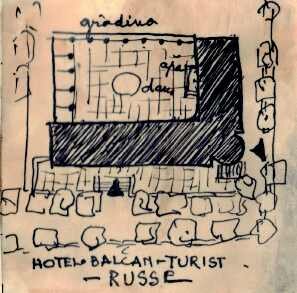
I. La RUSSE (Rusciuc). The hotel is situated on the main square, which is a veritable garden shaded by old trees.
It is built in a sober, travertine-colored style of plywood and artificial stone, construction based on monolithic concrete, the ground floor is a frieze of windows that illuminate the dining rooms of the restaurant, complemented by terraces that unfold towards the trotters.

The three floors of the passenger rooms complete the ensemble, which is influenced by the Dutch-Nordic style between the two World Wars, with insulated windows anchored with simple stone profiles and sober cornices at the crown of the building. The architectural massing is broadly L-shaped, framing a garden-like courtyard with terraces to complement the dining rooms, flanked between two elements that please and please. The restaurant is composed of a series of 3 rooms with an exceptionally harmonious colour scheme, discreetly combining the ceiling, walls and furniture in an optimistic, refined and refined ensemble, which suddenly places Bulgaria in an advanced civilization. Each of the three halls achieves a different variety in the clear and bright polychrome combination. They end in the rotunda of the corner café, with direct access from the outside, treated in a more lively color, appropriate to the movement and bustle of the public that frequents it. A circular staircase, free from the walls, ascends to the balconies of the floors in portafou4 and supported on tall, slender pillars, pillared with colored marble, giving grandeur to the high central volume it creates.
The hotel appears to consist of about 140 rooms for 280 travelers and to have been built around 1952-1953.
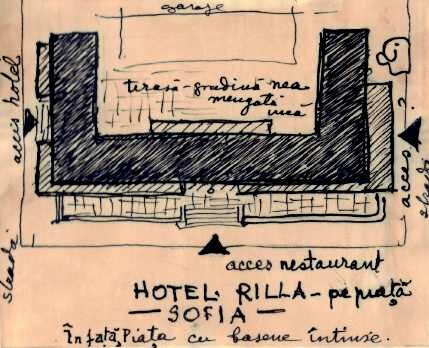
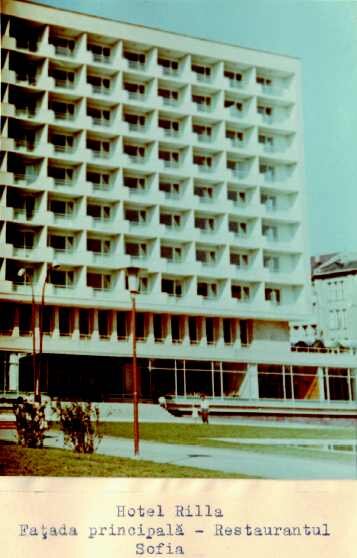
2. The last hotel, built in 196I-1962, also of Balkan-Tourism, is the Rilla Hotel, built on the entire upper side of a newly created square near the center of the capital city, which slopes down gently, giving grandeur to the architectural mass, set between three streets.
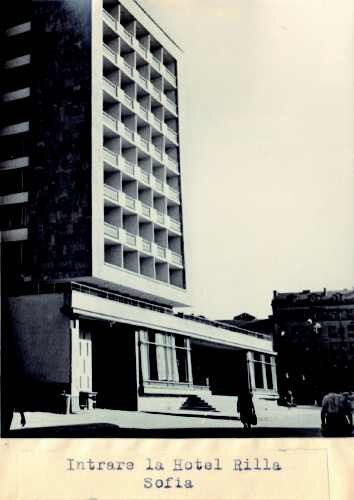
The construction realizes modern construction principles, on reinforced concrete columns (monolithic building) with ground floor and mezzanine, and the 8 floors in accentuated portafou about 1.60 meters above the mezzanine. The three exterior facades of the U-shaped building are designed in an alveolar character, each room being provided with a Loggia, with side walls of fine concrete, the Loggia's bottom, also of glass, gives maximum light to the room. The main facade, on a front about 60 m long, through the axis of which one enters the restaurant, unfolds its large and bright restaurant rooms with glazing all along the wall of the raised ground floor, completed with terraces overlooking the square. The entire facade is reflected in two series of giant basins, placed on the square for this purpose, veritable water mirrors, thanks to which the hotel takes on miraculous proportions.
The facade of the side street on the left encloses the entrance to the hotel, so as not to detract from the ambience created by the restaurant, terraces, basins and lawns of the gardens on the square, with the arrivals and departures of travelers.
The street facade to the right still contains an entrance through a series of projecting windows; but the hotel not being yet completely finished (except in the left wing and part of the center of the square) I could not analyze its purpose. Also, the garden terraces inside, not having yet been laid out, it was not possible to see what they would yield in the future.
In contrast, the luxuriously finished hotel entrance hallway has a specific circulation character, with direct access to the reception and rest rooms, in addition to the restaurant rooms.
The staircase ascends to the upper floors, where we were able to see an exceptionally refined and varied arrangement of rooms. According to the needs and requirements of each traveler, there are real apartments, composed of 1, 2, 3 or 4 rooms, forming groups of lounges, separated by simple doors or glaswanders, as the case may be; furnished in such a way that the lounges can also serve as living rooms for larger families or groups of tourists. The span (corresponding to a room) is about 4,00 m and the depth of the room about 5,00 m. The 340 or so rooms can accommodate an average of 340 x 5/3 = 570 travelers. The anterooms and toilet rooms in each apartment complete their ensemble in an exceptional way, which should be mentioned: each toilet room has a bath, WC, bidet and very wide basin, in harmonized coloring between the tiled walls (up to the top) and the tiled floor, and each one achieves another harmony in coloring; their exceptionally large size varies between 6 and 12 square meters.


The furnishing, too, has a specific character; in the four types of apartments, which I visited, it was of light wood, mostly of solid pine, also based on the simple, modern so-called "Bulgarian" principle, with very light and cheerful colored curtains and curtains, with original and distinct designs; modern carpets, thick and soft, in light shades, harmonized with the rest of the furniture and walls, so as to give the impression of a real restful euphoria, designed to welcome the traveler weary from his journey or to shelter a spirit seeking peace and quietness far from the neurosis of the cities.
The veils of the windows, once thrown aside, the Loggia welcomes you, and you gaze at the lawns and basins of the square, reflecting the sky and the city, which is lost in the distance, to the foothills of the Balkan Mountains, which rise their massive, old silhouette on the horizon.
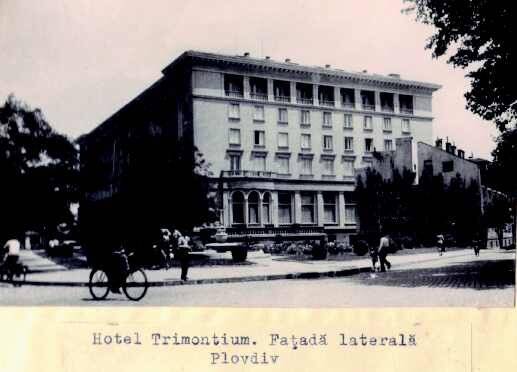
3. In PLOVDIV, the ancient Roman fortified town "Trimontium", over the Thracian tradition, took its name after the three-peaked mountain where the fortress was located and fortified, then in the Byzantine era Filipopolis possesses the most pleasant city hotel of Balkan-Tourism, executed in the era 1952-57. It is called "Trimontium Hotel" and its appearance is dominated by the Neo-Renaissance influence, realized under the constructive impulse of the USSR architects of that period. It is built of monolithic reinforced concrete, without having the character of a building element; in terms of its volume and the hollows and fillings it could just as well have been made of load-bearing masonry.


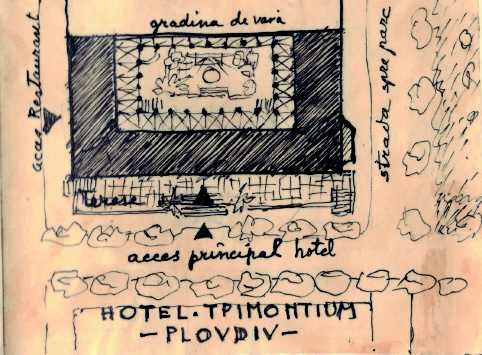
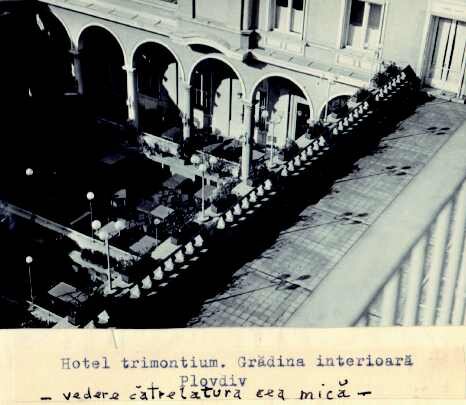
The overall mass of the building is designed in a "U" with the main facade running along the planted street, about 95 meters, the lateral ones 40 meters. The building is composed of a basement, a raised ground floor and 4 floors of living quarters, the interior, surrounded by arcades, creating a magical garden with exceptionally richly landscaped terraces on 3 levels going down to the middle. The rooms on the main east facade look directly towards the old Philippopolis district, from the Trimontium Mountain, a veritable museum, and the wooded mountain with its Turkish clock; and from the 4th floor loggias towards the one overlooking the city, with the monument of Alyosha, symbol of the liberation of Bulgaria, and the distant plain where the Marița River flows. Those to the north overlook the city park and the forest of the mountain dominated by Alyosha.
The interior is particularly spacious and richly decorated. The main staircase is monumental, the landing halls are real lounges with balconies and overlook the inner garden, wide and bright, the circulations are 3.50 meters wide, the large rooms are about 3.70 x 5.00 m, each with a spacious vestibule with mirrors and luggage space and a toilet with all the necessary items.

The hotel has about 200 rooms to receive about 400 travelers or tourists, who come to visit Plovdiv with all its monuments of the past and its oriental picturesque.
Outside, a wide and majestic staircase leads up to the superarched ground floor between two large terraces to the street, sheltered by its massive plantations, complete the dining rooms (especially for breakfast and tea time). The entrance to the restaurant and the inner terrace-garden is set on one of the side streets. Passing from the two large Restaurants into the inner garden, at a glance the landscaping appears charming. Its ensemble, composed on 3 ample levels, unfolds a charming garden surrounded by arches forming the covered part. In three years, the plantations have grown in size and, from the higher regions with arches and pergolas, you can see the weeping willows and exotic trees of the hirdae reflected in the waters of the basin. In this ambience of a gigantic Roman atrium, next to the impluvium with its jedouri, the dance floor adds whimsy and gaiety, creating a center of attraction for the city and holding travelers from far-off countries in their car-tourists and motor caravans.
GROUP II. HOTELS FOR TOURISTS AND ARTISTS
The hotels which are created, especially because of the need to enable tourists to visit picturesque or famous regions for their archaeological remains, stones or architectural remains, and which also become places of residence for artists in their more detailed research and visits, and even centers of creation, are solved architecturally according to the circumstances, terrain and local character.


As places with this specificity, we visited only Tirnovo and Nesebar. The Trimontium Hotel in Plovdiv also participates to a certain extent in this group, because of the Trimontium neighborhood with all the vestiges of the past - Roman and Byzantine, which, besides the Turkish ones, attract artists and give them the opportunity to create.
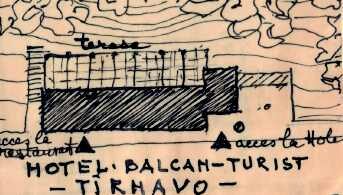
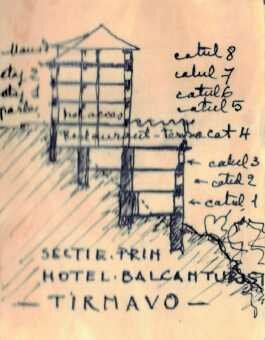
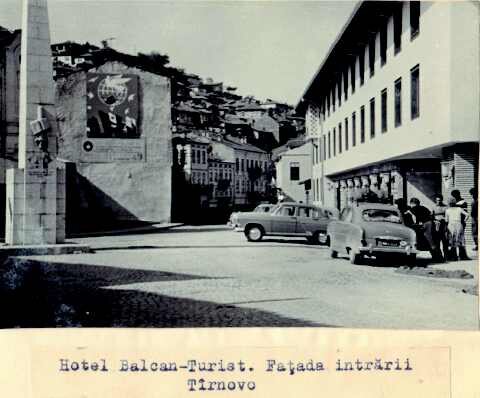
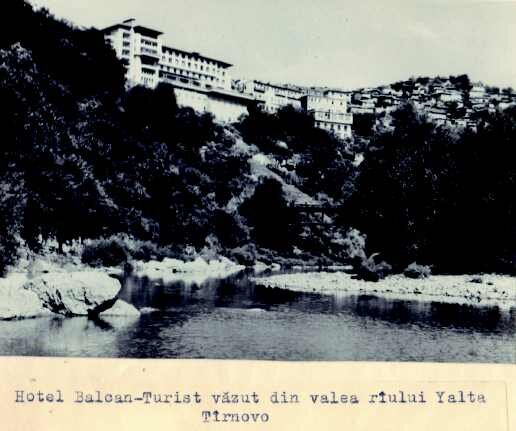
1. In T YRNOVO, the Balkan-Tourist hotel appears directly on the narrow street of the Balkan town, and with all the desire to give it a specific local character (realized only by the pottery covering), towards the street they have created a building in German-Hellvetian style from the 1930-1940s, which specifies the function of tourism. It was built between 1952-1955.
In addition to foreign tourists, who come in passing to satisfy their superficial curiosity in the romantic, fanciful and unexpected center of a corner lost in nature, which transports you back to the feudal era of the old Bulgarian capital, archaeologists also come here, for whom the remains present a virgin and vast field of research; painters in search of exceptional picturesqueness; and architects in love with documenting an epoch which today brings them no tangible, but only a soul gain, like an old forgotten area.
The architectural mass, this time, is a rectangular parallelepiped, with a little variation, but set on a steep and rocky slope, like the whole town, so that the access to the ground floor is through a hall-salon, with a large window overlooking the Yalta River and the mountains of Tsarevitch and Monastir, full of ancient Byzantine ruins, leads up to the hotel's three cathedrals (the third cathedron overlooking the street) and down to the basement for the large restaurant; which, however, in its turn, appears as the 4th floor of stone, compared to the grove from which the stone building rises. So the building, which appears directly on the street, invoking a modern pseudo-Tyrolean tourism, on 3 white plastered 3-castles, from the valley has monumentality and looks like it is built on a 3-castle stone fortress, the terrace with the 4th cat of the dining rooms and 3 whitewashed 3-castles, total 7 catles. The more oriental character can be seen here with all the resplendence of the staircase, which is composed of a series of modern blumer-windows5.


The restaurant can also be accessed directly from the street by special stairs and is complemented along its entire length by a very wide, plastic-covered terrace, which can accommodate all the restaurant's tables and which seems suspended over the emptiness of the valley, in which the Yalta River meanders. The rather simply furnished restaurant and terrace don't match the look of other hotels; instead, they share the same magical romanticism of the rolling hills in a succession of planes created by the meandering Yalta River, where the terraced cottages stand out amid the silhouettes of towers, fortress gates, churches and medieval ruins.
Of the 75 or so rooms, those to the east enjoy the view described above and those to the west the charm of a small Balkan town, with its terraced floors and today's patriarchal life, as if in a continuity that seems to have no beginning and no end! The Hotel Balkan-Tourist, the only modern hotel, which can accommodate only about 150 tourists, does not meet the needs created by such a sought-after center.
2. NESEBAR (Mesembria, from antiquity), the ancient island, where the traces of the fortified Roman fortress and the Byzantine churches, still standing, blend so harmoniously today with the pure Constantinopolitan character of the private houses (themselves tiny fortresses of stone and wood), on a main square, we saw a restaurant with hotel rooms upstairs, in the local style, with wooden pergolas like those in the gardens of oriental households. The tables were set on the square's cobblestones, and were adorned with stunted trees, covered with a white dust characteristic of the place, and rustic wooden pergolas, under which hung Afuzali grapes like colossal jewels. The Mediterranean character, where life is spent in the street and the participation of the style in that of the little wonder town, stranded as if from the sea, reviving long-lived epochs, from ancestral times, with its ancient port, is the most appropriate solution on which the architects could have stopped, not trying to externalize their personality, but content to preserve, maintain and continue a permanent existence.
Tourists are rarer and artists, in the quiet of the simple hotel, can dream and create.


The group of Hotels of Tourists and Artists would have been an ample subject had we been able to visit the string of exceptionally picturesque localities where painters are scattered, especially Sozopol, with its Turkish character on steep cliffs; Ropotamo, wooded; Primorsko; Kiten, with its picturesque bays and forest descending to the water; Miciuri; Ahtopol.
GROUP III. HOTELS FOR TOURISTS AND VACATIONERS
The purpose of the Tourist and Vacationer Hotels is to enable vacationers to find a resting-place after excursions and excursions or rest after a year's work, and to give a hospitable and pleasant welcome to the travel-weary tourist.
Bulgarian architects build their restaurants, which easily become places for parties and merrymaking, in direct connection with the hotel, but with special construction masses to isolate one from the other.
For part of the vacationers, the hotel and the restaurant being the ultimate goal, the center of life, the architects knew how to combine nature and construction and to capture it in their own architectural elements, adapting the composition to the surrounding ambience and even creating elements of nature to lift and enhance the concept. I will be able to describe the hotels in PLEVEN, VITOSA, BOROVEȚ and STOLETOV, visited or inhabited.
1. PLEVEN, the small historic town, Plevna, linked with the independence of the Bulgarian people, which they explain in detail to tourists, have succeeded, by will and ingenuity, in transforming it into a center of villagization.
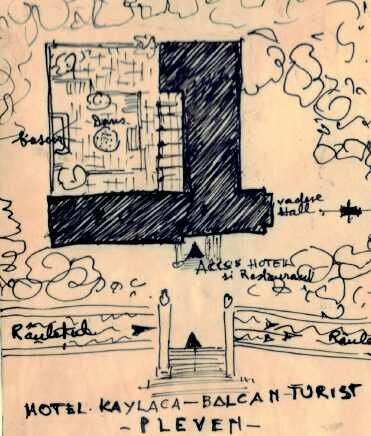
Indeed, a short distance from the little town, in a place called Kaylaca, where a tiny river flows, they have created a water sports and bathing center with a small establishment and a hotel, thanks to a dam built in the valley upstream, which gives the river a chance to flow.
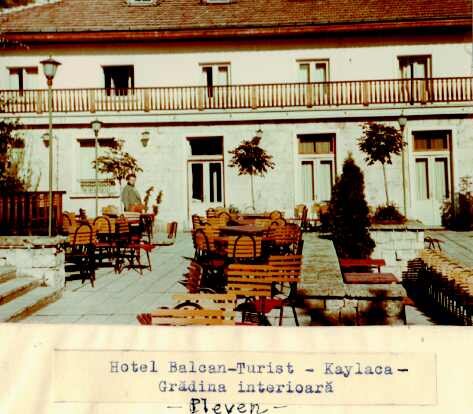
The hotel in Kaylaca, built by Balcan-Tourist, is slightly Germanic in character, like Tîrnovo, but almost monastic, with a stone ground floor, a first floor in white plaster, and a second floor with a loft, which is a bit too mean. They thought they were doing it in the Bulgarian style.


Set in the middle of the woods, it unfolds its volume somewhat in an "L", which catches a large garden-terrace with bumps, plantations, basene, shades covered with yellowish plastic masses, under which one dines; and in full sun, the light becomes strange.
Varied and rustically landscaped nooks are joined at the far end by a basen, and in the center is the dance floor, amid varied paving with small tables tucked among the plantings.
After crossing the romantic bridge over the little river of the resort, the hotel is entered through a wide, low-ceilinged lobby, which extends into a parlor like that of a large private house, graced with a large stained-glass window opening on to a green lawn lost beneath the woods that skirt the hotel on three sides. There are tourist rooms on the ground floor, on the main front of the building, and on the first and second floors and attics, picturesque but too dark for their specific construction.
The construction is based on load-bearing walls, reinforced concrete floor slabs and attics in the eaves covered with tiles.
The furnishings are quite simple, all in their principles.
There are about 110 rooms for 220 guests. A large dining room, lined with wooden panels, emphasizes the style of the building, which, both on the outside and more accentuated in the interior garden, have an Austrian monastic character, with all the success of the landscaping of the terraces.
To complete the entertainment needed by holidaymakers and tourists, the park continues near the hotel to a natural grotto, through lawns, flower sculptures, where a restaurant is set up on the sites of ancient paleontological settlements. The interior style has a Germanic-Naive character with stuffed bears, deer antlers among the stalactites, walls lined with brown wooden panels, mysterious electric lights, zip-line tables, orchestra, dance floor... everything, not forgetting the water games in the edge of the cave entrance vault to create merriment and antren, which does not discontinue day and night.
On the other side, at the head of the river, the valley continues between walls of rocks, which lead to the dam of which I have spoken, which forms a rather large lake. Above the dam, for 2 years a series of constructions for modern not too large hotels and rest houses have been started, creating a small resort with a nautical center, sailing, sports, baths, complete with mineral water sources.
Down by the lake, he dug into the rock to create an original construction for undressing cabins whose free solution delighted my Romanian colleagues with its simplicity and boldness of creative imagination.
This is what the will and labor of the Bulgarians created in Plevna, in places where once there was death and anguish near the battlefields.
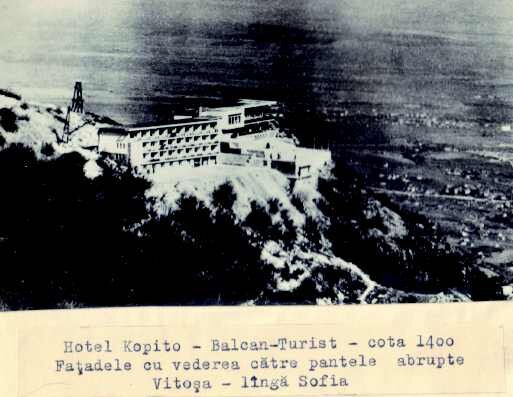
2. At VITOȘA, a point in the Balkan Mountains in the immediate vicinity of Sofia, but at an altitude 800 meters higher, Balkan-Tourism has built on the terrace called Kopito a hotel for tourists, weekenders and mountain villagers, which is a real revelation.


Reinforced-concrete architecture grouped in two outstanding masses. Architectural realizations of the last 2 years in a completely modern spirit, in which the light and unclad construction reads. The two-storey restaurant with its marvelous view wide open, through its glass panels and slightly scalloped balustraded terraces, barely existing and partly reduced to completely free planes on the rock. A glass link, with a sumptuous lounge above, connects the restaurant to the four-masted Hotel, which comprises about 70 rooms for about 140 vacationers enjoying the same impressions. The sudden transition from 600 meters to 1400 meters altitude, as well as the local ambience, produces a powerful effect and I have never seen a place more overcrowded and with a more madcap merriment than at "Kopit", where the high peaks of the Balkan Mountains draw the tourist-alpine-tourists another 700 meters higher, towards the peaks.
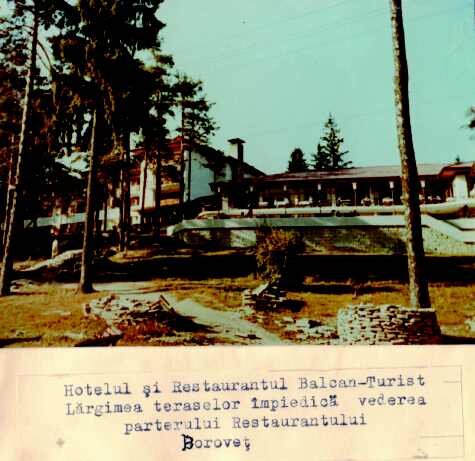
3. BOROVEȚ, a holiday resort in the high mountains, in the middle of a coniferous forest, Balcan-Turist has a hotel built, like a mass, on the Kopito principle of separating the hotel from the restaurant, the functional connection being made through the hotel entrance.
Access to the restaurant is also directly on the opposite side and through the two terraces, which are so wide that the ground floor disappears first, then the first floor. The dominance is categorical over the whole of the climatic resort, which stretches down into the valley with its buildings lost beneath the tall trunks of fir and pine trees, here being the center of attraction of the locality.
The almost all glass facade of the restaurant gives a modern character of reinforced concrete construction (very well behaved) with all the red cladding tying in with the character of the Hotel.

The style of the hotel, more modern than the Kaylaca-Pleven, however, consists of a ground floor and two floors, partly 3, partly 3, plain white, red-velled, load-bearing masonry, with monolithic reinforced concrete floor slabs, takes on a Central European mountain character because of the green shutters splayed outwards. The same principle of stone ground floor and plastered and varnished floors. The result is a rustic style, quite in keeping with the woodland and the moorland.
The interiors of the 100 or so rooms, with a third attic storey, place the hotel among the neat and well-chosen, on the same general principle explained above, enjoyed by the 250 or so guests; the rooms here have three beds.
In the interior of the Restaurant, exposed wooden slats limit panels of flowery cretonne, wood and glass furniture, in contrast with the large, modern windows and cheerful coloring, succeed in creating an unexpectedness which attracts and varies in each of the ground and first-floor rooms.
In the valley, basene and a river thread complete the as yet unfinished ensemble.
On the outside, although the Restaurant's style is less rustic, the two masses, linked by the Hall's bay window, harmonize, perhaps in large part thanks also to the tall trunks of firs and pines in the forest untouched by the builders of the buildings.
The large, wide, low, irregularly shaped Hall is a real surprise in its form, light, the exceptional achievement of the worked marble floor, the line, discreet of the staircase and the skill with which it links the different directions of the architectural masses, directed according to the contours of the land, the cadence of the transition from one tone to another, realized with the artist's fantasy.
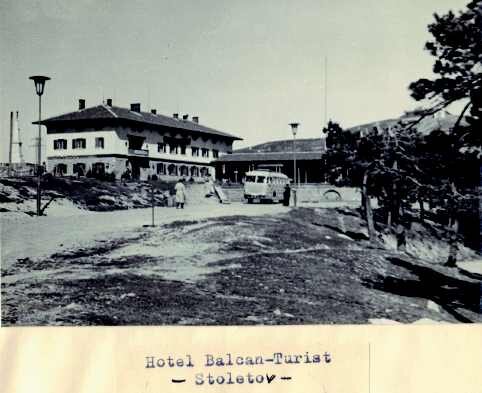
4. At STOLETOV, the historic point of the final expulsion of the Turks by the Russians, aided by Romanians and Bulgarian volunteers, is a tourist center today and somewhat of a resting place, on a steep mountain path, justified by the exceptional view over the wide and wooded valleys in two different directions, by the altitude and the pure air due to the height.
The tourist is attracted by the monument reached by climbing the 900 steps and is welcomed in the hotel built on the same principle as in Pleven, neo-Germanic style, with a stone ground floor, plastered floors and apparent open shutters. A less successful construction, but of moral value; after so much solitude, whether from North or South, the rustic hospitality, almost ascetic in such circumstances, is as gratifying as the most refined in the regions inhabited by men. The restaurant is housed in a special room.
The building contributes much to the solitude of the place, of the region which, although dominated by wooded valleys, remains sad and gloomy, as the name "Stoletov"6 suggests.
The hotel was built around. 1955, is planted in isolation, without any ornamental motif and without any softening of the inhospitable and inhospitable nature.

They have not worked here boldly enough and have not invested the necessary sums to dominate and conquer.
The locality remains an historic, pious pilgrimage to which the visitor to Bulgaria must obey.
GROUP IV. SEASIDE HOTELS FOR VACATIONERS AND TOURISTS
The seaside hotels are built mainly for holidaymakers, Bulgarians and foreigners, the tourists representing a much smaller proportion, by the very short time they spend in the localities, in comparison with those who spend their leisure time at the seaside.
The entire Bulgarian coast is a vast string of picturesque Black Sea resorts. They are strung out one after the other, each more charming and unexpected than the last, over a total length of about 230 km, which is in reality a single endless beach, sometimes wide, golden and open, sometimes in small bays with rocks, sometimes rocky, and always wooded, from the Turkish border to the Romanian one.
From what I have seen, I shall only give the general impressions which emerge, by locality, because, one after another, the strings of Hotels and Restaurants would have to be the subject of a long, detailed and long studied work.
What emerges from all constructions and town-planning is the care for man and his rest, the peace and cheerfulness which are necessary to restore him to health after a year's work, as well as the welcome of strangers in their own country; comfort, civilization, contentment being equal for all.
1. At BURGAS, an important port on the Black Sea, and a large town, a resort is being built, based also on the mineral waters which are taken 15 km. from the town and on its characteristic beaches, with special black sand, which contains iron and has a powerful action on the health.
A modern hotel, clearly made of monolithic reinforced concrete, new, from 1959-1960 on the principle of rooms with honeycomb loggias over its entire surface; with ground floor and 4 floors, it can accommodate about 250 holidaymakers and tourists.
The restaurant, an isolated building on the ground floor and first floor, is functionally linked to the hotel and complemented by ample shading and terraces, linked to the hotel terraces, the whole forming architectural masses distributed in an "L".
The composition is directed towards the newly created garden, a young plantation sloping directly down to the beach. From the hotel rooms, the Loggias overlook the sea and, in the evening, the music of the restaurant's terraces reaches the rooms in a discreet patina, accompanied by the murmur of the sea waves.
The rooms are equipped with vestibule, bathrooms with full and luxuriously finished toilets; they are for the most part two to a suite, in which the sitting-room is furnished to accommodate an extra person. That is three persons to two rooms.
The atmosphere that emanates from the hotel is one of order, civilization and hospitality, it is restful, with all the merriment, dancing and music that keep many people on the terraces late in the evening.
From the hotel, the vacationers, through the garden, go straight to the beach, which stretches all along the coast, only locally stopped by the rather important port of Varna.
Twice a day, the bus also takes you to the mineral water baths, 15km away.
By the luxury with which the hotel is presented and finished, in the best of condition, almost like Sofia's "Rilla", it attracts and retains.
2. THE COASTAL COAST is a large grouping of hotels, a seaside resort on the Black Sea, created on the site of a deserted steppe with an extraordinarily beautiful beach, along which grow sea-grasses and plants peculiar to sandy deserts and then wild woodlands, which they have developed and enriched. On the left bank of the coast, a green and populated hillside, and on the right, the long-forgotten island of Nesebar.
The Bulgarians have landscaped the woodland and, linked by well-paved, winding, winding lanes, have built hotels and restaurants, spaced apart from each other, each time seeming a new discovery.
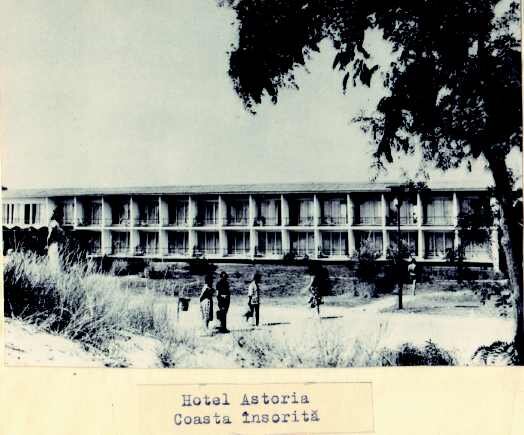
The sunny coast is the last of the whole seaside arrangements they have made; each building is so treated, the proportions and heights varying, that none resembles the other; the fancy and ideas and principles of each individual architect have been given free course. The hotels begin at the lowest, one cat, and run generally from 2 to 4 stories, and one 7 stories, so that the hand of man is lost in nature, among the plantations, no building surpasses and does not mar the area of the green-grey grasses which preserve the wild character, giving true rest and refreshment to the villagers, who restore their health, finding here a setting of true oblivion and isolation from the monotonous, large, massive, similar and overcrowded city elements.
Yet the architectural calm is punctuated by dominant, isolated accents that create the unexpected. The Balkan-Tourist Hotel rises its building mass 14 masts above the woodland, and at the far right, closer to the hills, on the edge of the dune, the seven-story Hotel Balkan-Tourist rises seven stories.
The ensemble of the Sunny Coast is the latest seaside creation and because it was designed and realized in the last 3-4 years, with all the freedom that was allowed in the conception, and it is because of this freedom that this ensemble is the most unitary in the whole of Bulgaria; because it represents the normal world current of an epoch. The unity is in the material: reinforced concrete; in principle, light, thin and functional; complete isolation in the life that goes on within the building; freedom, light and air; discreet coloring, almost non-existent in value between the blue of the sky and the sea, the gold of the sand and the varied green of the plantations.
The Hotel Astoria, for instance, on the edge of the grass, has a string of rooms on the ground floor and first floor, all with honeycombed loggias of solid reinforced concrete, perfectly isolating the rooms from each other, with light and sparse iron railings to let the violet rays of morning well in, and with windows along the wall sheltered by lightly colored curtains in ochre-pink on the ground floor and blue-greenish-green on the first floor.

It is of the same family as the dominant 14-masted Balkan-Turist, based on exactly the same constructive and functional principles. In the 14-storey one, monolithic columns support very wide balconies in portafou, which create room loggias laterally separated by glass panels (suppressed where the grouping of rooms into apartments requires it), which glass continues along the entire wall of the building. Light and delicate reinforced concrete balustrades of thin slats and vertical vertical posts between them realize a constructive lacing across the entire surface of the parallelepiped, giving the material lightness and weightlessness, the most difficult and unfeasible quality to achieve in architecture.
Beyond the first asphalted alley, the access to the Hotel is a little too narrow, instead the terraces run sheltered between the planting on the opposite side. The mules are strung out as follows: At the first a "raz-de-sol"7 of stone plywood: entrances, administration; halls - lounges etc. at the 2nd cat; a superarched, high, brown wood-panelled ground floor houses the dining rooms - restaurant, with dense but narrower windows under a very prominent reinforced concrete slab, definitely creates a "pare-soleil"8 for the return from the beach. The effect of the dark plywood displeased many colleagues; I felt it was a way of tying the building into the surrounding dendrological environment. Set back from this general, more prominent sub-basement9 of 2 masts, rises the 3rd mast, the mezzanine, from which then rise, white, bright and airy, the 10 masts of the living rooms, overlooking the plantation and looking out over the dune and the sea. The 14th floor is a group of terrace rooms, set back from the mass of the building and covered with three wide concrete waves slightly sloping so that they appear almost sinusoidal. From the ground, I reckoned there to be ca. 350 rooms for 500 vacationers (at 2 rooms, possibly 3 people on average).
The 7-masted hotel at the north end is also worth mentioning, especially on the honeycomb, reinforced-concrete principle, with thin walls separating the loggias; the exterior also glass to the sea. Great and unexpected variety in the combination of the apartments and the formation of the rooms. Cleverly designed architectural masses, T-shaped, with a horizontal bar towards the sea, at the edge of the marine plants.
It should be emphasized once again the unitary and at the same time so varied and fanciful architectural realization, due to the complete freedom in which it was designed, the unity in time that sincerely reflects an era. From an architectural point of view, it is the most successful of the Bulgarian villas and very cleverly conceived from an urban planning point of view.
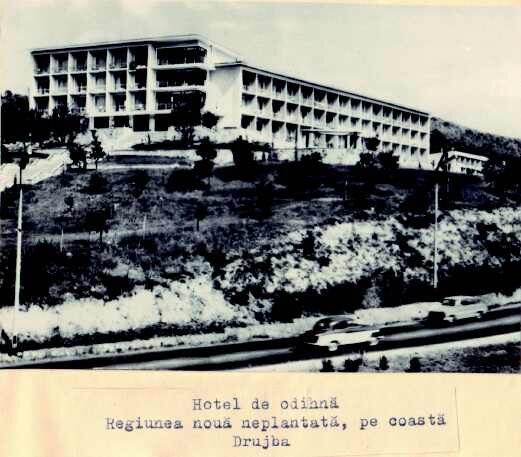
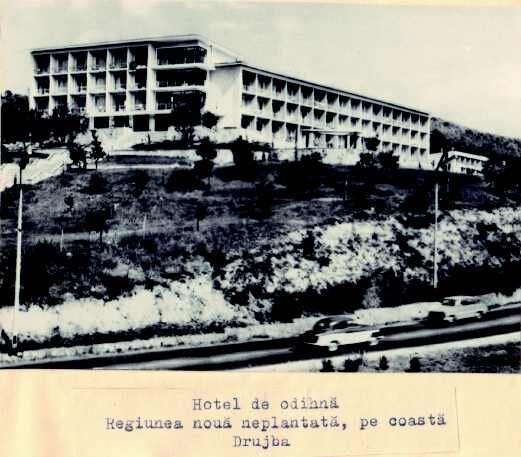
3. DRUJBA (Friendship.) in the framework of gigantic former botanical parks with plantations of strange and exotic old trees, which are interwoven with naturally grown pines and oaks, hotels and restaurants for tourists and holidaymakers have been built, which I have seen in passing; noting as a common feature the adaptation of the construction to nature: Covered terraces pierced by old trees, restaurant terraces shaded by the foliage of pine trees, natural roofs leaning on their stems, like the poles of polystyle halls.
Lost between the plantations set in glades overlooking the sea and the beach, the styles of different eras, mostly from the last two decades up to the present, blend harmoniously with nature, which dominates them. The circulation between the architectural ensembles scattered in the woodland is made only on pleasantly shaded, well-paved roads, which are pleasantly linked to the various beaches, nestled between cliffs, up to which the giant park descends in terraces. Each inhabited center seems to be unique and each new hotel or Restaurant appears like a discovery, none resembling the other and yet in the same spirit for the last five years.
Characteristic is the maintenance of the planting and the adaptation of the building to the unevenness of the terrain, making these one of the guiding elements of the "Theme" he realizes.
In the new construction of monolithic concrete and masonry with large bright openings, pergolas and terraces, which blend with the planting, either bypassing it or integrating it into the building itself, according to the architect's fantasy and power of adaptation.
The massive plantations and lawns lead down to the beach via winding, well-paved, winding roads with constantly changing scenery.
Under such conditions the vacation days of working men are as pleasant as can be, and strangers who come from distant, dreary, cold and damp countries find a hospitable and civilized environment in the midst of exceptional nature.
4. THE GOLDEN NISIPES is an older village, which began to be built in the inter-war period and has developed further.
The hotels and restaurants are more luxurious and massive, the woodland less interesting and the urban layout of the buildings less mysterious, the buildings going down to the sand, the ensemble is more static and the proximity between buildings gives way to more mixing of population.
I could visit no closer hotels and too few restaurants, the main [hotel, ed. note] being extremely large, opening to a pretentious sea-view, it has a gap echoed from the staircase all along the wall, though it is massively surrounded by plantation.
5. WOODEN COTTAGES are a kind of holiday and weekend hotel, broken up into independent wooden cottages camped in the same place. Each one is a room, made of plank, limited to the space necessary for a small family; they are each painted in a different color and installed in groups at interesting vacation spots, in the mountains, on the edges of lakes, dams or on the coast (Drujba), with common annexes, in small, isolated buildings, which serve the whole group.From a practical and social point of view they are very interesting, but they have no constructive or aesthetic interest.

They look like dwarfs' houses.
The Sunken Coast, Drujba, Golden Sands, as well as the other southern seaside villages would be worth seeing and studying in detail, in order to describe in detail both the ensemble and the Hotels and Restaurants which fit in with today's vision, conception and function.
From what I visited in Bulgaria it is clear that Bulgarian architects have closely studied the world architecture of city hotels, mountain resorts, spa resorts and seaside resorts and have had the freedom to design each according to their own ideas, which has given definitely interesting results.
They are not yet building in prefabricated buildings, because, being a poor and practical people, they are waiting for other countries to make more thorough experiments and to adapt them to them when they judge the time to be economically opportune.
The study of adaptation to the land and the appreciation and integration of the buildings with nature also show that a people still earth-bound, perhaps and because it can, must not give up what is permanent in man: living in accordance with the laws of nature.
Romanian architects would have a lot to learn by studying in more detail what and how the Bulgarians have built and what they have accomplished, by visiting their country under the same conditions as our plastic artists do, that is to say freely.
The Bulgarians are waiting for us, and Caloian's Tirnovo Gate10, which was built to prevent foreigners from entering the Citadel, around which bloody battles were fought, is today wide open for us to enter the city.
1 This "report", typewritten, with the original corrections and annotations and illustrated with photographs and sketches by Mrs. Delavrancea, with the author's holograph dedication, was made available to us by the UAR Library. We have preserved the original spelling and explained some French-derived words and expressions that betray the author's "unhealthy origin".
2 From 'Buvette' in French, translated as small place, tavern, serving snacks, breakfast.
3 'Jet d'eau', French for water fountains.
4 'Porte à faux', French for a console.
5 These are windows made up of groups of at least three narrow windows in a full arch.
6 'Stoletov' translates as 'century'.
7 'Rez-de-sol' in French translates as 'at ground level'.
8 Parasolar.
9 Soubassement - foundation, base.
10 Reference to Ionika Caloian, also known as the "Slayer of the Romas" (Bulgarian Калоян Ромеоубиеец), a tsar of Wallachian origin in the Wallachian-Bulgarian Wallachian Tsarate between 1197 and 1207. He was the third brother of the restorers of the Bulgarian state, Peter and Asan, freeing it from Byzantine rule. He stabilized the central power after the assassination of his two brothers and expanded the borders of the Bulgarian Tsarate, securing its position as the main power in the Balkans, mainly at the expense of the Latin Empire of Constantinople. The nickname of Caloian (in Latin, Caloiohannes), translated as "John the Beautiful" or "John the Good" derives from the Greek: Kaloiōannēs representing a form that became standard for some Byzantine emperors having the name "John" (Iōannēs) in the Comnenian period, but especially later. The other name, Iōōnē or Ioannitsa (Йооаница, Ioannica), is a simple diminutive for John. Ioniță Caloian is the name used by modern Romanian historiography. The Byzantines secretly preferred to call him Skyloïōannēs ("John the Dog"). Buried in Veliko Tarnovo.
The original spelling has been preserved and the photographs and drawings illustrating the article belong to the author.