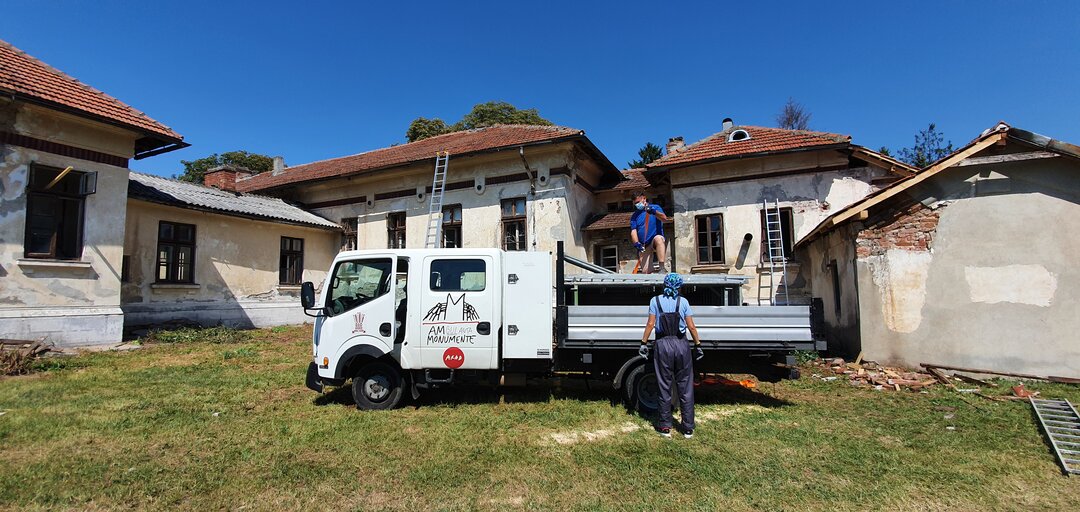
Europa Nostra Award 2020 and Public Award 2020 - Ambulance for Monuments, excellence in safeguarding Romanian heritage

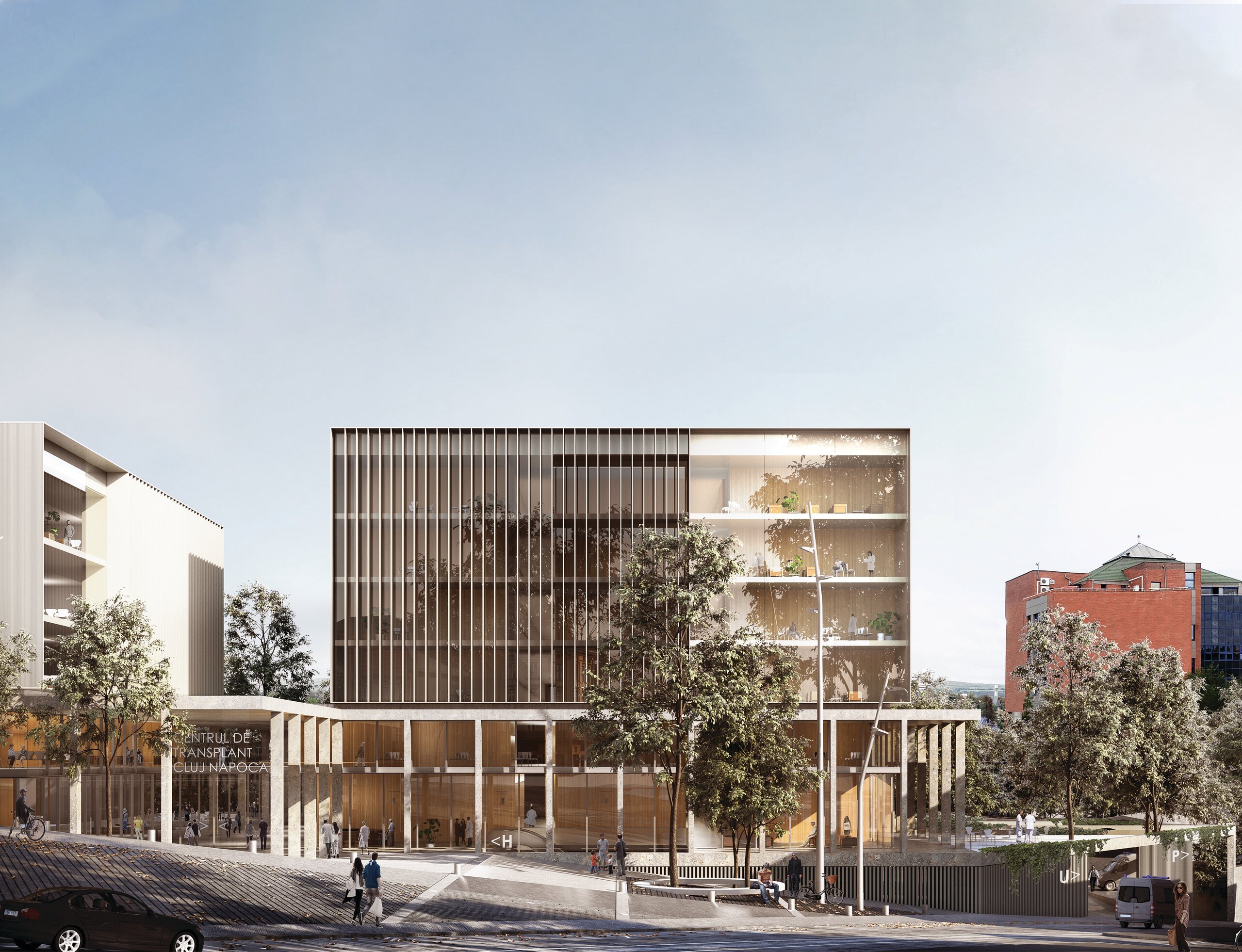
© PINEARQ S.L.P. în asociere cu DICO și Țigănaș birou de proiectare S.R.L.
Prize
I
PINEARQ
S.L.P.
in
joint venture
with
DICO
and
Țigănaș
office
de
design
S.R.L.
Author:
arh.
Alberto
de
Pineda
Álvarez,
co-authors
arh.
Jenica
Craiu,
arh.
Alexandra
Demetriu,
arh.
Șerban
Țigănaș,
arh.
Alexandrina
Kiss.
Contributors:
arh.
Giovanna
Pomo,
arh.
Bogdan
Dragomir,
arh.
Maria
Buiga
Center
Integrated
from
Transplant
to
Cluj-Napoca
Architecture
for
balance
text:
Șerban
ȚIGĂNANAȘ
The story of the place
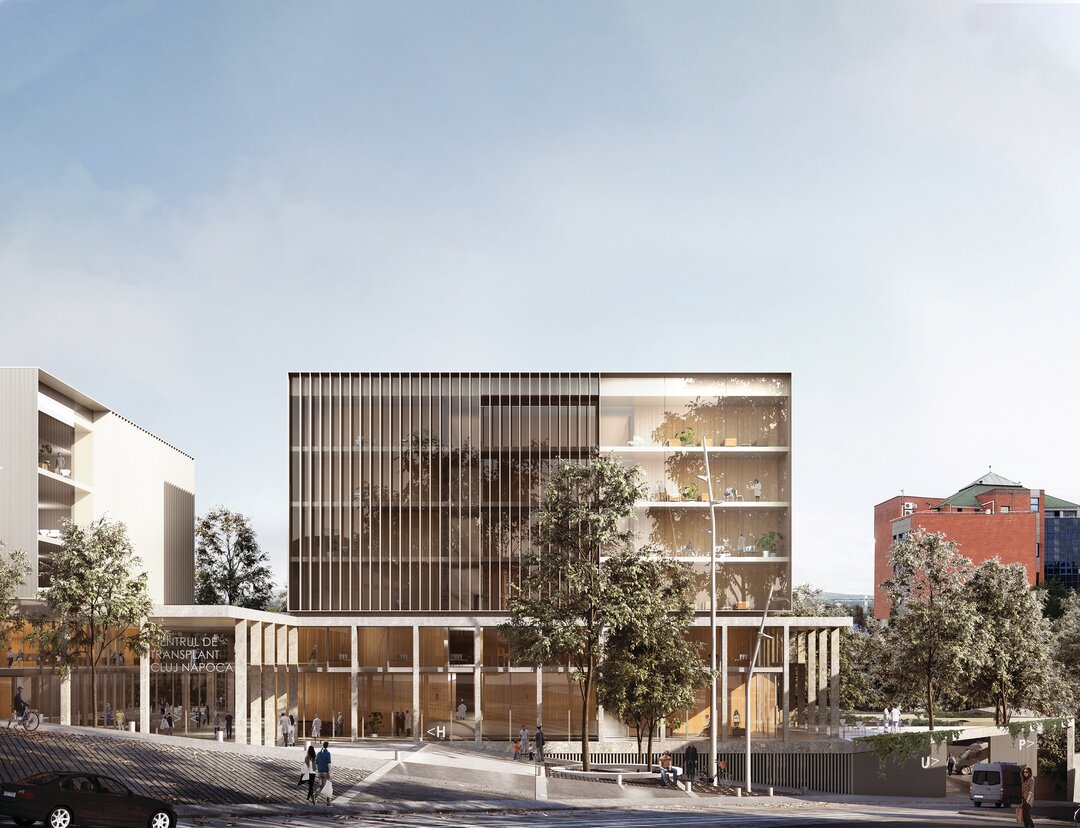
The University Clinics Complex in Cluj-Napoca is a medical oasis in the west of the central area of the municipality, a few hundred meters from the City Hall, the Students' Cultural House and the Central University Library. In fact, the entire area bordering the city center to the south is devoted to doctors and teeming with students. In cafes and supermarkets here you can often hear French being spoken, thanks to the large contingent of international students. In a word, the "clinic zone" is dense and active, combining the institutional severity of the flagship hospitals with the wide open space of the precinct, a veritable mapped park on the terraces and slopes that connect them, with the liveliness of the not-too-wide streets. If you don't know the places you have to be very careful to distinguish between clinics, university buildings, student dormitories or housing and premises. The ensemble was largely realized in a relatively short period of time, following a unified design, which gives it a strong and homogeneous character over an area of several hectares. Remarkable are also the interventions of the 1960s that are located in the neighborhood of the main ensemble. Then various other constructions appeared which cannot be categorized as architecturally inspired, even if each of them solves functional problems that have arisen over time. Such a place must be known and experienced to understand it in all its nuances. It is all the more provocative because the layers superimposed here contribute to a particular charm, on the borderline between rigor and disorder, between institution and the absolute freedom of the street.
Prize
II
Team:
Vlad Vlad
Sebastian
Rusu,
Octav
Olănescu,
Anamaria
Olănescu,
Miruna
Moldovan
URBAN CONCEPT
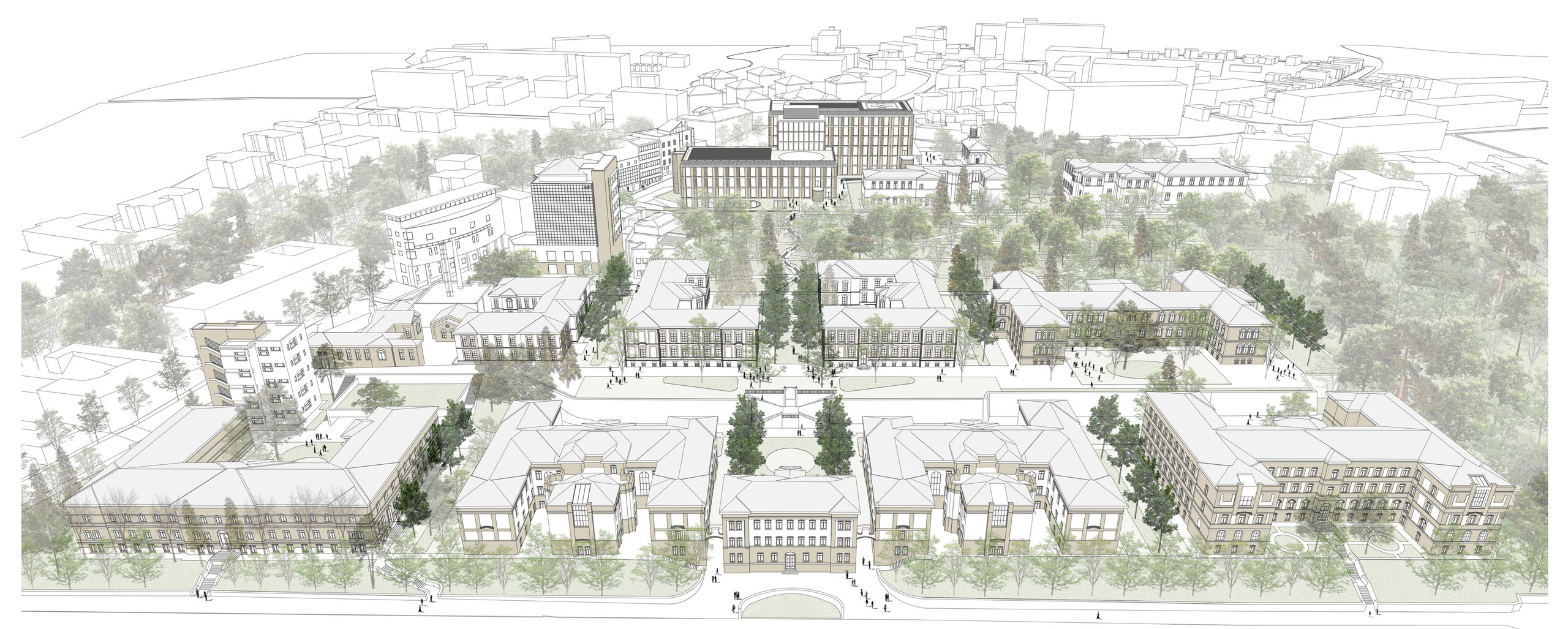
The urbanistic impact of the location of the new hospital was considered beyond its belonging to the Lower University Clinics Ensemble, having resonances in terms of the immediate unstructured neighborhoods, the presence of the Miko Garden to the west, and the southern neighborhood of the Upper University Clinics Ensemble. In this respect, two stages of urban planning measures are proposed as a horizon for implementation:
Stage I - aims to realize the development of the Lower Clinics Ensemble, with the construction of the new Integrated Transplant Center. The development of the precinct proposes the recovery of the original heritage composition, the north-south axis regaining its structuring and functional role within the complex. Vehicular and pedestrian access is maintained for each terrace, but without surface parking, which would be possible in a new above-ground parking structure, proposed concealed in the existing slope in the north-eastern part of the enclosure. From a landscape point of view, the existing notable trees are maintained and complemented by alignment planting that reinforces the structuring role of the main compositional axis and the lines of force of the three terraces. The courtyards of the pavilions have been landscaped according to their cardinal orientation, honoring to the north - in front of the main entrances - and intimate to the south, in accordance with the function of rest and contemplation. The entire ensemble is proposed to benefit from an integrated rainwater catchment system, with part of the courtyards of the pavilions being laid out as rain gardens.
The landscaping of the historic park of the precinct includes the analysis and inventory of the existing tall vegetation, the preservation of old historic paths and alleys and the creation of new connections in order to rehabilitate this green space. As the green area is laid out on a steep north-facing slope, the possibility of creating small glades by removing diseased or old trees so that sunlight can penetrate to these areas will be studied. The old alleys and historical paths will be particularized by the arrangement of low vegetation (tapestry vegetation and shrubs) which by the choice of identifying species (mentioned in the 1:500 situation plan) will dynamize and contribute to the definition of a unique character of this place, a therapeutic, tonic, regenerating character.
Prize
III
Author:
Maria-Iulia
Stanciu,
Florian
Stanciu
Co-authors:
Cosmin
Gălățianu,
Cosmin
Valentin
Georgescu,
Octavian
Bîrsan,
Cristian
Alexandru
Beșliu,
Cezara
Lorenț,
Oana
Grămadă,
Roberta
Furmușelu,
Eduard
Untaru
Contributors
architecture:
Nela
Andrieș,
Ana
Cătălina
Mușetescu
Collaborators
specialties:
eng.
Kristian Kristian
Kiss
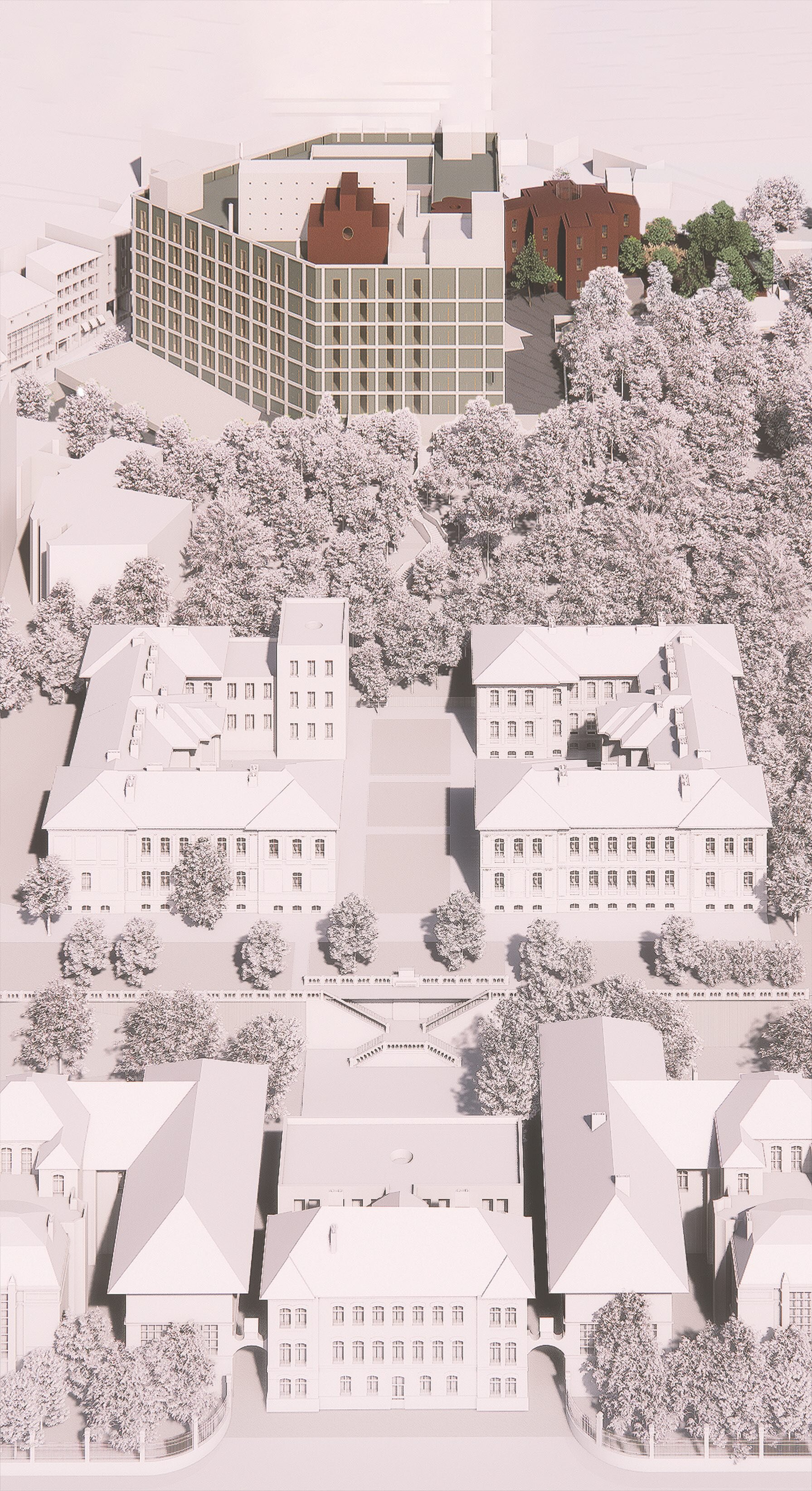
Piazza, Villa, Clinic and Garden City
The layout on the plot of the new integrated transplant center in Cluj-Napoca arose naturally from the constraints and limitations imposed by the surroundings and neighborhoods to the extent that we tried, at the same time, to restore the historic pedestrian alleys, facilitate the urban connections crossing the proposed study area, free and widen the sidewalks in the immediate vicinity of the site and also to organize and prioritize the car accesses. But perhaps above all of this, the historical ensemble of the University Clinics as a sum of built artifacts, pavilion buildings placed together in the form of autonomous strings and agglutinations of rooms in an order of a clarity that is not that of the spontaneously developed city, but rather is there to enhance each other with the surrounding medieval Transylvanian city.