A decade of space planning in Romania


From April 30 to July 28, 2014, the Centre Pompidou in Paris is devoting the entire Galerie Sud to a major retrospective of the French-Swiss architect Bernard Tschumi (b. 1944). Through more than thirty projects and 350 documents including: sketches, models and documentary films, organized thematically and chronologically in five sections, the exhibition presents Bernard Tschumi as artist, teacher, theorist, but also architect.
How can architecture be presented in an exhibition space? In contrast to art, whose very existence depends on an indispensable relationship with the exhibition space, architecture is already present in the real world, material, functional and three-dimensional (1). An exhibition space is thus often incapable of exhibiting the original (2), delegating instead the function of representation to a collection of documents, drawings, models, photographs, films and texts capable of reproducing at least some of the attributes of the project. On the occasion of the publication of the catalog of the architectural collection of the Frac Centre museum in Orléans (3), Frédéric Migayrou, co-curator of the exhibition dedicated to Bernard Tschumi, asks whether a paper archive or a collection of disparate documents can really represent or successfully substitute a built reality? Are these often technical documents nothing more than objects of secondary rank, mere remnants of a concrete reality? Can they ever be considered works of art in their own right? Can they acquire a sufficiently important symbolic value to be fully considered art objects? Mark Wigley (4) goes on to discuss a recent problem: architects today have abandoned paper in favor of black screen. If until now we were debating the right of a sketch to be considered an original and not just a delegated object, today the original no longer exists. The computer screen allows the architect to go from concept to realization through a fluid organization of data. This raises the question of what form such projects can be presented in, and how or under what status museums or architecture departments can collect and archive such documents, in the absence of any fixed point of reference in the evolution of a project or physical support.
In recent years, increased media interest and the growing number of architectural exhibitions have brought these debates back to the fore. The Pompidou Center, for example, has hosted a whole series of monographic exhibitions in recent years: Jean Nouvel (2001-2002), Morphosis (2006), Richard Rogers (2007) and Dominique Perrault (2008), and 2014 will be an eventful year for architecture, with the Center hosting two major exhibitions, Bernard Tschumi from April and Frank Gehry from October. In April 2015, the commemoration of the 50th anniversary of Le Corbusier's death will mark the third architecture exhibition in less than 18 months.
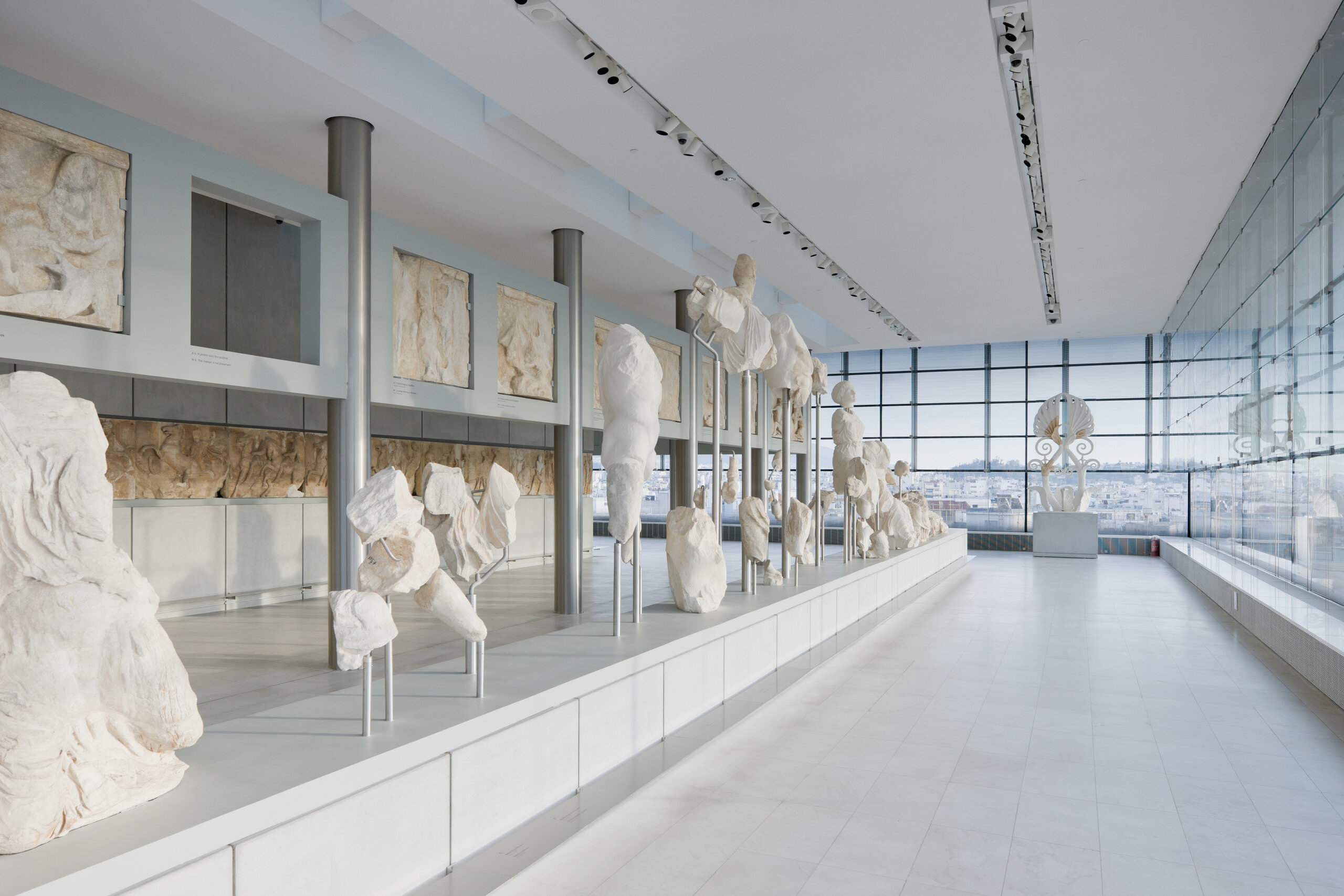
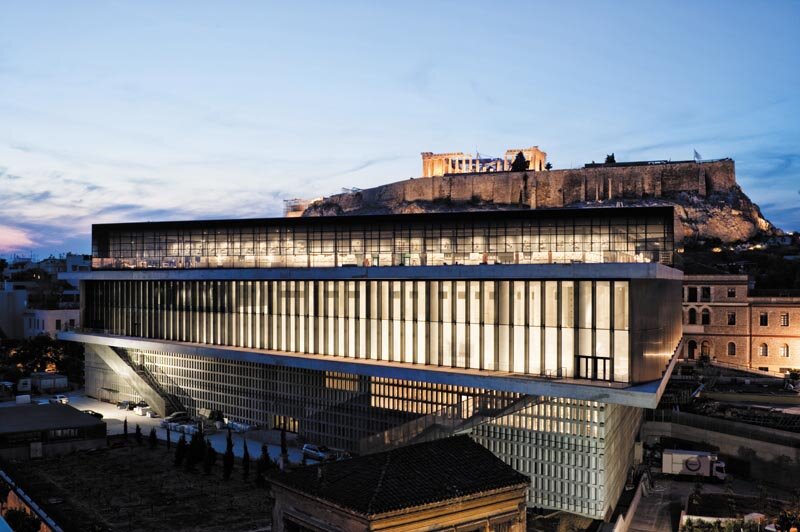
The retrospective dedicated to Bernard Tschumi promises to be a unique opportunity to debate all these themes. An active member of the New York and European art scene throughout the 1970s, a theorist close to the post-structuralist scene and Jacques Derrida in particular, he taught at the Architectural Association in London alongside: Cedric Price, Nigel Coates or Rem Koolhaas, dean of Columbia University and founder of Paperless Pedagogy -the first university program of digital architecture-, winner of major architectural competitions: the La Villette Park (1983) in Paris or the New Museum of Acropolis (2001) in Athens, Bernard Tschumi reveals to the public an impressive, complex and multifaceted career as an architect, spanning over 40 years.
Born in 1944, the son of modernist architect Jean Tschumi, he graduated in architecture in 1969 from ETH Zurich and began teaching a year later at the Architecture Association under the tutelage of Alvin Boyarski. In his interview with Frédéric Migayrou on the occasion of the exhibition at the Pompidou Center (6), Tschumi evokes the period of crisis in which architecture found itself after the events of May 1968, and the negative reputation it had acquired as a tool of the authorities or of big business. Tschumi was mainly attracted to post-structuralist philosophy, literature, film and art, and was particularly influenced by the Fun Palace (1961-64) and Potteries Thinkbelt (1966) projects by British architect Cedric Price. He opposed the modernist idea that form follows function, giving rise to a fixed and permanent architecture with a precise and immutable purpose. His designs, unrealized but realizable, reveal buildings on an urban scale, adaptable, flexible and able to respond at any time to the demands of users, with the help of technology and in particular the notions of cybernetics developed by Norbert Wiener. This new ephemeral and temporal way of thinking about architecture, together with post-structuralist theories, and the interest in the representation of moving bodies in cinema and performance art, will lead Tschumi to define his architecture as characterized by the notions of space, event and movement.
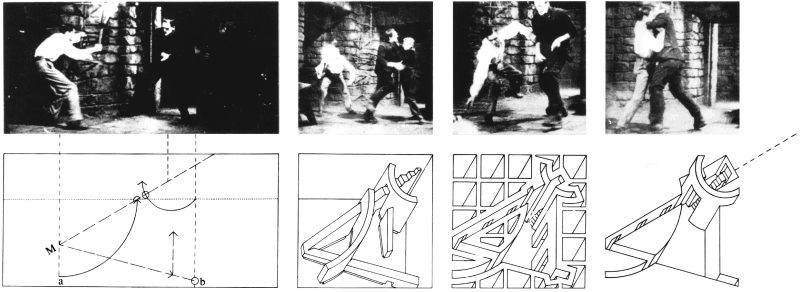
In this context, throughout the 1970s, he participates in or organizes a series of exhibitions situated on the borderline between art and architecture, such as the project he started in 1971 with RoseLee Goldberg, which culminates in the exhibition 'A space. A thousand words' in 1975. Tschumi and Goldberg invited 30 artists and architects, including Daniel Buren, Bruce Nauman, Dan Graham, Trisha Brown, Nigel Coates, Nigel Coates, Will Alsop, Elia and Zoe Zenghelis, to contribute a drawing or a black and white photographic document and a typed text of up to 1000 words, with the theme 'the production of space' and how it is perceived. Tschumi lends himself to the exercise, realizing one of his many artistic projects in the 70s. Inspired by Russian filmmaker Sergei Eisenstein's methodological diagrams (7), in which set, music, composition of shots and movement diagrams were presented in the same document, Bernard Tschumi produced a series of four episodes, The Manhattan Transcripts, between 1976 and 1981, exhibited in New York and London. They are on the borderline between fiction and reality, and are not architectural projects, but investigate architectural space. Tschumi unravels the thread of stories through diagrams and individual images in relation to each other. The series of speculative projects continues with Joyce's Garden (1976), Advertisments for Architecture (1976-77), Screenplays (1976-78), and Follies (1979-92), all of which were presented in the exhibition at the Pompidou Center.
Architectural exhibitions of this type, often presented in close connection with sociology, ecology, technology or contemporary art, depending on the practice of each architect, are seen (8) as occasions that redefine the boundaries of architecture. Patteeuw, Vandeputte and Van Gerrewey reinforce this view by seeing the gallery as a productive space for creativity and experimentation, thus emphasizing the capacity of exhibitions to encourage analysis of the development of architectural practice. In both cases, Bernard Tschumi's involvement in the London and American art scene in the 1970s is the ideal example of an attempt to interrogate the limits of architecture through an experimental multidisciplinary process.
Bringing back to the question of the original, a novel element of the exhibition at the Pompidou Center is the presentation of the second episode of the Manhattan Transcripts series. The document considered to be the original is a serigraph (9) more than 30 feet long, in the possession of the Museum of Modern Art in New York. Although the other three episodes were on loan specifically for this exhibition, the second episode comes from the architect's personal archive and is the medium on which the final silkscreen was made. This document composed of collages, corrected, spliced and intensely altered, stands as testimony to the process by which the project was realized. Other documentary showcases contain remnants of the other episodes, they are either intermediate or rejected pieces. In addition, this will be the first time that all 4 episodes of the series will be shown.
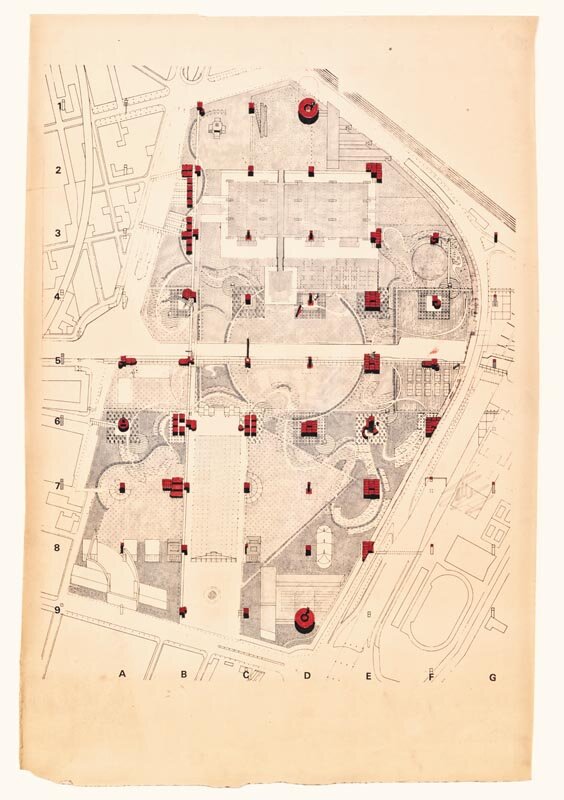
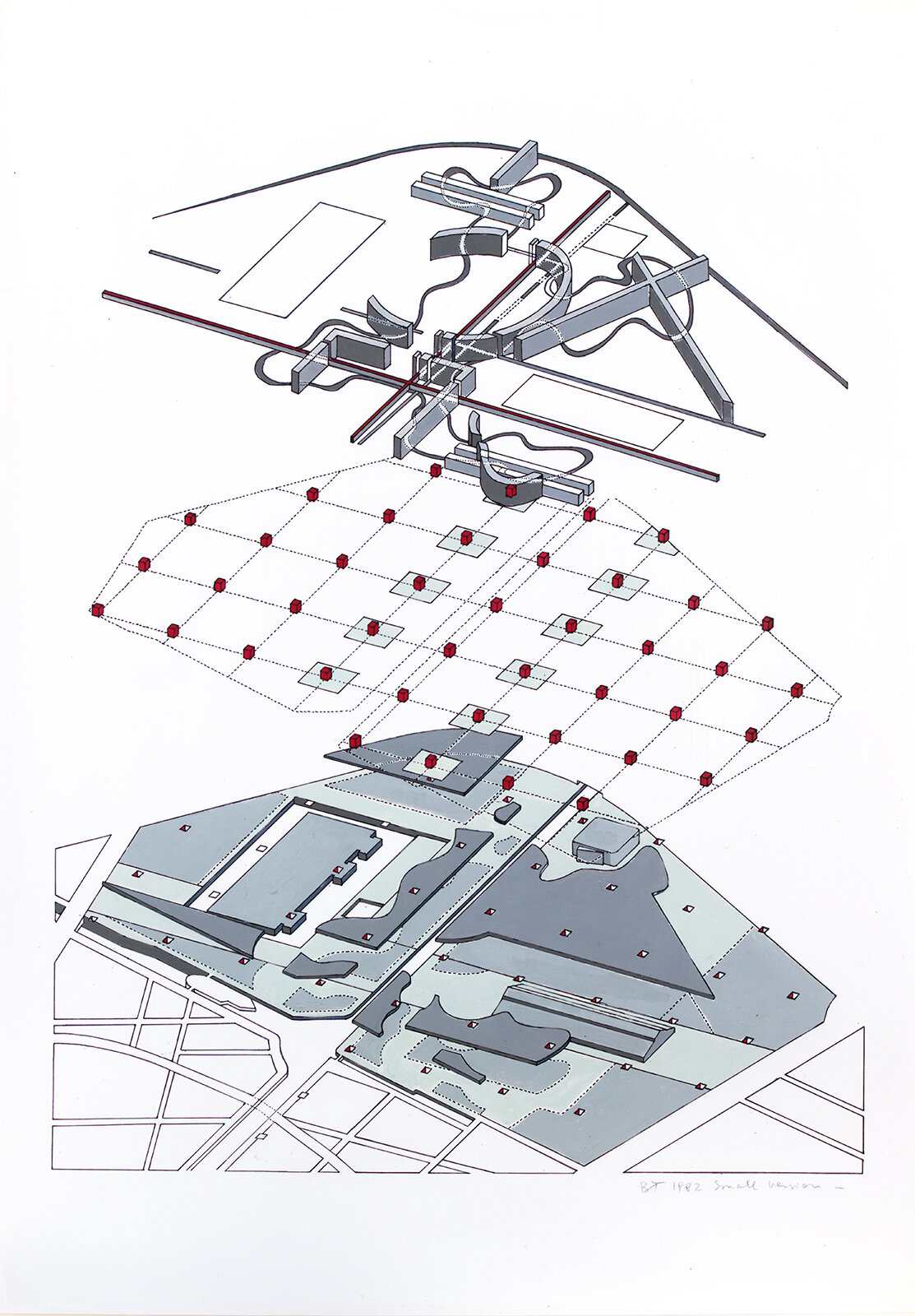
While during the 1970s Bernard Tschumi explored the notion of architecture using practices specific to various arts (performance, literature, cinema), in 1982 he received his first architectural commission in what would prove to be a rich career as a builder. For Tschumi, architecture invents concepts and materializes them by transforming them into physical spaces (10), and the La Villette competition is the perfect opportunity to move from the abstract to the concrete. The origins of the project can be traced back to his previous research and once again reveals his interest not in architectural form but in the process of conception, program and event. The project is defined around three layers of juxtaposed elements. The first layer of "points of intensity" or "event generators" consists of a series of small buildings scattered along a rectangular grid throughout the park, with either precise functions (restaurant, exhibition space) or undefined. A second layer of lines consists of two perpendicular axes and a sinous path, accompanied by a series of themed gardens. The last layer is composed of horizontal surfaces defined by the intersection of the other two layers. The project has had a resounding echo on the French cultural scene, being considered the architectural embodiment of post-structuralist theories, particularly faithful to Jacques Derrida's deconstruction. In 1988 the project was included in the famous 'Deconstructivist Architecture' exhibition by Philip Johnson and Mark Wigley.
Continuing his participation in major international competitions such as the 'Très Grande Biblioteque', the Kansai Airport in Japan, the New Theater in Tokyo, where he was awarded second place ex-aequo with Hans Hollein, and the New Acropolis Museum in Athens, Bernard Tschumi consolidates his position as an architect. This productive period in the classical sense of the profession is marked by another important transition. The advent and spread of the use of computers in architectural practice triggers a mutation in the way projects are represented and realized. This transition, visible in all post-1995 projects, is all the more interesting because in 1993, Tschumi, then dean at Columbia University (1989-2003), was among the founders of Paperless Pedagogy, the first teaching unit dedicated to the study of digital architecture. Bernard Tschumi's monograph provides an ideal opportunity for a discussion of curatorial practices related to digital continuities, since as Mark Wigley argues, the development of a museographic strategy for the preservation and exhibition of digital archives is critical.(11)
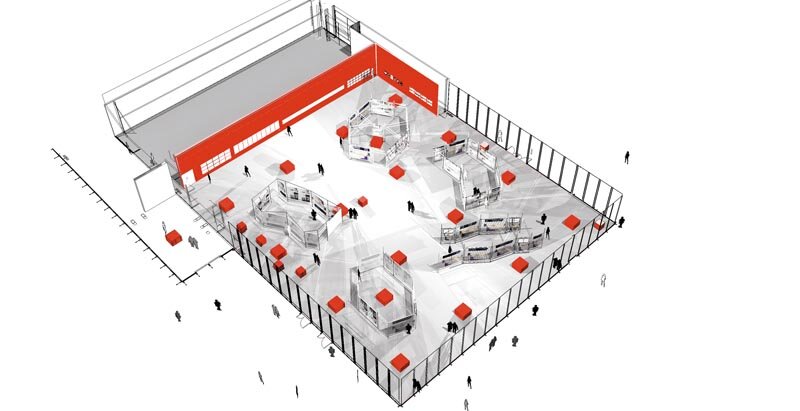
The exhibition's scenography, conceived entirely by Bernard Tschumi, organizes the projects into five distinct sections in order to be able to present to the public such diverse documents, ranging from purely theoretical projects and texts, to competitions or constructions made pre- and post-digital era. Each section is titled according to the main concepts developed: Manifest - Space and Event, Program / Juxtaposition / Overlap, Vectors and Envelopes, Concept / Context / Content, Forms - Concept. A large area outside the five sections houses the entirety of the four episodes of the work "Manhattan Transcripts", together with five documents belonging to the project "Advertisments for Architecture". In addition, 16 documentary tables punctuate the space by providing additional insight into the context in which the projects were conceived, containing documents ranging from intermediate sketches and abandoned solutions, manuscripts, articles and books by Bernard Tschumi, to conceptual models and press articles. Along with the fifty or so projects, more than forty projects are presented, as well as a wealth of documents reconstructing the cultural and political context of the period in which they were realized. A large projection also introduces the audience to the constructed reality of the projects.
The vast majority of the documents and objects on display come from the architect's personal archive, which is being opened up for the first time to such a curatorial intervention. Through his involvement in every aspect of the realization of the exhibition, along with the two co-curators of the Pompidou Center Frédéric Migayrou and Aurélien Lemonier, Bernard Tschumi becomes both the collector and the narrator of his own architectural journey. Quoting Walter Benjamin (12), Frédéric Migayrou associates this figure of the architectural collector with that of the historian, who, by means of a dispersal of fragments from a heterogeneous combination of sources, provokes a reminiscence through a certain assemblage of the fragments at his disposal. The act of presenting a collection thus reveals both the aesthetic, temporal and spatial domain to which each project belongs, and the strategy of reassembly that triggered the narrative. The exhibition reveals the dynamics of architectural research and conception from a historical point of view, but it also becomes a flexible support for reflection on architectural practice. And if in France Bernard Tschumi's name is inextricably and for the moment exclusively linked to the La Villette project, the exhibition organized by the Centre Pompidou offers the opportunity to reinterpret this international architect, whose practice has touched and influenced major architectural themes over the last 40 years.
Notes: