A decade of space planning in Romania

Scene Design In Architecture: A Tool For Research, Methodology, Or Eagerness To Understand The Present?
|
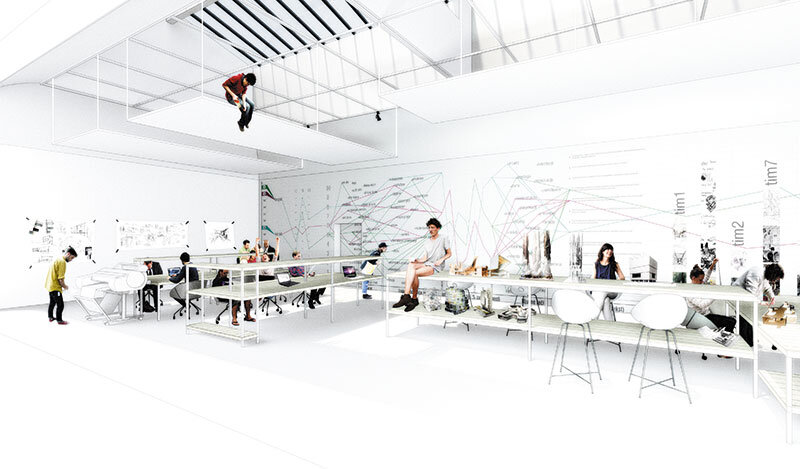
Case Studies: two proposals for the Serbian National Exhibition at the Venice Biennale 2012 & 2014 submitted by the Department of Architecture and Urbanism, Faculty of Technical Sciences, University of Novi Sad, Serbia. |
| Prolog Two years ago, together with two of my friends and colleagues, I participated in the national competition for the selection of the exhibition to represent Serbia at the 2012 Venice Biennale in 2012, without any official success. This did not come as a surprise to us, as we are fully aware that our approach to architectural education, which we have developed over many years, is not generally accepted in Novi Sad, not even in our own circle. The surprise came later, last fall, when I was invited to participate as a member of the National Program Council (which also constituted the national jury) and to participate in deciding who (and what) would represent Serbia at the Venice Biennale in 2014. I accepted without any reluctance and took the opportunity to observe, analyze and try to understand how architecture is thought about in Serbia today (and not only in relation to the Fundamentals Biennale). My research included not only the 29 selected projects, but also (or primarily) the discussions held by the jury members during the evaluation process. I realized once again that architecture is generally understood as a visual or conceptual art, which led me to ask myself again: what is the essence of architecture? What is its raison d'être, its content? What is fundamental in and about architecture? And once again, Roland Barthes' profound idea that photography does not reach art through painting, but through theater1 reminded me that, reversing the situation, architecture reaches art through its functions, not through visuality. "This is why architecture does not only have a utilitarian function (bearing in mind that without utility there is no architecture), but is a complex system of responses relating to different existential needs of an economic, ecological, aesthetic, social, cultural, psychological, philosophical, ethical, political, etc. nature. Architecture as a system of spatial thinking simultaneously establishes relations with all these key aspects and becomes an ideological category per se. Since human life is the basic and essential object of architecture2, the structure and final form of architecture must be implied as a machine3, and not as a scene, sculpture or artifact"4. Thanks to this meditation on the function of architecture, and not function in architecture, I understood the word "function" as a pluralia tantum or even as a material noun. At the same time, I understand architecture as a frame of an event, a liminal space of existence. If we accept that an event is "a point"5, i.e. the basic element of the space-time continuum, it is obvious that the four-dimensional space of our existence is one of spectacle. Performance and stage design The term 'scenic design' was introduced to describe the totality and complexity of process, appearance, profession, art, perspectives on reality and creativity that Pamela Howard has termed 'scenography'6. In a broader sense, "stage design brings together scenographers, costume designers, technicians and specialists in theatrical technology, architects, sound and lighting engineers, as well as critics, scientists, directors, producers, dramaturges and all those whose activities are directed towards the stage"7. From a closer study of this concept the question arises: what is a staged event, what are all the possible manifestations of staged events and, consequently, where can one find stages. Outside the theater, stage design could be defined not only as "extended" set design, but also as an art form in its own right: "A work of art in the field of stage design can arise from any creative process that includes a scenic way of thinking and the use of scenic resources with the aim of creating a scenographed event"8. Therefore, if we apply the logic of theater to other artistic disciplines, stage design can also be seen as an art in itself. It is clear that "in the last decade, the practice of set and stage design has moved steadily away from the black box of theater, migrating into a hybrid zone at the intersection of theater, architecture, exhibitions, visual arts and media"9. Moreover, the same zone was constructed through action and interaction, as well as "clearly defined individual and collective behavior"10. In the light of the above, it is natural that the issue of the "scenographization of space"11 becomes a reason for bringing together architecture and event, physical structure and temporal fluctuation, morphology and "slice of life"(tranche devie12). It seems extremely natural to think about the location of an event or, in other words, the performative space when we talk about the exploration and exhibition of architecture today. Stage design understood as a tool, as a methodology or as a point of view could constitute a solid and powerful platform for rethinking, re-evaluating and re-presenting contemporary architecture. This, more than anything else, presupposes that educational programs and systems introduce a different perspective, based on research on methods, on communication, on topics, on willingness to dialog, on development and new points of departure. |
| Read the full text in issue 2 / 2014 of Arhitectura Magazine |
| Notes: 1 Barthes, Roland: La chambre claire: note sur la photographie, Gallimard, Le Seuil, 1980. 2 Milićević, Slađana: A study of architectural structure in function of experience regeneration, University of Novi Sad, Novi Sad, 2008. 3 Le Corbusier: Toward an Architecture (translated by John Goodman) Getty Research Institute, Los Angeles, 2007. 4 Dinulović, Radivoje: The ideologycal function of architecture in the Society of spectacle, in Architecture & Ideology (ed.: V. Mako; M. Roter Blagojević & M. Vukotić Lazar), Faculty of Architecture, University of Belgrade, 2012. 5 Hawking, Stephen: Kratka povest vremena(Short History of Time), Alnari, Belgrade, 2002. 6 Howard, Pamela: What is Scenography?, Routledge, London, 2002(Šta je scenografija, Serbian translation by Irena Šentevska, Clio, Belgrade, 2002). 7 Dadić Dinulović, Tatjana: Scene Design As Art, Scenography Expanding 2: On Artists/Authors, Belgrade, 2010, www.intersection.cz. www.intersection.cz. 8 Ibid. 9 Lotker, Sodja: Scenography Expanding 2: On Artists/Authors, Belgrade, 2010 www.intersection.cz. 10 Ibid. 11 Ibid. 12 Term attributed to the French playwright Jean Jullien (1854-1919). |
| Case Studies: Two proposals for national exhibition at the Venice Biennales 2012 & 2014 from the Department for Architecture & Urbanism, Faculty of Technical Sciences,University of Novi Sad, Serbia. |
| Prologue Two years ago, with two of my friends and colleagues, I participated at the national competition for the Serbian exhibition at the 2012 Venice Biennale, without any formal success. It was not a surprise at all; we know very well that the approach in architectural education that we have been developing for years in Novi Sad is not generally acceptable, not even in our own environment. Surprise came later, last autumn, when I was invited to be a member of the National Program Council (at the same time, the National Jury) and to participate in the decision as to who (and what) was going to represent Serbia at the 2014 Venice Biennale. I accepted without any doubts, taking the opportunity to observe, analyze and try to understand the ways of thinking on architecture (not only in the relation to "Fundamentals"), in Serbia, today. In my focus stepped in not only the 29 proposed entries, but also (or, in the first place) the discussions among the jury members during the evaluation process. That brought me back to the questions: what is the essence of architecture, what is its raison d'être, its substance, what is fundamental in (and about) architecture? And, once again, Roland Barthes's profound idea that Photography does not touch art through painting, but through theater1 reminded me that, vice versa, architecture reaches art through its functions, not through visuality: "This is why the function of architecture is not only utilitarian (having in mind the fact that without utility there is no architecture), but it is a complex system of answers about different existential needs: economic and ecological, aesthetic, social, cultural, psychological, philosophical, ethical, political etc. Architecture as a system of thinking about space establishes relations towards all of these problem aspects simultaneously and becomes an ideological category per se. Since human life represents a basic and essential object of architecture2, structure and final form of architecture need to be concerned as a machine3, not as a scene, sculpture or designed artefact"4. Thinking about the function of instead of function in architecture led me to understanding of the word "function" as pluralia tantum, or even as material noun. At the same time, I understand architecture as a framework for event, a liminal space of existence. If we accept that the event "is a dot"5, i.e. the basic element of space-time continuum, it is clear that the four-dimensional space of our existence is the space of spectacle. Spectacle and Scene Design The term "scene design" was introduced to describe the totality and complexity of the process, appearance, profession, art, views of reality and creativity that Pamela Howard called "scenography"6. More broadly, "scene design interconnects set designers, costume designers, theatre technicians and technologists, architects, light and sound designers, as well as critics and scholars, directors and producers, playwrights, and all those whose activities were directed at the area of the stage"7. Further study of this concept leads us to the question: what is a staged event, what are all the possible manifestations of staged events, and, consequently, where stages can be found. Outside the theater, scene design could be defined not only as an "extended" set design, but also as a distinct art form: "A work of art in the field of scene design can also arise from any creative process which includes a scenic way of thinking and the use of scenic resources aiming at the creation of a staged event"8. Therefore, if we apply the logic of theater to other artistic disciplines, scene design can also be viewed as an art in itself. It is clear that "in the past decade the scenographic practice and scene design have continually wandered off from the theatrical black box towards a hybrid area placed within the points of intersection of the theatre, architecture, exhibitions, visual arts and media"9. Additionally, that very same area was built through action and interaction, as well as "defined individual and collective behavior"v0. In light of this, it is entirely natural that the question of "staging the space"11 becomes the reason for gathering of architecture and event, of physical structure and time fluctuation, of morphology and "slice of life"(tranche devie12). Scene design, understood as a tool, or as a methodology, or as a point of view could be a strong and potent platform for re-thinking, re-evaluating and re-presenting contemporary architecture. That includes, more than anything else, an eagerness to make a difference in educational programs and systems, difference based on research in approaches, in communication, in subjects, on readiness for discussion, development and new starting points. |
| Read the full text in the print magazine. |
| Notes: 1 Barthes, Roland: La chambre claire: note sur la photographie, Gallimard, Le Seuil, 1980. 2 Milićević, Slađana: A study of architectural structure in function of experience regenaration, University of Novi Sad, Novi Sad, 2008. 3 Le Corbusier: Toward an Architecture , Getty Research Institute, Los Angeles, 2007. 4 Dinulović, Radivoje: The ideologycal function of architecture in the Society of spectacle, in: Architecture & Ideology (ed.: V. Mako; M. Roter Blagojević & M. Vukotić Lazar), Faculty of Architecture, University of Belgrade, 2012. 5 Hawking, Stephen: Kratka povest vremena(A Brief History of Time), Alnari, Belgrade, 2002. 6 Howard, Pamela: What is Scenography?, Routledge, London, 2002 (Šta je scenografija, translated into Serbian by Irena Šentevska, Clio, Beograd, 2002). 7 Dadić Dinulović, Tatjana: Scene Design As Art, Scenography Expanding 2: On Artists/Authors, Belgrade, 2010, www.intersection.cz. www.intersection.cz. 8 Ibid. 9 Lotker, Sodja: Scenography Expanding 2: On Artists/Authors, Belgrade, 2010 www.intersection.cz. 10 Ibid. 11 Ibid. 12 The term credited to the French playwright Jean Jullien (1854-1919). |