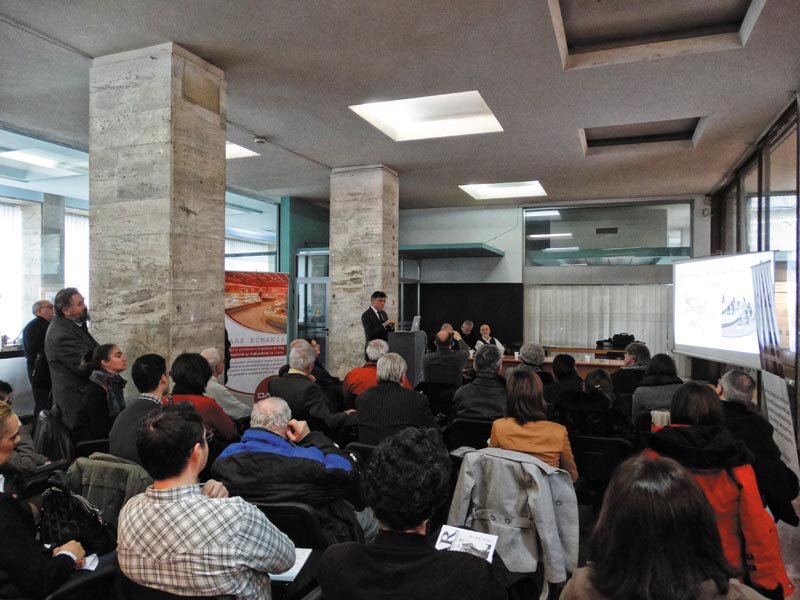
A decade of space planning in Romania

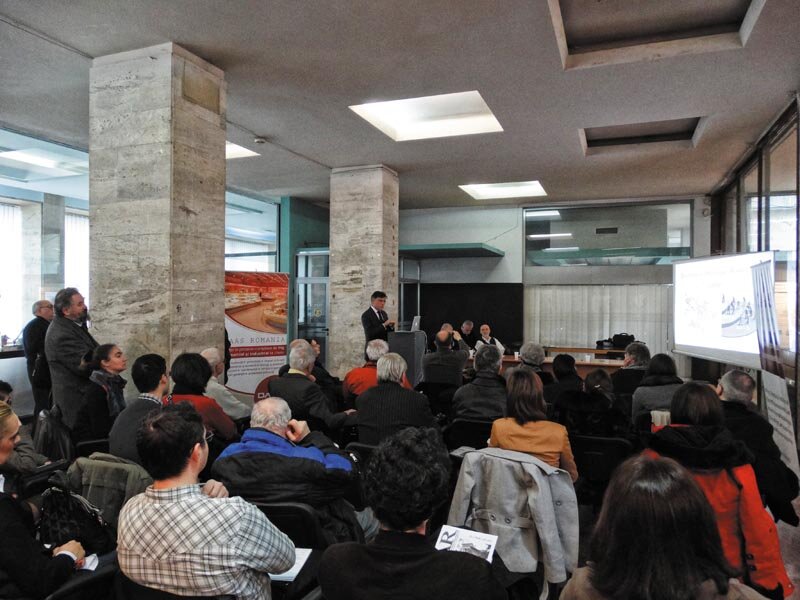
The exhibition entitled "A Decade of Spatial Planning in Romania", organized as a partnership between UAUIM, UAR, RUR and APUR1, was one of a series of prestigious events in the field of architecture and urbanism. The University of Architecture and Urbanism "Ion Mincu" Bucharest celebrates this year 150 years of Romanian architecturaleducation2 . The Union of Romanian Architects celebrated the 123rd anniversary of the founding of the Society of Architects on March 1 with the Architects' Ball3. The Romanian Professional Association of Urban Planners celebrated its 24th anniversary on March 5.
The substance of the exhibition included different spatial planning and urban development instruments such as: the Bucharest 2035 Strategic Concept, a number of 24 spatial plans, 26 PUGs of important Romanian municipalities and cities, 12 PUZs of central areas or protected areas and multiple studies. All these documents and studies on spatial planning and urbanism were exhibited and could be studied in the exhibition space on the ground floor of the UAUIM from February 26 to March 9, 2014.
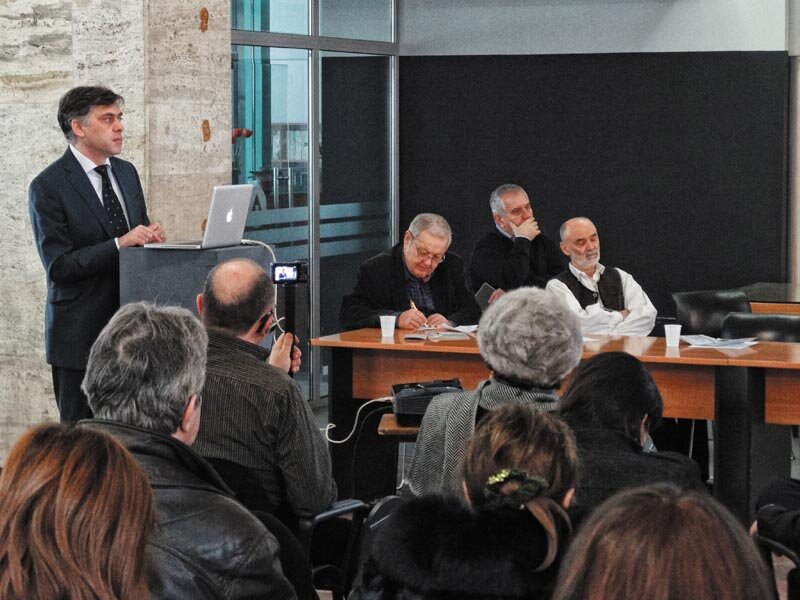
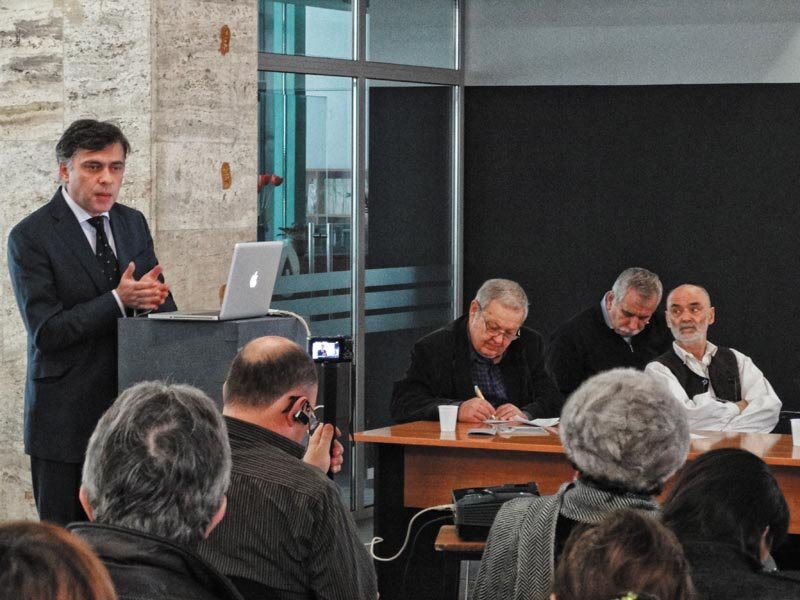
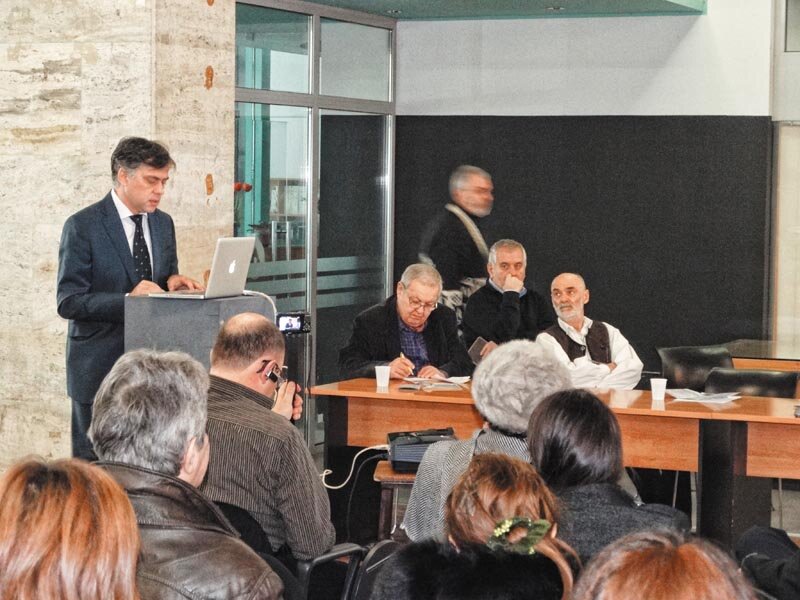
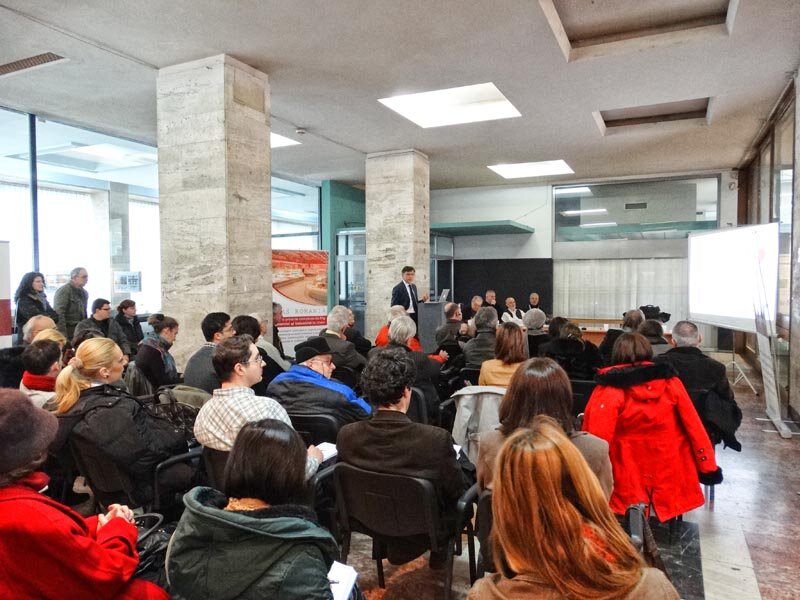
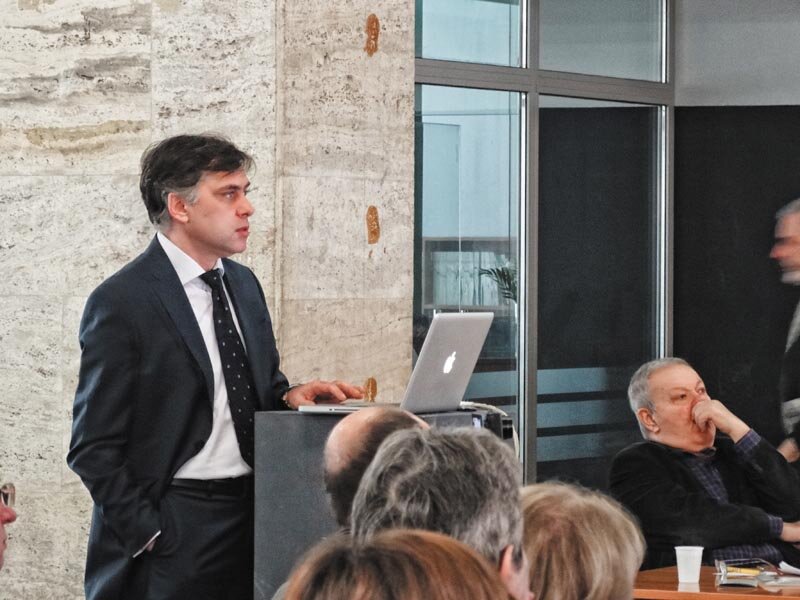
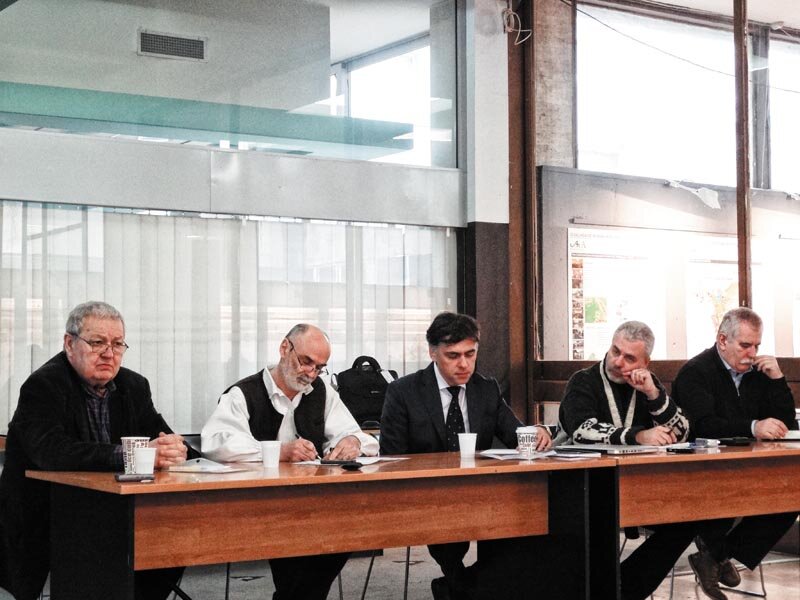
The highlight of this exhibition was the public debate "The General Urban Plan, a strategic tool in urban development - principles, innovation, management". The discussion took place at UAUIM, on March 1, in the exhibition space dedicated to spatial planning4 and urbanism. Tiberiu Florescu, Alexandru Sandu, Constantin Enache and Liviu Ianăși spoke on the panel, and the moderator of the event was conf. dr. arh. Gabriel Pascariu, president of APUR, opened the debate by emphasizing that the PUG is "a keystone" in the urban development foundation, both for professionals and local administrations. Referring to the PUG of Bucharest (in particular to the proposal to revise it), Mr. Gabriel Pascariu emphasized that this project, being developed within the UAUIM, benefits from a happy context in which the profession is closely linked to education.
PUG - A dynamic vision
for Bucharest
Mr. Tiberiu Florescu is the project leader of the Consortium5 working on the technical proposal for the revision of the Bucharest PUG. In his presentation, prof. conf. dr. dr. arh. Mr. Tiberiu Florescu, Dean of the Faculty of Urbanism at UAUIM, referred to this complex project as a dynamic PUG, a tool for the 21st century, which defines the framework of urban existence and evolution for the city.
The PUG for Bucharest in 2014 includes 6 levels of analysis. These are the European, permanent (in the sense of permanent problems), public, connected, business and identity levels. These led to proposals on the morphological and functional structuring of the city. The speaker emphasized that the biggest problem is identity Bucharest. The identification of the key elements for the technical proposal included ongoing or prospective projects such as the median ring and the ring road.
The speaker pointed out that: 'A city that is punctually regulated is the victim of its own development. For Bucharest, the existence of general levels and 6 sectors makes the city ungovernable and non-operational. In the reality of 2013 - when the study for the technical proposal for the revision was launched - areas with very different potential for representation, governance and development are distinguished. For the urban development of Bucharest, the diagnosis is obvious: urban coherence is lacking.
Under the motto "prospering together", the technical proposals for the revision of Bucharest's PUG take into account the Bucharest 2035 strategy and build on the trend towards specialization of the city. In this sense, the PUG will support distinctive features at the zonal level: the station city (in the North-West, where another station could be built to current international standards), the sports city (near the National Arena), the business city (in the North), the smart city (polarized by the Măgurele platform) and the green city (based on the urbanization of the army lands between the Ghencea and Rahovei districts).
The objectives are to generate a framework of urban composition of high architectural quality, to identify and coordinate integrated urban regeneration actions and to promote new urban development processes. In order to dilute the rigid and passive character of the previous PUG, the emphasis will shift from a regulation based on territorial reference units, which have identical regulations regardless of their position in the city, to one based on the specific needs of each neighborhood. In distinct situations there will be specific rules. In other words, it is notified and accepted truth that there are different priorities related to how we thrive. These priorities include: pathways, representative spaces, representative functions, new neighborhood centers, and raising real estate standards.
In order to remedy the lack of coherence and nuance in previous documents, the technical proposal for the revision of the Bucharest PUG is based on the stable population that "consumes the city" in a specific way. Neighborhoods are determined irrespective of administrative or sector boundaries, where the population inhabits and utilizes areas with unitary or similar morphology. The proposed operationalization distinguishes 67 such neighborhoods.
The phases of the technical proposal for the revision of the PUG are spread over three years. The target date for adoption is 2015. One year has already been dedicated to the initiation phase. This has been followed by an eight-month feedback period, simultaneous with the second phase of actual implementation. This is followed by an 18-month period for refining the urban regeneration tools and a 12-month period for acquiring approvals.
Bucharest's revised PUG will emphasize the quality of the basis for decisions at governmental, local, sectoral and investor level.
To this end, three types of regulation will be distinguished: firm, flexible and directive - for consolidated, undefined, unstructured or mixed areas, and for those areas undergoing redevelopment and with strategic prescriptions. In the first tier of regulation - the firm - exemptions will be able to be substantiated and will only be detailed through PUDs. In the flexible one, the PUZ will detail and establish regulations. In the third regulatory case, only substantiation studies will be able to nuance the guiding elements.
A new component - introduced for the first time in Romania in the elaboration of a general urban development plan - is GIS. Urban planning assisted by the Computerized Geographic Information System (GIS) generates constantly updated information. The PUG thus becomes a living organism. It has a dynamic vision. Through its one-to-one function between the actual framework and the implementation plan, it establishes a simultaneity between the actual plan and the desired effects. The pro-active nature of the UWMP in the process of being drawn up is operable by means of a real-time completion and updating.
The reference of this GIS component is a SIMCITY. The concept is based on the existence of coherent and updated spatial information in the city hall portal, including the direct visualization of the simulation of changes, but also a very fast and highly accurate data management.
The PUG of the city of Bucharest concerns the harmonization of existing resources, urban development principles, the decision-making process that define performance indicators such as: net present value NPV, internal rate of return IRR, cost/benefit ratio in an investment, etc.".
Prof. Alexandru Sandu, PhD in urban planning, pointed out that the technical proposal for the revision of the Bucharest City PUG is not a dismantling of the previous PUG, but an understanding of it in a new approach. In his capacity as President of the Romanian Urban Planners' Register, he deplored the unsafe conditions under which the RUR's Board of Governors is forced to collaborate with the Ministry. He then wished to point out some aspects of the "lack of cooperation" in the elaboration of PUGs, which are frequently endorsed but useless because of their extremely poor quality.
The PUG, the speaker pointed out, is an instrument that involves the responsibility of local government and professionals. Such a document is essential in managing conflicts and interests in the territory. Everything in urban planning is interest. It remains to be seen which interests are the good and bad. From this point of view, the role of the PUG is to ensure a certain "calm" about what happens to the spaces in the territory. But such a tool for negotiating, monitoring and updating cannot be ideal. In fact, in architecture and urban planning, nothing is ideal. There is no ideal spatial configuration. Everything is open to criticism. In evaluating a PUG we focus on what the content creates as availability and imposes as effect.
The experience in carrying out the PUG for the city of Bucharest, approved in 2000, has a number of aspects that have not been taken into account. There are elements that require responsible interpretation - the ratio between indicator and quality, for example, has a determining role in the way spatial development issues are managed.
Prof. dr. dr. arh. Alexandru Sandu wanted to raise an alarm signal on the syncopathic way of urban planning regulation in Romania and accused that the political space is not familiarized with the concepts, tools and processes of planning and urbanism. Urban planning is therefore suffering.
In a vicious circle, when we talk about quality in the development of urban spaces, we say that we are not interested in indicators. And then we turn to indicators to support our decisions. For example, in Bucharest, we have no official recognition of the very serious state of green spaces. The quality of planted space is derisory. Some indices in the standards need to be revised to include the quality aspect itself. In other words, there is a need for types of rules which also require the interpretation of the rules to be made explicit. Planted spaces call for different rules per type of city. They cannot be identical for Brașov and Brăila, for example, for the simple reason of different climates.
In terms of the actual state of the planted areas, the Cișmigiu Garden is operating at 60% of its capacity due to lack of care. Strangely, however, no one is protesting about this.
"Another decisive aspect of this strategic instrument in urban development is the fact that it cannot be neutral or indifferent: any PUG determines a policy. I would like to refer to an interesting precedent: in the elaboration of the previous version of the PUG for the city of Bucharest. In their conclusions, the authors indicated 30 possible programs, programs that were in a relationship of interdependence and interdetermination. At that time, this made it difficult for the administration to choose a program."
In conclusion, Prof. Dr. Alexandru Sandu, architect and urban planner, observed that, in most of the PUGs he has witnessed as an assessor, the authors are unable to answer a fundamental question: what is the offer made by this General Urban Plan to the City Council for the next three years? The lack of an answer is one of the reasons why we do not know how to spend European funds. The conclusion of the intervention of the president of the Romanian Register of Urban Planners emphasized the need for diversity in the ways of interpreting urban development instruments, as well as the imperative of involving professionals in territorial development (which, for the time being, is only done by economists).
Prof. Dr.Constatin Enache (RUR), an architect and urban planner, intervened in the discussion, stating that he was commenting from the point of view of the practice of the drafters of urban development plans.
Each of the versions previous to the one presented has a number of complaints and shortcomings. Due to the fact that we cannot discuss all the issues related to the elaboration of a General Urban Plan, two essential elements are chosen - namely, the database and the legal basis.
"I note in reaction to the inclusion of GIS in the technical proposal for the revision of the general urban plan for Bucharest that, in fact, GIS is a kind of announced futurity, and databases have a certain stubbornness - let's call it - because they 'refuse to settle down'.
It is precisely about futurism that I am "very worried" about the future of urban development in Romania. In recent history we have destroyed the centers of thought and coordination in urban planning. The ISLGC and the Bucharest Project no longer exist, and after 20 years of disorientation we are in an ungrateful situation: we collect data, but there is no one to coordinate it. The re-establishment of coordination centers in no way means a monopoly on drawing up urban planning documents.
A characteristic aspect of any urban planning documentation is that it involves permanent work and intervention. A PUG should not be redrafted every 15 years. Instead of a validity term, we should understand that a PUG is an instrument that is permanently correlated, associated and coordinated.
Over the last 20 years, the UAUIM has produced a series of urban planners. They are scattered throughout the territory. My feeling lately is that we train them and then throw them away, instead of using them for Romanian society. If they would join forces in a coherent team we could hope that the GIS would work, without idealizing self-balancing. Fortunately, however, there is both the study center and the research and design center at UAUIM , which has remained a real think-tank in the field of urban planning."
Prof. Dr. Alexandru Sandu, an architect and urban planner, referred to the case of France, which abolished a number of rules in strategic planning and urban development in the 1990s. "This was part of a broad decentralization process. But it's relevant to add that the French - whose model we took up as our own in the early years of democracy - replaced the rules with a series of specialists who oversee an area in a specialized way. This creates, in a truly decentralized territory, highly accurate reports on population/unemployment/population growth. This data generates rules that are discreetly applied in specific development projects
Technical rules for drafting planning regulations are developed outside the profession. I think that we are expecting too much from the Ministry of Development and we need to convince urban actors that the only way out of the crisis is to call on specialized organizations such as ASPUR, RUR, UAR, OAR.
A number of clarifications and revisions are needed: for the General Town Planning Regulation to really underpin urban development, it must refer not only to POT but also to CUT.
A plethora of inadequacies in the field of the legal basis make urban design or urban proposal impossible or - worse - condemnable in court. For example, the Housing Act has a certain requirement for sunshine (stipulating that all rooms must receive at least one hour of sunshine), and the Ministry of Health's Hygiene Rules are different (stipulating a minimum of 2 hours of sunshine in the most unfavorable zone). On top of all this, the Ministry of Development mentions something else (that at least one habitable space of the dwelling, a room, must have sun for one hour a day in the most unfavorable season and date). In conclusion, officials operating in the field of strategic planning and urban development are vulnerable because the legislation has ambiguities and inconsistencies."
Dr. Liviu Ianăși, an architect and urban planner, said that he was intervening in the discussion from the perspective of strategic planning and that of coordinator of the Bucharest 2035 Strategic Project. The changes in planning are a paradigm shift. Talking about the territory, we are confronted with a strange truth: paradoxically it is difficult to predict what will happen at a particular point, but it is very possible to predict a global phenomenon. Planning is not just a process that precedes a goal. It includes a reactive and proactive component, and therefore it involves being ready and reacting quickly.
"I deplore the degree of culturalization, not only urban, of politics in Romanian reality. The predictability of certain strategic projects is thus significantly diminished. The actors of urban development are based on a (sometimes equilateral) triangle: administration, society and economic power. Strong tensions arise between these vertices. The moment of equilibrium - the equilateral triangle - is dynamic. (Similar to the technical proposal for the revision of Bucharest's urban development plan put forward by Tiberiu Florescu.) However, there is a very wide gap between the variety of opinions and the 'tearing' generated by the alliance of two peaks against the third in this triangle.
One condemnable thing in strategic development for Bucharest is that there is no obligation to cooperate in a metropolitan area. In parenthesis, I confess that we have drawn up the 2035 plan without direct access to or connection with a city hall around Bucharest. One hindrance to development stems from the difference in decisions at personal and institutional level. Therefore, we should be more concerned about where and how decisions are made regarding the city's development. In this strategic aspect, it is necessary to have a dynamic balance between direction and conjuncture in an algorithm similar to the norm-availability relationship.
I understand Bucharest's PUG as an instrument for guiding development dynamics. Crucial is the dimensioning of its role - an urban development plan is simultaneously an instrument and a product. Its deep understanding requires changes in perception in the administrative pole. The risks of an urban development instrument of the PUG caliber are: the disjunction of discourse, the difference between the areas indicated with potential and the setting of the city's agenda. I affirm that urban planning in Romania needs to recover its discourse, but I am not passively criticizing. The visionary dimension of Bucharest's PUG takes into account the strategic elements of Bucharest 2035. This attitude obviously responds to a very valid and topical desire of the moment, which can be expressed simply: how can we do better in these circumstances? In this reading, a PUG is a guiding tool, but it also has the quality of monitoring."


NOTES:
1 Union of Romanian Architects, Romanian Register of Urban Planners, Professional Association of Romanian Urban Planners.
2 Among many reforms that contributed to the modernization of Romania, Alexandru Ioan Cuza decreed in 1864 the Organic Law, the Civil Code, the Criminal Code and the Education Law which stipulated free access to education and compulsory education in primary school. The University of Bucharest was also founded in the same year. Architectural education was established under the decree of Prince Alexandru Ioan Cuza of October 1, 1864, under the name of "School of Bridges and Roads, Mines and Architecture". This first architecture section soon disappeared due to lack of funds and students. In April 1891, the Steering Committee of the Society of Romanian Architects decided to set up, under its auspices, a private school of architecture. Approved in August 1892 and directed by Ion Socolescu, the School of Architecture of the Society of Romanian Architects operated regularly for five years. This private school was formalized as a state school, under the name of National School of Architecture, a section of the School of Fine Arts in Bucharest, by the education reform initiated by Minister Spiru Haret in December 1897.
3 On 26 February 1891 a number of architects set up their first professional organization, which was called the Society of Architects of the Kingdom of Romania. Therefore, an attempt was made to organize the Architects' Ball as close as possible to February 26.
4 The term "spatial planning" refers to the field of spatial and urban planning.
5 The consortium partners are: INTERGRAPH, ARNAIZ, AECOM, SYNERGETICS CORPORATION and CCAT.