School architecture

German School Bucharest
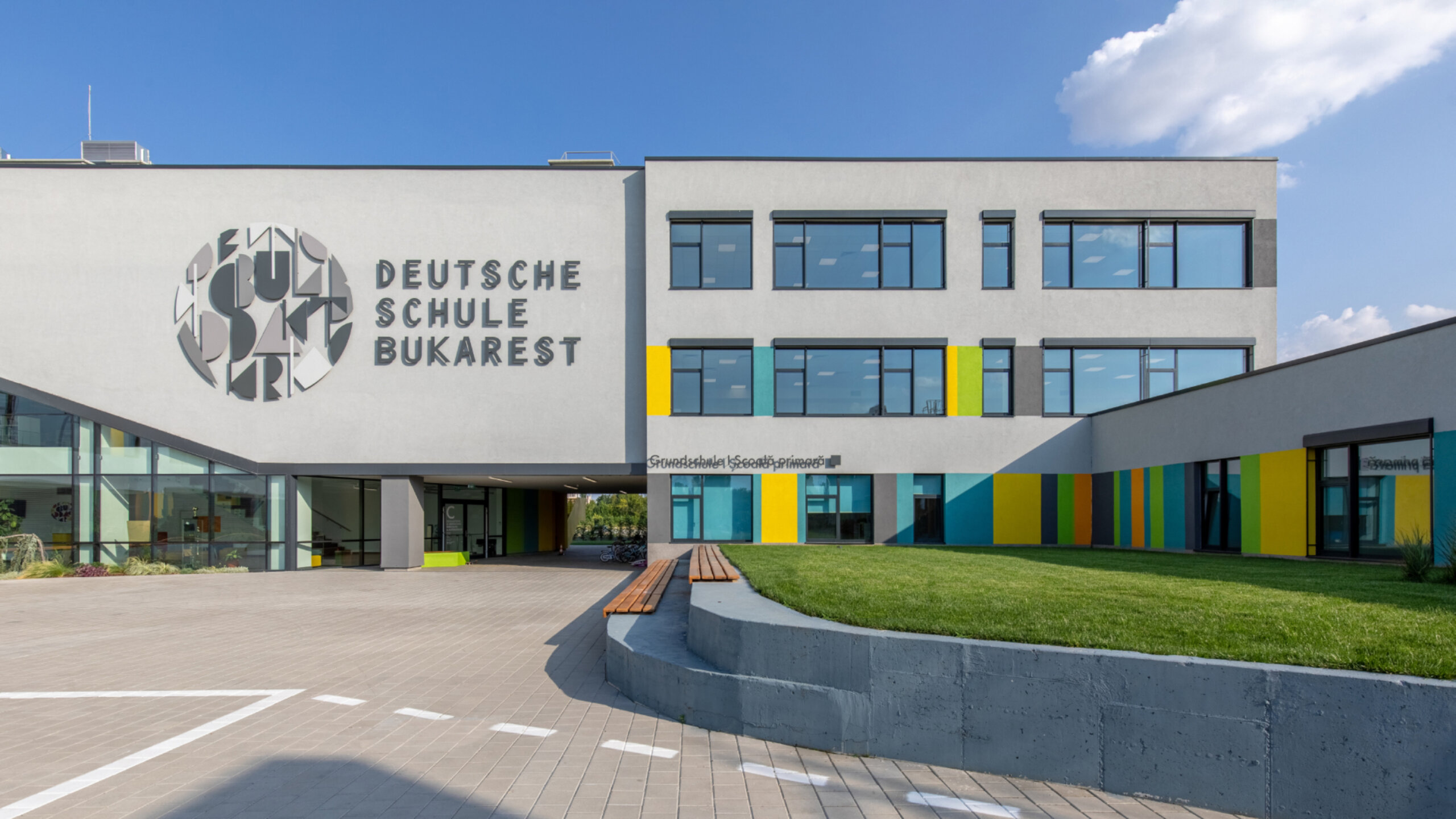
The design of the new campus of the German School Bucharest(Deutsche Schule Bukarest - DSBU) is based on a set of timeless European principles - democracy, equality, unity, diversity and mutual learning - that transcend mere functional organization, configuring an educational space that becomes a matrix of human formation. Like the great public squares of Europe, which are not only meeting places but also spaces for intellectual and cultural exchange, the campus proposes an architecture that not only demarcates places, but shapes thoughts, emotions and identities.
We have sought to respond to this challenge by drawing inspiration from Gaston Bachelard's "Poetics of Space", which reminds us that the spaces in which we live and learn are not merely physical settings, but become "houses of the soul", shelters for our thoughts, emotions and memories. In this poetic key, educational architecture takes on a dual function: a practical one, organizing flows and activities, and a symbolic one, shaping identities and cultivating values.
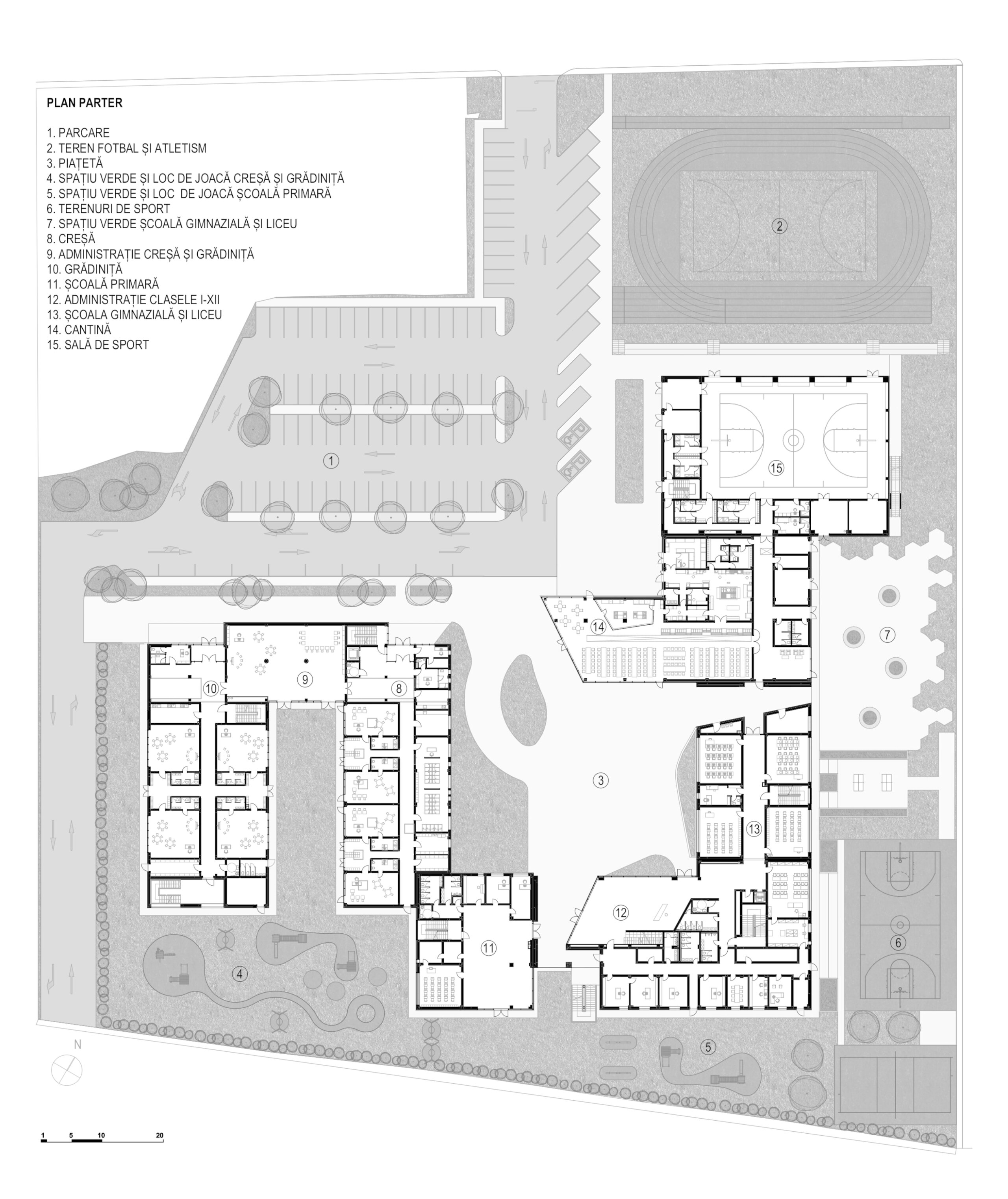
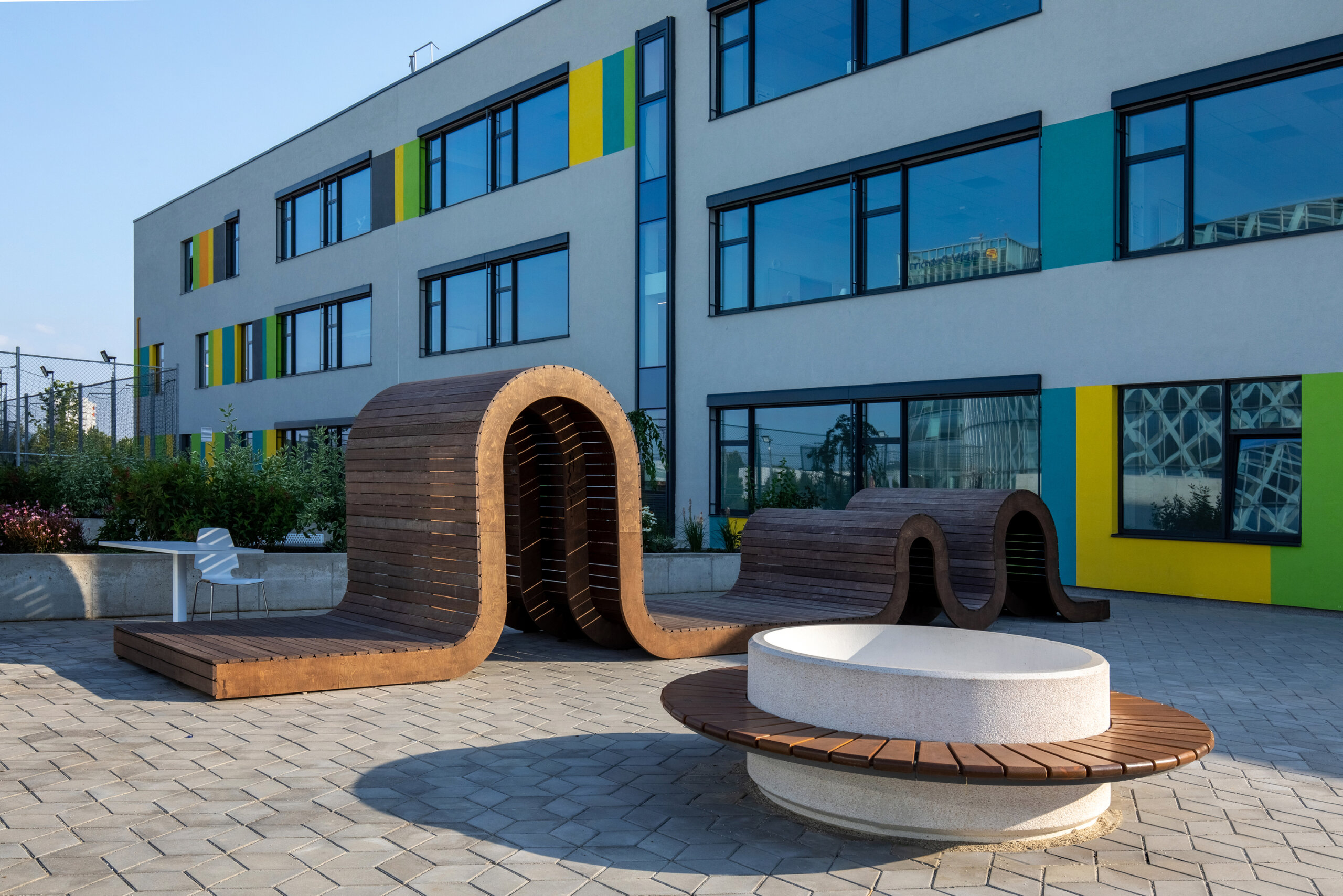
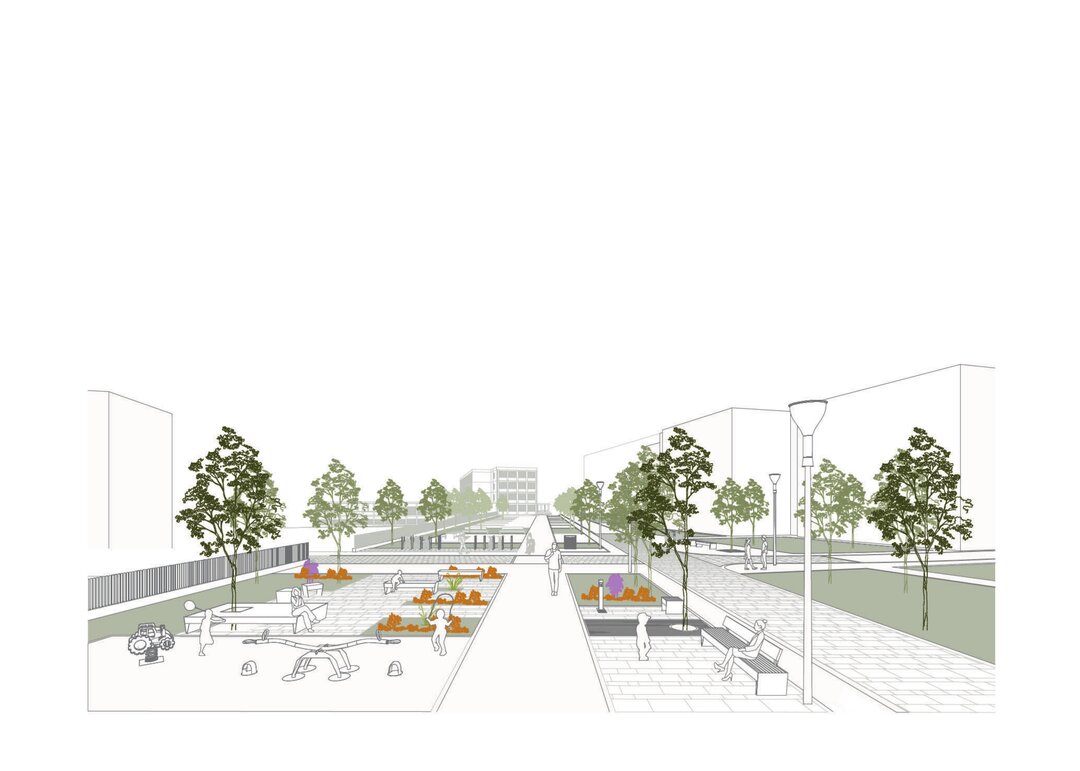
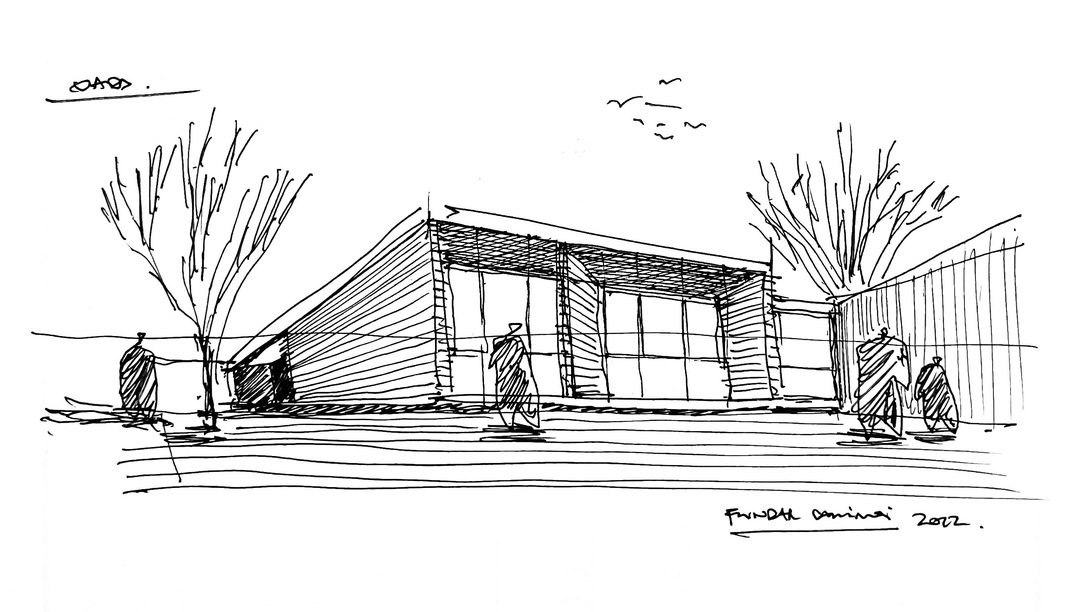
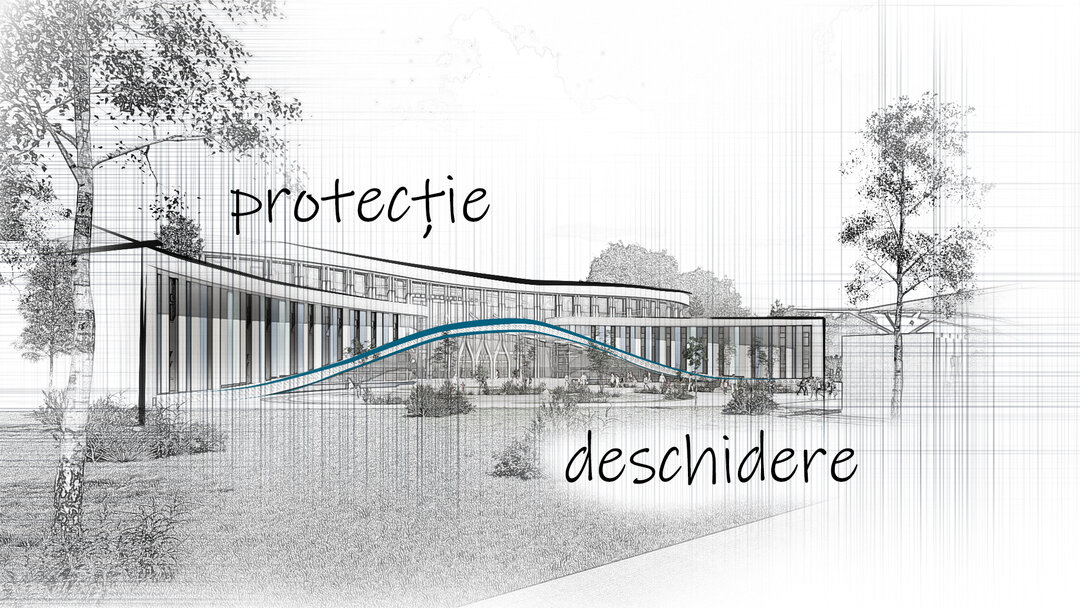
We have rejected the temptation of a soulless functionality and opted for a humanistic approach, where spaces open up and communicate, creating a natural dialog between inside and outside, between education and community. The arrangement of the buildings around a central nucleus - an open square, accessible from all directions - is reminiscent of the ancient agora, not only as an urban form, but also as a symbol of meeting, debate and shared knowledge.
The campus is thus not only a place of education, but also a living space, a 'house of words' where students not only accumulate knowledge, but also construct their identity through collective and individual experiences. It is a place where education transcends the school curriculum and becomes a form of initiation into the spirit of democracy, diversity and mutual respect.
Building this space has meant not only rigorous compliance with energy efficiency and sustainability standards, from the perspective of both Romanian and German legislation, but also the assumption of a moral responsibility: that of helping to form a generation aware of the importance of protecting the environment and living harmoniously with nature. Materials with a proven ecological compliance or performance component, energy efficient systems and the integration of green spaces are not only technical elements, but also expressions of a philosophy that sees architecture as a form of education in itself.
More than an engineering feat, the DSBU campus is an attempt to answer a fundamental question: How can the spaces in which we learn become places of inspiration and human becoming? We believe we have found an answer in an architecture that speaks the language of the soul and, like a well-written poem, lingers in the memory and shapes personalities.
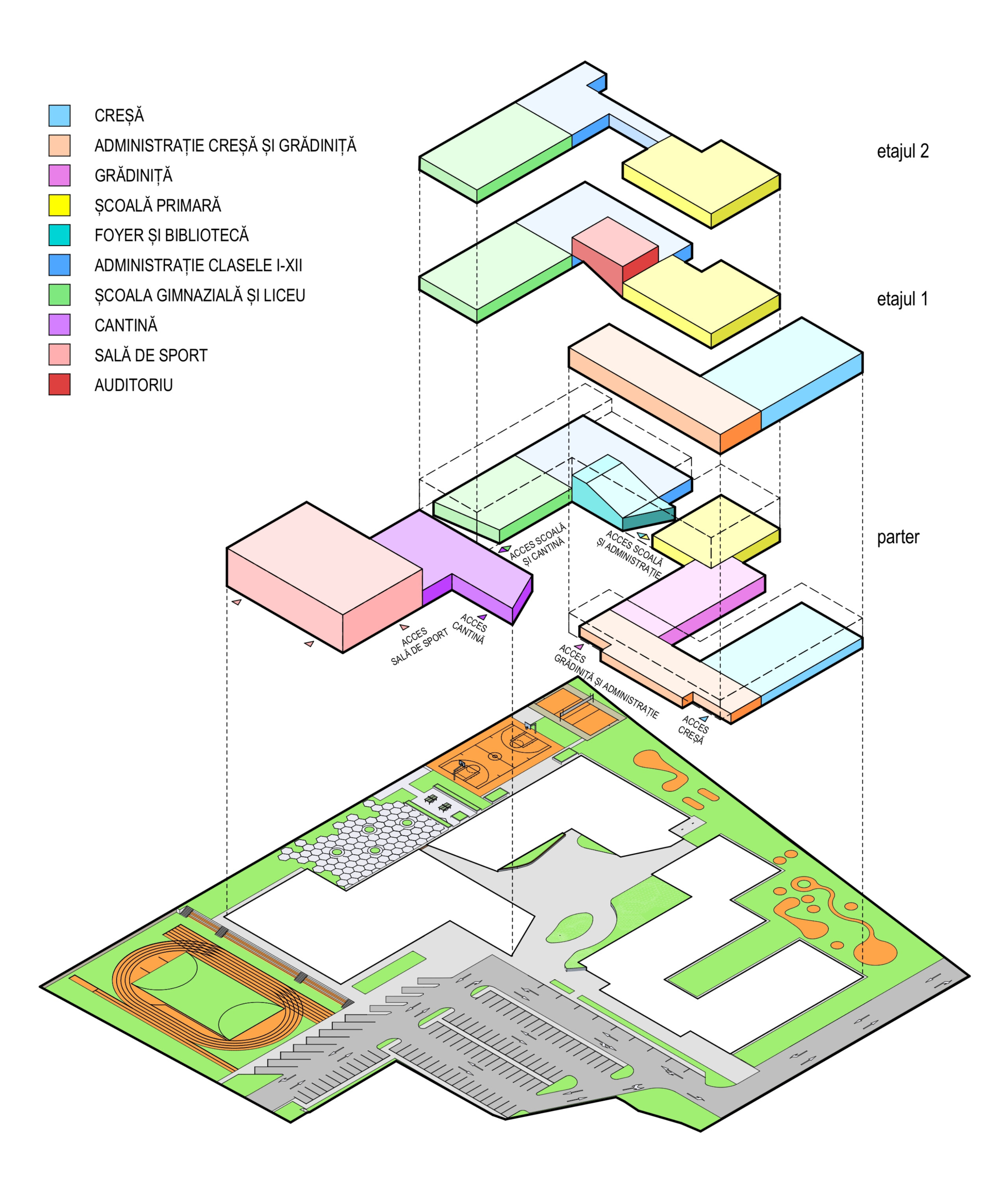
In a country where the built environment for education is largely obsolete, lagging behind new pedagogical directions and contemporary technology, the DSBU School Campus is not just an architectural project, but a statement of intent: it aims to bring the standards of European academic performance and create an environment conducive to lifelong learning. Educational spaces are designed to optimally serve the training process and secondary spaces are organized for maximum efficiency.
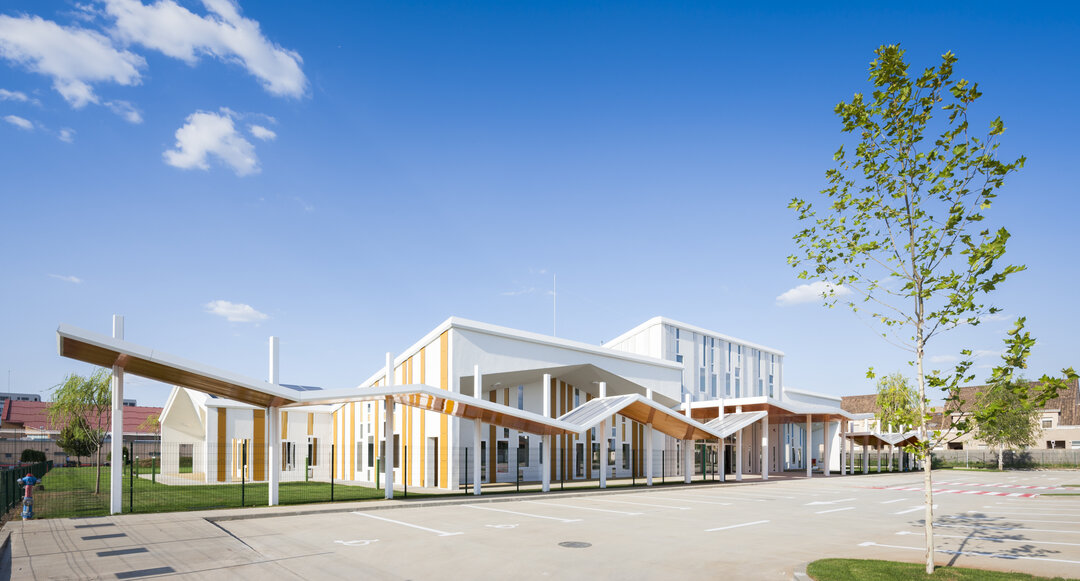
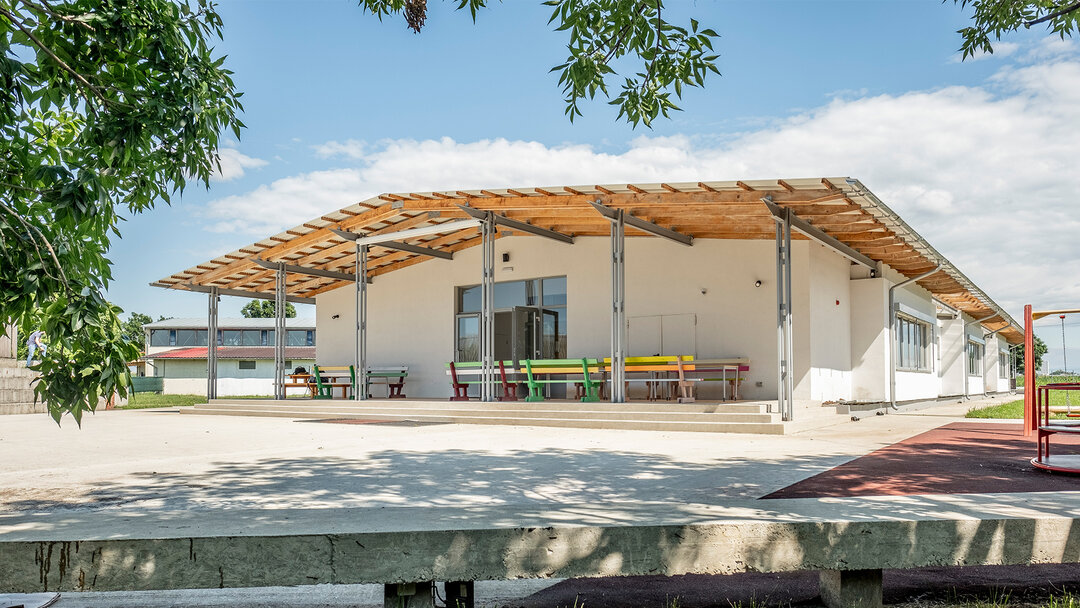
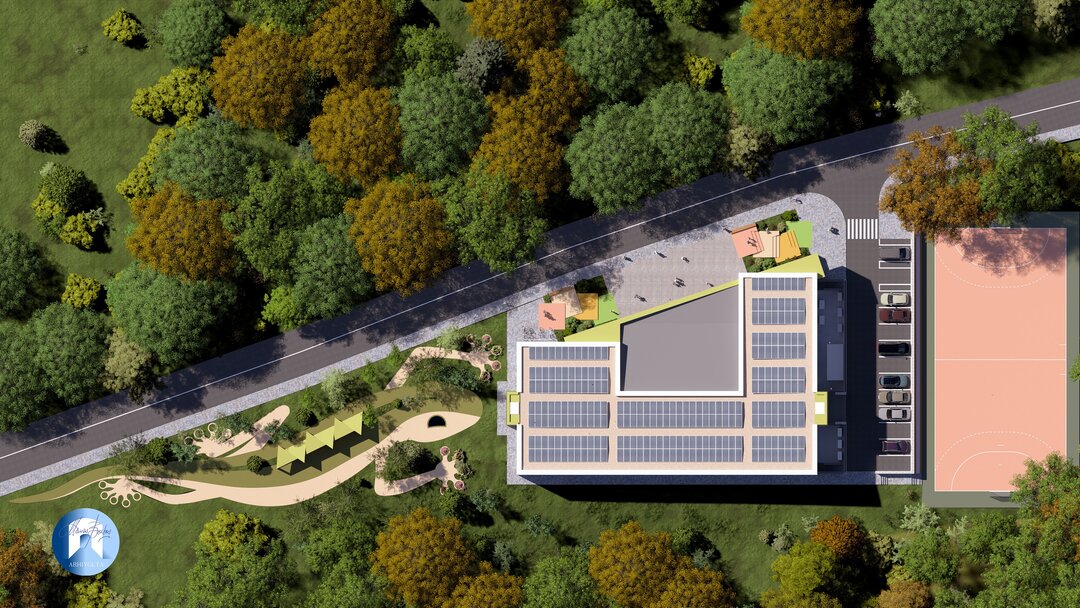
At the heart of this ensemble is the Square - a meeting place reminiscent of the traditional town square, that public space of profound importance in the history of European urbanity, a veritable bridge between nature and architecture. Intermediate and transitional spaces play an essential role, ensuring continuity between outdoor and indoor activities. Connectivity is not left to chance, but is realized through sheltered, semi-open spaces that facilitate free movement but with a refined balance between openness and privacy.
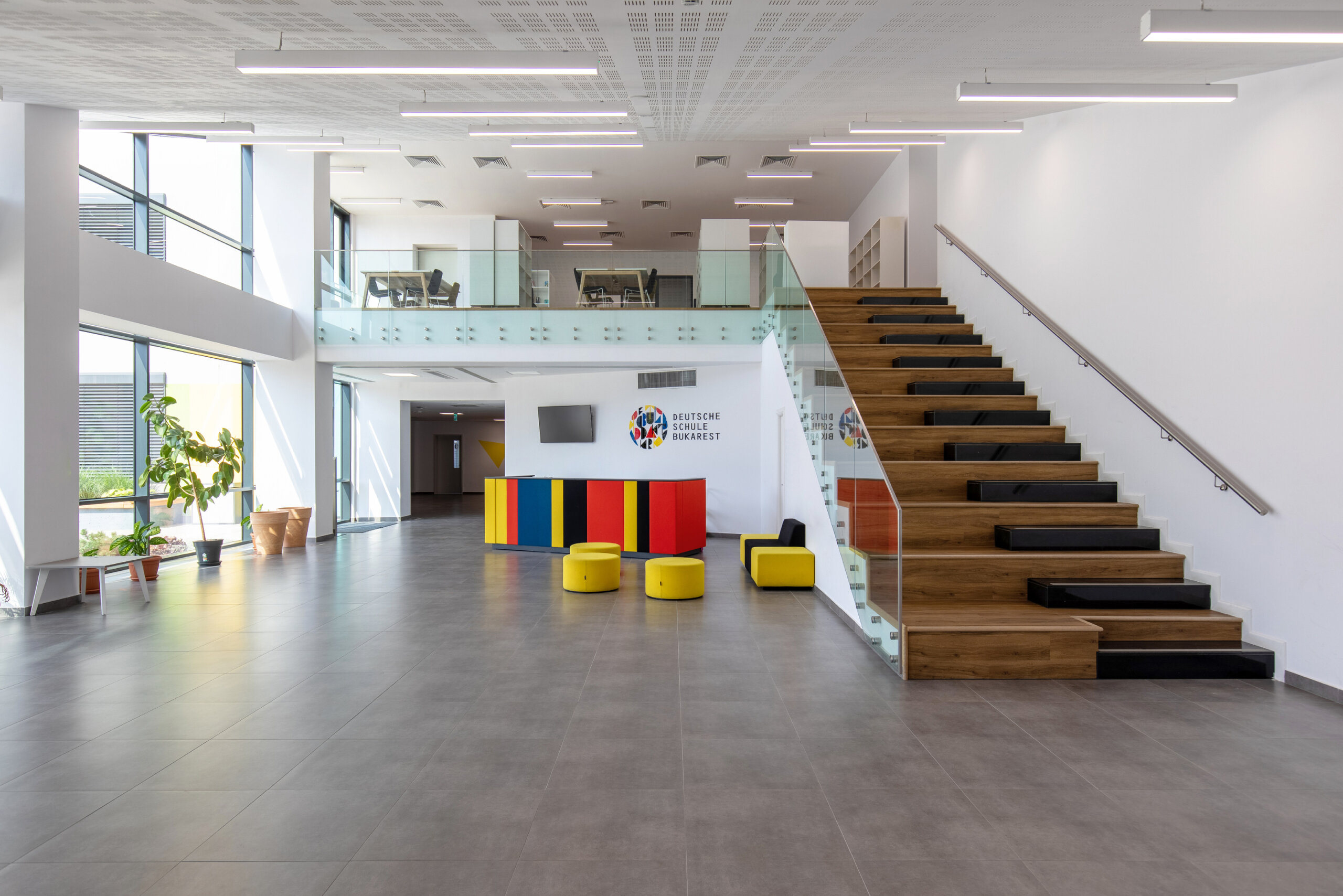
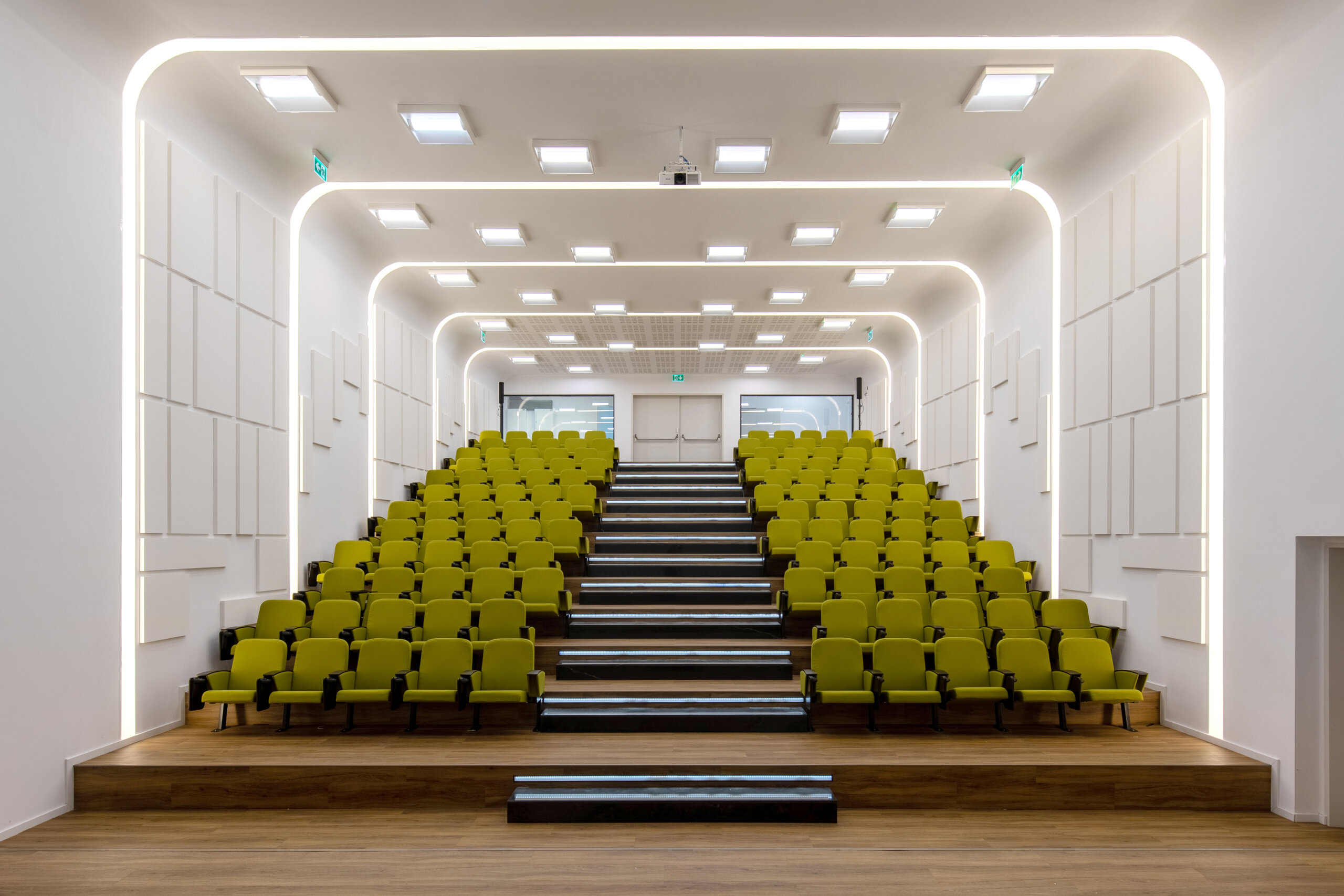
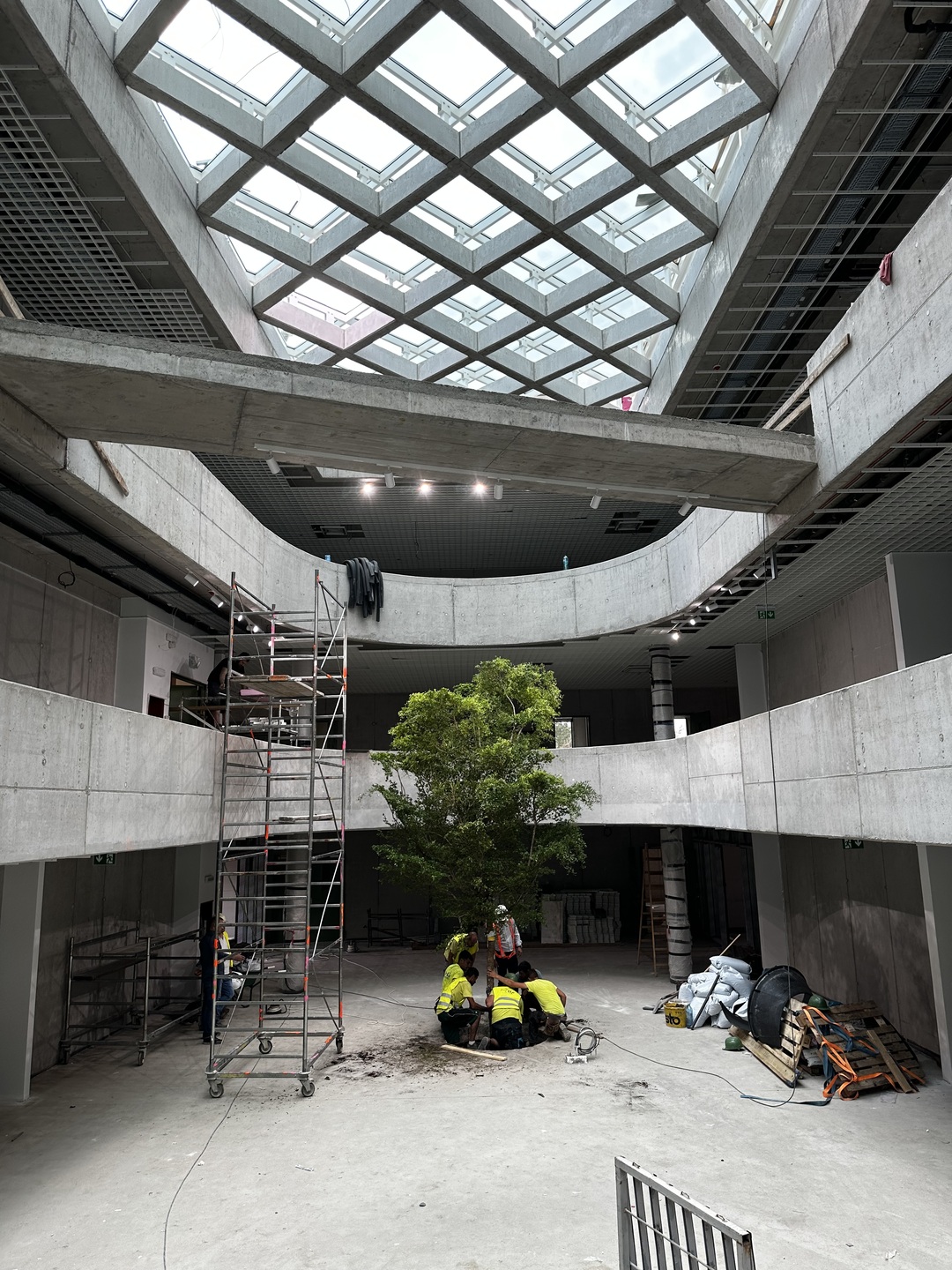
The school's main hallway is designed double-height, with the library above, and above, as a symbol of elevation of the spirit, the classroom - a veritable avatar of the ancient agora, but transposed into the contemporary register, where culture and the arts meet to stimulate communication, interaction and, above all, the cohesion of the school community.
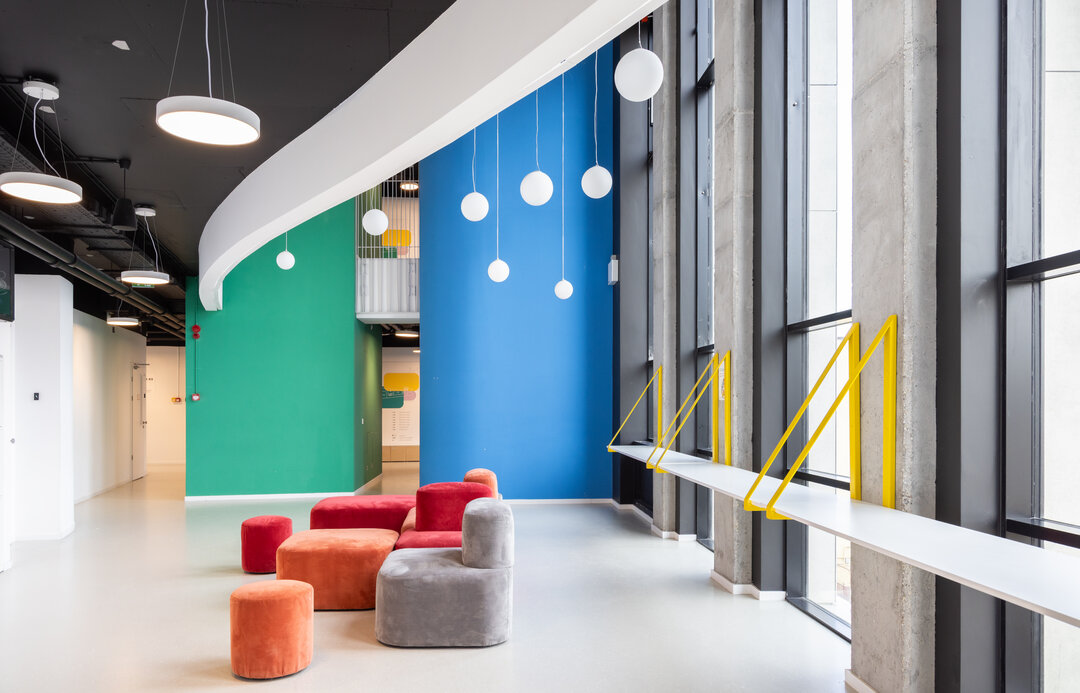
In terms of interior organization, rigid boundaries are abandoned in favour of flexible spaces that respect the natural dynamics of childhood. Common spaces are generous and not only encourage social interaction, but also give pupils an essential freedom: the freedom to assume and interpret the space according to their own needs and perspectives. This is no small detail, for the connection between people and the place they feel is deeply formative.
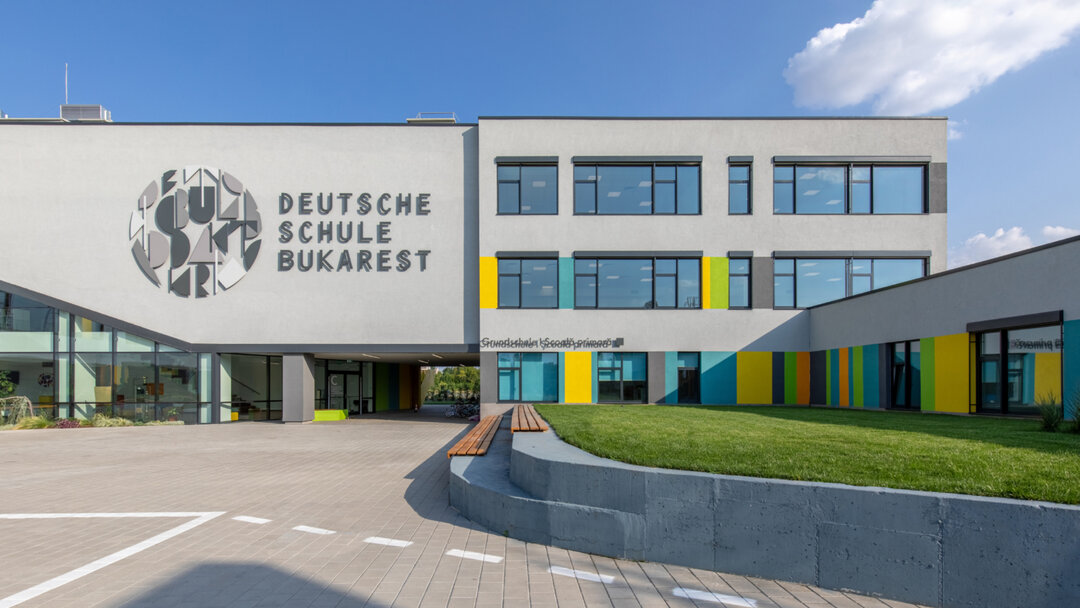
The architecture of this campus is also transparent and comprehensible: its functions are clearly recognizable even from the outside, facilitating both the autonomous use of the interior spaces and the harmonious coexistence of complementary activities. This clarity makes it easier for students to understand and internalize the structure of the place in which they learn, thus developing a natural and harmonious relationship with the space. The idea of dwelling in a state of impermanence, as stated by Bachelard in the quotation at the beginning, rather than of finality, can be transposed to the training of DSBU students, where the educational space is not conceived as a rigid and definitive framework, but as a flexible environment, open to reinterpretation and evolution, thus stimulating imagination, adaptability and the continuous development of their personality.
In the current context, where climate challenges demand a radical paradigm shift, sustainability is no longer just a technical option but a moral duty. The DSBU Campus was born out of this deep conviction, approaching sustainability not just as a set of technical energy efficiency measures, but as an integrative philosophy that permeates the entire architectural concept.
The materials chosen for the construction not only reduce the carbon footprint but also contribute to a healthy indoor microclimate. Interior finishes, mineral plasters and eco-friendly insulation systems ensure an indoor environment free of volatile organic compounds, protecting students' health. But more than that, these materials create a warm, inviting space, an ambience that educates aesthetically and sensitizes to the beauty of simplicity.
The use of energy-efficient systems, such as roof-integrated photovoltaic panels and heat recovery systems, not only reduce energy consumption, but also create a space for hands-on learning. Students are involved in monitoring the building's energy performance, turning the campus into a living laboratory for environmental education.
Responsible water management, by collecting and reusing rainwater to irrigate green spaces, helps to reduce the consumption of natural resources, while providing a visual lesson on the circular economy. In this way, the campus not only complies with sustainability standards, but also cultivates the new generation's environmental awareness.
Sustainability is not only about energy efficiency and environmental protection, but also about creating superior comfort, both physical and emotional. The DSBU campus has been designed to provide a healthy indoor climate and exceptional acoustic, thermal and visual comfort, contributing to the well-being of students and creating an educational environment conducive to learning.
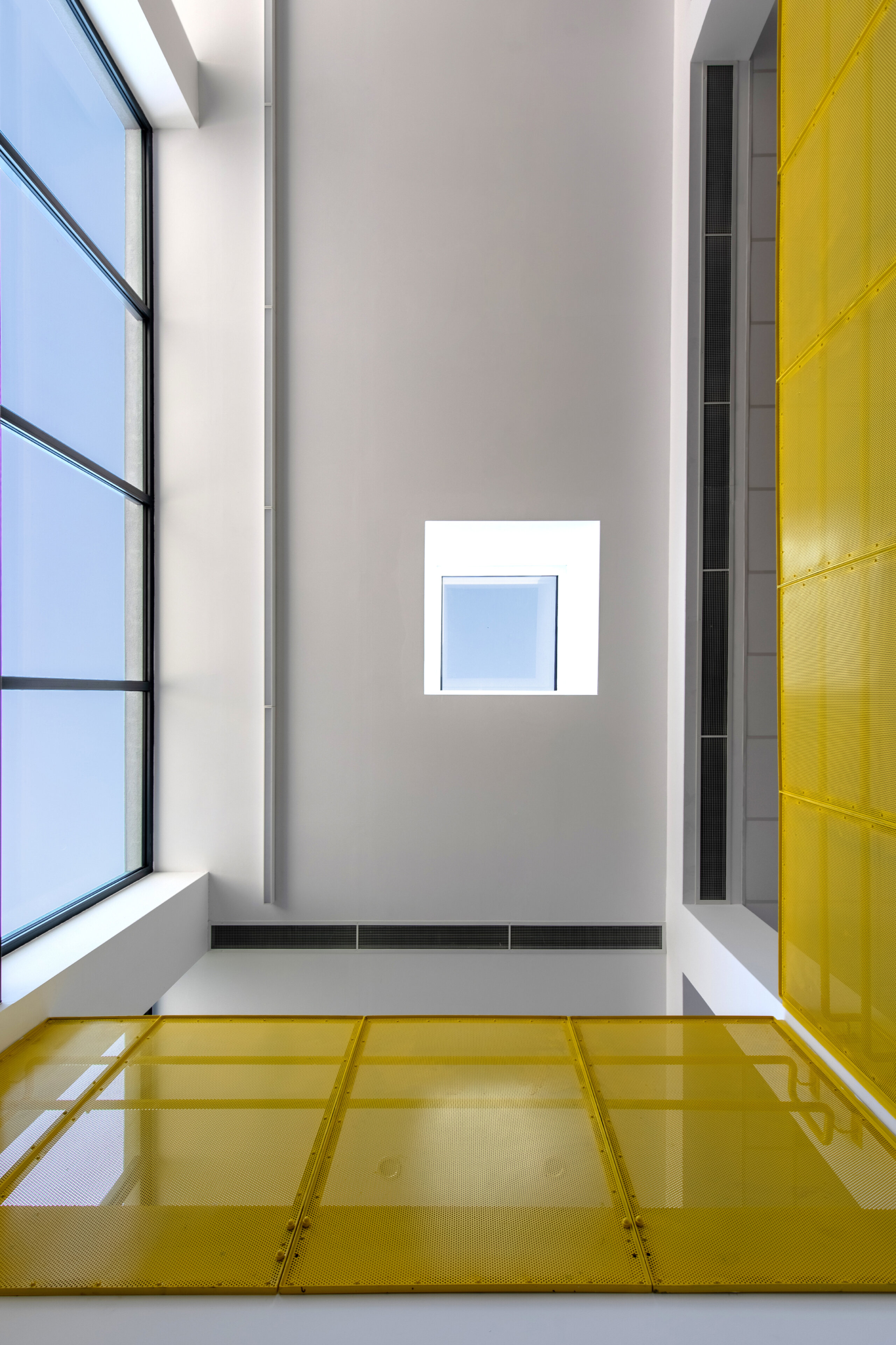
Large windows, strategically oriented to capture natural light throughout the day, reduce the need for artificial lighting, but above all create a vibrant, upbeat atmosphere. Studies show that exposure to daylight improves concentration, teaching performance and well-being, and this principle has been integrated into every detail of the design.
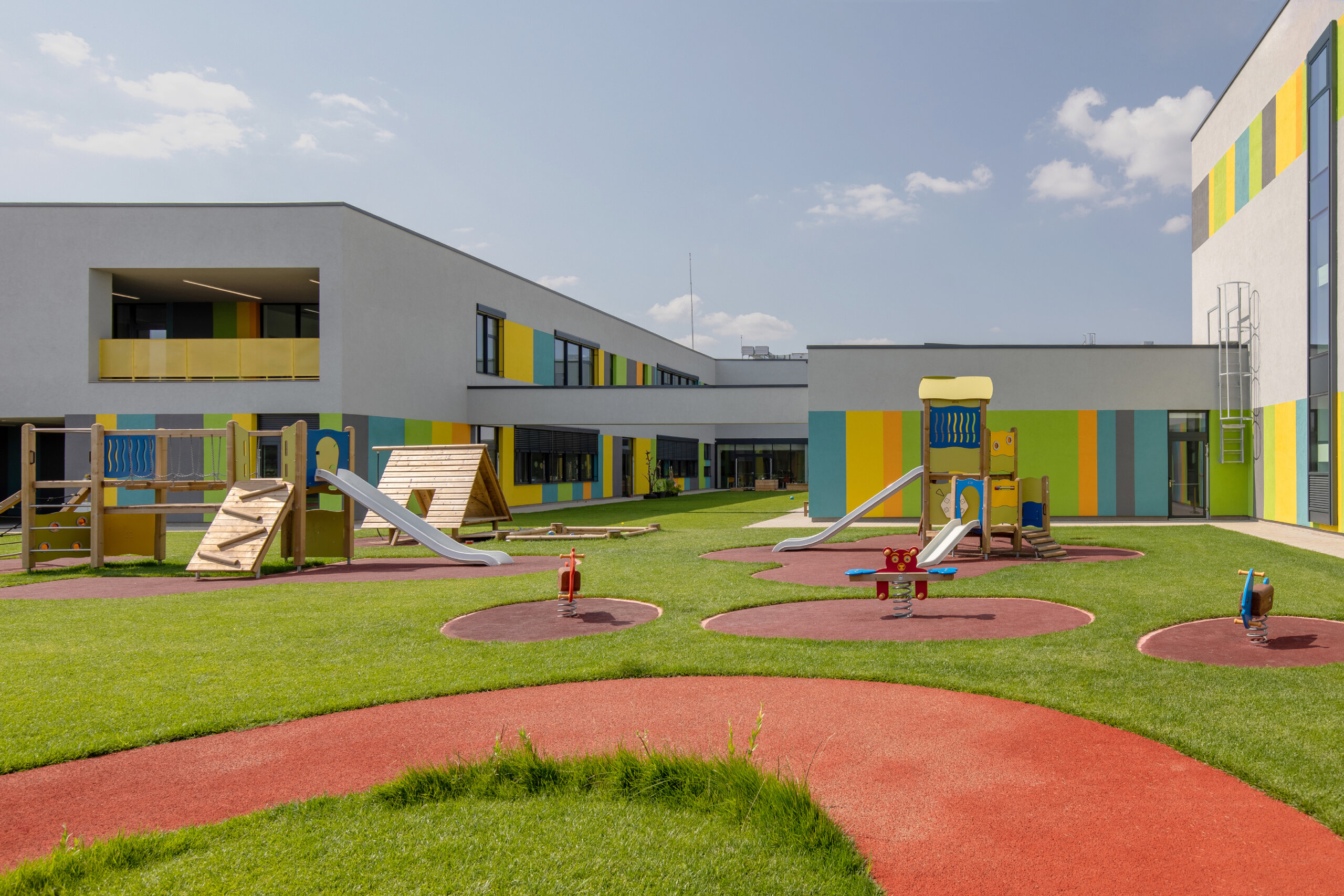
Central ventilation with heat recovery ensures superior air quality while maintaining outstanding energy efficiency. All educational spaces are oriented towards playgrounds or indoor gardens, creating a visual continuity that reduces stress and creates a sense of belonging. Sealing the interior spaces of education buildings against radon was essential to prevent the build-up of this radioactive gas, which in high concentrations can have harmful health effects.
Acoustic comfort, often neglected in educational architecture, was given special attention. The sound absorbing materials used for the interior finishes and compartmentalization of the spaces ensure optimal acoustics for teaching and learning, contributing to a quiet atmosphere conducive to concentration and creativity.
The DSBU campus is not just a building, but also a poetic manifestation of how spaces can nourish the soul and contribute to the beautiful growth of architecture. The careful integration of green spaces not only improves the thermal performance of buildings, but creates a permanent dialog between nature and architecture, between past and future, between inside and outside.
Interior gardens and semi-open courtyards become places of refuge and reflection, in the spirit of Bachelard, offering children spaces for dreaming and introspection. Through this lyrical approach, we tried to humanize architecture and make it a partner in human development.
We sought not just to build a school, but to create a place that inspires, speaks to the soul and stimulates the imagination. Like a well-written poem, this campus will be remembered not just for its harmonious forms or energy efficiency, but for the human experiences it will host.
Architecture thus becomes not just a physical setting, but a form of education in itself, an art that shapes personalities and cultivates values. We believe that we have built not only a place of learning, but also a space of human becoming, where students will not only accumulate knowledge, but also build their identity through a constant dialog with the beauty of the space and the world around them.
Designing architectural spaces that contribute to human formation, like a Bildungsroman metamorphosed into a building, means understanding that architecture is not just an exercise in functionality, but a cultural act, deeply educational. After all, space is an extension of the spirit, and light, textures, pathways and materiality are not mere details of composition, but the means by which man is introduced to the mysteries of the world and society, as well as to his own being.
We cannot talk about space without recognizing its vocation as a place of encounter and contemplation, in which the child not only exists but also becomes. The way in which the spaces are orchestrated, their narrative sequence - from intimate retreats in the kindergarten hallways to the wide openings of the corridors - gives a rhythmicity of discovery, not far removed from the way in which Goethe's or Proust's characters discover their identity through their confrontation with the world.
The generous use of natural light is not simply an atmospheric element but a metaphor for knowledge. Subtly filtered, it invites reflection, reminding us that all great revelations are born of the fine interplay between light and shadow. Textures and colors are chosen not just for tactile comfort or visual indulgence, but to educate taste, to refine sensitivity. In contact with the materials that define the immediate space, the child learns authentic simplicity, as opposed to garish artificiality.
The interior and exterior paths, staircases, terraces and sports areas are not utilitarian routes, but formative itineraries designed to cultivate curiosity and provoke the imagination. Getting lost in order to find yourself - that is the lesson that a discreet labyrinth can teach. As for the essentialized materiality of the architectural epidermis, we felt that it should be honest, durable, bearing the memory of time as a testimony to continuity, respect for the past and responsibility for the future.
In essence, architecture thus becomes a three-dimensional Bildungsroman, a form of modern paideia, a place of becoming, not just of passing through. Here, the student not only learns lessons, but also undergoes formative experiences, growing harmoniously, learning the freshness of belonging and the beauty of discovery.
Ever since we won a two-phase architectural competition, our approach has centered on two pillars, fundamental to the evolution of contemporary European society: culture and sustainability. Confronting the educational program is not only the quest for architectural performance, but also a cultural assumption. The campus becomes a living space, a school of democracy and pluralism, a place where young people not only accumulate knowledge but also discover their identity, exercising their freedom of thought in a spirit of mutual respect. Education cannot be conceived outside a culture of dialog, diversity and human solidarity.
In this humanist vision, sustainability is not only a technical necessity but also a moral duty. The campus is not limited to respecting ecological norms, but integrates in its philosophy a responsibility towards nature and future generations. Eco-friendly materials, green spaces and efficient energy systems thus become expressions of an active environmental conscience, through which students learn not only to know the world, but also to protect it.
It is not just a lesson in architecture, but also in civilization. Thus, the DSBU campus is not only a place of knowledge, but also a place of human becoming, where the child not only learns, but also forms himself in the deepest sense, integrating himself into the great European tradition of free spirit and humanistic culture.
Authors. Sergiu-Cătălin Petrea, arh. Sabrina Ene-Butnariu, arh. Cristina Mototolea, arh. Sebastian-Ștefan Apostol, arh. Dan - Alexandru Roșu, arh. Tania-Victoria Băncilă, arh. Diana-Elena Fusea.
Design office: TecTo Arhitectura
Collaborators:
Structure - Arcadia Engineering, POPP & Asociații, Profesional Construct Proiectare
Installations - Tehnoclima
Urban Planning Documentation - Point Zero
Landscaping - CMD Design Project
Traffic Studies - DO.IT Arhitectura, Urban Trafic
Project Management - REC Immpuls, Ensight Management Consulting, arh. Radu Sava
Site Management - Qbuild Profteam
Environmental Impact Studies - HPC AG Hamburg, ERM Enviromental Resources Management
Acoustic studies - Enter Studio
Multi-Comfort Consultancy - Gabriel Golumbeanu
Consultancy: Integrated Solutions Expert (I.S.), Nego Project (architecture)
Photo: Sabin Prodan / TecTo Arhitectura
Beneficiary: Association for the Establishment and Support of the German School in Bucharest

.TIF--17914-m.jpg)

--18036-m.jpg)