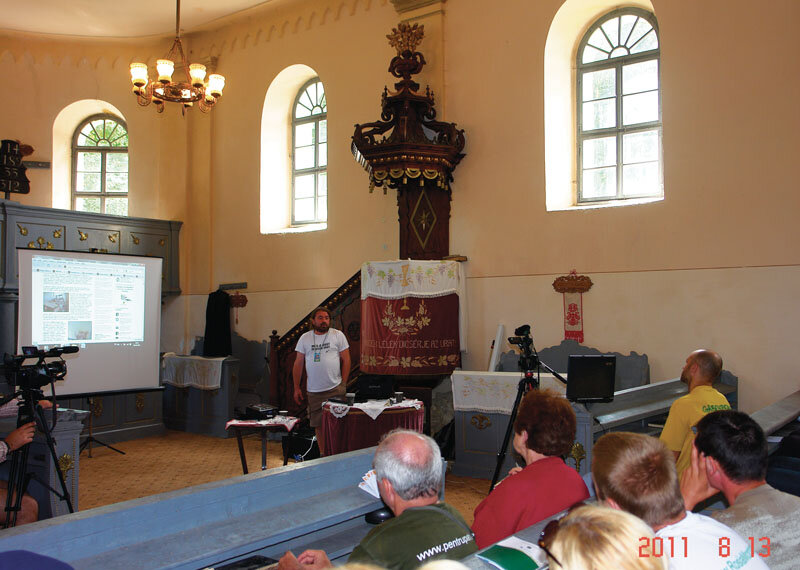
FânFest Conferences


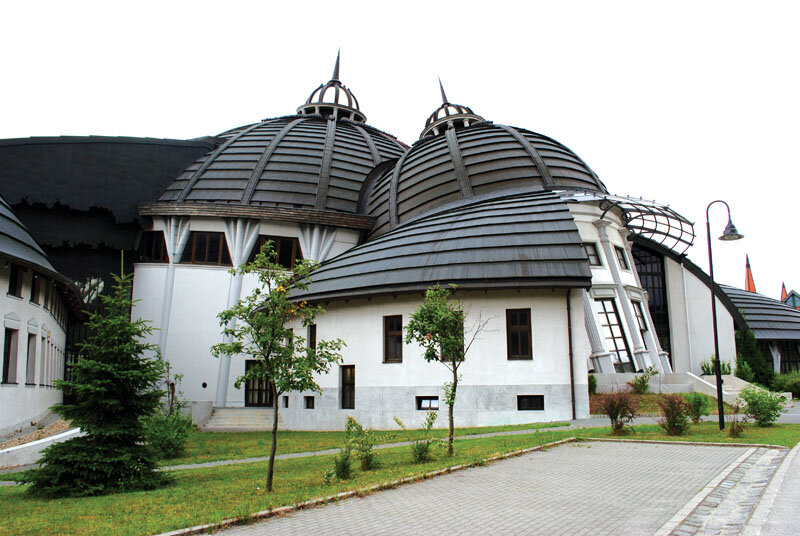
On September 27, 2011, Hungarian architect Imre Makovecz, whose career spanned more than 50 years and included more than 100 buildings, passed away. At the time, he had several projects in progress.
Imre Makovecz was born in Budapest on November 20, 1935. In 1959 he completed his architectural studies at the Technical University of Budapest and then worked for various state design companies between 1959 and 1981, when he opened his own office in Budapest under the name Makona Építész Tervező és Vállalkozó Kft. In the same year he became a professor at the Technical University and the Higher School of Applied Arts. In 1992 he was one of the founding members of the Hungarian Academy of Art, of which he became the permanent president. He received 10 awards and was an honorary member of several societies in England, Scotland and the United States. During his lifetime, eight books on his work appeared, four in Hungary, but also in the UK, Germany, the Netherlands, Italy, and his architecture became the subject of research.
Imre Makovecz was closely linked to the tradition of his country, communicating this link not only through the language of his buildings. Inspiration from tradition is not a new element in Hungarian architecture, trends in this direction have existed since the early 20th century. Folk architecture served as a model for Makovecz, who confessed that vacations in his grandparents' village of Nagykaporna in western Hungary developed his taste for folk architecture.
Makovecz's architecture is organic, a philosophy pioneered by Frank Lloyd Wright, whose work he knew as a student but whose influence in
Hungary reached through both early 20th-century architecture and the anthroposophy of Rudolf Steiner. In the Hungarian architect's work, participatory rather than design, participation was manifested mainly in the building process, through the involvement of folk craftsmen.
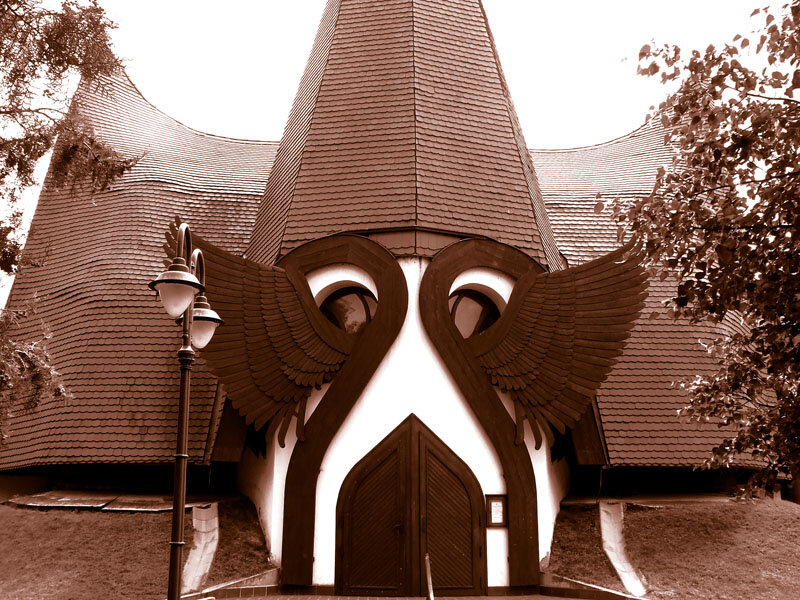
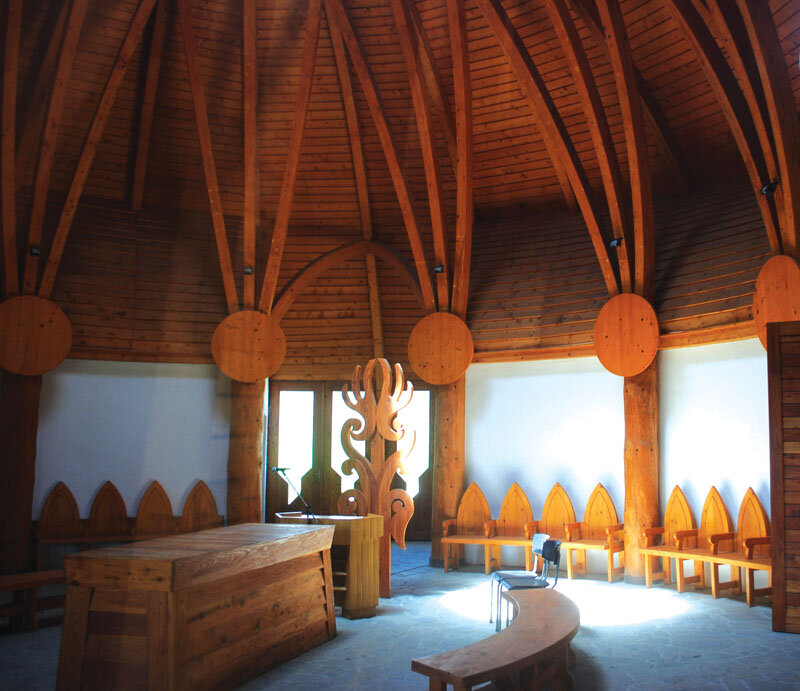
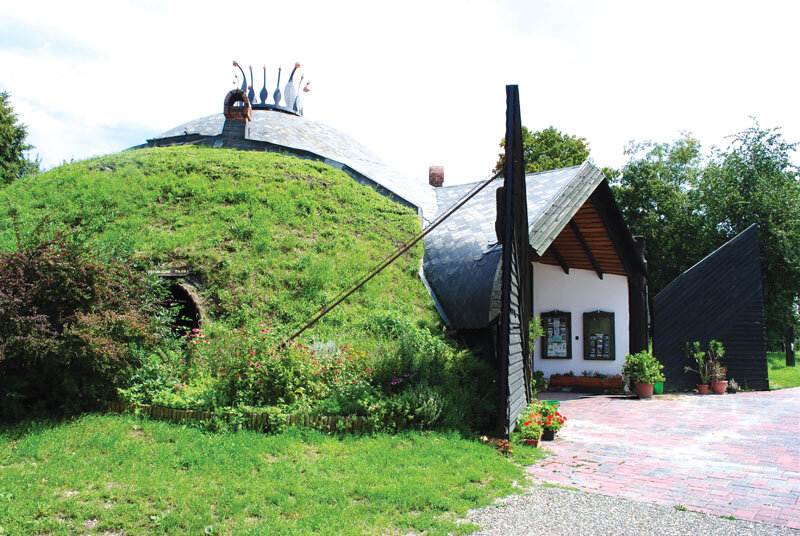
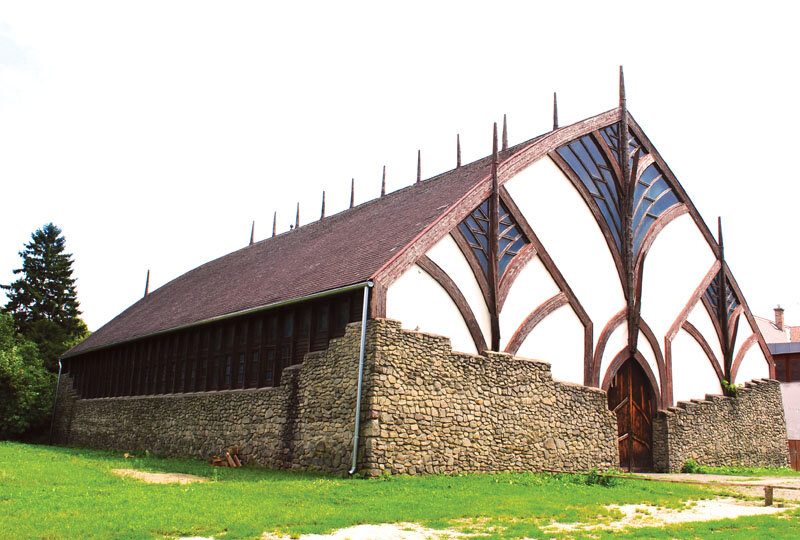
We find the Makovecz style in public projects: hall-type buildings such as churches and chapels of different denominations, cultural halls for university lectures or for various sports, as well as restaurants. Characteristic are the steeply sloping or curved roofs and the preference for wood, both structurally and in the finishes. The green architecture is notable. In both Szazhalombatta and Sfântu Gheorghe he built partly green, sloping roofs. The Hungarian architect's signature is the wooden eagle.
The first important building designed by Imre Makovecz, notable for its concave façade, was a restaurant in Berhida, Balaton, in 1964. It was here that the connection with Rudolf Steiner's Gotheanum1 first became apparent. Also on the banks of the Balaton are the Szövösz vacation homes in Balatonszepezd (1965) and the Reformed church in Siofok (1986).
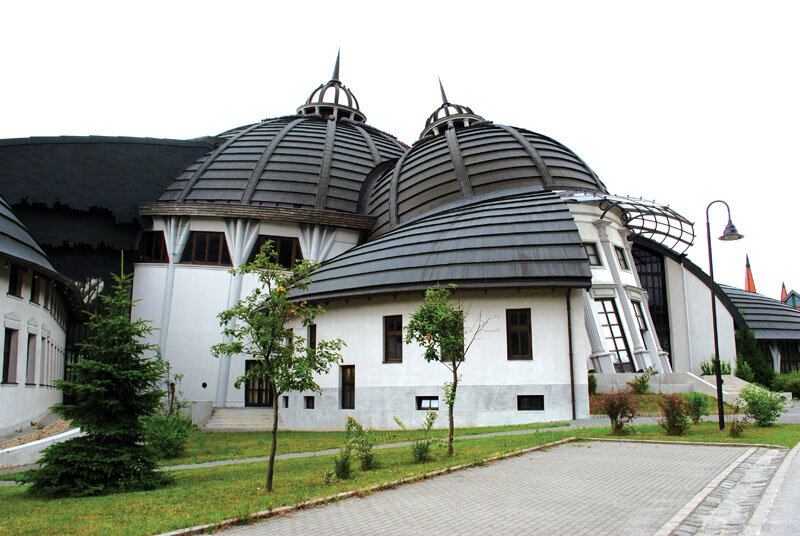
In 1975, in Budapest, he built the mortuary chapel of the famous Farkasrét Cemetery, which he only shaped from the inside with a ceiling reminiscent of human ribs, and an illegally erected memorial with concrete elements, where he used the mirror element. Early in his career, the architect tried to design in reinforced concrete - the Sárospatak Cultural Center in Sárospatak (1972) - but ran into difficulties in forming the designed shapes and turned to wood. Even in concrete, the building was an innovation as the architect tried to move away from prefabricated.
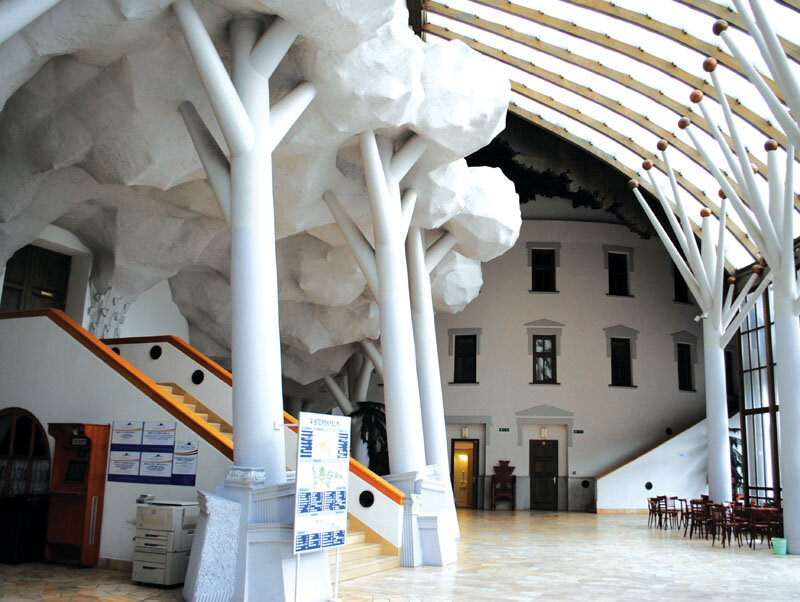
His best known building is the Stephaneum, the central hall with the lobby of the Catholic University
"Pazmany Peter" in Piliscsaba, near Budapest (1995), from the same year as the church in Szazhalombatta, which has a related typology of pillars. However, other critics consider the Hungarian Pavilion at the 1990 Seville exhibition as Makovecz's emblematic building, and it has been included in international monographs of contemporary architects (Meyhöfer, 1994). The pavilion has symbolic value, 1990 was the year of the fall of the Iron Curtain, that is why it was declared a monument. The architecture of the pavilion is oriented to the predominant program in Makovecz's work, that of churches: the diagonal of the pavilion consists of seven church towers.
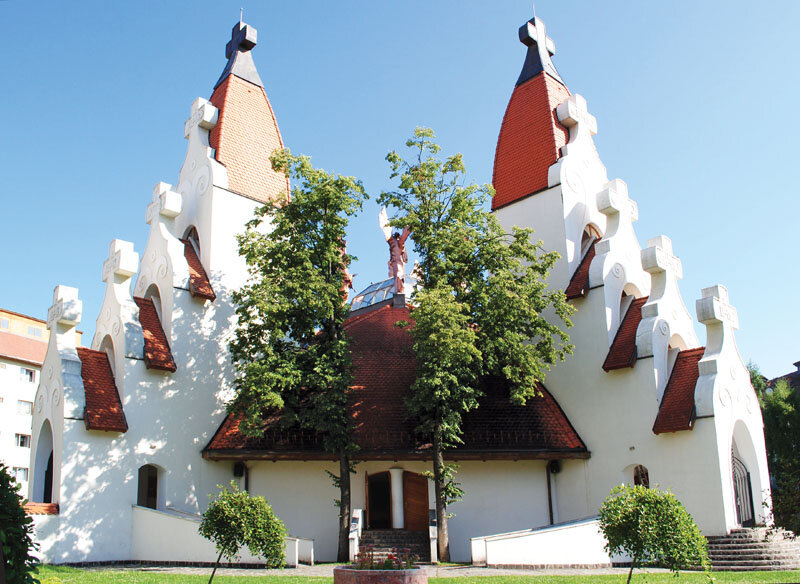
After 1990, Imre Makovecz received commissions in Romania, erecting the Reformed mortuary chapel at the cemetery in Sfântu Gheorghe (1998) and then the Catholic Millenium church in Miercurea Ciuc (2001). In Miercurea Ciuc he also designed the altar for the services of the pilgrimage of St. Mary in Șumuleu Ciuc. Reformed churches in Timișoara and Cluj are under construction. The Reformed center church in Timisoara, located in Sarmisegetuza Square, is being built in red and looks set to include concrete elements in addition to masonry walls and an organic wooden roof. The church in Cluj's Donath Street is being designed by his former student Csaba Müller after an idea by Makovecz2.
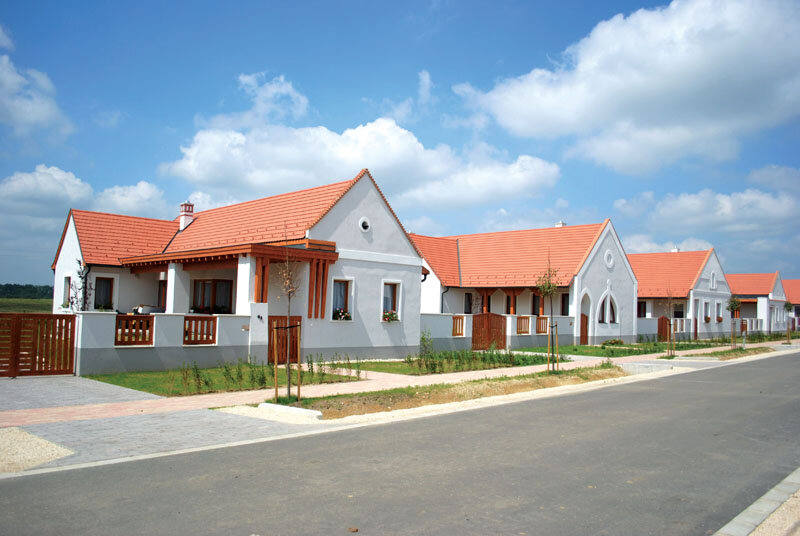
Recent completed projects include housing in Kolontar and Devecser (2011), areas rebuilt after the chemical disaster at the Ajka aluminum factory. Makovecz has respected the elements of traditional Sevretian architecture: the door connecting the intermediate space of the porch to the street through the main facade, with the tympanum facing the street, and the organization of the street. Not all of the houses were designed by Makovecz: he designed only three, and the others belonged to other volunteer architects, being variations on the same theme. Two of the dwellings designed by Imre Makovecz show neo-Gothic elements, but also elements typical of his architecture: unfinished trunks and the stylization of eagle wings3. The acceptance of these buildings by the tenants reflects another dimension of the association of Makovecz's architecture with Rudolf Steiner's anthropozoic philosophy and the consequences in the participatory aspect, which was also noticeable in earlier buildings, such as the complex built on Mogyoróhegy, Visegrád, in 1980 (Kuhlmann, 1998, chapter 6.3.1). Participatory architecture in post-disaster reconstruction places Makovecz ahead of some European approaches. After the 2009 earthquake, l'Aquila was rebuilt at a high technical level, but using prefabricated elements and the 'Zeilenbau' architectural approach of Modernism, without the participatory involvement of citizens, who are now virtually rebuilding the historic city in Google Earth.
Imre Makovecz's death is a loss for European architecture. Perhaps the new orientation in architecture will survive him and the young architects he worked with will follow his example.
Bibliography:
Maria Boștenaru Dan: "Vernacular and Modernist Housing in Germany and Romania. An Analysis of Vulnerability to Earthquakes", Cuvillier Verlag, Göttingen, 2010.
Dörte Kuhlmann: "Metamorphosen des Organizismus. Zur Formensprache der Lebendigen Architektur von Imre Makovecz" [Metamorphoses of the Organism. A look at the language of forms in the living architecture of Imre Makovecz], PhD dissertation, Bauhaus Universität Weimar 1998, available online at http://e-pub.uni-weimar.de/volltexte/2004/70/index.html
Dirk Meyhöfer: "Contemporary European Architects II", Benedikt Taschen, Cologne, 1994. Imre Makovecz: pp. 118-125.