
Let's talk about architecture schools
Thematic articles
One yellow kitchen, millions of gray kitchens
ONE YELLOW KITCHEN, MILLIONS OF GREY ONES
| COULDTHE KITCHEN, A ROOM WITH A DOMESTIC VOCATION, DESIGNED FOR FAMILY INTIMACY AND A WOMAN'S FAVORITE TERRITORY, EVER BECOME A CENTRAL SPACE IN THE GREAT STORY? |
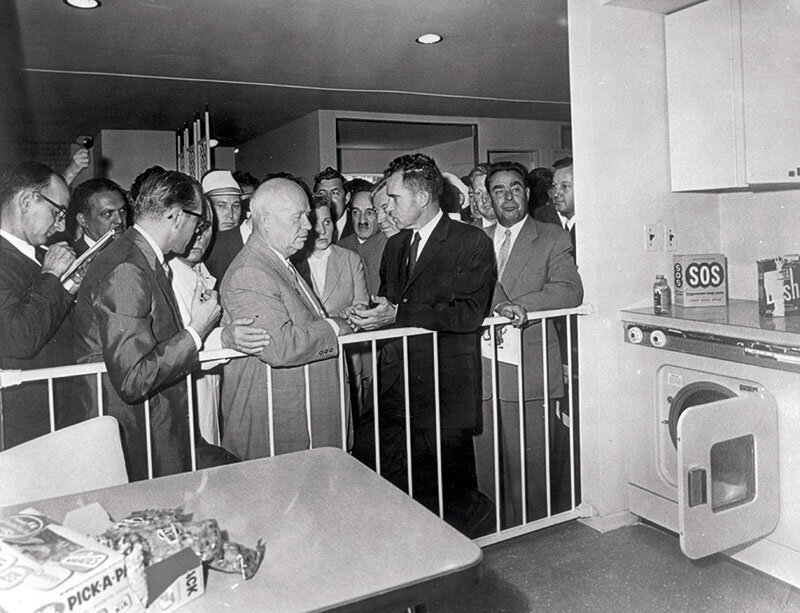
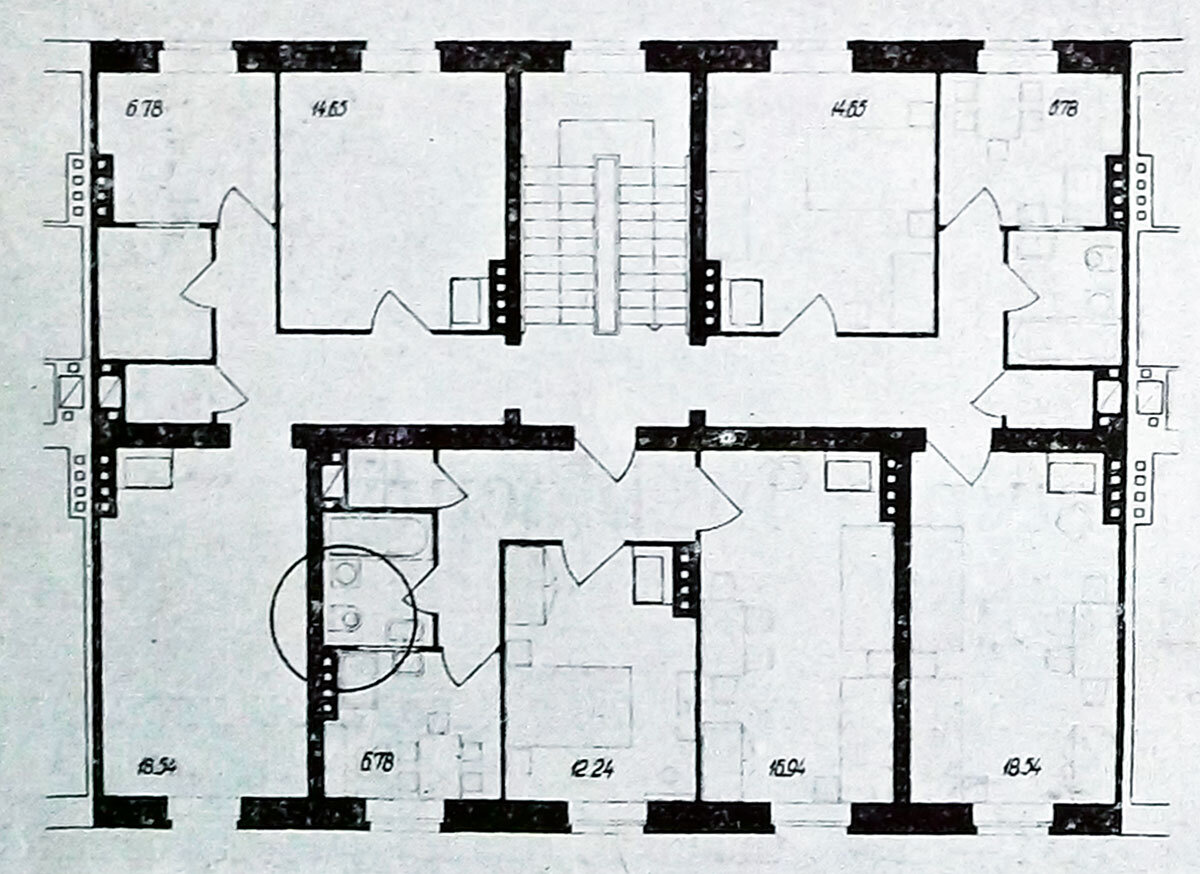
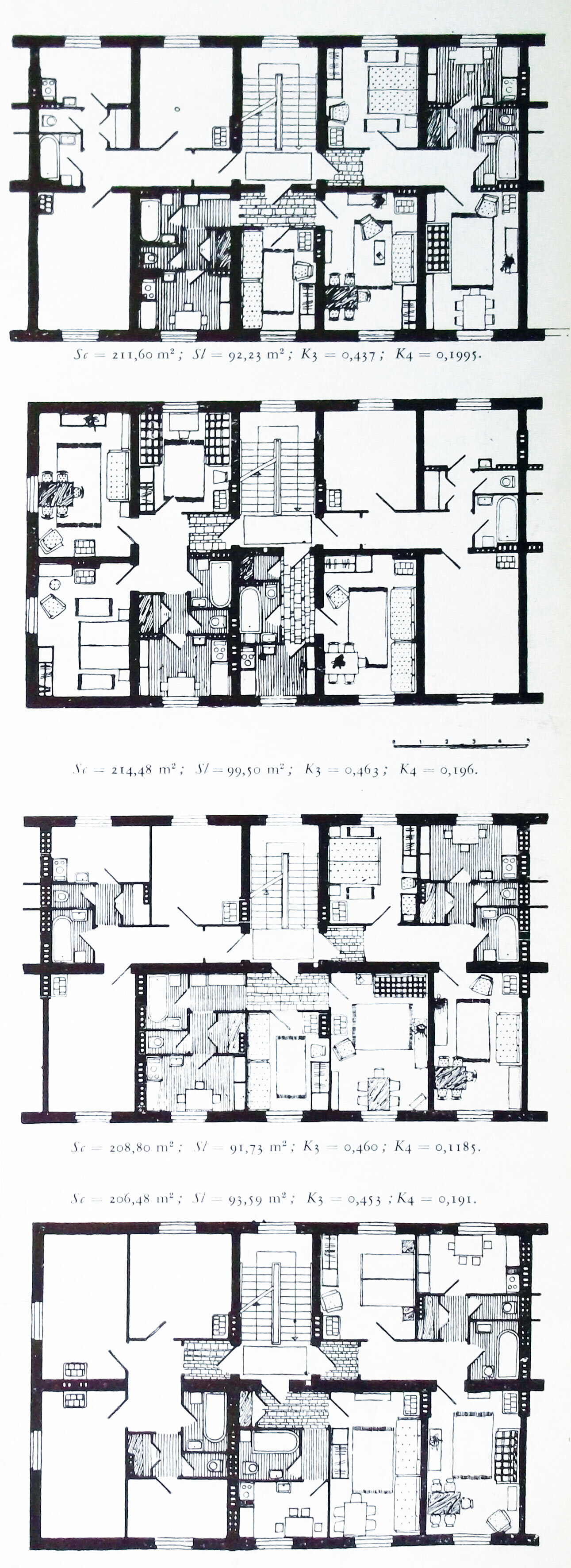
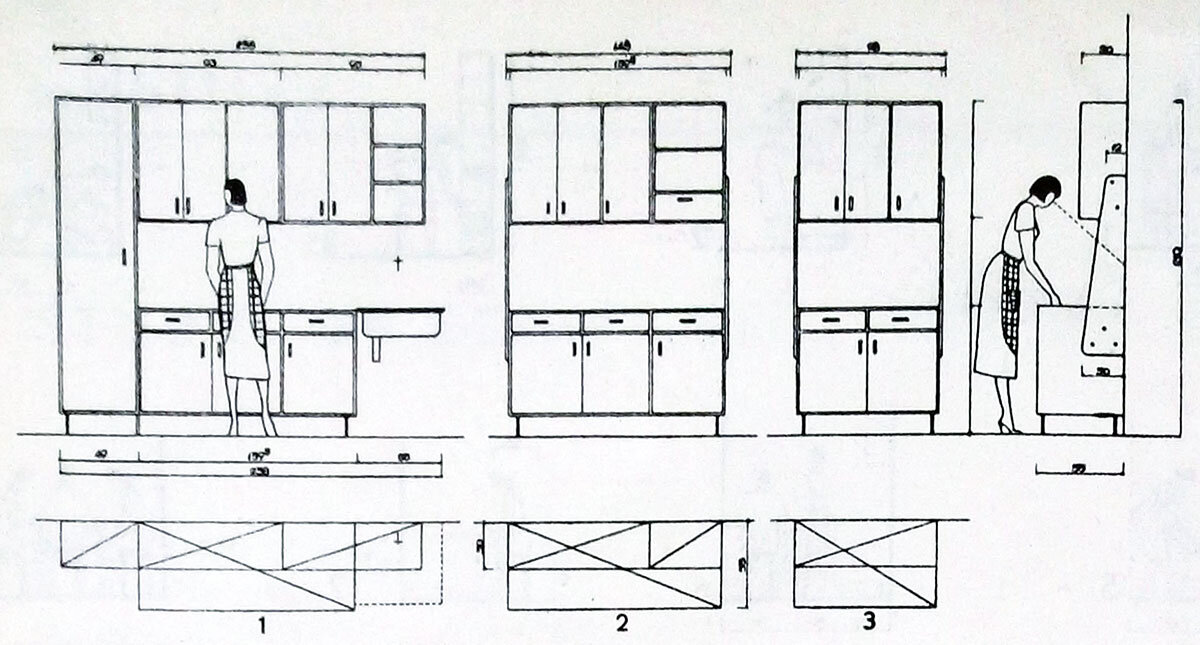
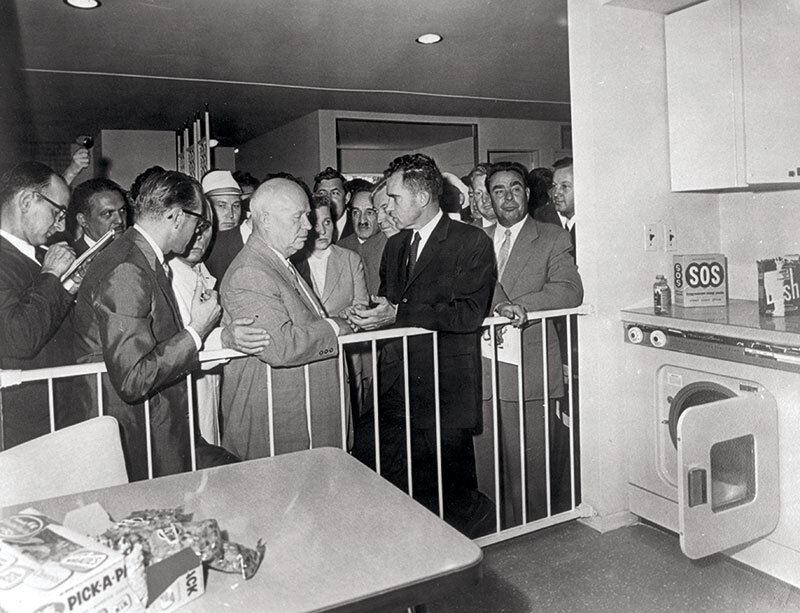
| It was the chance for a yellow kitchen, furnished and equipped by General Electric, to be the scene of an important Cold War episode. We are talking about the meeting that came to be known as the 'Kitchen Debate' between Richard Nixon and Nikita Khrushchev at the 1959 US exhibition in Moscow (Fig. 1). While the unintended irony of the situation cannot escape us, and while it is obvious that the stakes of the debate were ideological, it is worth noting that the war was leaving the trenches and moving into the realm of domesticity itself. Thus the kitchen, equipped with the latest technology to support every American housewife, emerged as a tool of the temptation of Western life in a Soviet Union that was just beginning to think about the development of the consumer goods industry. While the 1958 New York pandant exhibition in New York focused on Soviet achievements in high technology, heavy industry and even the conquest of space (with the launch of the Sputnik satellite), the Americans decided to exhibit consumer goods that would appeal to the Soviet man in the street, especially the housewife. At least on a declaratory level, the Americans had decided that high technology should be put at the service of mankind through such consumer goods and equipment that would make his life easier.1 Thus the kitchen entered a race of technologization, like other areas affected by the ideological dispute between the two great powers. The Soviet Union also decided to produce kitchens equipped with fixed furniture and a (not very wide) range of household appliances. Everything smaller, less elaborate but, very importantly, cheaper. And the Soviet housewife could only rejoice: for most families, an apartment with its own kitchen was already a dream come true. The family apartment was a rarity, as "shared" living in the Soviet Union had a much wider career and spread than the post-nationalization Romanian experience, which began immediately after the October Revolution of 1917.2 I have chosen to begin with this episode for two reasons: first, because we cannot discuss the history of Romanian housing without referring to the politically imposed Soviet model, and because the thrill generated by the "Kitchen Debate" was felt to some extent in the design of housing in our country. We therefore find ourselves in the following local situation: after Khrushchev's speech in December 1954 at the "Unitary Conference of Builders, Architects and Workers in the Building Materials Industry, in the Construction Machinery Industry, in Design and Research", which put an end to the exercise of socialist realism in architecture and made way for a return to an unnamed modernism, and after Gheorghe Gheorghiu-Dej's speech of acceptance of this change in the Romanian context, at the Plenary C.C. of the P.M.R.P. in November 1958, the architecture of the Romanian dwelling is once again under the sign of rationality. The discussion of how it got here would be too long in the context of an article on the development of the kitchen at the end of the 1950s and the beginning of the 1960s, so I will limit myself to noting a few moments of this development. I hesitate to put this discussion under the sign of a possible evolution of the kitchen because, at least in relation to a part of the dwellings built before the war, the changes do not show an improvement or an increase, on the contrary, the dimensions decrease for the whole apartment and functionalist principles already explored are, for a period, put in brackets. It must be said that, although the ideological charge superimposed on the space and function of the kitchen is strong and has its origins in the pre-World War II modernist thinking on the dwelling, in the Romanian architecture of the period we are talking about, the kitchen is rarely analyzed separately. Rather, local solutions initially followed Soviet solutions delivered through compulsory documentation, and later, when it became possible due to the relative liberalization of the 1960s, they dared to revisit modernist principles related to the equipment with fixed furniture. The 1951 sample sections do not represent the furnishings of kitchens in plan, but only of bathrooms. However, the dimensions and the 'clean' rectangular shape lead us to imagine minimalist kitchens, with the dining area included. The 1952 typical sections are very little concerned with kitchen furnishing possibilities, as their form is the result of an effort to couple the kitchen and bathroom facilities on a single column in a narrow beam, keeping both rooms naturally ventilated. The shape of the kitchen, which includes the dining area, is ambiguous, and the location of the pantry suffers from its proximity to the position of the stove (Fig. 2). The shape of the kitchen in the Type 1953 section is closer to a square, the fixtures remain coupled, but the natural ventilation of the bathroom is sacrificed and the pantry is converted to a closet (Fig 3). In terms of dimensions, the recommendations for this period follow Soviet documentation. For a 2-room apartment with living area between 24-30 sq. m, the kitchen is to be 6-7 sq. m; in a 2-room apartment of 34-38 sq. m, the kitchen is 6-8 sq. m; in a 3-room apartment of 40-46 sq. m, the kitchen is 6-8 sq. m, and in a 3-room apartment of 46-55 sq. m, the kitchen is 7-9mp3. In spite of closely following Soviet solutions in the first series of Romanian-type projects, the attempt to realize apartments with a shared kitchen failed and was quickly abandoned. For example, the 'Brotherhood Among the Peoples' housing complex in Bucharest Noi is one of the very few to feature such apartments. The year 1954 heralded the changes to come after Khrushchev's December speech. When the design basis for the typical dwellings of the following years was drawn up, the dimensions of the apartments began to exceed the Soviet proposals, so that an apartment with one room of 20-24 square meters, one or two of 15-17 square meters, was proposed with a kitchen of 7-9 square meters, a pantry of at least 1 square meter and a bathroom with a 4 square meter bathtub and separate toilet4. In the wake of the Khrushchev's discourse, the practice of building so-called Khrushchev housing blocks, i.e. P+4-5 blocks based on the K7 series designed by Eng. Vitaly Lagutenko. In their kitchens, the furnishings are beginning to take on a more compact look, with worktops incorporating the sink, but leaving the stove separate for the time being. The type sections prepared for 1955 show much more detailed furnished plans, the living room is eventually furnished more decisively for day use and no longer has a sleeping area included. The kitchens also acquire countertops and cabinets that are precursors of the fitted ones (Fig. 4). It was not until 1956, in the newly-established I.P.C.T., in the workshop composed of arch. Gh. Sebestyen, Elena Stoenescu, M. Caffé, Al. Stan, N. Pruncu and the engineers M. Drimer and I. Hossu, the most varied set of type sections ever designed: three series of types - series I (with 8 sections A, B, C, D, E, F, G, H), series II with 8 sections and series III, also with 8 sections5. With the volumetric simplifications imposed by the new directions - economy and industrialization - the complexity and flexibility of the apartment types increases. The important innovation of these series is the half-room division of apartments, as a way of reconciling the imposed economic indices with a comfortable real situation. The 1½-room and 2½-room apartments are thus created. The 1½-room apartments are intended for 2-3 people, that half-room being, in fact, a sleeping niche. The 2½-room apartments are for 3-4 people, and the sleeping alcove avoids turning the living room into a bedroom. The kitchens of the Series I apartments are solved in deep and narrow spaces, which is why the dining area can only be in the living room. Series II has an interesting particularity, an alternative use of the dining niche is proposed: by closing a harmonic door, it can be separated from the kitchen and function as a work place (Fig. 5). In rare cases, rather in the case of one-off projects, the open kitchen solution is explored. Given the local culinary specificities, for a long time the open kitchen has not been a viable solution, in the absence of special ventilation equipment. Fixed kitchen furniture became the subject of special studies, so that the necessary dimensions could be taken into account when designing apartments. After Lajos Gádoros's 1957 publication in Budapest of Lajos Gádoros's "The Layout and Sizing of the Dwelling", which included ergonomic studies of kitchen furniture, the architect's studio in Budapest, the architect's studio in the city of Budapest, in the studio of the architect. Dorian Hardt of the IPCT produced a similar study6 in 1958 (Fig. 6, 7). A special moment, which gives the measure of the relative liberalization we mentioned, is a study by architect Mircea Alifanti, published in 1963. It presents a series of principles of flexibility that could be explored in the development of mass housing types7 (Fig. 8). Throughout the six-year plan, 1960-1965, there are no major leaps in the design of the kitchen itself. It is a period of nationwide construction that makes maximum use of solutions already developed and tried. In terms of the design of the entire apartment, the next important milestone comes in 1966, with H.C.M. 26/1966, concerning state support for city dwellers in the construction of their own homes.The fact that the law allowed for a minimum of contact between the beneficiary and the architect and a minimum of flexibility in the solution meant that in the following period, projects were drawn up that took into account the variety of family types. The nine types of apartments are defined (using half-rooms) and the one-room apartment, which until then had been shunned as uneconomical, is finally accepted. These changes seem to herald a good future for house building, but they are misleading - the acceptance of owner-occupied housing was a compromise solution decided by the political system faced with an economy unable to sustain the necessary pace of construction. What's more, while the comfort of owner-occupied apartments is on the rise, the construction of state-owned ones is increasingly precarious. From the stage of great history few things have really made it into the kitchens of Romanian apartments. However, without having been throughout this period a space favored by the designers, the kitchen has compensated for the lack of comfort with extra space frequentation, because in most homes, this is where the "soul" of the family is located. |
| Notes: 1. Oldenziel, R., Zachmann, K. - "Kitchens as Technology and Politics: An Introduction", in Cold War Kitchen. Americanization, Technology, and European Users, MIT Press, 2009, p. 6. 2. Azarova, K. - L'appartement Communautaire. L'histoire cachée du logement soviétique, Sextant, 2007, p. 12. 3. Silvan, I. - "In connection with the design of housing-type sections", in Arhitectura R.P.R., no. 1/001954, p. 3-15. 4. Silvan, I., Popescu Negreanu, Gh. - "New type-sections for dwellings in blocks with few levels", in Arhitectura R.P.R., nr. 5/1954, p. 2. 5. Popescu-Negreanu, Gh. - "Noi studii de secțiuni-tip pentru locuințe în blocuri", in Arhitectura R.P.R., nr. 6/1956, p. 8-15. 6. Enescu, M. - "Studiu de echipament pentru bucătării", in Arhitectura R.P.R., nr. 7/1958, p. 20-24. 7. Alifanti, M. - "Researches in the field of elaboration of types of mass housing", in Arhitectura R.P.R., nr. 1/1963, p. 40-48. |
| Could the modest kitchen, the ultimate domestic space intended for family intimacy, the woman's almost exclusive realm, ever become the central focus of the grand history? |
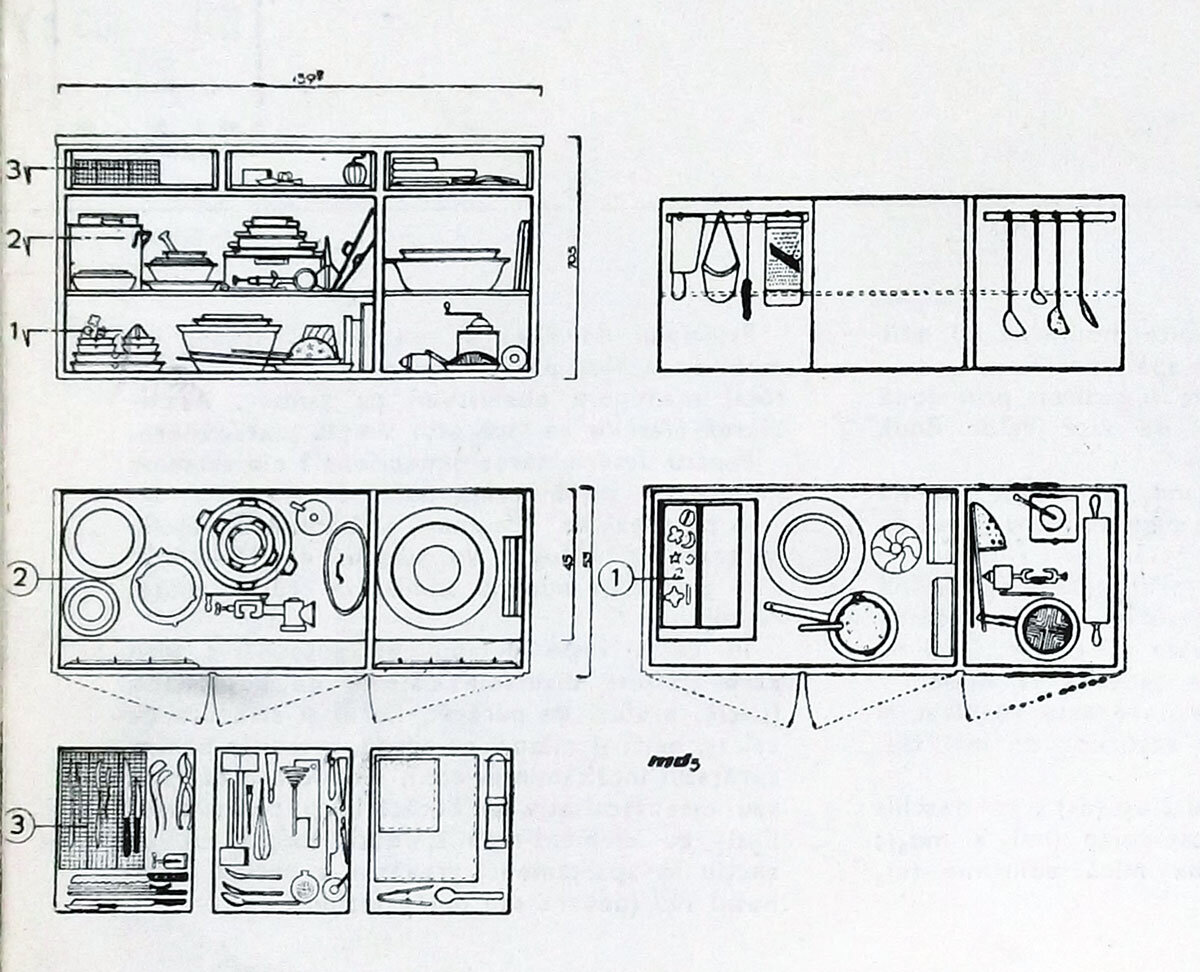
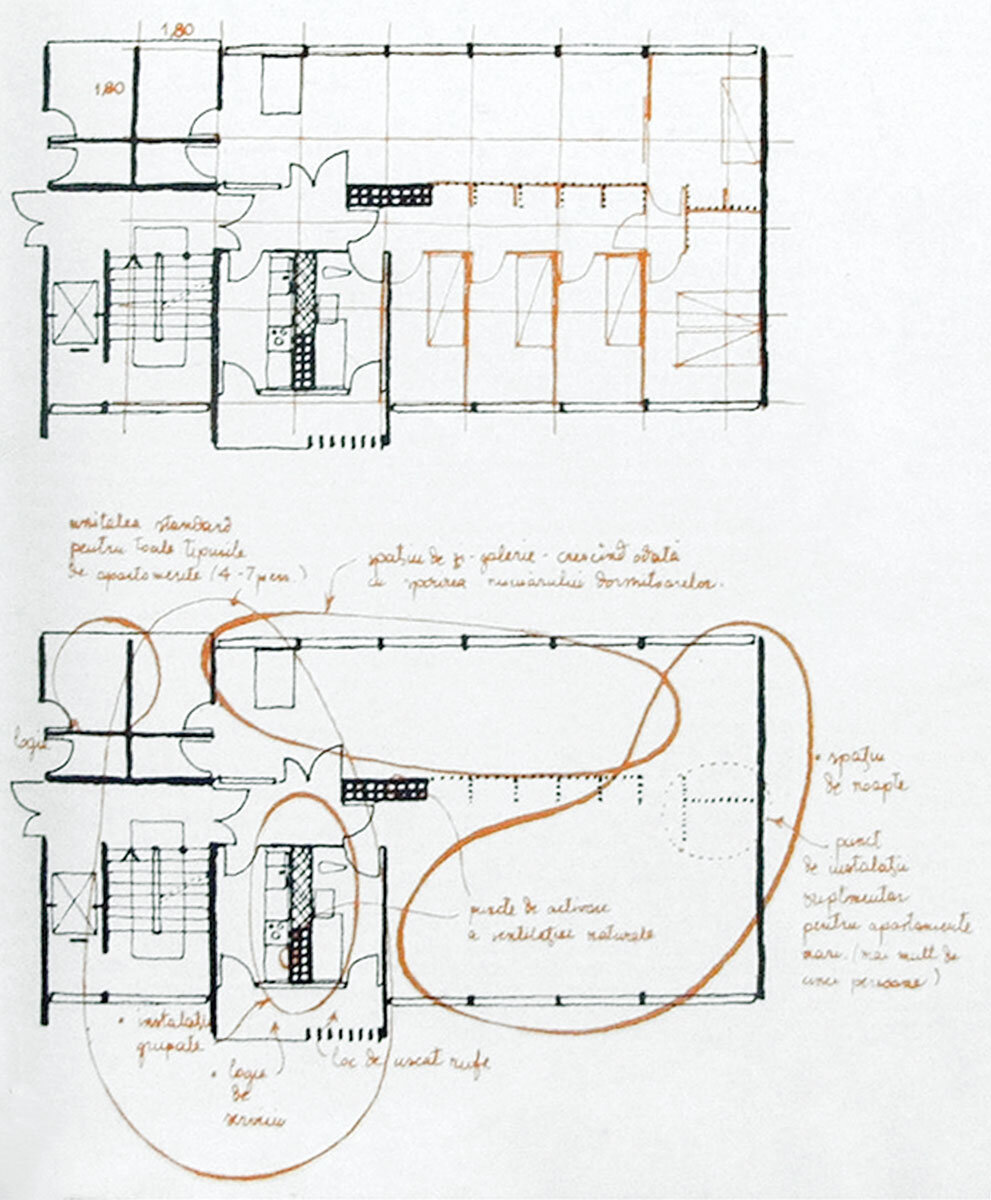
| It was the chance of a yellow kitchen, fully furnished and equipped by General Electric, to be the scene of an important episode of the Cold War. I am talking about the meeting that would come to be known as the "Kitchen Debate" between Richard Nixon and Nikita Khrushchev, on the occasion of the United States exhibition in Moscow in 1959 (Figure 1). While we cannot escape the involuntary irony of the situation or our being aware of its ultimately ideological stake, it is worth noticing that the war was shifting from the trenches into the very realm of domestic life. Thus, the kitchen equipped with the latest technology in order to come to the help of every American housewife appeared as an instrument of temptation of Western life in a Soviet Union that was just beginning to consider the development of the consumer goods industry. While the equivalent exhibition organized in New York in 1958 aimed to showcase Soviet achievements in the field of high precision technologies, heavy industry and even space conquest (they had launched the Sputnik satellite), the Americans decided to exhibit consumer goods that would incite the ordinary Soviet man and especially the ordinary Soviet housewife. In declarations, at least, the Americans had decided that high-precision technology had to be put to the service of man through consumer goods and equipment that would make his life easier1.Thus kitchens entered an era of intense technological development, like many other fields targeted by the ideological dispute between the two great powers. The Soviet Union also decided to make kitchens provided with fixed furniture and a (not very wide) range of household appliances. Everything, at a smaller and less elaborate scale, but, and that was very important, cheaper. And the Soviet housewife could be but happy, since for many families an apartment with its own kitchen was a dream come true. The family apartment was rare as it was, "common" living in the Soviet Union lasting longer and spreading on a much larger scale than in post-nationalization Romania, having begun immediately after the October Revolution of 19172.I have chosen to begin with this episode for two reasons: firstly because we cannot approach a history of the Romanian dwelling without referring to its politically imposed Soviet model, and secondly because the thrill generated by the "Kitchen Debate" was also felt, to some extent, in our country's housing design as well. So the state of affairs was as follows: after the speech delivered by Khrushchev in December 1954 at the "National Conference of Builders, Architects and Workers in the Construction Materials Industry, in Machinery Production for the Construction Industry, in Design and Research", which put an end to socialist realism in architecture and heralded the return to an unnamed form of modernism, and after the speech accepting such change, in Romanian context, delivered by Gheorghe Gheorghiu-Dej at the Plenary of the Central Committee of the Romanian Workers' Party, in November 1958, the architecture of the Romanian dwellings returned once more under the auspices of rationality. A debate on how things got here would be too lengthy in the context of a piece on kitchen development throughout the 50s and early 60s, therefore I shall confine myself to pointing out only several significant moments of such development. I hesitate to call it kitchen evolution because, at least in relation to part of the pre-war dwellings, the changes did not amount to an improvement or an increase; on the contrary, room sizes decreased overall and functionalist principles that had already been explored were set aside at least for a while. One has to note that, although the ideological load transferred onto the space and function of the kitchen is strong and originates in the modernist thinking on dwelling before the Second World War, the kitchen was rarely analyzed separately. Instead, the local solutions first focused on the Soviet solutions delivered via mandatory documentation, and then, in the relatively more liberalized 60s, dared to revisit modernist principles concerning its being equipped with fixed furniture. Plane type sections from 1951 do not represent furnished kitchens, only bathrooms. However, the sizes and the clean rectangular shape make us think of minimalist kitchens with an included eating place. Type sections from 1952 are barely concerned with any possibilities to furnish the kitchen, because their shape is the result of the efforts to couple the bathroom and kitchen installations along one single column, in a narrow span and to preserve the natural ventilation in both rooms. The form of the kitchen, which also included the eating place, was ambiguous, and the location of the larder suffered because of its proximity to the stove (Figure 2). The form of the kitchen in the type section from 1953 was closer to that of a square; the installations were still joined, but the natural ventilation of the bathroom was sacrificed and the larder was converted into a storeroom (Figure 3). Regarding the sizes, the recommendations for this period are in line with Soviet documentation. For a 2-room apartment and a dwelling surface area between 24 and 30 square meters, the kitchen was to have 6-7 sqm; in a 2-room apartment with a surface area between 34 and 38 sqm, the kitchen had 6-8 sqm; in a 3-room apartment with a surface area between 40 and 46 sqm, the kitchen had 6-8 sqm, and in a 3-room apartment having a surface area of 46-55 sqm, the kitchen had 7-9 sqm3. While closely following the Soviet solutions, the first Romanian projects failed in their attempt to construct apartments with a common kitchen; this option was quickly abandoned. For instance, the dwelling complex "Brotherhood between nations" in the Bucureștii Noi district is one of the very few including this type of apartments. Year 1954 heralded the changes about to take place after Khrushchev's December speech. Upon the preparation of the design theme for the standard dwellings of the following years, the sizes of the apartments began to exceed Soviet proposals, so that an apartment having a 20-24 sqm room and one or two rooms about 15-17 sqm was provided with a proposed kitchen of 7-9 sqm, a larder having at least 1 sqm and a bathroom with a bathtub in area of 4 sqm and separate toilet4. Following Khrushchev's speech, in USSR gained ground the practice of building apartment blocks referred to as hrușciovska, namely the blocks of the type Ground Floor+4-5 constructed after the K7 series, designed by engineer Vitaly Lagutenko. In their kitchens furniture began to take on a more compact appearance; the countertop incorporated the sink, but left the stove aside. More elaborate type sections from 1955 presented plans furnished in more detail; the living room was finally furnished more decidedly for daily use and was no longer provided with a sleeping place. Kitchens were also equipped with working surfaces and cupboards preceding the wall-incorporated ones (Figure 4). It was as late as 1956, within the newly established I.P.C.T., in the workshop consisting of architect Gh. Sebestyen, Elena Stoenescu, M. Caffé, Al. Stan, N. Pruncu and engineers M. Drimer and I. Hossu, that the most varied set of type sections existing until then was designed: there were three series of types - Series I (with 8 sections A, B, C, D, E, F, G, H), series II with 8 sections and Series III, also with 8 sections5. Along with the volume simplification simplification imposed by the new guidelines - parsimony and industrialization - the complexity and flexibility of apartment types increased. The important innovation brought by these series was the emergence of apartments with half a room, as a method of reconciling the imposed economic indices with a comfortable real situation. Thus emerged the 1½ room apartments and the 2½ room apartments. The 1½ room apartments were meant to be inhabited by 2-3 persons, that half of a room actually amounting to a small recess with a sleeping place. The 2½ room apartments were meant for 3-4 persons, with the sleeping recess avoiding the transformation of the living room into a bedroom. The kitchens of the apartments belonging to the Ist series were positioned in narrow, deep places, for which reason the eating place could only be in the living room. The IInd series boasted an interesting feature, namely it proposed an alternative use of the eating place, with a concertina door closing and shutting the recess off from the kitchen, as a working space (Figure 5). In rarer situations, and rather as part of more unique projects, the solution of the open kitchen was explored. Given the specific local cuisine, the open kitchen was not a valid solution for a long time, in the absence of appropriate ventilation equipment. Fixed furniture for kitchens became the subject of specialized studies so that its necessary dimensions could be taken into account when designing the apartments. After the publication of the work Arrangement and Sizing of Dwellings by Lajos Gádoros, in Budapest in 1957, which comprised studies about the ergonomics of kitchen furniture, a similar study was drafted in the workshop of architect Dorian Hardt from IPCT6 in 1958 (Figures 6, 7). A special moment which gives us a fair picture of the relative liberalization referred to above was a study of architect Mircea Alifanti, published in 1963. It presented a number of flexibility principles which could be explored when drafting the types of mass dwellings7 (Figure 8). Along the six-year plan 1960-1965, no other important changes took place as to the design of the kitchen as such. It was a time of countrywide building efforts, which made maximum use of the solutions already prepared and tested. In terms of overall apartment design, the next big change occurred in 1966, along with H.C.M. 26/1966, regarding State support for city dwellers in building privately owned dwellings. The fact that the law allowed for a minimum exchange between the beneficiary and the architect and for a minimum amount of flexibility of the solution led to projects, in the following period, which took account of the variety of family types. The 9 types of apartments were defined (with the help of half rooms) and the one-room apartment, until then avoided as non-economical, was finally accepted. These changes seemed to herald a positive future for housing construction, but they were deceitful: the acceptance of privately owned dwellings had been a compromise solution resolved upon by the then political system, faced with an economy which could not sustain the necessary construction pace. In addition, while privately owned apartments witnessed an increase in comfort, the condition of State-owned ones became increasingly precarious. Few things from the grand history scene made it into the kitchens of Romanian apartments. However, while it was not a space privileged by designers over all such time, the kitchen compensated the lack of comfort with a more intense visitation, because in almost all houses, it is in the kitchen that the "soul" of the family survives. |
| Notes: 1 Oldenziel, R., Zachmann, K. - "Kitchens as Technology and Politics: An Introduction", in Cold War Kitchen. Americanization, Technology, and European Users, MIT Press, 2009, p. 6. 2 Azarova, K. - The Community Apartment. The Hidden History of Soviet Housing, Sextant, 2007, p. 12. 3 Silvan, I. - "In connection with the design of housing sections", in Arhitectura R.P.R., no. 1/1954, p. 3-15. 4 Silvan, I., Popescu Negreanu, Gh. - "New type-sections for dwellings in blocks with few levels", in Arhitectura R.P.R., no. 5/1954, p. 2. 5 Popescu-Negreanu, Gh. - "Noi studii de secțiuni-tip pentru locuințe în blocuri", in Arhitectura R.P.R., no. 6/1956, p. 8-15. 6 Enescu, M. - "Study of equipment for kitchens", in Arhitectura R.P.R., no. 7/1958, p. 20-24. 7 Alifanti, M. - "Research in the field of the elaboration of types of mass housing", in Arhitectura R.P.R., no. 1/1963, p. 40-48. |

Bucharest. In search of visual identity
Patrimoniophobia: the false dilemma of the conflict between development and heritage conservation
95%
Architecture, the car and the modernist interior
Pruitt Igoe Now - Natural Reclaim
Converting Christian sacred spaces

Great Expectations
Good practices for saving and reusing old wooden churches Boz, Târnăvița, Cervicești
Bunești School. Protostructuralism
One yellow kitchen, millions of gray kitchens
Cinematic architecture
Some notes on traditions and tradition
The Church of the Monastery of Arges - Re(in)stauration, musealization and national myth
Savings. For an exhibition of frescoes from Arges
Fort 13