The photography archive of Romanian Union of Architects. Online and Offline

In issue 6/ 1966 of the magazine "Arhitectura", Cezar Lăzărescu's project for the civic center of Pitești was published.1 At that time, when the administrative division of Romania into counties had not yet been restored, Pitești was one of the least developed regional capitals. In terms of administrative rank, it was on a par with cities such as Iași, Cluj or Constanța, in terms of architectural history, it practically did not exist on the map of Romania, but from an economic and social point of view, it was in full recovery.
Arhitectura magazine and the urban planning debate in the second half of the 1960s |
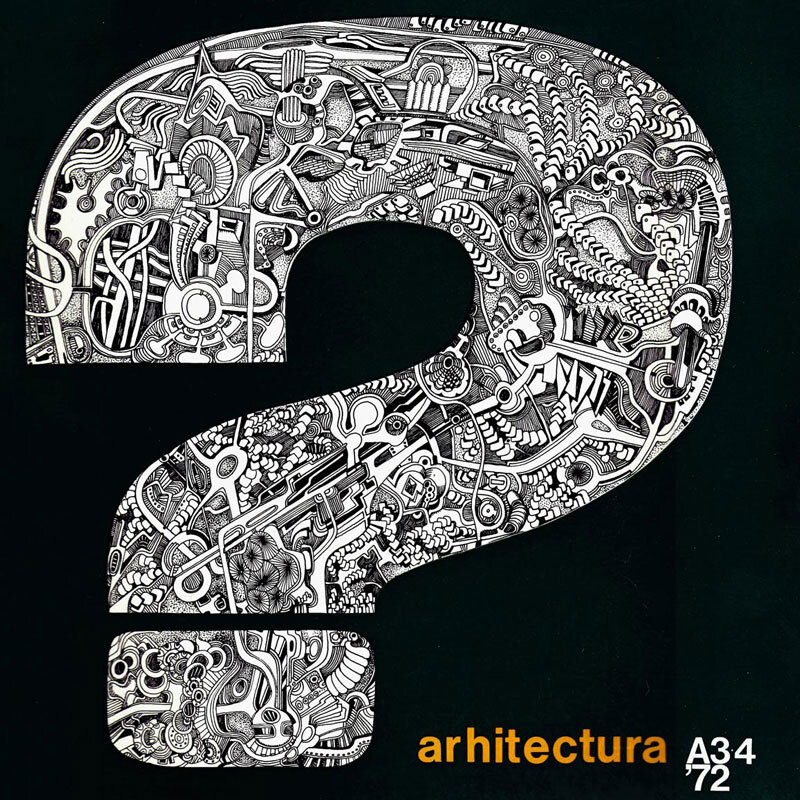
| Our Forerunners was one of the most durable sections of the Arhitectura magazine, with an uninterrupted run between 1972 and 1989. Initiated by a group of young architects just as the entire publication was undergoing a major makeover at the beginning of the 1970s, Our Forerunners rapidly became one of Arhitectura's flag columns. The authors publishing under this header amounted to a very heterogeneous group, with consecrated figures sharing the pages with young researchers on the rise. The section enjoyed a well-defined graphic identity, as a particular page format and a specific font created an easily recognizable brand that quickly acquired professional notoriety. Even if the topics of the articles were quite diverse, some of the frequently re-emerging subjects ensured the scientific relevance of the column, as they were seldom treated elsewhere at the time. Among these, one can certainly emphasize the biographies of some well-known architects, the studies on 19th century and interwar Romanian architecture and planning or on the history of architectural education, the articles discussing doctrinal issues linked to urban restoration and renewal, etc. During its almost two decades of existence, Our Forerunners established itself as a platform that had the merit of being both accessible to most of the relevant researchers of the time and open to scientific topics that would have been otherwise hard to publish. Many of the articles still maintain their interest and validity today, and some of them became a base for larger research projects after 1990. At the same time, the column maintained high professional and scientific standards, and even indulged in upholding topics and opinions sometimes at odds with the official discourse. |
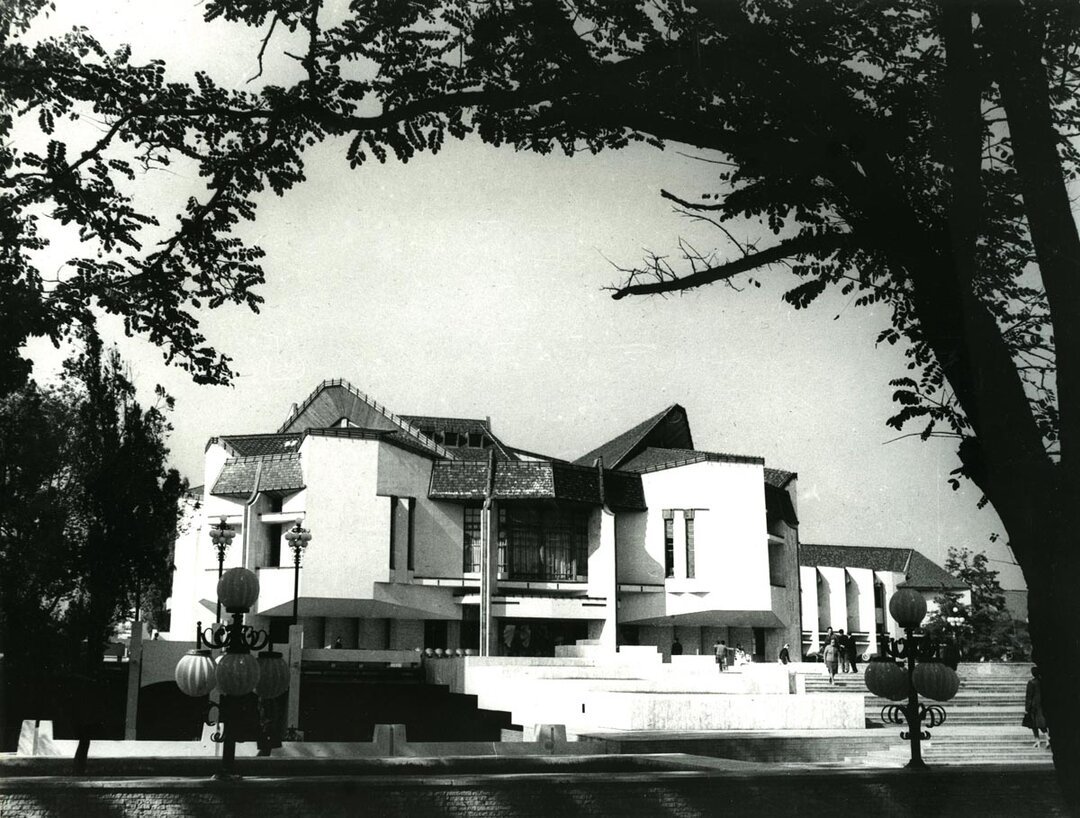
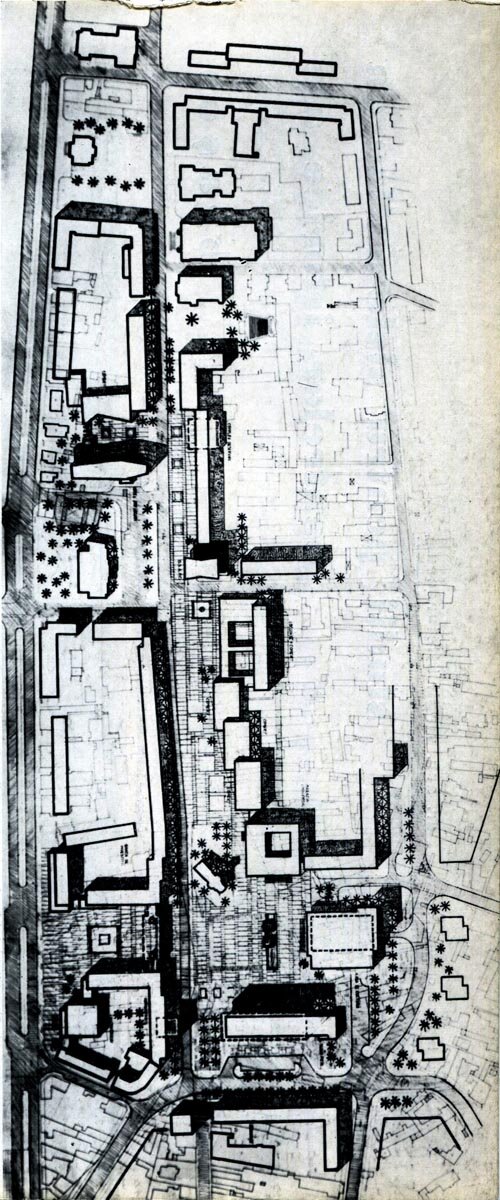
Cezar Lăzărescu's civic center project for Pitești, which proposed not only the almost complete replacement of the architectural elements that defined the main square2, but also a radical change in the scale of the city, was perceived in the following years as a turning point and an example to be followed by architects and political activists concerned with the urban restructuring of the newly established county seats after the administrative reform of 1968.
Unfortunately, the collection of the magazine 'Arhitectura' does not shed any light on how Cezar Lăzărescu negotiated the programmatic content and stylistic expression for the Pitești project: who had proposed the joining of the House of Culture to the political-administrative headquarters in the main square, who had taken the initiative to outline the esplanades, only one of which was realized according to the project, who had proposed the number of apartments, the commercial surfaces, the size of the square and the related economic indicators, by whom and on the basis of whose drawings had the typically brutalist form of the House of Culture been accepted, what sources of inspiration had been invoked in the discussions, etc.and so on? The decision-making process in Soviet-style communist states is often hidden from the public and this case is no exception.
Fortunately, the collection of "Arhitectura" can answer, at least in part, at least one other question: what was the process by which the guild of architects paved the way for such projects to be proposed and implemented.
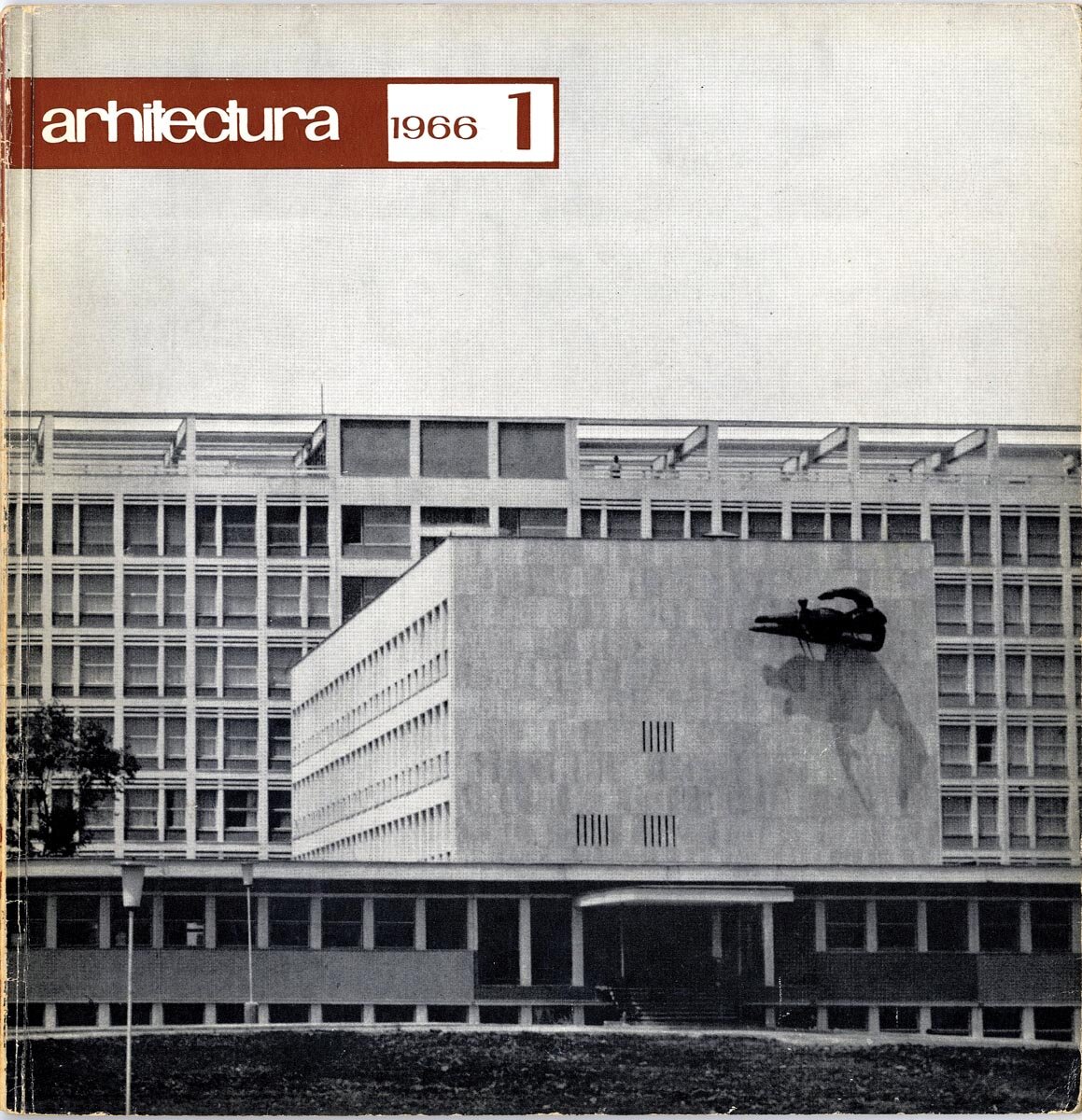
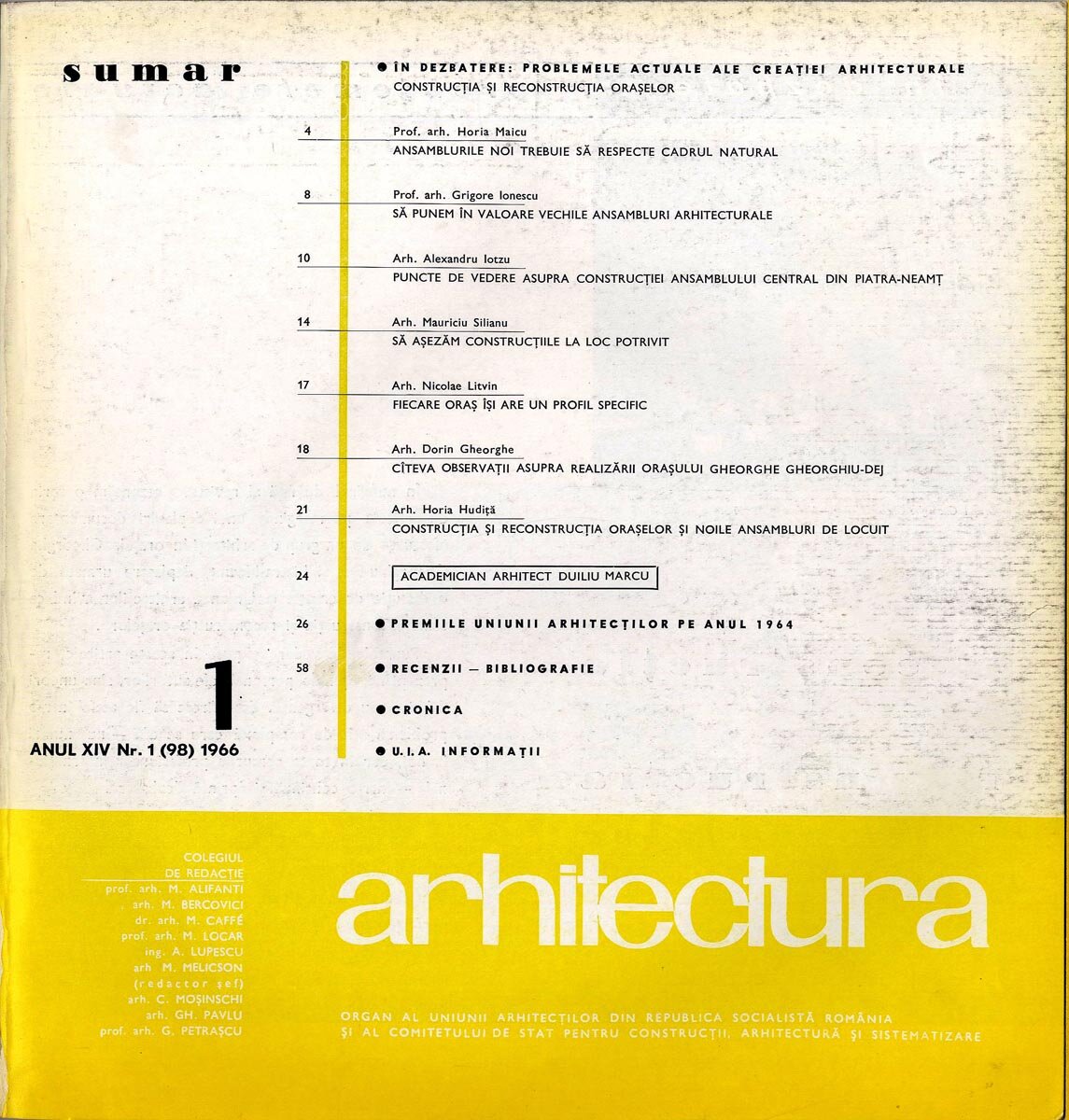
The answer to this question can be found in the 1/ 1966 issue of "Arhitectura". It is a unique testimony in its complexity and an essential source for tracing the fluid and ambivalent relationships between architects and politicians in the more liberal period of Soviet-style communism.
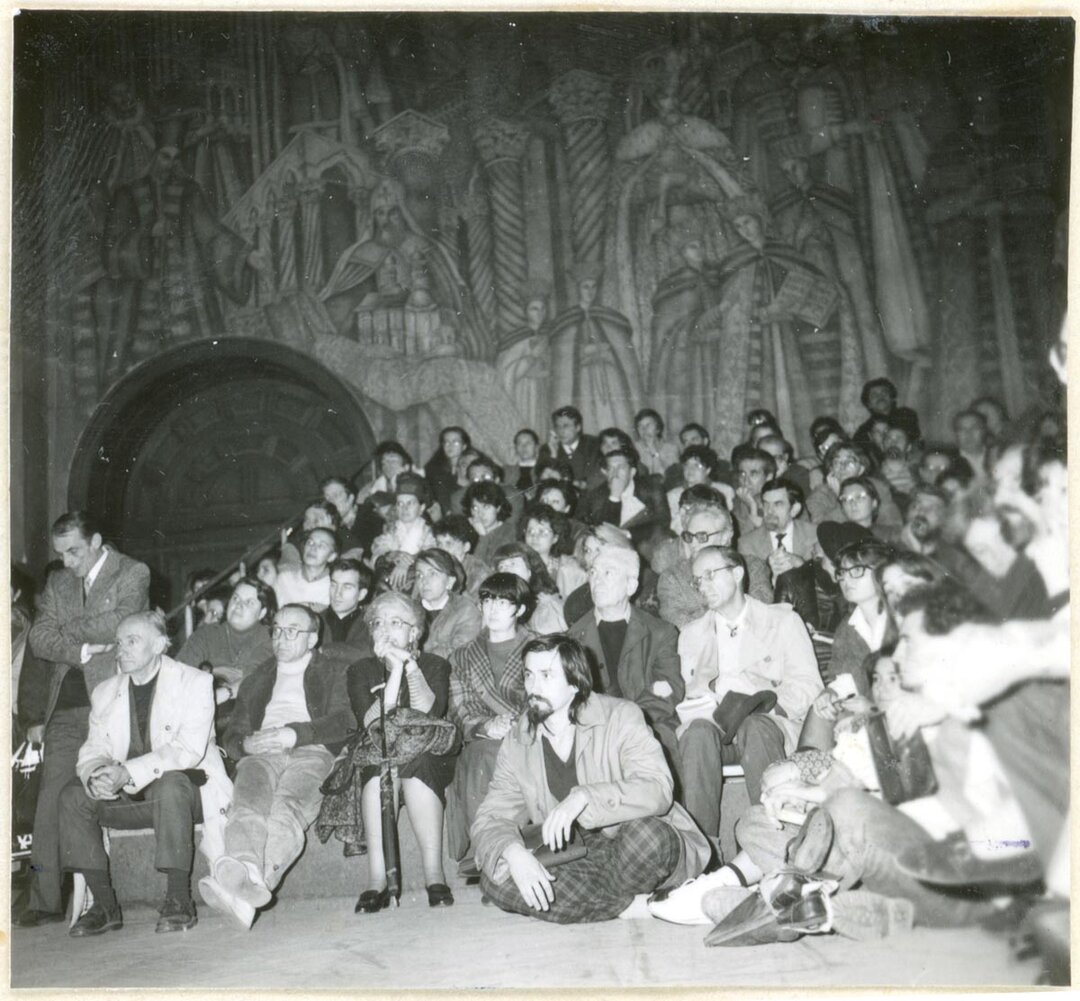
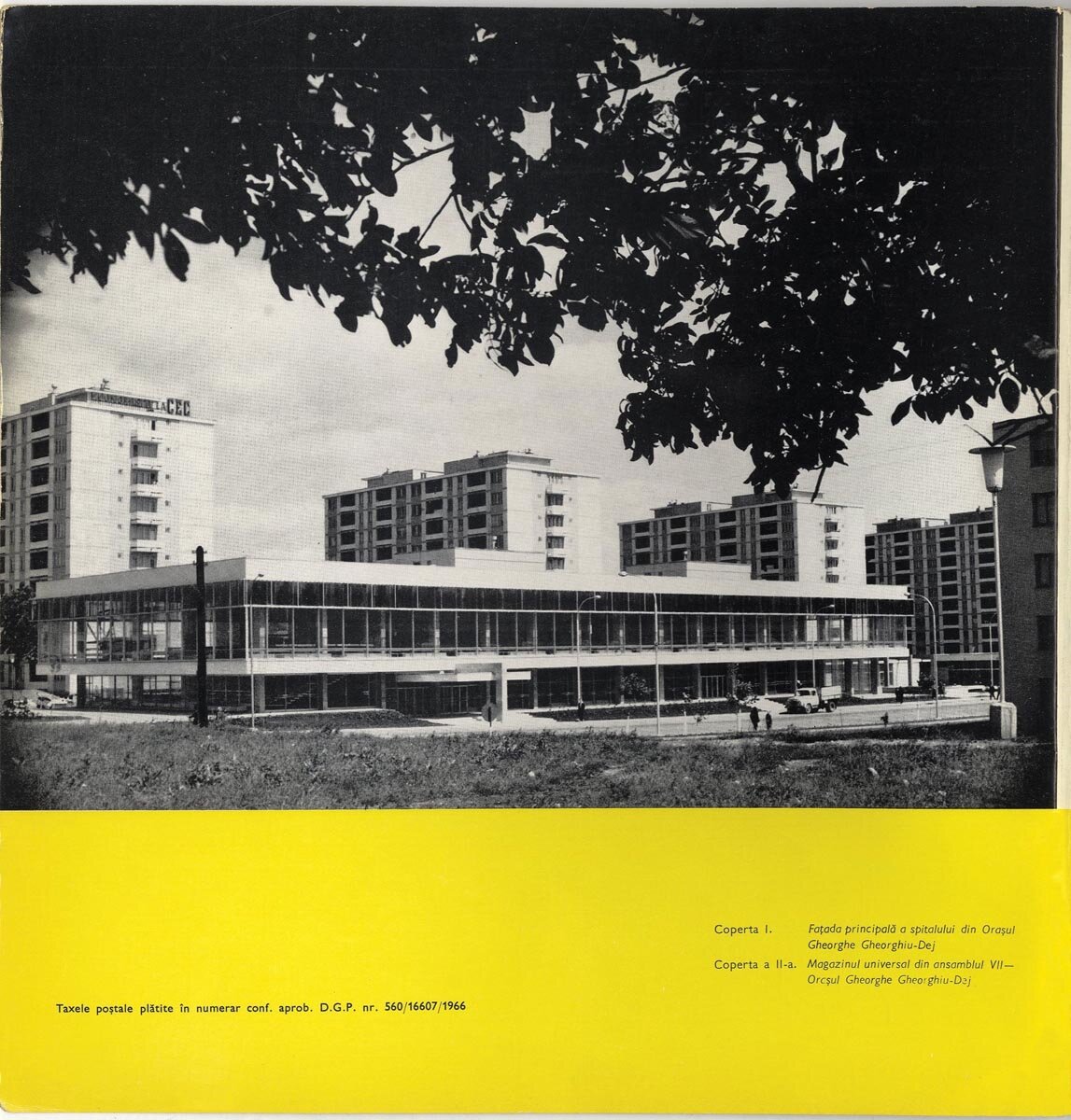
This issue of the magazine presents in a condensed manner the views of several architects, shaped by a fact-finding trip to the cities of Gheorghe Gheorghiu-Dej (today Onești) and Piatra Neamț, and initially expressed in a debate organized by the Union of Architects under the title, Construction and Reconstruction of Cities, later adopted by the magazine.
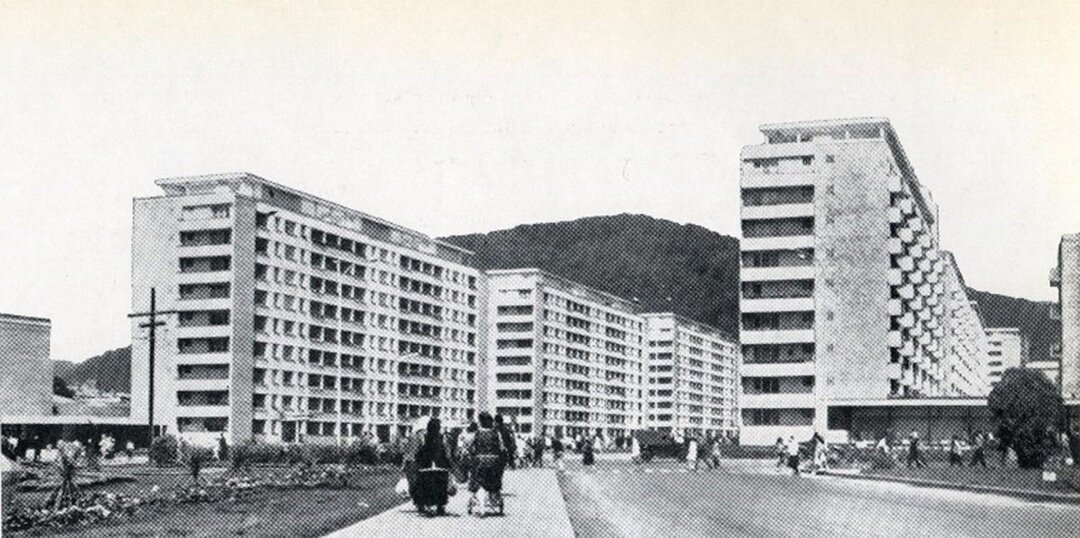
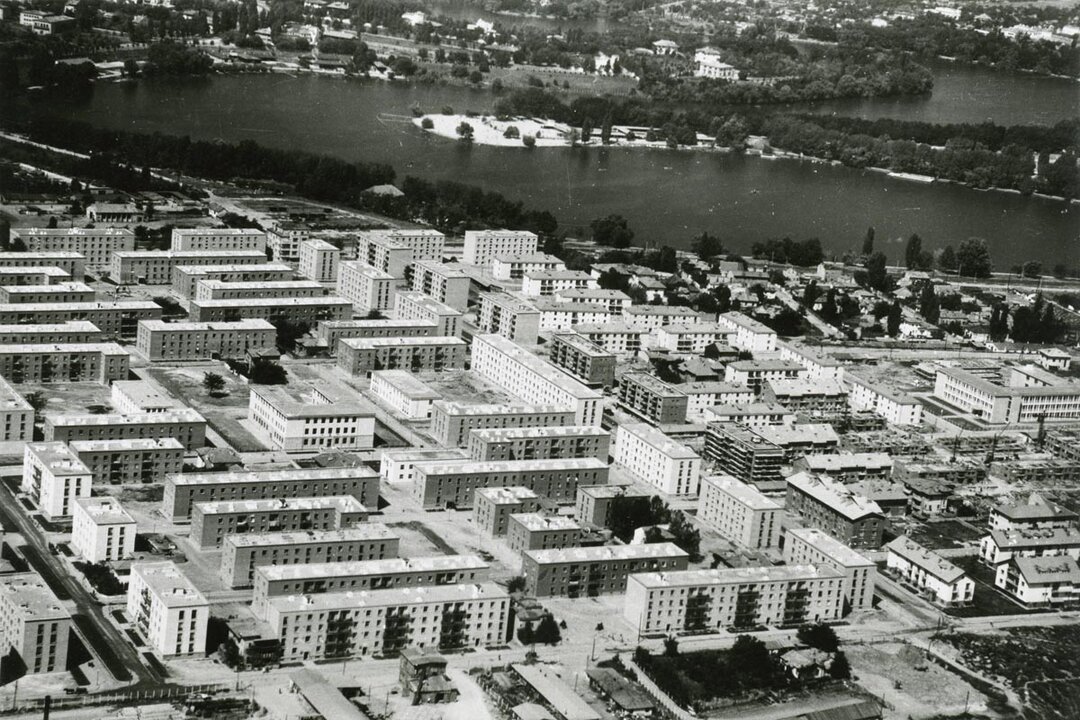
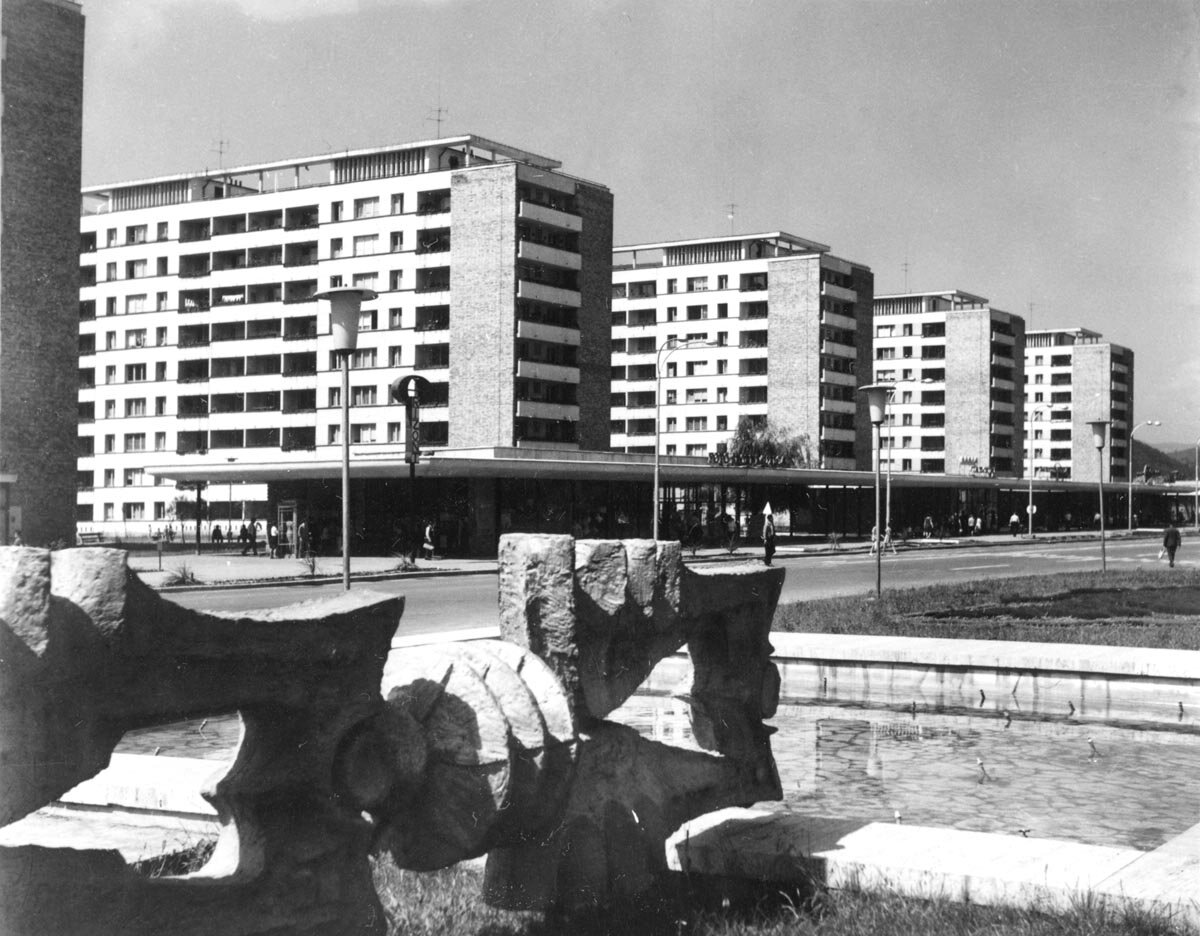
The central issue of the discussions turned out to be the way in which the collective housing estates could contribute to the shaping of a city identity. With the help of slipforms and prefabricated housing, new housing estates could be built faster and faster, larger and larger, and more and more economically. For several years now, these relatively monotonous housing estates have been occupying larger and larger spaces in urban areas. Cities such as Piatra Neamț, Suceava and Deva, mentioned on this occasion, or Tulcea, presented in the same issue of the magazine as noted and rewarded by the Union of Architects for its architectural achievements in 1964, were even defining their central areas with such blocks of flats3.
From all the articles published, it is quite clear that the architects consulted had very few means at their disposal to counter the impression of uniformity given to cities by the new collective housing districts. Horia Maicu emphasized the idea of enhancing the natural landscape4, a typically modernist remark which was not new in that context, while Grigore Ionescu proposed the preservation and restoration of the heritage already built5. To these remarks, Alexandru Iotzu, the author of the central collective housing complex in Piatra Neamț - the main target of the critics in this debate - replies that his project was already oriented towards enhancing the Pietricica hill and that the "unhealthy dughenele" of the "patriarchal" city could not be a basis for the city's identity6.
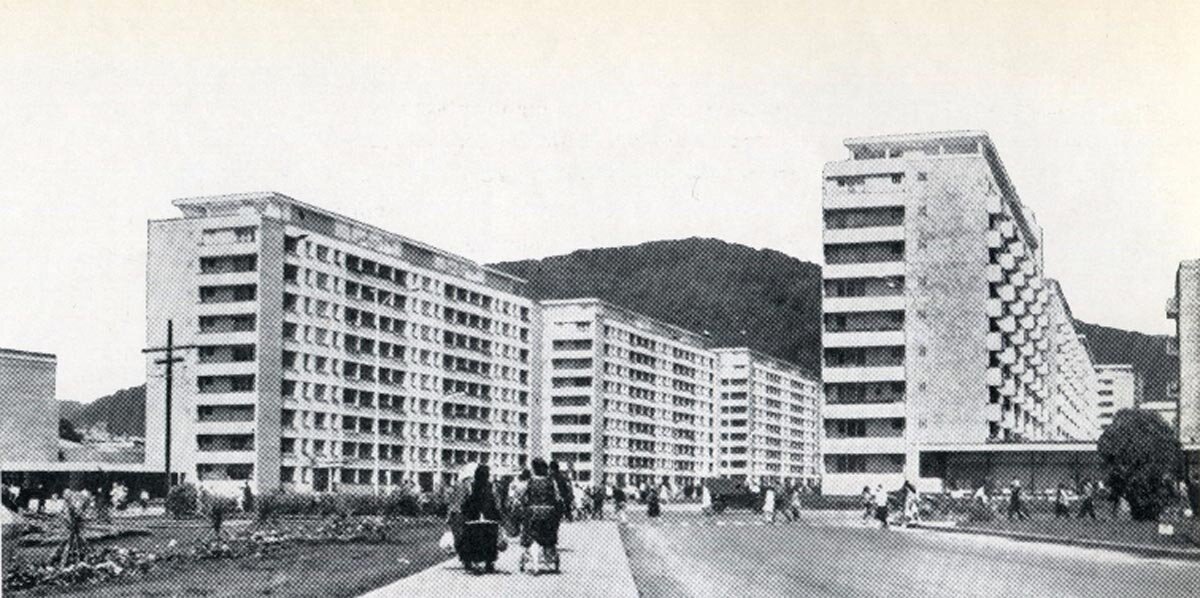
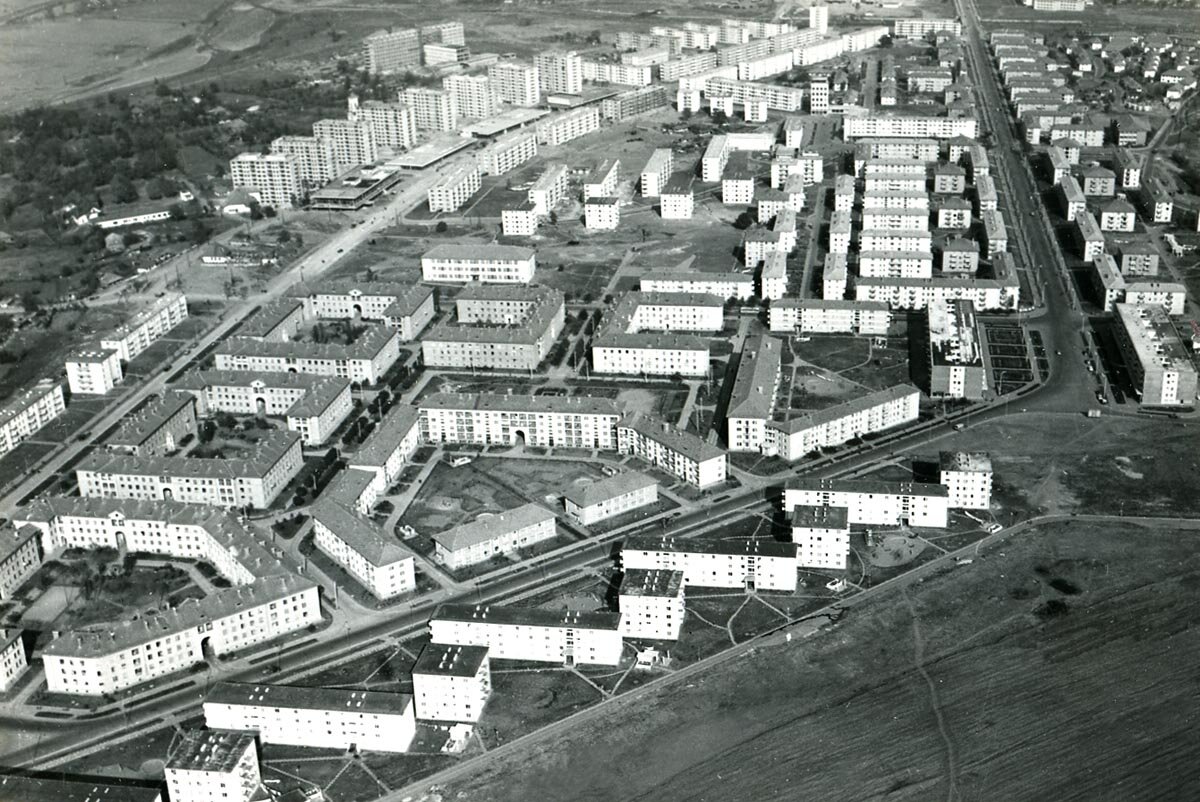
Further, Mauriciu Silianu raises the issue of the lack of experience of architects in working on the scale assumed by a collective housing district and suggests that, thanks to modern means of transportation, such complexes can be located at greater distances from the industry they serve, including for reasons of harmonious city development and healthy living7. Nicolae Litvin is basically asking for more money, a wider range of standardized buildings, and permission to make single-unit buildings, especially of the social-cultural kind, if not housing8.
Of all the contributors to this issue of 'Arhitectura', Horia Hudiță is the clearest in his attitude: beyond the many constructive, organizational and financial approaches through which improvements could have been made to the general appearance of the collective housing districts, he argues that the central areas should have been kept unbuilt with blocks for the time being. Housing was only a priority for the time being and, in the future, city centers could have been restructured with a different type of investment, social-cultural, which Horia Hudiță seems to have believed would not have raised the problem of monotony and lack of identity9.
Somewhat curious appears the attitude of Dorin Gheorghe Gheorghe, who was part of the design team of the new city Gheorghe Gheorghiu-Dej (now Onești). Compared to Piatra Neamț, this project is greeted with almost unanimous appreciation, except for a few objections raised to the color scheme of the block facades. In contrast to Alexandru Iotzu, who had been pushed on the defensive by the visitors' criticisms, Dorin Gheorghe displays a cautious attitude, suggesting himself directions of criticism of the project in which he had participated10. For example, the city would not have been realized as a unit, it seems, mainly because the overall design process was carried out in parallel with the execution. Thus, some details appeared "bizarre". The shopping center had also been "insufficiently" thought out, too dense, too enclosed, too lacking in green spaces. In addition, some buildings did not benefit from favorable views, some construction details had been too hastily worked out and some finishes had not stood up to the short time they had been in place.
The contrast between the almost unanimous appreciation of the visitors to the new town and the rather self-critical attitude of Dorin Gheorghe can be explained in several ways. First of all, the architects' appreciation may have translated into words a rather realistic attitude towards the limited possibilities of expression in the context of available resources and the industrialized architecture of the 1960s. At the same time, Dorin Gheorghe may have already perceived a certain change of political direction possibly felt to have made all architects active in the field of housing vulnerable, with the coming to power of Ceaușescu in 1965. This change was to be very concretely expressed in the following years through official criticism of the monotony of new interventions in cities, accompanied by the urge to make more use of tradition as a source of inspiration11. For this reason, he preferred to remain cautious in his attitude. One can, however, also consider the idea that designing a new city involved a very large team of architects, with diverse opinions and contradictory proposals, and Dorin Gheorghe wanted to emphasize the experimental nature of the whole operation of building a new socialist city, from which the whole guild had to learn. It could be said, however, that Dorin Gheorghe's cautious attitude prevented him from expressing the ideas being debated internally about the civic center of the new city. Thus, instead of his team setting the tone for a debate on civic centers, Cezar Lăzărescu's contribution had to wait for Cezar Lăzărescu's contribution, which was exposed several months later.
All these articles quoted above are written by experienced architects and represent quite diverse points of view. Among these points of view, one can find some that discreetly questioned some fundamental premises of the regime, such as: the fact that cities needed to develop in big leaps (Nicolae Litvin says that, in the Cluj region, they had done better in preserving local specificity due to lower level industrial investments, while Mauriciu Silianu seems to propose distributing the development effort associated with an industrial mammoth among several cities), the fact that the main criterion for evaluating buildings was cost (a principle that had been established since 1958, now contested by Nicolae Litvin and Horia Hudiță, who advocate diversifying the means available to architects), and the fact that the new communist regime had to be expressed in the urban built form through a manifestly new architecture (Grigore Ionescu proposes interventions to renovate housing to up-to-date standards while preserving the old facades).
Even if such somewhat heretical opinions could have been formulated on an individual level, it is certain that, one way or another, the leadership of the Union of Architects had proved to be politically astute enough by organizing this debate and arranging its publication in the journal "Arhitectura". Thus, by giving a signal that the immediate past was subject to critical scrutiny, it was preparing the ground in its own guild for suggestions that might or might not be formulated at the political level, following Ceausescu's coming to power. On this open path, the architects' long-suppressed energies seemed to be unleashed, first and foremost, in the direction of restoring and preserving the built heritage and reinterpreting the architecture of the time in a traditionalist key. As can be seen in issue 6/ 1966 of 'Arhitectura' magazine, Cezar Lăzărescu was to work against these unbridled energies, with all the prestige he had gained from his modernist projects on the seaside. His project for Pitești was to be decisive in establishing the application of the civic center principle in the restructuring of the central areas of the county towns in Ceausescu's Romania.
NOTES
1 Cezar Lăzărescu, "Studiu pentru sistematizarea zonei centrale a orașului Pitești", "Arhitectura", nr. 6/ 1966, p. 50-51.
2 With the exception of St. George's Church, a 17th century historical monument.
3 Lutfi Sefchi Sait, "Reward: Residential blocks in the central area of Tulcea", "Arhitectura", no. 1/ 1966, p. 56.
4 Horia Maicu, "Ansamblurile noi trebuie să respecte cadrul naturale", Idem, p. 4-7.
5 Grigore Ionescu, "Let's enhance the old architectural ensembles", Idem, pp. 8-9.
6 Alexandru Iotzu, "Points of view on the construction of the central ensemble of Piatra-Neamț", Idem, p. 10-13.
7 Mauriciu Silianu, "Let's place the constructions in the right place", Idem, p. 14-16.
8 Nicolae Litvin, "Each city has a specific profile", Idem, p. 17.
9 Horia Hudiță, "The construction and reconstruction of cities and new housing estates", Idem, p. 21-23.
10 Dorin Gheorghe Gheorghe, "Some Observations on the realization of the city of Gheorghe Gheorghiu-Dej", Idem, pp. 18-20.
11 See, for example, "Conclusions of the Section for Construction and Transportation Problems", 10th Congress of the Romanian Communist Party, August 6-12, 1969, Bucharest: Editura Politică, 1969, pp. 610-616.