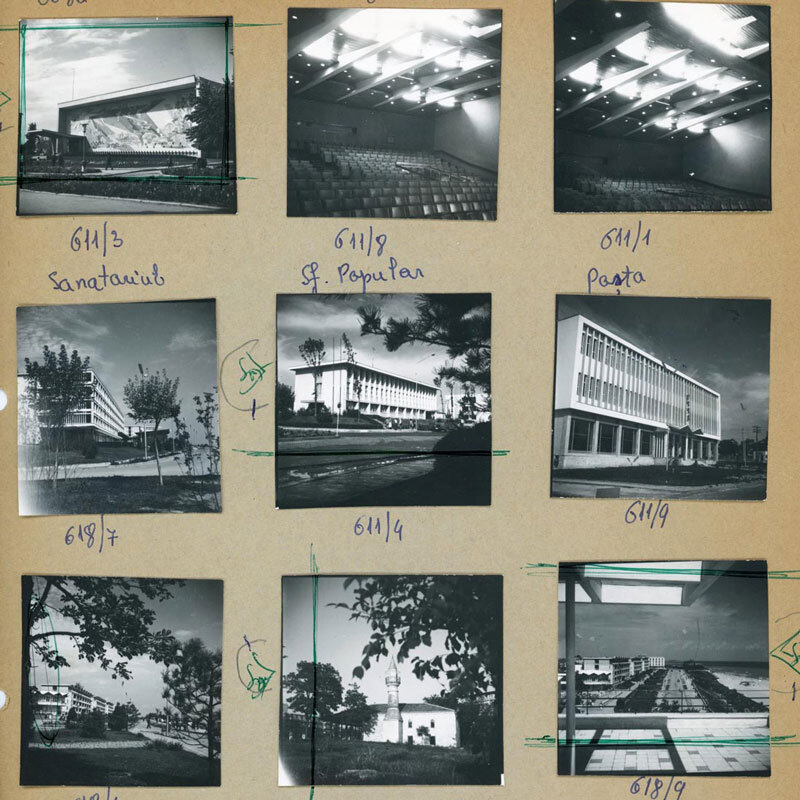
The photography archive of Romanian Union of Architects. Online and Offline


Communist architecture", which assertorically replaced any value judgment. It was said by students, who were still told too little about the architecture of the period; but it was said with the same ease by media personalities and people of culture who were also navigating in an unexpected lack of criteria and information. A kind of "white spot" was growing , an abnormal historical hiatus, covered only by the omnipresent shadow of the People's House, which continued to dominate our discourse.
Ana Maria Zahariade, Arhitectura în proiectul comunist. Romania 1944-1989, Bucharest: Simetria Publishing House, 2011
The magazine "Arhitectura" asked me some time ago, through the voice of architect Monica Lotreanu, editor-in-chief, for a review of Miruna Stroe's book Locuirea între proiect și decizie politica. Romania 1954-19661. I had to re-read the book with pencil in hand - I had read the text of the doctoral thesis that Ana Maria Zahariade had given me in order to decide whether Simetria Publishing House was interested in publishing it - a reading that resulted in a subjective summary for each chapter. I found it interesting, especially for young readers who did not live through the times described in the book, to include some of these summaries in this presentation. I have selected from that chapter what I found relevant. The summary - written in black - is followed, in some cases, by personal comments written in blue in the margins of Miruna Stroe's admirable text. Significantly longer than a review, the commentary is more than such an analysis requires, but also less, because I should have been totally impartial - and I tried my best to be - but volens-nolens I am part...
Housing. Between Project and Political Decision. Romania 1954-1966Annotations to a Book by Miruna Stroe |
| This article is a sort of scientific metaliterature - a book review written by architect Alexandru Beldiman, a professional active since late 1960s, who examines the interplay between the production of housing and government strategies during the Communist time.
Alexandru Beldiman begins by mentioning that he was first acquainted with Miruna Stroe's text, recently published by Simetria Publishing House, when he reviewed her PhD thesis, written under the supervision of Professor Ana Maria Zahariade. To the summary he then drafted (published here in black) he now adds new comments (impossible to imagine in the Communist period), giving insight into some of the events and facts present in Miruna Stroe's argumentation (here in blue). Miruna Stroe's investigation takes into account realized and unrealized housing projects (published mostly in Arhitectura) as well as competitions on this topic. The first analysed projects belong to the post-1954 period. 1954 was the year when the de-Stalinization process started in Romania, echoing Khrushchev's speech. This determined the re-evaluation of the soviet-inspired legislation concerning urbanism and architecture. An important source in Miruna Stroe's investigation (and Alexandru Beldiman's commentary) comes from the articles published by Arhitectura at the time. The second key moment in Miruna Stroe's research is the year 1958, when the General Secretary of the Romanian Workers' Party, Gh. Gheorghiu-Dej, gave the green light to build the Romanian version of Communism. The same year, the Union of Architects adopted some resolutions with significant impact on architecture. As a consequence, modernist architecture was back in favor, referring to international urban planning models was allowed and a balanced ratio between prefabricated and unique solutions was encouraged. These were to be found in the housing estates built in Bucharest and the central area of other cities. The third pivotal moment of the research is 1965-1966, when newly-elected President Nicolae Ceaușescu laid the foundation for his vision of residential architecture. |
Here is a young architect researcher, Miruna Stroe, a former student of Ana Maria Zahariade under whose guidance she wrote the remarkable doctoral thesis Housing between project and political decision. Romania 1954-1966, which she transformed into the (relatively) recent volume published by Editura Simetria and which is the subject of this presentation. Extremely serious and consistent research, carried out with the investigation of unpublished documents, research that brings to light an era in which much was built in Romania, not always uninteresting, not always devoid of professional interest, always with the involvement of political power whose approaches to the subject and interventions are excellently captured and revealed. Ana Maria Zahariade places Miruna Stroe's study within a "programmatically sympathetic history, naturally empathetic and sheltered (as far as possible) from the same human sympathies and anti-human sympathies", in a broad academic endeavor called by Vintilă Mihăilescu "the new wave" in the rewriting of Romanian history.
The author's investigation was carried out both on the production of housing architecture put into operation and through research into unrealized projects (published mainly in the magazine "Arhitectura") and competitions organized on the subject: "These unrealized projects - says Miruna Stroe - have helped to build a more complete picture of the design activity, joining to the realized constructions many of the architects' efforts, which bear witness to their concerns, education, stylistic orientation, often to a greater extent than the built work".
The choice of the subject of dwelling is generated, the author tells us, by the fact that, unlike housing, dwelling obliges you to relate "to the scale of the housing unit, as well as to the large scale of the city, passing through the intermediate level of the grouping".
The choice led Miruna Stroe to identify in the archives unpublished materials that highlight the evolution of the emergency urbanism of the time in our country. The result of her research is dissected with the joy of a surgeon who knows that what he is doing will restore his patient to health. Miruna Stroe's patient is Romanian society in general and, in particular, architecture, urbanism and the architects' guild. We need, even later, to know what happened to us and why.
Part I
The state of housing design in 1954. Architectural-urban, political and legislative milestones.
The political situation
The political peculiarity in our country, namely the fact that the destalinization took place without the replacement of the party and state leadership, is highlighted. In this regard, the author quotes from the final report on the communist dictatorship in Romania, in which the authors conclude that in Romania there was, in fact, no real de-Stalinization: "Romanian intellectuals did not lead movements similar to the Hungarian revolution or the Prague Spring [...] the popular discontent in Romania, at least to the same degree as in the other Sovietized states, did not have any supporters at the top. There was no Imre Nagy, no Alexander Dubček...".
We learn that the communist architectural and building legislation and the centralized institutions that generated it and directed all the activity were directly inspired by the Soviet system. They were designed to put an end to the liberal practice of the profession. A series of decrees began to be issued from February 1949, establishing the Ministry of Construction and the Institute of Construction Design (IPC). A decision in October 1949 unappealably restricted the participation of still liberal architects from being involved in state projects. The IPC, which is the author of projects, and therefore in competition with the liberal architects, has to give its opinion on their projects before they are submitted to the Ministry of Construction for approval. Not allowed! By a Decision of the CC of the PMR in 1952, the State Committee for Architecture and Constructions (CSAC) was established. At the same time, the following were set up: the Directorate for Architecture and Systematization of the People's Council of the Capital; the post of chief architect; the Institute of Architecture; and in 1953 the first issue of the magazine "Arhitectura RPR" appeared, under the auspices of the Union of Architects (UA) and the newly established CSAC, whose first president was the architect Nicolae Bădescu.
In this context, the CC Decision of the PMR and the Council of Ministers of the RPR no. 2448/1952 on the general plan for the (socialist) reconstruction of Bucharest also appears.
The laws that were to govern the practice of the profession are reviewed. With some modifications and additions, this legislation will keep in its structure the original sin of having been born in the USSR. If, however, in our country architectures and parts of cities have been built that could be included in a textbook on the history of European architecture - a fact in which I believe - this has been possible exclusively thanks to the convictions and professional and moral probity of a greater number of architects than society has assumed and still assumes.
The chapters on architecture and urbanism in recent books on contemporary history that have appeared in our country have not been able to penetrate to the very heart of the phenomenon of the building and rebuilding of cities after the Second World War in Europe and, implicitly, in Romania. For this reason, we have the opportunity to read history texts in which, without much discernment, architectures that are in keeping with the spirit of the times and are more or less equal to their Western sisters and bad works of architecture are lumped together, thus creating an infamous amalgam of architects as a whole.
In the West, reconstruction began immediately after the war, in the strict spirit of the Athens Charter. In our country, from 1944 to 1949, architecture was practiced according to the inter-war way of building. In the West, the phenomenon continued under the pressure of the housing shortage, with the practice of emergency urbanism, in which the main elements of urban composition were the towers and the towers. In our country, about 10 years behind the West - a gap imposed by the Stalinist decade - solutions close to Western ones have been used since 1958 officially (unofficially, somewhat earlier). There was therefore a spirit of the times in which we can place the approach of Romanian architects and urban planners from the aforementioned moment, when the gap was largely made up.
The issue of housing as seen in "Arhitectura" magazine
In 1954, ten years after the fateful August 23, 1944, five regular issues and a sixth double issue (6-7) were published, all of them dealing with the subject of housing. No. 1 dealt with "Mass Housing". Two ideas are emphasized: the need to use the Soviet experience exclusively and the use of typization of housing projects.
In the same issue, Pompiliu Macovei, then vice-president of the UA and chief architect of the Capital, wrote an article highly critical of the work of Professor Richard Bordenache - known in the world of architects as "Palazzo Calcani" (1953), the facade that closes southwards the Revolution Square and in front of which is the square of the Iuliu Maniu monument by Mircea Spătaru. He was criticized for not interpreting classical architecture in a way that corresponded to the new content: "Not having considered the content of the ideas to be expressed in this work, Mr. Arch. R. Bordenache did not have, with regard to the elements of classical architecture that he used, that just attitude of critical, innovative processing, in order to realize something current and new, corresponding to a new content, but sought to do something as different as possible only in form, although he used for this an old vocabulary, which he sought in the most unusual formulas, in the most particular solutions of the late renaissance architecture"
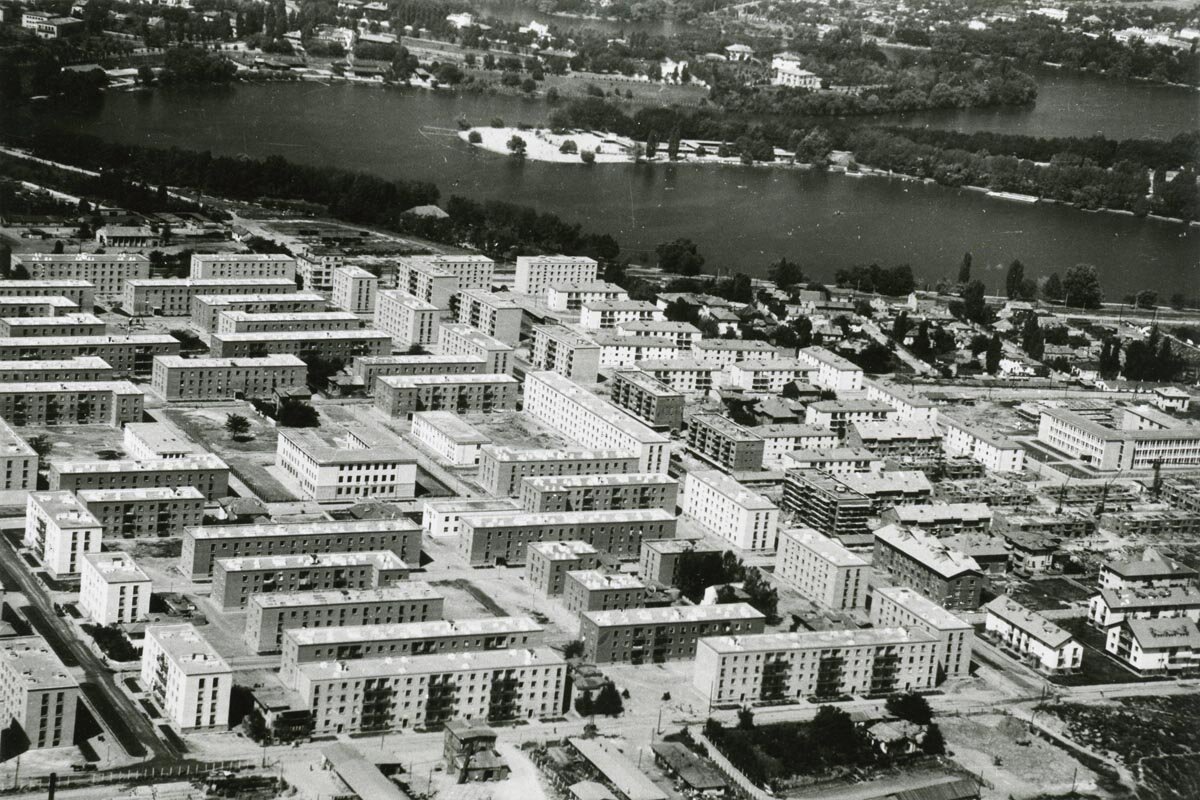
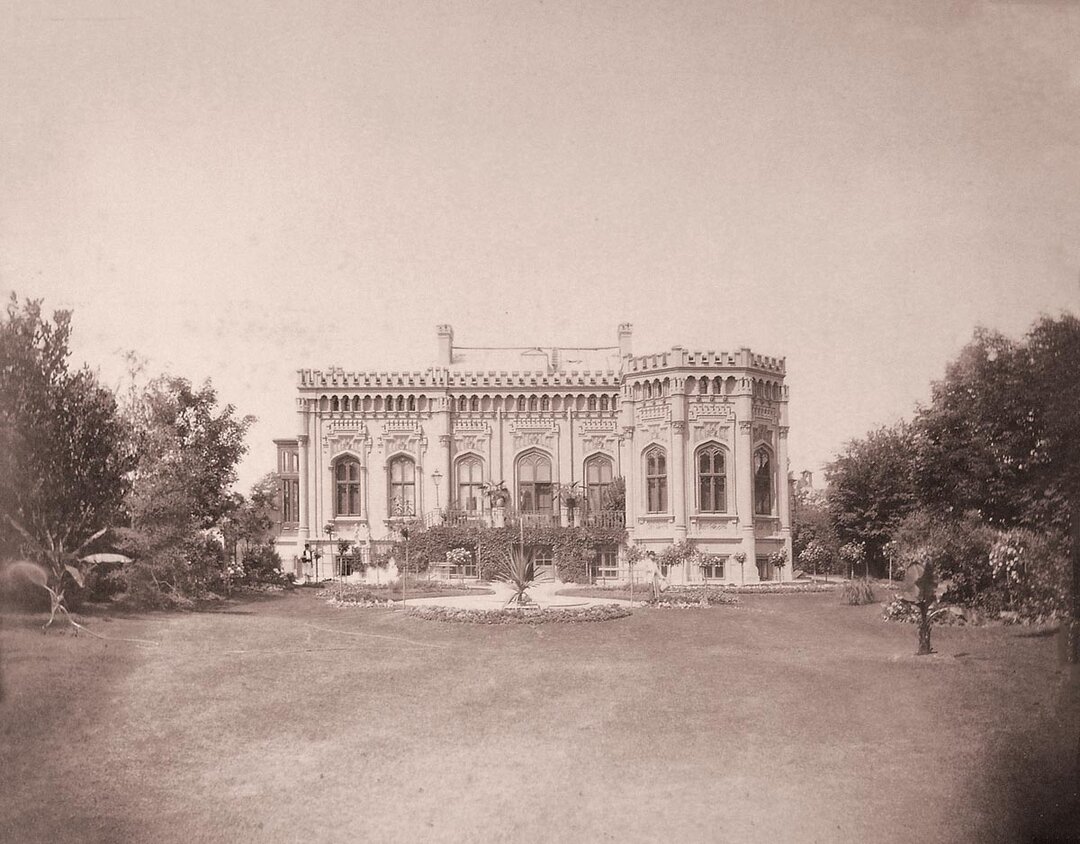
Personally, I believe that Professor Bordenache's first aim was to construct a building between the Ministry of the Interior and the Kretzulescu Galleries, a building that would properly enclose the Palace Square (today, Revolution Square), and to this end he wanted to dialog with the architecture of the Kretzulescu Galleries, the work of G. M. Cantacuzino and Horia Teodoru. The two facades are on the same level, separated by Calea Victoriei. We only have to look at the proportions of the windows, the material and color of the facades of the two buildings. Pompiliu Macovei, who had - and would continue to have - various high political and administrative positions, was, I believe, unnecessarily overzealous. But Pompiliu Macovei was an intelligent and cultured man and I do not think that he did not intuit Professor Bordenache's intention2.
Issue 2 of the magazine presents the systematization of Vulcan. Miruna Stroe readily seizes in the text of the main author of the project, T. Iconomu3, the link with the Athens Charter theories and with Clarence Perry's neighborhood unity.
In issue 4, Professor Gustav Gusti gives an exhaustive account of the house-building activity in "the usual wooden language with frequent explicitly ideological parentheses", of the month-long visit of the Romanian architects' delegation to the USSR.
In issue 5, the column entitled "Chronicle" comments on a housing competition. Here, Miruna Stroe notes the first signs of the abandonment of the decorations typical of socialist realism4.
The issue 6-7/ 1954 is devoted, for the most part, to the reports presented at the second UA Plenary on housing design. In the article "A Decade of High Transformations in RPR Architecture" by the CSAC president, Prof. N. Bădescu, the author describes and brings to our attention, with evident amusement, if not irony, "an extraordinarily pragmatic (and, moreover, unpoetic)" definition of the architect's task, "... who must realize his images - the expression of the rich content of ideas of our society - as rich and convincing as possible, by as few plastic means as possible, in as short a design time as possible and allowing for a quick and simple execution on the building site". No comment!
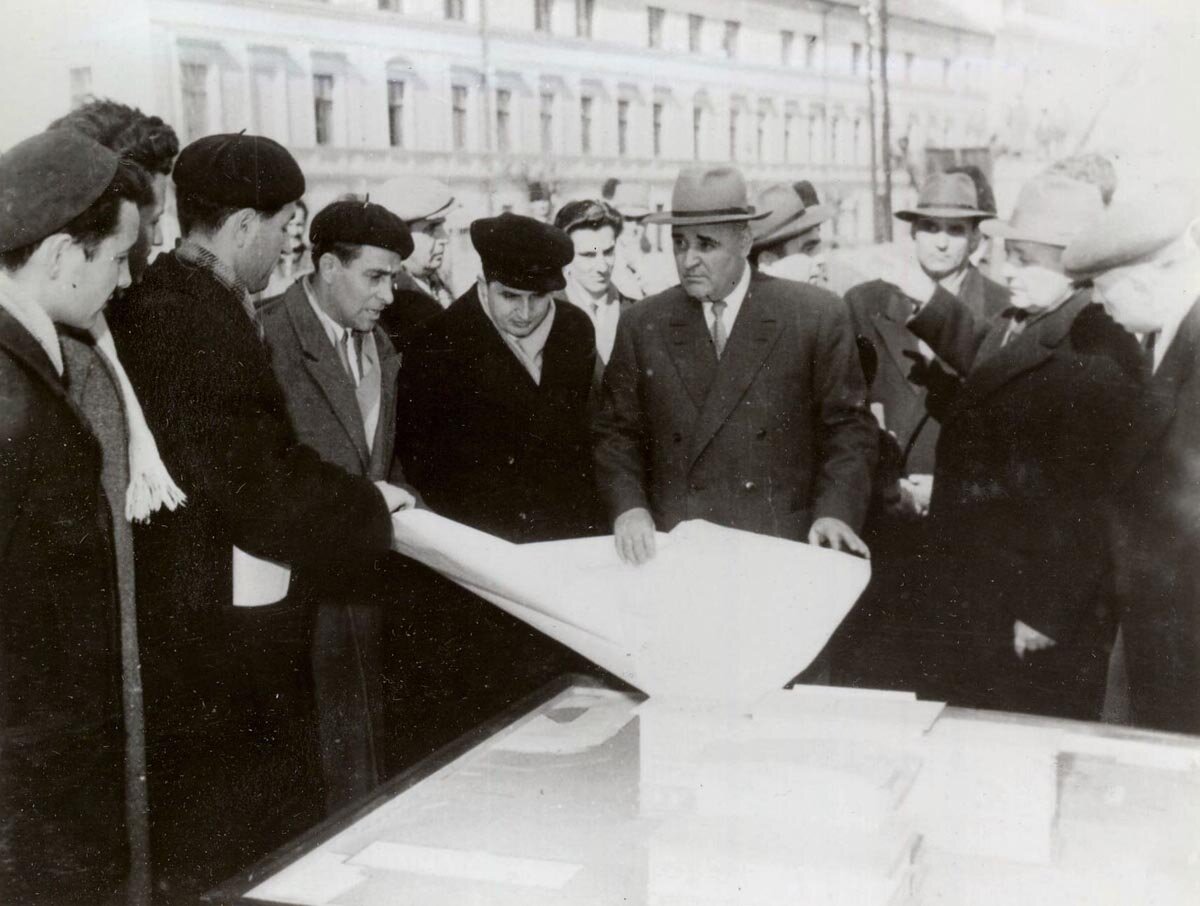
The impact of Nikita Khrushchev's speech at the All-Union Conference (of builders, architects and workers in the building materials industry, in the construction machinery industry, in design and research), 1954
Hesitations in speech reception?
"The possible political change sent a shiver of uneasiness through the upper echelons of the PMR leadership, and therefore all Khrushchev's decisions were received with caution."
The cautious reception of the speech also spilled over into architecture and urban planning, generating a period of transition. The fact that No. 1 of the 1955 issue of "Architecture of the RPR", which appeared after Khrushchev's speech in December 1954, dealt exclusively with agricultural architecture - a neutral subject - expresses the indecision of the political powers in the face of the changes that Khrushchev's unexpected stance implied.
Khrushchev's speech. Further reading
We learn from the text of the volume that Khrushchev's speech was considered by American academic circles years later as an architectural manifesto and included in the anthology of theoretical texts Architecture culture, 1943-1968: A documentary anthology, published in 1993 by the prestigious New York publisher Rizzoli. Miruna Stroe, on the other hand, presents us with a text by Khrushchev that is a direct attack on architects: "I am convinced that most architects will understand our demands. And those who don't must be brought to the right path".
The mere appearance of this text in "Arhitectura RPR" must have aroused at least a terrible intellectual, if not existential, discomfort in Romanian architects, many of them released (or not) from communist prisons. Most of the political prisoners were to be released in 1964.
Reception and acceptance of the discourse
The CIA report on the USSR's economy in 1955 ignores "subtleties about architectural style" and emphasizes the economic changes that have occurred and will occur. For CIA researchers, the economic aspects presented in the conference are more important than the political ones. R. W. Davies, the author tells us, notes that the reduction in the cost per square meter of housing from 1,700-2,000 rubles to 800-1,000 will cause architects to take the two measures at their disposal: to dispense with decoration and to design at or below the comfort limit.
At first glance, I'm more seduced by the pragmatism of the CIA researchers than by academic studies that insert Khrushchev's discourse into architectural theory textbooks, though, I admit, the idea can be fascinating.
The journal "Arhitectura RPR", no. 11-12/ 1955, publishes "The Decision of the CC of the CPSU and the Council of Ministers of the USSR on the Removal of Excesses in the Design and Execution of Constructions" from which Miruna Stroe extracts the following passage:
"The great existing shortcomings and distortions in architecture are explained to a considerable extent by the fact that the former USSR Academy of Architecture (President tov. Mordvinov) oriented architects towards solving, first and foremost, the external aspects of architecture at the expense of comfortable plans, rational technical solutions, and the economy of construction and building operation. (...) The former Academy of Architecture of the USSR and its scientific research institutes did not, in their time, give a critical appraisal to the manifestations of formalism and other great shortcomings in architecture, they broke away from life".
Khrushchev had forgotten the famous cultural-populist slogan of Stalin's Commissar of Culture Anatoly Lunacearsky in 1934, "columns for the people," five years after Stalin had decided to build socialism in one country, the USSR, leaving the internationalist avant-garde in his country without an object of labor.
The effects of discourse in Romanian practice
The Third Plenum of the AU took place a few days after Khrushchev's speech. The Romanian architects who had attended the Moscow Consf. did not attend the Plenum. The hesitation of the political leadership led to a gap between the ideological direction generated by Khrushchev's speech and the practice of architecture in Romania.
It was not until issue no. 4/ 1955 of the magazine "Arhitectura RPR" that the problems raised by Khrushchev began to be presented.
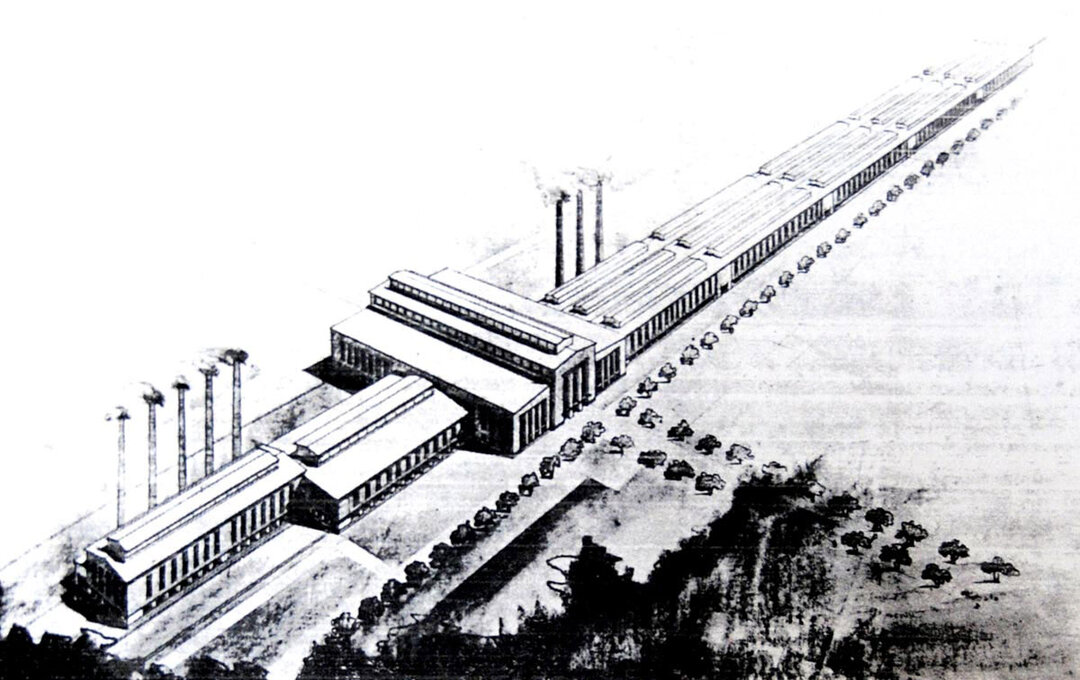
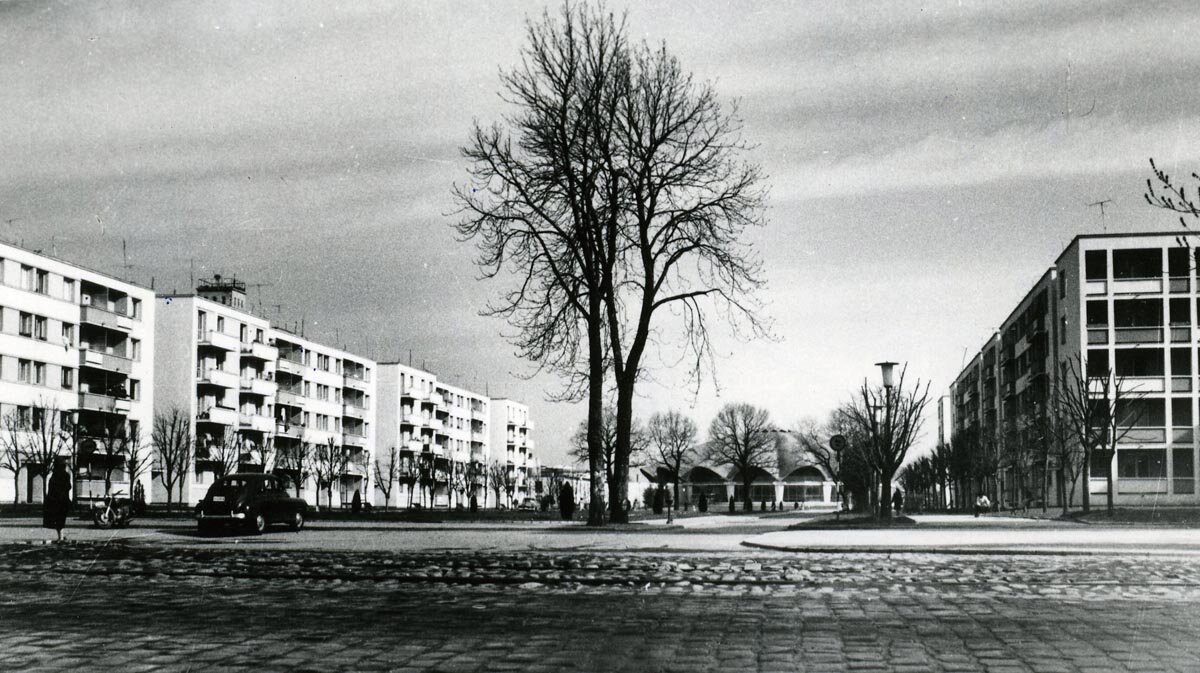
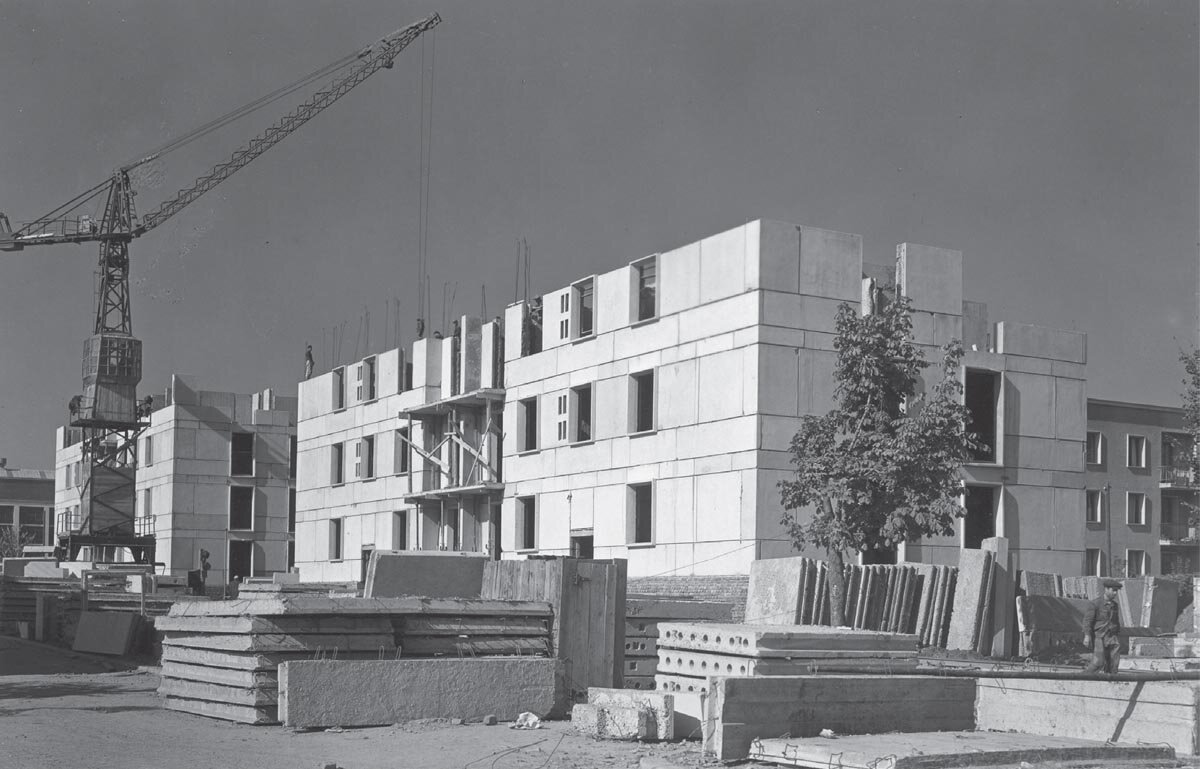
It is interesting to note the way in which the text of the chapter is illustrated. Miruna Stroe's photographs of building sites highlight the fear of the political powers that be to give the green light to the changes brought about by Khrushchev's speech. The tacit and on-the-fly removal of Soviet Stalinist-style facade decorations from buildings under construction (designed during the Stalinist period but not completed in this manner) is an expression of this fear, subtly deciphered by the author in the marker photographs. The illustration supports and reinforces the understanding of the text. In a future volume or in a new edition, images of the first, richly decorated and sculpted versions of some of the projects (the Opera, the Radio Broadcasting, the "Romarta copiilor" block, all in Bucharest) could be shown in comparison with what was finally realized.
A brief overview of the magazine "Arhitectura RPR" until 1958
"If during the period of publication from 1953 until no. 4-5/ 1956 the cover is unique, dominated by the capital in relief, with this double issue the cover changes along with the graphics of the first page. However, we may think that by mid-1956 the architectural change had already been imposed... The gesture of eliminating the capital may be almost symbolic of the discreet architectural change", says Miruna Stroe.
The first article on architectural theory (published in the journal "Arhitectura RPR") by Professor Mihail Caffé should be placed in the same vein. "The author deplores the ungrateful status of architectural theory, the article also addresses the issue of national specificity: 'Speaking, then, of national architecture, we should not always refer to the adoption of forms that have become traditional in popular and historical architecture. On the contrary, architecture must first of all be modern, contemporary, in order to be truly national. The historicism of certain national studies is, in fact, a retrograde anachronism". The author also points out that from issue 5/ 1957 onwards, the journal 'Arhitectura RPR' is no longer the organ of the UA and the CSAC, but only of the Union, and from issue 7/ 1957 onwards, continuity with the pre-war journal is emphasized.
It would be interesting to make a comparison with the magazine "Plastic Art", published by the Union of Visual Artists at the same time, to see to what extent there was a politically dictated synchronism in the discreet announcement of changes.
I believe that it is worth mentioning the courage of Professor Mihail Caffé, who, in contrast to the official theories on how architecture should be conceived in Romania, put the above text on paper. At that time, the chapter on Kenneth Frampton's Critical Regionalism had not yet been written. I refer explicitly to the British historian's commentary on the Bagsværd Church (1976, Copenhagen), designed by Jørn Utzon.
Conclusions to the Hrușsciovian speech
"Khrushchev's discourse makes a more or less desirable operation of synchronization with the West in the practice of architecture, but in an exclusive and discretionary way [...] even if the internalization of the new architectural style is more lesecious, for it sometimes seems to overlap the architects' genuine convictions, it cannot be easy in the absence of critical possibilities. Valid criticism of architecture is non-existent, so that the practice of the profession remains to be done by constantly navigating through politically imposed rulings and regulations."
Why was this so, why was there no architectural criticism? First, because at the time criticizing architecture was synonymous with criticizing the communist regime. The consequence was that the projects presented in the magazine, which should have benefited from a welcoming critique written by an authoritative voice, were always accompanied only by the text of the author of the project, which could sometimes be more or less self-critical.
The official end of the transition
Study on the evolution of housing, documentary material preceding Gheorghe Gheorghiu-Dej's speech
A rare discovery is the great joy of those passionate about archival research, the author's finding of the material entitled "Study on the problem of housing and social-cultural construction in the RPR" - a real goal - is such a case. Miruna Stroe discovered the text that formed the basis of Gheorghe Gheorghiu Gheorghiu-Dej's speech that officially marked the beginning of destalinization in 1958.
It is the study made by a team of 23 specialists, engineers, architects and economists - under the direction of the Economic Directorate of the CC of the PMR - in preparation for the official speech accepting the change brought about by Khrushchev's speech in December 1954. The study was conducted in 1957 and was structured in 5 parts: 1. The current situation regarding the housing stock; 2. Determining factors, ways of reducing the cost of improving the quality of housing and social-cultural buildings; 3. Funding sources and other financial issues; 4. Maintenance and repair of the housing stock; 5. Conclusions and proposals. The participating architects are names popular at the time: Ladislau Adler, Ion Silvan, Mircea Kernbach, Marcel Locar, Gustav Gusti, Simson Gredingher.
Words with the force of law: Gheorghe Gheorghiu-Dej's speech at the 1958 PMR CC Plenary Meeting
Practically, the speech delivered by Gheorghe Gheorghiu-Dej at the Plenary CC of the PMR on November 26-28, 1958, is the result of the conclusions chapter of the above-mentioned study. Through this act the political power validated the course that architecture had already taken.
The Floreasca landmark ensemble
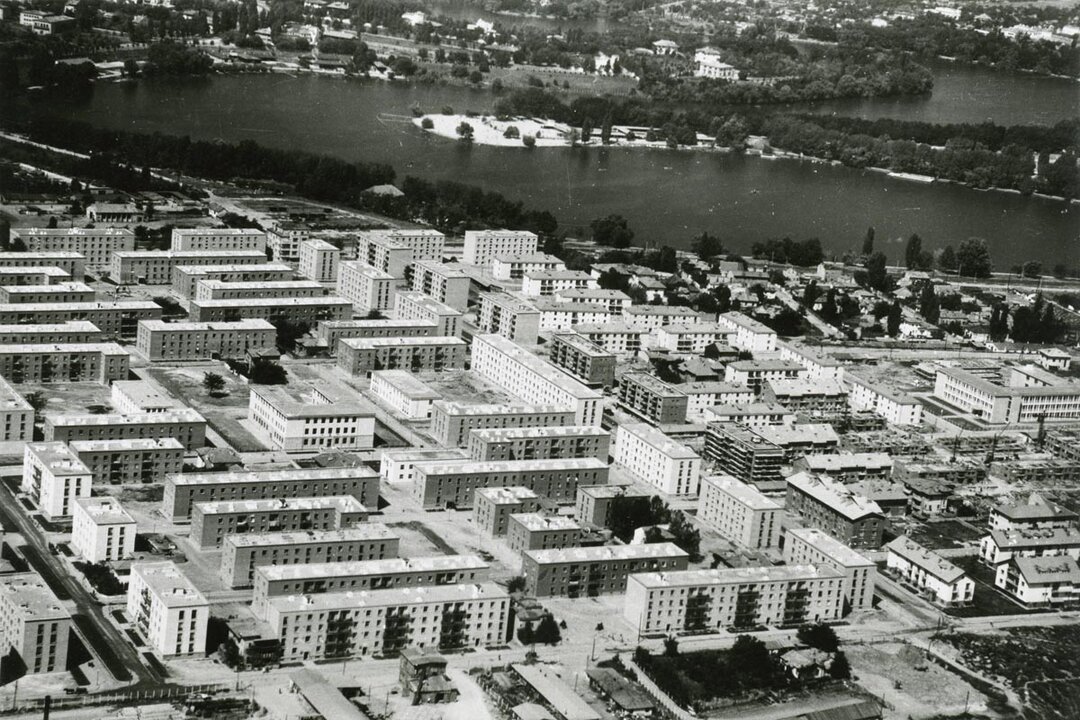
The researcher believes - and rightly so - that the value of this ensemble as a benchmark is conferred by the moment of its construction, after Khrushchev's speech, but before the political leadership's official acceptance of the change in architecture. The author notes, in favor of the project, that, although we are dealing with a compromise solution, the urban planning solution comes close to free urbanism and that it is the first example of housing in a park in our country. The project was to be presented at the 5th UIA Congress in Moscow in 1958. It will appear on the cover of the magazine "Arhitectura RPR" (No. 12/ 1958). The main authors of the project were the architects Corneliu Rădulescu and Virgil Nițulescu.
I believe that today there is a need to carry out and publish monographic research (including sociological studies) on urbanistic units that represent either turning points such as the ensemble we are discussing, or moments of excellence, such as parts of the Drumul Taberei, Balta Albă ensembles in Bucharest and several others in the capital and the provinces. At least in the first phase of their conception and construction, these urban developments are, in my opinion, not inferior to Western housing estates. But this has to be validated by careful comparative studies. In the West, at the end of the 7th century, interesting experiments began to emerge, and the bar and the tower were no longer the only forms populating new urban compositions. In Paris, for example, the La Grande Borne ensemble (1963-1974), arch. Emile Aillaud, Martin Schulz van Treeck's post-Corbusian ensemble in Rue de Flandres (published in 1975 in "AA") or Christian de Portzamparc's postmodernist ensemble in Rue des Hautes Formes (1979) are experiments which, sadly, have only existed to a very limited extent in our country. I have in mind Virgil Nițulescu's exceptional project for a high-rise block of flats at the beginning of the eighth decade, on Boulevard 1 Mai, on the corner of Rue Ion Manolescu. Proposed as a counterpoint to the block located behind the square (which I designed) and, at the same time, to constitute the perspective end of Ion Mincu street. The unusual architectural design and a made-to-measure resistance structure - soft diaphragms5 - by the engineer Eleodor Săftoiu, generated a highly original volumetry that I did not find in the publications of the time5, which I still consider an experimental project.
1958, a special year
The November 1958 PMR CC Plenary in November 1958 gave the green light to the new direction, the one that made it possible to practice modern architecture. In the preamble, the UA Plenary of November 1957 had emphasized, in connection with the reorganization of design, through sufficient authorized voices, the need for free criticism; unusually, Western examples were presented as possible examples to follow. In the year of the CC Plenary, the exhibition on model buildings organized in the German Democratic Republic and first opened in Berlin, toured Bucharest. The event aroused great interest among Romanian architects, generating many articles in the magazine "Arhitectura".
The next plenary session of the AU (1958) dealt with the theme of "cost reduction in housing construction". Miruna Stroe points out a difference of almost 100% between the prices of housing determined by design (by architects, engineers, economists) and political ones, obviously the low ones being the latter.
Between January 21 and February 10, 1958, the exhibition Contemporary Architecture in the United States was to open at the Sala Dalles. The event was symbolic.
Even if, as Ana Maria Zahariade says, the euphoria of the 1960s was not present among architects in 1958 - the signal of change that allowed the architecture to be brought into line with Western architecture in Romania generated, even then (timidly at first), a wave that would grow into a wave of energy. As a result of this state of affairs, projects were "more freely and carefully studied", which presupposed, for their correct implementation, budgets that were calculated with the utmost probity. Not very sensitive to this interest of the profession, the political power judged only in economic terms, hence the price difference mentioned by Miruna Stroe and the architectural syncopes... As for architectural criticism, it was never to gain any consistency for the reasons mentioned above.
5th UIA Congress
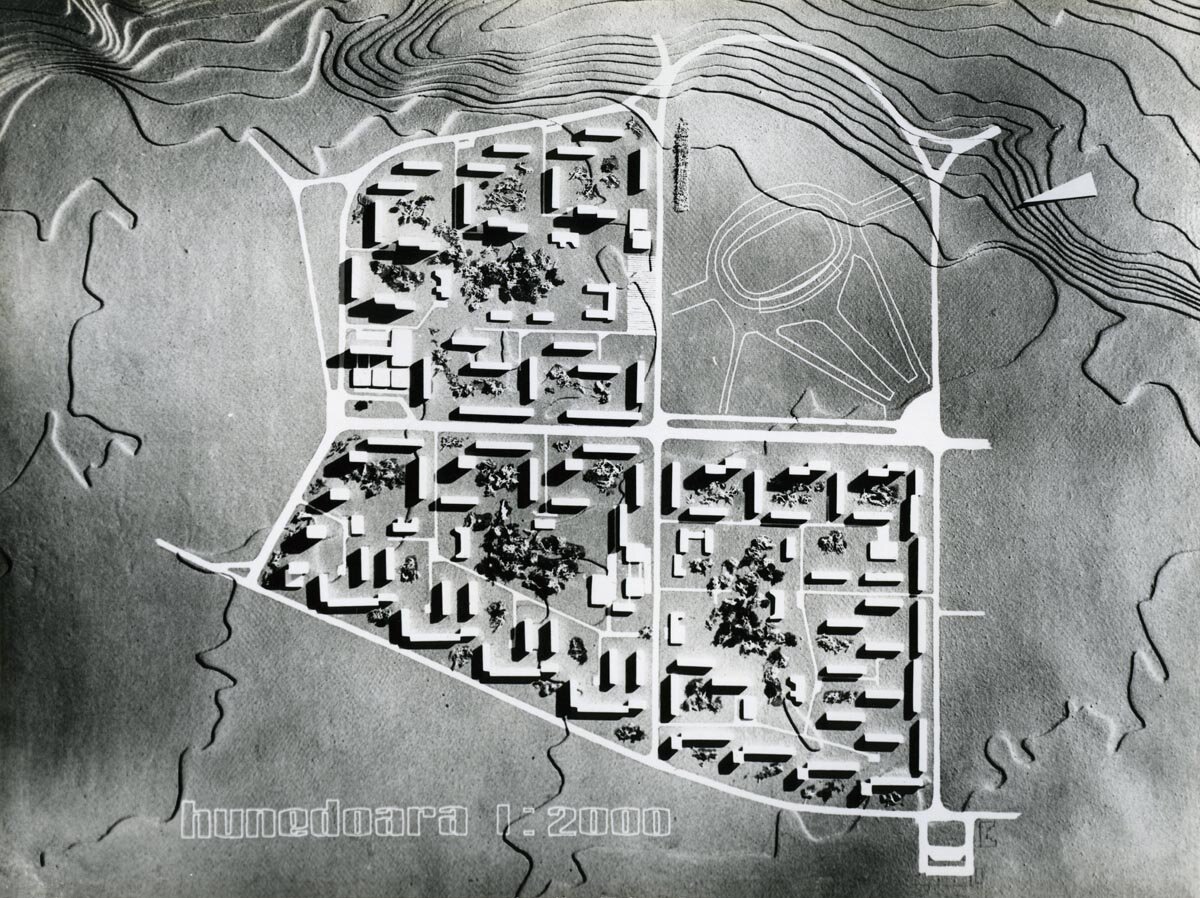
The event was held in Moscow, July 20-27, 1958. The choice of venue was symptomatic, says the author, of the way Western countries reacted to Khrushchev's speech. The Congress was to debate the theme "Construction and Reconstruction of Cities, 1945-1957". Miruna Stroe points out that the representative of the Academy of Constructions and Architecture, architect Professor N. Baranov, appreciated the experience of design based on the neighborhood units proposed as early as 1929 by the American Clarence Perry. The author also notes the emergence of the term microraion, a concept derived directly from the neighborhood unit. Adopted in all the countries of the socialist camp, the term covers a type of urban unit developed on areas ranging from 20-50 ha for a population of 5,000-15,000 inhabitants. In addition to housing, it includes shops, schools and nurseries. It was to be declined in various forms, from the classic (grouping of blocks with social and cultural facilities) to forms broken up and recomposed taking into account previously built-up areas or the presence of arteries or squares.
Activity of the Regional Design Institutes, IRP
From March 1, 1958, 16 regional design institutes came into being. In the following year the first projects realized in the IRPs are published, and in April of the same year the Young Architects' Conference is organized. "Arhitectura RPR" inaugurates a special, non-permanent column entitled "From the Activity of the Regional Design Institutes", starting with issue 1-2/1958.
A well-chosen illustration highlights several works produced in Craiova, Oradea and Deva, of at least respectable quality. The concern for a regional character in architecture, in line with similar concerns in Italy, Spain (Catalonia), Greece, Denmark, etc., is now more visible.
Unique projects before neighborhoods and squares
The plan for the systematization of the capital proposed: the creation of new districts, the creation of urban squares bordered by housing, and the addition of high-rise residential buildings to the city's main roads and housing in the city centre. Many of these constructions, given the size of the land in the city center, with its particular geometries and not always very large surface areas, have generated unique projects. Connection to the inter-war urban fabric required connection to this type of architecture. The situation left the door open for a modernist approach. The buildings on Calea Victoriei 136, the blocks on Brezoianu Street, built on land that became vacant after the bombings of the Second World War, were built in this spirit.
Miruna Stroe shows us some small housing projects "escaped from the tyranny of the indexes, in keeping with interwar modernist architecture", the Păsculescu-Tei street complex, by architect. Mircea Dima, and the housing complex in Ana Davila Street, by architects. Mihaela Slomnescu and Vl. Iliescu. Built on free, small plots of land, following more relaxed projects that were to produce human-scale urban units, these complexes often had very high quality architecture.
I would add here (although it has been mentioned in another chapter, p. 58), for the note of obvious modernity, the Sanitas block (as it was known in the late 1950s) built before the buildings mentioned, in 1957, by the architect Virgil Nițulescu (1922-2000). Situated on Nicolae Balcescu Boulevard, near C. A. Rosetti Street, between two modernist inter-war blocks and practically opposite Horia Creangă's Malaxa block, the Sanitas building is in an interesting dialog with the latter6. Known for his avowedly modernist stance, Virgil Nițulescu had been vehemently criticized by Gustav Gusti in an article in "Arhitectura RPR" (no. 2-3/ 1950), which commented on a housing competition: "[...] a project devoid of any architectural or constructive value nevertheless aroused wide-ranging discussions among the members of the jury, due to its value as a manifesto of an enemy ideology [...]".
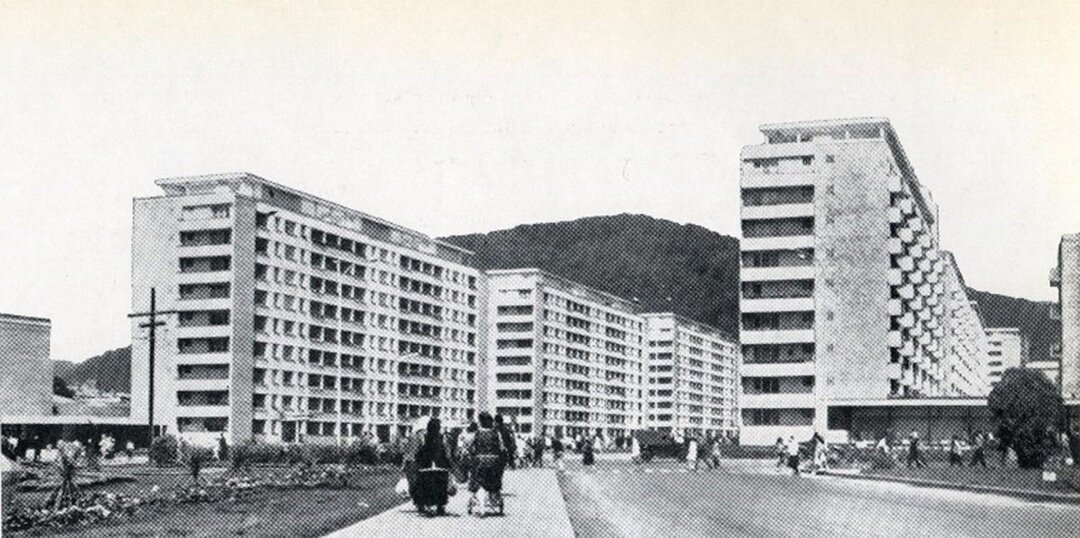
One of the many merits of the book we are reviewing here is the fact that, to support the ideas in the text, we are provided with a concentrated iconography that brings to light valuable architectural works: the Păsculescu-Tei complex, the Sanitas block, the block at 136 Calea Victoriei, the blocks in Brezoianu Street, etc.
International parenthesis. Expo 1958
For the socialist countries, 1958 triggered a return to modernism, says the author. Expo 1958 - the first post-war world exhibition - was attended by all the communist countries except Romania. All these countries had pavilions in which up-to-date architectural research was visible. The pavilions of Czechoslovakia and Yugoslavia were noticed and appreciated. Miruna Stroe considers that: 'This exhibition demonstrates the rush to reconnect the socialist states with the Western architecture of the time, as soon as this was possible'; one could see 'the desire to go beyond the known in architecture and art'.
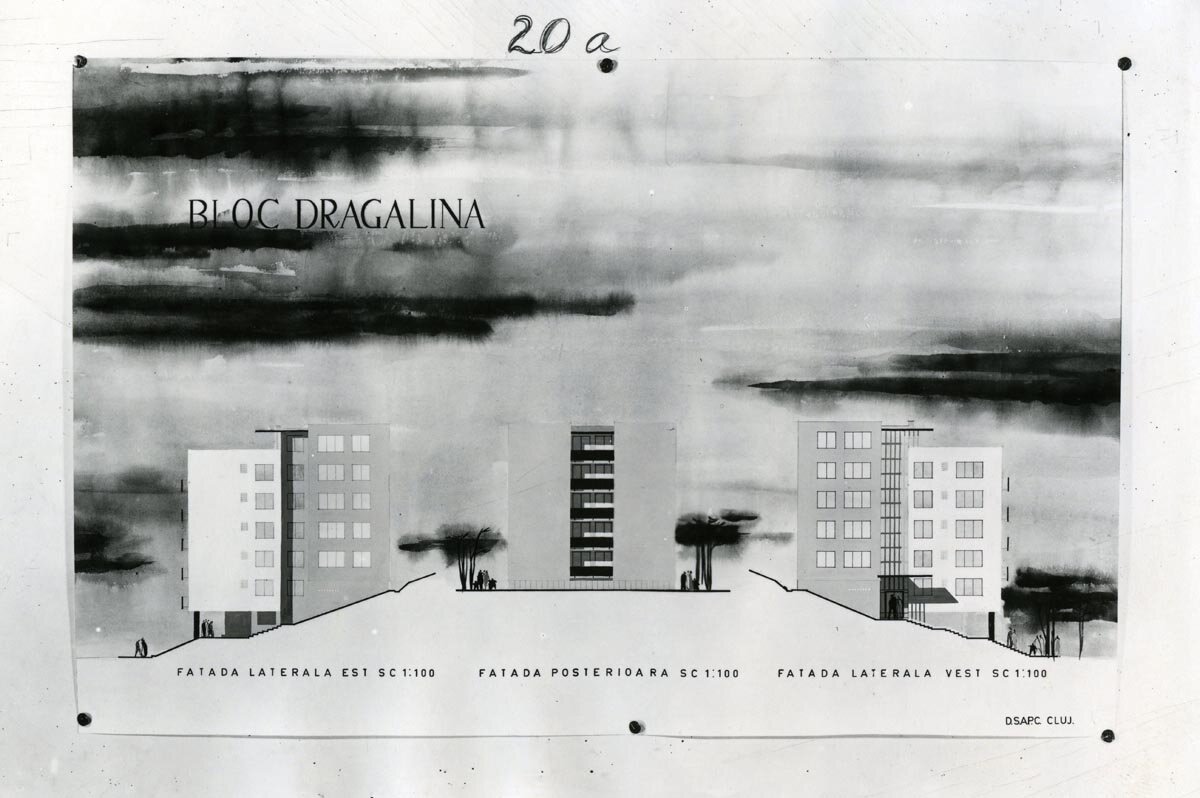
The most talked-about project at the time in the press, the architectural press, and the architectural guild was Le Corbusier's Philips Pavilion (coll. Iannis Xenakis), one of the most "provocative" (Nicholas Fox Weber), the most unusual of pavilions (New York Times critic). Inside the pavilion, an 8-minute film designed by Le Corbusier was shown, with music by Edgar Varèse composed for the event. Le Corbusier called the result an electronic poem. Extraordinary sense of anticipation on the part of the author of the project when you consider what is happening in the visual arts today!
Part II. Modernism unnamed is coming into its own
Preparing the six-year plan
Until 1960, the focus of effort and the direction of the Romanian economy was directed towards agriculture, from that year onwards the focus would shift to industrialization, which would include the building materials and construction industry. Some enlightening graphs on the housing situation are presented. We learn that the habitable area per inhabitant since the establishment of communism, compared to the inter-war period, has decreased; that the sanitary norm of 8 square meters per inhabitant will not be reached until 1971, and that the housing crisis will be solved around 1975. Compared with other countries, "the habitable surface area per inhabitant does not place Romania in a comfortable zone". Miruna Stroe extracts the situation from archive files on which she writes in strict secrecy, which tells us, with good reason, that we are dealing with the real situation, put at the disposal of the political powers and far from what was being propagated in the press of the time for the knowledge of the masses.
A recurring problem is that of the relationship between the industrialization of housing construction and the height regime. There continues to be a lack of confidence in the ability to construct tall buildings, not least because of the high cost of this solution. Miruna Stroe illustrates the points of view of the various apparatchiks with texts extracted from stenograms, such as Gheorghe Gheorghiu-Dej, Florian Dănălache, Petru Borilă, etc. We can thus get an idea of the intellectual level of those who decided the country's destiny in those years. For a more accurate edification I recommend reading the texts in the appendices, of which here is a sample:
"Tov. Gh. Gheorghiu-Dej: [...] it was a matter of organizing the residents, talking with the party members and establishing how to behave towards these new constructions.
Tov. Boroș Carol: For the new blocks, we have taken measures in this respect.
Mr. Gh.Gheorghiu-Dej: You didn't put curtains?
Tov. Boroș Carol: We didn't put them, the tenants put them. We only indicated which curtains to put up.
Tov. Gh. Gheorghiu-Dej: Let them be cheap.
Tov. Boroș Carol: We only give a few models, and the party members are the ones who say how the curtains should be, to keep it clean".
Intense concern for systematization
From 1959 onwards, discussions about town planning became increasingly topical, especially the question of where to locate housing in cities. It was at this time that the concept of a "layout plan" began to be used with the explicit aim of facilitating the approval of projects. The starting point of the sketch was to be the economic profile of the area to be urbanized, says Miruna Stroe, and one of the first operations was to delimit the perimeter of the settlements. This type of project was used to define housing and industrial areas, traffic, green spaces, the location of the main socio-cultural facilities, etc., using a replacement language for the first four points of the Athens Charter (1933). However, the important issue of historic city centers was sidestepped.
This approach would lead to the destruction of the historic centers of cities located mainly outside the Carpathian arc. The historical heritage of these centers was structurally altered. Even if the architecture and physical condition of the demolished buildings was more "precarious" compared to the condition of the city centres inside the Carpathian arc, the old urban settlements signified the identity of a civilization. The few studies on these centers, as well as those of Eugenia Greceanu, dedicated to the cities of Pitesti and Botoșani, certify the existence of a valid and viable urban civilization. However, I would like to draw your attention to the fact that, while we deplore the demolition of these historic urban areas, even if it was often accepted by the architects, the judgment of architecture and urban planning must be made in the spirit of the times: after the Second World War, everywhere in Europe, in France, Germany, etc. In Romania too, architects had been brought up in the spirit of the Athens Charter, which they had not only learned, but believed in and many of them loved: free plan, piles, roof terraces, horizontal windows for architecture; zoning for urban planning (living areas, working areas, spaces for traffic, leisure, historical heritage of cities). Even though 30 years later Reyner Banham criticized the results of the Athens Congress, the architectural-urban microcosm took some time to react. In our country, change will take place mainly at the level of architecture, which at some point becomes postmodern, but to my knowledge, change does not take place at the level of urbanism.
Architects systematize, comrades dispose
We are presented with projects designed by architects with an obvious desire to create projects to Western standards, projects that will sometimes be severely criticized by the political powers. Of the examples she presents, the author chooses the most evocative, according to the author, Iași. The example was chosen because it was here that the whole development of the city during the communist period could be traced, from the 1954 systematization sketch proposed by the team led by the architect George Filipeanu to the achievements of the early 1960s, including the 1956 and 1960 systematization sketches.
Political decisions on the systematization of cities were taken on the basis of a briefing note prepared by signed or unsigned specialists. Miruna Stroe tells us that "the information note for Iași completely ignores issues related to urban composition, but presents the city's economic profile in great detail".
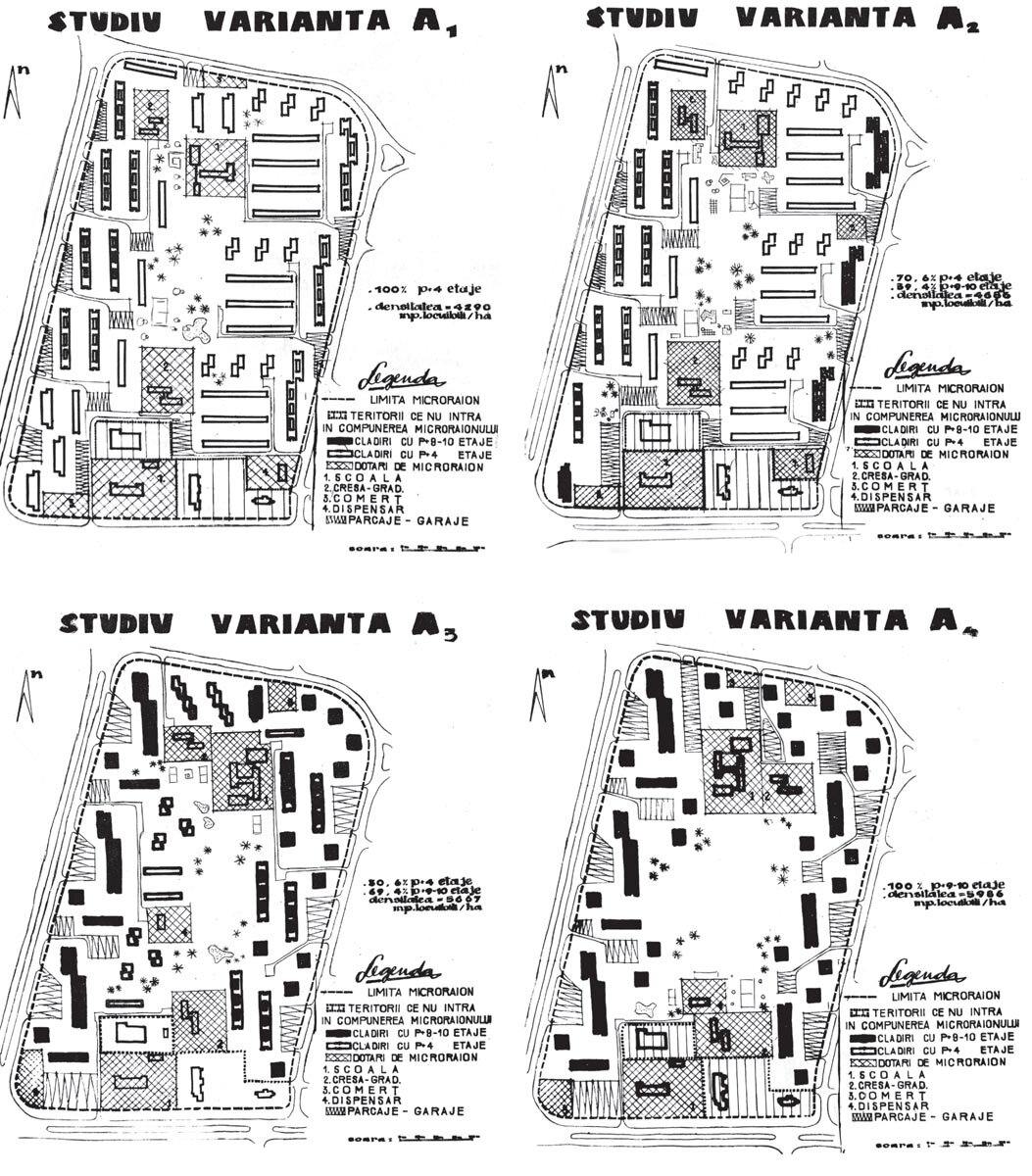
The note was translated into a modus operandi that was to lead to the destruction of Iasi's silhouette. The first project, that of 1954, was based precisely on the idea of preserving the city's cachet, proposing a height not exceeding P+2 storeys.
The project was implemented on the ground in a city with a very particular relief and a characteristic silhouette. In addition, in Iași, where there is good and sometimes very good quality old architecture, it had to be built taking into account the existence of this heritage, which meant seeking a dialog with what pre-existed. In this respect, Ignazio Gardella's Casa Borsalino (1951) in Alexandria/Italy or José Antonio Coderch's buildings such as the ISM in Barcelona (1952) or Casa Catasus (1956) in Sitges/Catalonia are good examples. They would have been good examples to follow in Iași!
Systematization of squares, central areas and bus systemization
Although they are all housing developments - given the different principles that govern them - the author intends to treat separately from the micro-regions the urban spaces of the magistral and squares type, representative by their location, arranged along avenues or perimeter squares.
Some of the ensembles built between 1958-1966 are carefully and subtly analyzed: the Palace Square, the North Station Square, the State Circus ensemble, the Calea Griviței ensemble, which Miruna Stroe rightly praises for its "remarkable compositional effort". Also featured are the north-south axis (Magheru-Bălcescu-Brătianu) and the east-west axis (Ferdinand, Pache Protopopescu, Carol, Elisabeta, Kogălniceanu), all in Bucharest. Miruna Stroe points out "a critical view of these projects expressed in an article by conf. arh. Radu Laurian. One of the observations made with reference to both bus routes is that the projects lack the approach to the depth of the lots".
The fact that Prof. Laurian points out a weakness in the projects mentioned should not give us the impression that 'the coast has been cleared' for architectural and urban planning criticism, but that we are dealing with an exception.
As far as urban interventions in the provinces are concerned, the central areas of Cluj, Pitești, Ploiești, Râmnicu Vâlcea, Bacău, etc., which were appreciated as urban and architectural successes at the time, are commented on or mentioned. However, the author considers the interventions in Iași, Suceava and Piatra Neamț to be traumatizing because of their scale. The new Constanța and Brasov station boulevards are also reviewed, as well as several competitions: the systematization of Timișoara's city centre, and Unirii Square in Bucharest.
As far as the first two projects are concerned, I totally agree with Miruna Stroe, but for the Piatra Neamț ensemble I would put a flat note against the criticism, because at the time it was created it was an airy composition and the architecture had a certain panache.
Design organization, new legislation
In view of the rapid pace of construction, it became obvious that the number of people involved in design, primarily architects and engineers, had to be increased accordingly, and hence the number of design institutes. On 12 April 1963, HCM No 191 on the organization of design activity appeared. Among other measures, research and higher education institutes were allowed to realize projects. At the same time there was a concentration of professionals in two particularly dynamic cities, Bucharest and Constanța. The same normative act provides for the distribution of higher education graduates throughout the country, a situation that lasted until 1989.
What changes when everything stays the same?
Second country conference of the Union of Architects of the RPR
The conference was held May 24-26, 1965, with the presence of Gh. Apostol, then Vice-President of the Council of Ministers, in the absence of Ceaușescu. Pompiliu Macovei becomes president of the UA, while the former president, Duiliu Marcu, becomes honorary president. In addition to recycling some familiar ideas, the conference circulates the idea of consulting professionals from other fields in the design process in order to study the impact that the buildings will have on society (sociologists, physiologists, psychologists, economists). It also draws attention to a more informed approach to historical heritage issues. It also discusses local specificity, the relationship with traditional or heritage architecture, where inspiration should be sought to combat the monotony of recent architecture.
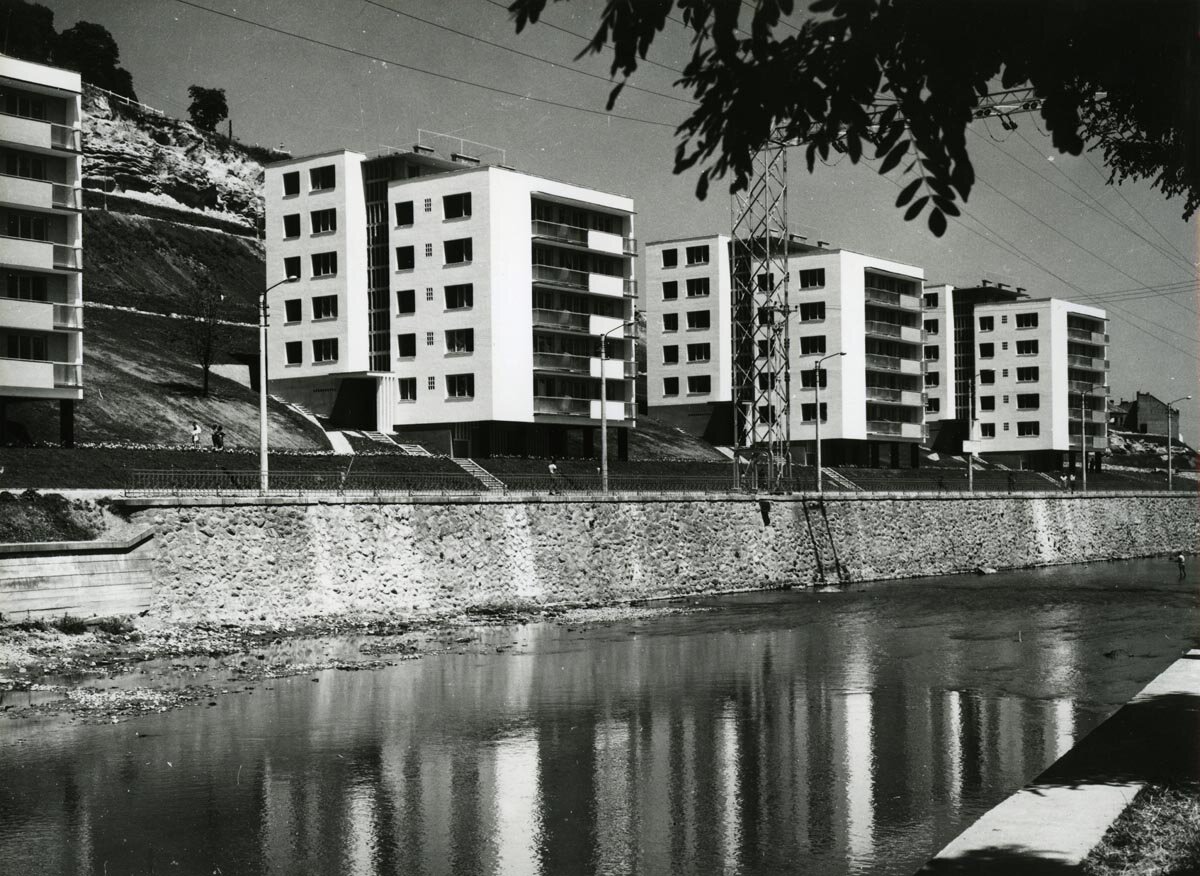
This line of thought on local specificity, which the conference advocated, had its origins both in local research already under way and in international experiences. Examples include the Barcelona experiences of the MBM team (Martorell, Bohigas, Mackay), those of José Antonio Coderch or the Italians Ignazio Gardella and Carlo Scarpa, the Greeks Dimitrios Pikionis and Aris Constantinidis, or the Japanese who were working in a modern key, in concrete, in a sophisticated manner, with traditional architecture. In any case, the decade following the conference will probably be the most interesting moment in post-war Romanian architecture, at least until 1990. During this period, the Houses of Culture in Suceava and Baia Mare (arch. N. Porumbescu), the National Theater in Craiova (arch. Alexandru Iotzu), the Prefecture of Baia Mare (arch. Mircea Alifanti) and about 10-20 other works of similar values were built.
Nicolae Ceaușescu's speech at the Country Meeting of Construction Workers
From the National Archives, file 34/1966 (CC Fund of the PCR, Economic Section), Miruna Stroe transcribes:
"The diversity of the ensembles, of the buildings and even of the detailed elements will be successfully realized only by combining the most advanced and precious in world architecture with the local specificity, with the traditions, with the values of Romanian national art. We are convinced that our architects and builders, who have proven their ability and talent, will fully assert their spirit of initiative and creative imagination in order to continuously develop and enrich the architecture of socialist Romania with its original stamp, characteristic of the era we are living in".
Miruna Stroe comments: "Ceaușescu [...] using a rhetorical tool, builds a grandiose image of the future in which builders and architects are to participate".
Unfortunately, it was not to be! Five years later, in 1971, following Ceaușescu's visit to North Korea, the famous July Theses were decreed, marking the end of the period of "liberalization". It would be interesting to find out, perhaps the future research that Miruna Stroe will carry out will reveal, who were the people who wrote her speeches on architecture and urbanism or who provided her with information in this field.
The five-year period 1966-1970 and the new sketch of systematization of Bucharest. Discussion
The housing of the following five-year period would have to take into account a new benchmark, comfort, in addition to the supposedly obligatory ones of economy, industrialization and standardization: "In the contemporary conditions of collective life, the notion of comfort can no longer be conceived only within the restricted framework of the individual apartment, but is increasingly closely intertwined with the organization of the urban ensemble, of the outdoor spaces and social and cultural facilities, of the building and circulation arrangements, as well as for quiet, rest and relaxation".
However, the housing construction plan will be rejected because of insufficient information on the true cost of the apartments: "The methods of calculating the prices of apartments are always an unknown - whether or not they include building works, landscaping, expropriation costs, demolition costs, etc.".
On the question of the density of housing estates, Ceausescu exclaimed:
"For the Soviets [...] the question of land does not matter. But for countries where the land issue matters, they fight for every square meter [...] We have to realize that we don't have serious documentation; we read in two magazines - one in the Soviet Union and one in France - and that's all. Since CSCAS has been working on this problem, they should have had proper documentation. How can we start doing it if we don't know what's being done in the world? We should have had room for options on density. We walk around abroad all day and we don't have the basics [...]. We are not going to reach the level of Switzerland, the US or Sweden for another 20-50 years. Let's see how they build".
The building program seems to begin conceptually in 1965, when proposals were made for the construction of 13,000 apartments by this method the following year, in the main large complexes of Balta Albă, Drumul Taberei, Armata Poporului, Pantelimon, etc.
As far as the layout of Bucharest is concerned, out of the many variants proposed, the VIIth, the one with the fewest demolitions, was chosen as the guideline variant, rather than the final one, which was to have even fewer demolitions.
The program, initiated by Ceaușescu, was to transform the housing estates (Drumul Taberei, Balta Albă, etc.) into the dormitory towns we see today. Their creators had left room for the creation of centers of the housing estates, which were to have spaces for culture, commerce, education, recreation, etc.
Personal housing
In January 1966, the author tells us, "Decision No. 26/1966 of the Central Committee of the CRP and the Council of Ministers of the Russian Socialist Republic on state support for the construction of privately-owned housing by citizens of the cities" was published. This normative act was to bring an important inflection in architectural practice. Even if the architect would not be in direct dialogue with his client, he would receive feedback from the state organization in charge of marketing these apartments.
The year 1966 in Miruna Stroe's title is chosen because of the appearance of this act. Even if it is not as important a landmark - in terms of history - as the date that marks the beginning of the study, 1954, the year of Khrushchev's speech, 1966 in the lives of Romanian architects of the time marked a change that reinforced the feeling that liberalization was underway, i.e. on the rise, which was not the case.
Conclusions
The way in which the political power legislated for architectural production to operate in society is one of the objectives targeted by the author.
Miruna Stroe's research focuses on the party documents she has identified in the archives, which she complements by tracing in the journal "Arhitectura" themes that are insufficiently outlined by what the archives have so far provided. But this volume is also a remarkable text of architecture and urbanism criticism. Balanced, subtle and learned commentaries put us in front of a vivid fresco that portrays us differently than those of us who lived through the period were accustomed to, the history of a profession that illuminates certain points in the great history of Romania. This is why I take the liberty of insisting and inviting, in addition to architects, the academic society, in particular, contemporary historians to carefully read Miruna Stroe's admirable study. I found reading the text interesting throughout. The introduction of stories such as those concerning the controversy stirred up by the design and realization of the 'Palazzo Calcani' or the ubuescei definition of the architect given by the president of the CSCAS, N. Bădescu, as well as the aforementioned Ionian-Caragagian dialogues of the members of the party and state leadership - are meant to spur the reading by breaking the rhythm.
The author is perfectly aware that there are still unresearched testimonies/documents, which makes her intend - perhaps also following Ana Maria Zahariade's suggestion - to continue the research that would lead to the publication of a second volume, which Simetria Publishing House would be interested in publishing.
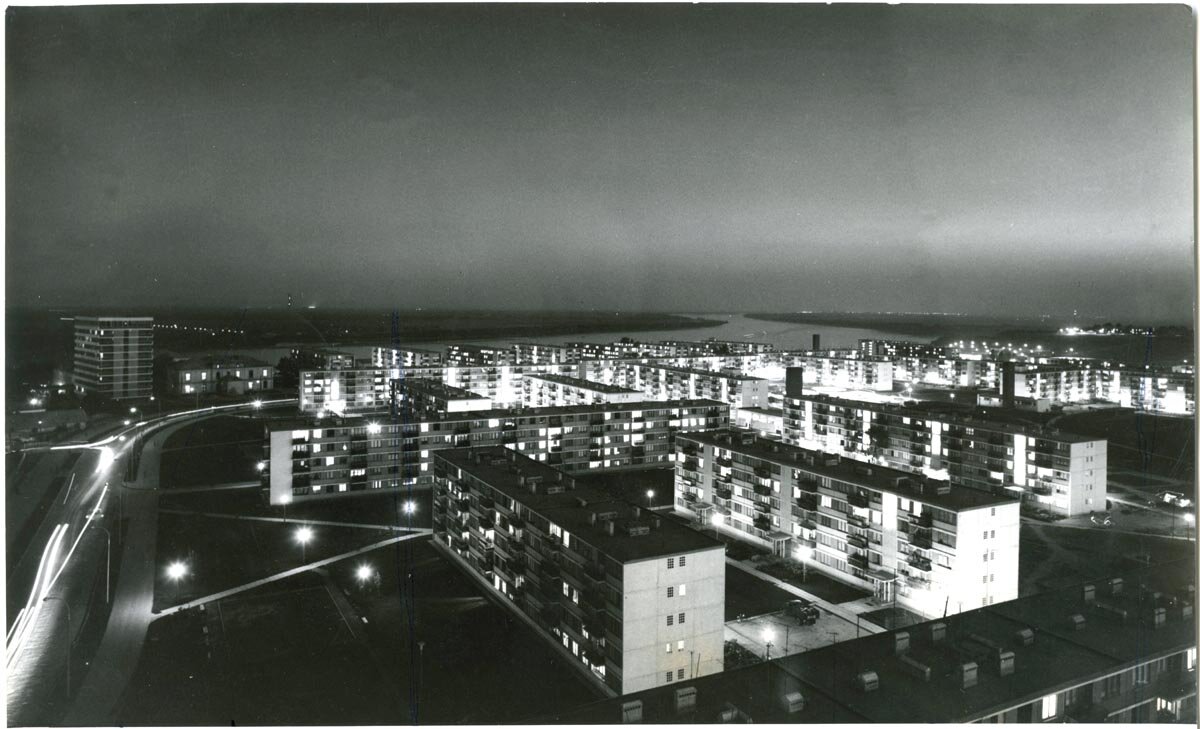
The illustration of the article is at the suggestion of the editors, with images from Miruna Stroe's book.
NOTES:
1 Miruna Stroe, Housing between project and political decision. Romania 1954-1966, București: Simetria Publishing House, 2016.
2 More likely, being a communist, he did not see with good eyes in this place charged with symbol, the Palace Square, the dialog with the architecture of the then outlaw G. M. Cantacuzino (in detention at the Canal). In fact, a few years later (in 1957), on the orders of Lygia Macovei, a member of the UAP board and the architect's wife, the painting and watercolor exhibition opened by G. M. Cantacuzino in the Herăstrău Park, on the night of the day it had been inaugurated by Tudor Arghezi. Regarding the symbolic value of the Palace Square: in a conversation I had with Neagu Djuvara, he told me that, in his opinion, the Communist regime built the Palace Square adjacent to the other one with the idea of overshadowing it.
3 A remarkable architect with a complete culture, T. Iconomu was up to date with contemporary architecture and urbanism, despite the bibliographical desert of the time. Having left the country in the late 1960s (if I am not mistaken), in less than a year he became head of the Beaudouin&Lods agency, one of the most notable architectural firms in Paris at the time, with works that marked the evolution of architecture both through their functionality and plastic balance and through their advanced technicality (Paul Constantin, Dicționar universal al arhitecților, Bucharest: Ed. Științifică și Enciclopedică, 1986, p. 35).
4 Which could be seen at the Casa Scânteii, in the housing complex and the Cinema "Fraternization between Peoples", at the "Nicolae Bălcescu" Open-Air Theater.
5 As I witnessed the approval meeting where the project was rejected, I can say without any hesitation whatsoever that the management's envy has blocked the realization of the project, depriving Bucharest of an achievement of international level. The project was published in "Arhitectura" magazine.
6 In 1967, when I joined the Bucharest Project Institute, I heard from my new colleagues that Virgil Nițulescu had wanted - and had expressed his intention - to take charge of the Unic block, to the left of the Malaxa residential building. As would happen on other occasions - some of which I witnessed - the Institute's management felt that it would be too much to give Virgil Nițulescu the opportunity to build a building next to Creangă's building, considered by the world of architects as the most beautiful residential block in Bucharest. Such a situation would have put Nițulescu on a pedestal that would have strengthened the legend born since his student days, the legend of his talent and culture (v. Ion Mircea Enescu, Architect under Communism, Bucharest, Ed. Paideia, 2006, p. 188).