70-300

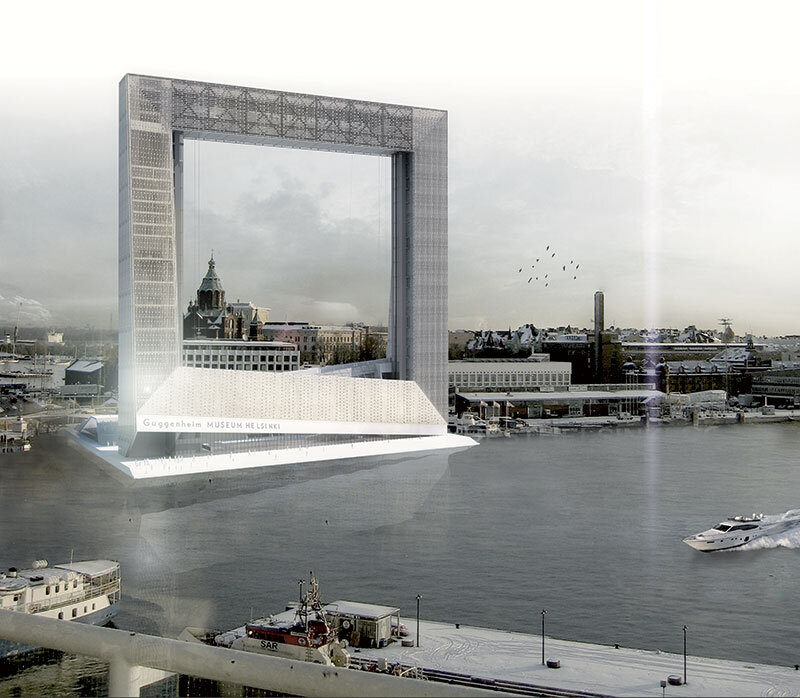
project author: Mara Victoria Bogoescu
supervisor: prof.dr.dr.arh. Ștefan Scafa-Udriste
supervisor: prof. eng. eng. Andrei Dragoș Marcu
Guggenheim Museum Helsinki
| On March 3, 2012, a competition was launched to develop a project for the Guggenheim Museum Helsinki. Positioned in the South Harbour area, it was to become the city's new landmark and a driving force for the future large-scale transformation of the harbor. The new building was to meet the challenge of becoming a symbol of the city that could be easily seen from any point in the city and play a role on the urban stage alongside Helsinki's other memorable buildings that today define its skyline. What should the contemporary Guggenheim Museum look like? Is the sculptural approach of the Bilbao case valid for Helsinki, when we talk about Alvar Aalto's Scandinavian architecture defined by straight lines? How can we define the city's architectural identity? Should the new museum conform to the existing typology or try a new approach? |
| On March 3, 2012, a competition for the design of a Guggenheim Museum in Helsinki was launched. The new landmark was set to be built in the South Harbour area, an urban waterfront undergoing an important transformation. The Guggenheim concept had to face 2 very important challenges: to become one of the major icons of Helsinki, visible from all spots along the waterfront, but to do so without challenging the existing landmarks of the city which today constitute the skyline of the harbour. Other questions came in quick succession: How should a contemporary Guggenheim Museum look like? Is it the sculptural approach of Bilbao appropriate in a city like Helsinki, where Aalto's architecture runs along strait lines or smooth curves? What is the architectural identity of Helsinki? Should the new icon comply with the existing museum typologies or attempt a new programmatic approach? |
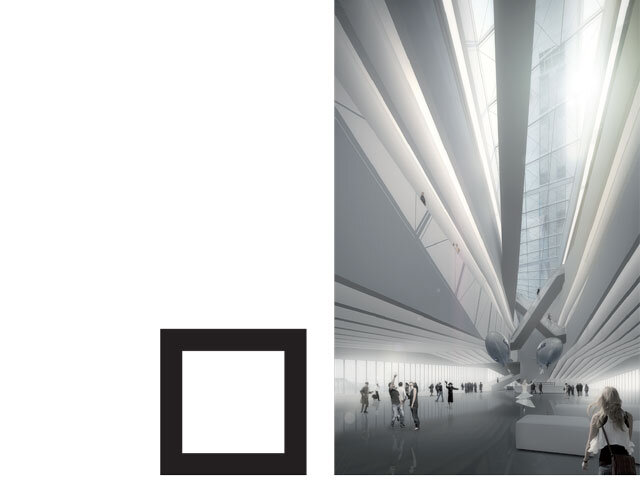
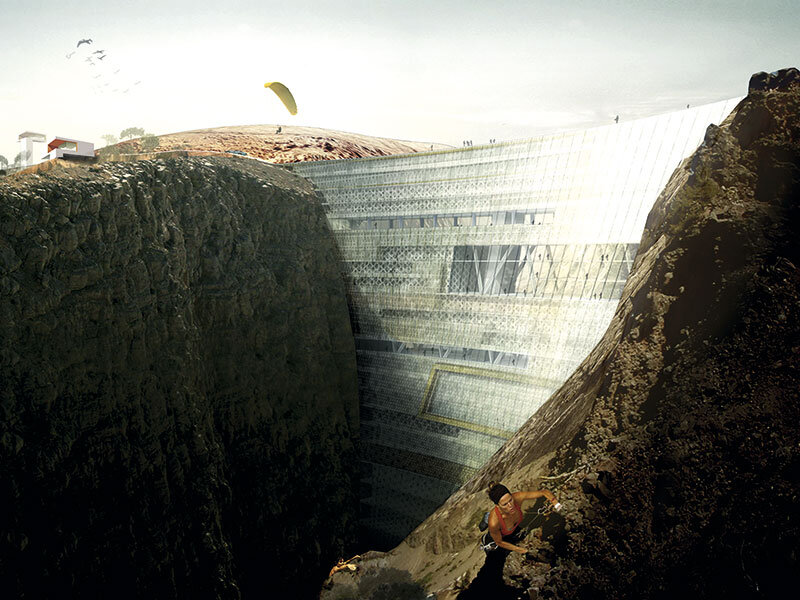
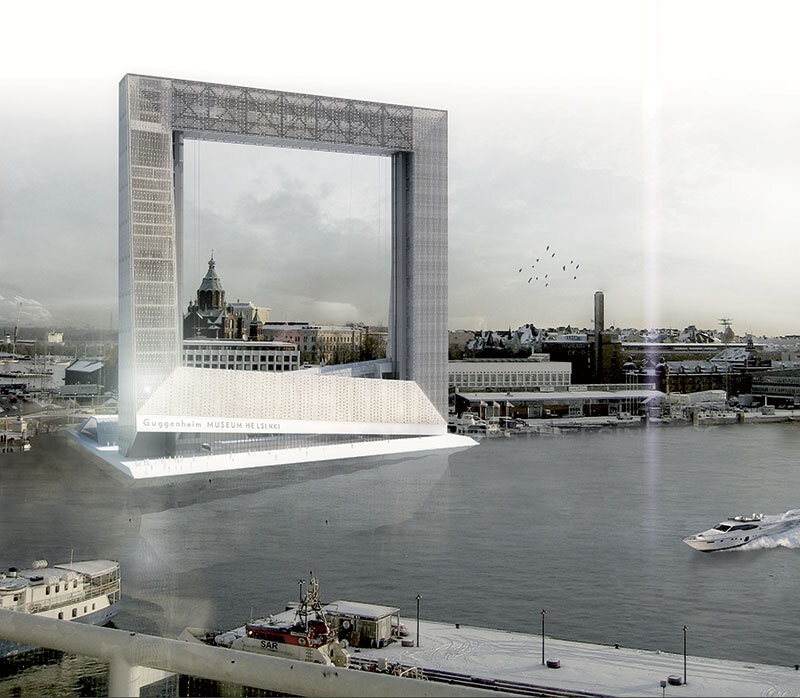
| A REMEMBRANCE Because the new Guggenheim building needs to be visible from anywhere in the city, it needs to be HIGH. In order not to distort the silhouette of the city, while maintaining its perceptive and symbolic capacity, it must be realized in a volume that is SHORT, but... A HIGH and SHORT building is not suited to the museum typology because it leads to a massive fragmentation of the exhibition space.... The building must be ORIENTED, but at the same time non-referential: A PATTERN. The visual link between the Observatory and the Uspensky Cathedral becomes the virtual axis of the project defined by a GOL. Around this GOAL is generated the thin FRAME, later concretized by the specific program Guggen-heim, present in the competition theme. The base of the frame extends horizontally, encompassing the exhibition spaces along double ramps that give fluidity to the museum itinerary. The two side towers contain hybrid functions complementary to the typical museum program. The top levels enclosing the entire system house a large (multi-purpose) "ballroom" and a restaurant, both with a privileged view of the entire harbor. The building thus becomes a precious RAME, which preserves and enhances two of the city's symbols: the Observatory and the Cathedral. The Guggenheim Museum is thus a HIGH, LOW, ORIENTED AND STRAIGHT. It is easily visible from anywhere, both from the sea and from the city, marking its silhouette without obscuring Helsinki's other landmark buildings. |
| A FRAME Since the new Guggenheim had to be visible from all spots it had to be TALL. In order to screen as little as possible from the skyline, its volume had to be SLIM, but... A TALL and SLIM building is not suitable for a museum typology because it produces a high fragmentation of the exhibition spaces ... The building had to be ORIENTED but in the same time non-referential: A SQUARE. A line of sight was chosen between the Tähtitornin-vuori Observatory and the Uspenskin Katedraali - A VOID linking the two buildings, which became a virtual axis of the project. Around this VOID a slim square FRAME is generated and populated by the whole program of the Guggenheim Museum, as presented in the Competition Brief. The base of the frame expands horizontally to accommodate the museum spaces spiraled along a series of double helix ramps. The sides of the frame (two towers) host most of the hybrid program linked to the museum concept. The top of the frame hosts the great ball room (multifunctional hall) and the restaurant overlooking the whole harbour area. Within the frame a precious void which holds two iconic images of the harbour: cathedral and observatory. The building was shaped to be TALL, SLIM, ORIENTED and SQUARE. It is visible in the whole harbour area and beyond, but it doesn't screen any of the existing urban landscape. |
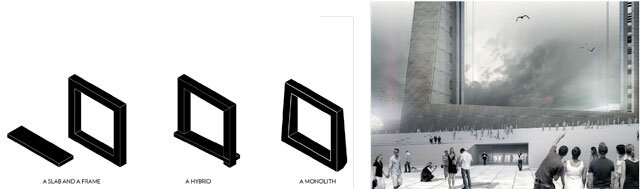
| A MONOLITH The Guggenheim Museum never had the classic characteristics of an ordinary building defined by walls, windows and doors. Starting with Frank Lloyd Wright's sculptural spiral, the Solomon R. Guggenheim Museum in New York, and ending with Frank Gehry's architectural gesture of curved lines and intersecting volumes, both buildings become non-referential sculptures within the city. In the same sense, RAMA is to become a strange apparition, an object thrown into the middle of the South Harbor, virtually linking and framing symbolic buildings of the city. The Guggenheim Museum Helsinki thus becomes autonomous, non-referential, yet defined by subtle citations. The MONOLITIC entity is taken from Stanley Kubrick's masterpiece 2001: A Space Odyssey. The straight lines and sharp angles recall the architectural vocabulary of Alvar Aalto. Black and white are hallmarks of Finnish design. The building's simultaneous reverence for the two defining elements of the city, the natural element and the architecture, defines the condition and position of the building within the site, on the boundary between water and land. The deformation of the urban square, which precedes the Guggenheim Museum, seems to be generated by the energy with which the alien RAMA hit the ground. Under its broad steps, the square is given space for artists and cultural events. It becomes the centerpiece of the museum, creating an image of massiveness and heightening the effect of surprise. Once up the steps, the massive RAMA seems to float above the water. The MONOLITH is now perceived in an unstable equilibrium on the border between water and land. The material chosen is white natural stone, which covers the entire façade like a lace. The side facades, which take the shape of a sail, rise solitarily above the water. The opaque, glazed surfaces are hidden behind the tracery, revealing their materiality only at night, when the mysterious interior spaces are illuminated. |
| A MONOLITH The Guggenheim Museum never embraced the appearance of a regular building made of walls, windows and doors. From the sculptural spirals of Frank Lloyd Wright's New York Solomon R. Guggenheim Museum to the folds of Gehry's Bilbao Museum the architecture is sculptural and non-referenced to the context. The FRAME should have the appearance of an estranged object, which was dropped in the middle of the South Harbour and came to a rest polarized on the axis linking the two existing icons. The Guggenheim Museum Helsinki is autonomous, non-referenced, but is also permeated by subtle quotations. The MONOLITH appearance is borrowed from Stanley Kubrick's representation of the alien object of in 2001: A Space Odyssey. The straight lines and sharp angles recall Aalto's architectural vocabulary. The black and white is a Finnish Design Trademark. Finally the reversed bending of the two towers marks the split condition of the site: on the thin line between water and land. The bending of the square in front of the new Guggenheim Museum seems generated by the energy with which the alien FRAME hit the ground. Underneath the steps of the Plaza, spaces for artists and cultural events are hosted. The bend also hides the glazed foyer of the Museum from the Skatuddskajen creating an illusion of great massiveness and generates the effect of surprise. When the top of the steps is reached, the massive FRAME seems to be floating above the waters of the port. The heavy MONOLITH appears to be in an unstable balance on the limit of the waterfront. The material is natural white stone perforated along the façades facing the water and the land. The profile which takes the shape of a slim sail rises blind from the water of the port. Glazed or opaque surfaces are hidden beyond the stone triforium revealing their materiality only at night when the mysterious interior spaces are illuminated. |
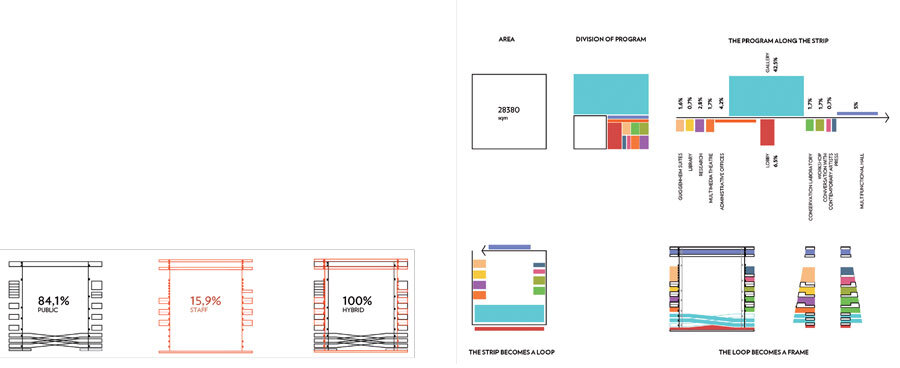
| A NEW TYPE OF MUSEUM As mentioned in the competition theme, the program of the Guggenheim Museum Helsinki is atypical, this time not for art but for architecture and design. In addition, the program must be hybrid, combining conventional museum spaces with complementary spaces designed to attract a large number of visitors, who this time will be in direct contact with the art world. Courses and workshops will take place in the new cultural environment, transforming the museum from a large, austere exhibition space into a place where the two worlds of artists and visitors merge. Chosen to be located in the European Design Capital 2012, the new Guggenheim establishes a relationship with the fascinating world of fashion, high society, materialized in the new building through representational spaces such as the multipurpose room on the top floor, a grand ballroom or fashion catwalk, a Michelin Restaurant with a panoramic view of the entire harbor. The project shows concern for the museum's special guests by offering them hotel rooms and suites located in the north tower, on the top levels facing the water. Due to this functional variety that defines the image of the new Guggenheim, the program has been divided into distinct zones, located according to the needs of each function. At the base of the frame are the exhibition spaces defined by wide, zenith-lit ramps reminiscent of the concept of the first Guggenheim (Frank Lloyd Wright's building), specific to the Scandinavian architecture of Alvar Aalto. The suspended plaza above the ramps becomes the museum's panoramic deck, defined by the two towers that border it. These house the workshop rooms, the administrative offices, the hotel and the library leading to the top floors for the restaurant and multi-purpose hall, the whole system defining RAMA. |
| A NEW MUSEUM TYPOLOGY As stated in the Competition Brief, the program for the Guggenheim Museum in Helsinki was not typical, since it was not destined primarily to art, but to architecture and design. Moreover, the program had to be hybrid, including more than the conventional spaces and activities usually related to a museum, in order to attract a numerous visiting audience and to allow them direct contact with the artists. Workshops and masterclasses were program-med to take place in this new cultural environment, transforming the museum from a mere exhibition space to an educational "melting pot". As the new Guggenheim was to be situated in one of the European Capitals of Design, a relation-ship between this new icon and the glamorous world of fashion and high society was to be materialized in representational spaces like a multifunctional hall which could be morphed into a ball room or a catwalk, and a Michelin Restaurant overlooking the port area. Finally for special guests a small hotel of 7 rooms and 2 apartments was created within the seaside tower. Due to this variety in the activities linked to the image of the New Guggenheim Museum, the program was split in distinct parts, coordinated with the surface and shape requirements of each function. The base was destined to the exhibition spaces situated along a continuous system of spiraling ramps recalling to memory the first concept of a Guggenheim (the Frank Lloyd Wright Building), illuminated by a skylight and zenithal light, another trademark of the Great Finnish Architect Alvar Aalto. The terrace above the ramps became the pano-ramic deck of the museum, the towers hosted workshop spaces, offices, hotel and library and the top bridge closing the frame was designed as a great hall and restaurant. |
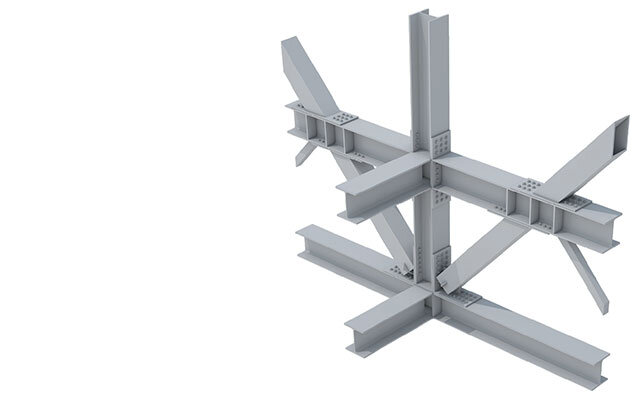
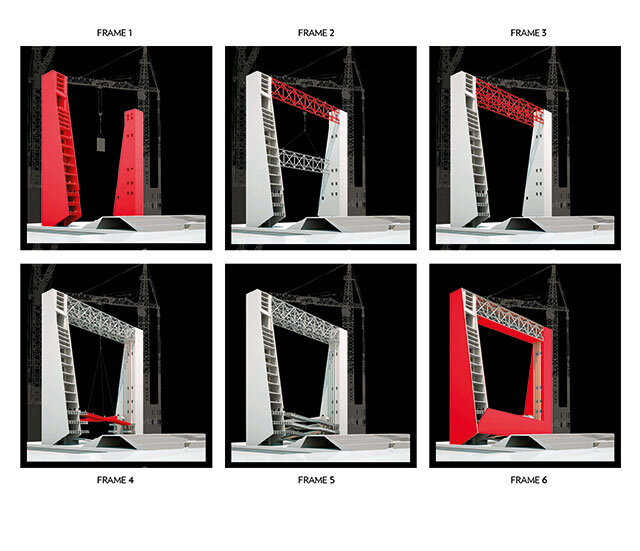
| A FLOATING STRUCTURE The RAMA must meet two contradictory conditions: it must be HEAVY and LIGHT at the same time. The structure has to be visible, covering the whole shape of the building, but at the same time dematerialized in such a way that it gives the building the image of a frame floating above the square and the water. The principle is quite simple: two concrete towers touching the ground at two points and leaning towards both land and water, supported by a cantilever 16 m long; a series of ramps, accompanied by longitudinal ribs, placed between the two towers, floating above the foyer and strongly anchored at the ends to their structure; a large lattice girder at the top level also supported by the two towers; a coffered ceiling designed to allow large openings without intermediate support. The structural walls of the towers are perforated punctually at the accesses to the panoramic elevators, as well as in the museum area, to allow the public to flow to exhibitions, conferences, etc. The overall effect is that of a large-scale effort supported by the longitudinal elements, a structure on the verge of instability, A PLUNGING STRUCTURE. a RAM, a MONOLITH, a FLOATING STRUCTURE... |
| FLOATING STRUCTURE The FRAME had to appear HEAVY and LIGHT in the same time. The structure had to be visible, embracing the whole shape of the building, but also dematerialized to the point that the building should appear to be floating above the Plaza and the water of the port. The principle is quite simple: two concrete towers which touch the ground in two points and bend towards sea and land in a 16 meter cantilever; a series of concrete ramps with longitudinal beams between the bases of the towers, above the foyer which are anchored at the ends and supported by the bended wall linking the towers with no intermediate structure; a steel beam on top supported by the two towers; rib ceilings for high spans and no columns. The load bearing walls of the towers, suffer only minimal, punctual perforations along the accesses of the panoramic elevators and at the museum levels, where the exhibition continues in the tower rooms. The general effect is that of a huge effort in the longitudinal elements, a structure designed on the limit of instability, a FLOATING STRUCTURE. |