70-300

project author: Adelina Ioana Popescu
supervisor: prof.dr.dr.arh. Dorin Ștefan
supervisor: iprof.eng. Adrian Iordăchescu
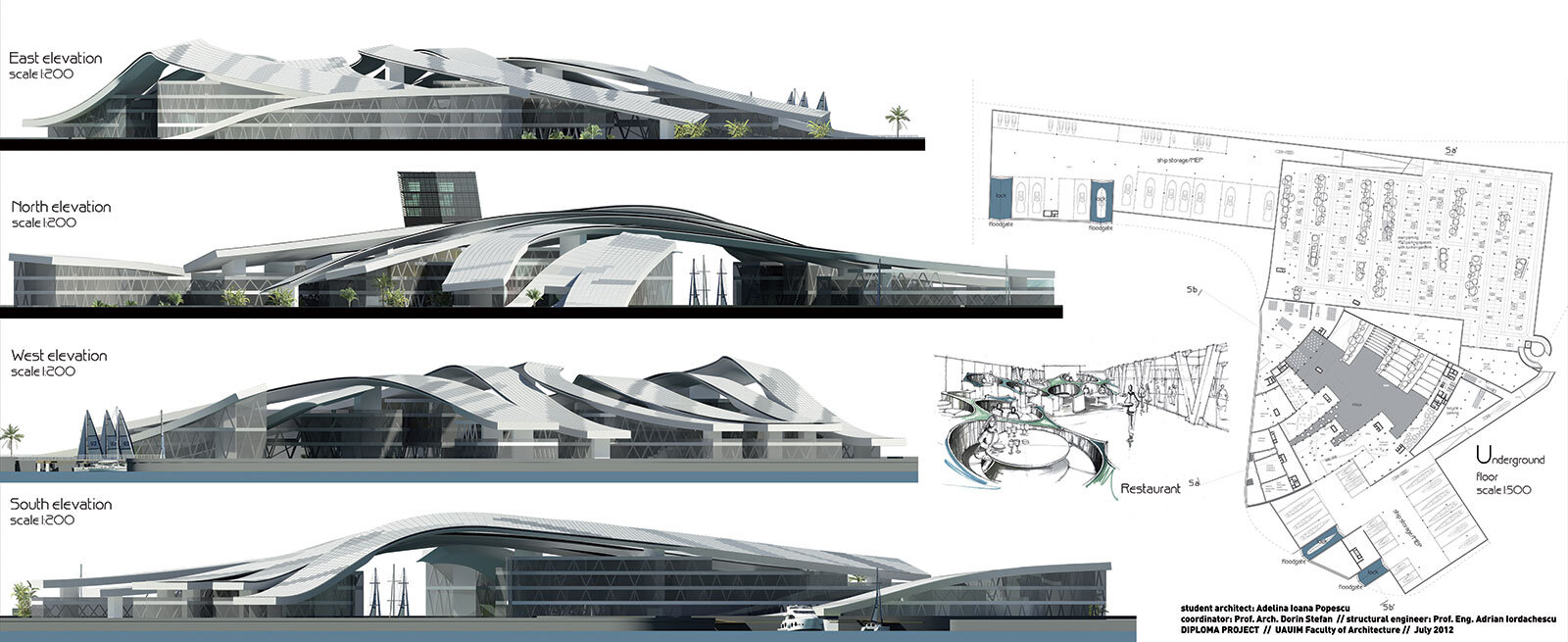
The project I propose is based in Lisbon, Portugal. Having had the opportunity to interact with the city for a long time (one year Erasmus program + internship in an architectural office) I felt close to the city's waterfront issues. I chose a site that reflected my attachment to the area and my passion for maritime activity. This work has helped me to delve deeper and better understand what a waterfront intervention means.
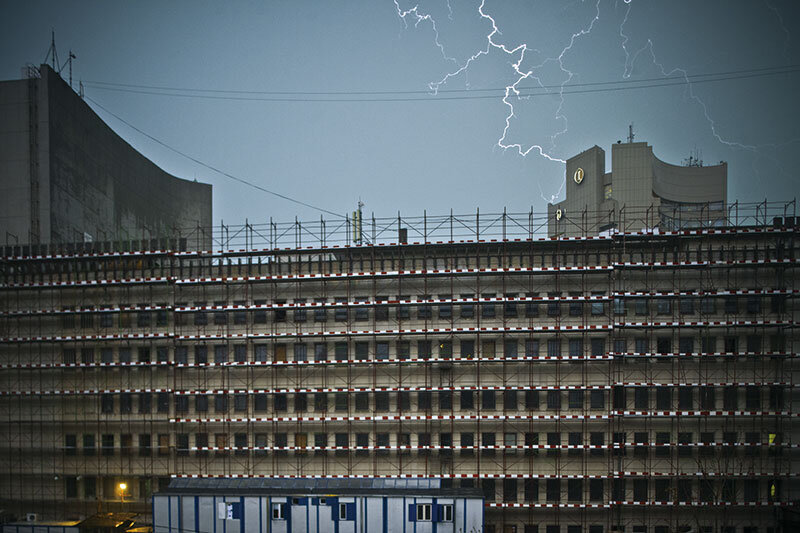
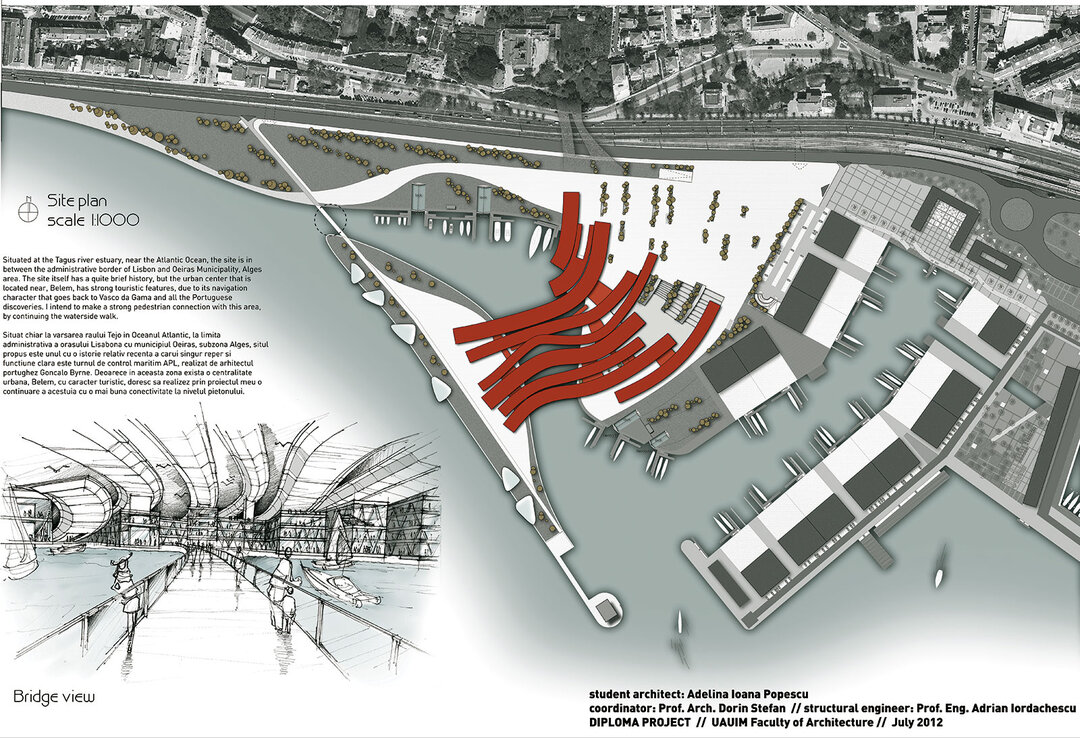
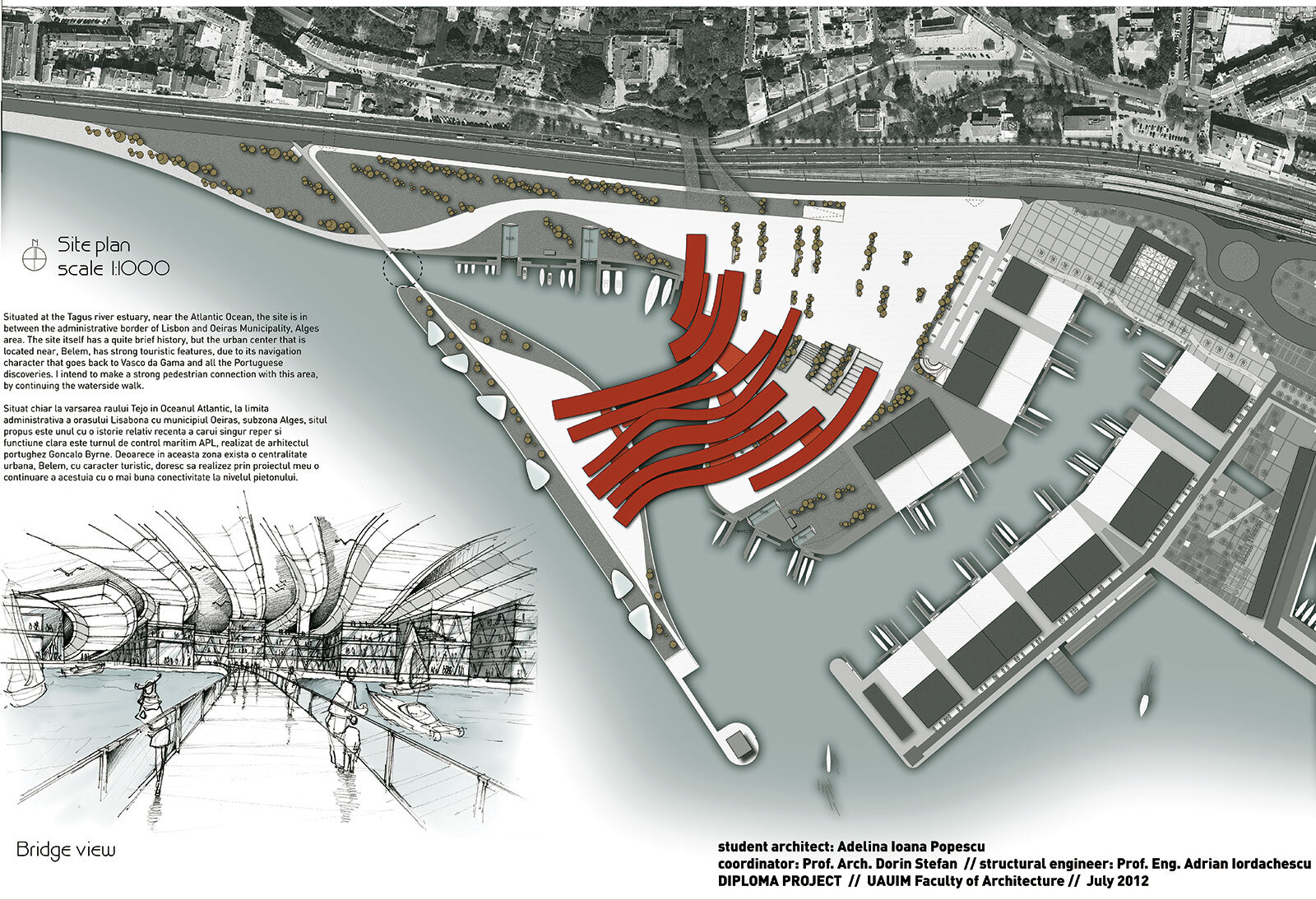
Situated right at the mouth of the Tagus River into the Atlantic Ocean, on the administrative boundary of Lisbon and Oeiras municipality, Alges sub-area, the proposed site is one with a relatively short history. Its only clear landmark and function is the maritime control tower A.P.L. The building is by the Portuguese architect Goncalo Byrne. In this area there is an urban but tourist-oriented centrality (Lisbon has three such centers on the waterfront from east to west: the Expo '98 or Oriente, the old center or Baixa and Belem - my site is next to the last one). I want to realize through my project a continuation of this through better pedestrian connectivity.
The program I propose is a mixed one - naval center of advanced design. The Lisbon waterfront research project leads to a beneficial function to activate the area. It will bring together the functions of both a yacht club and a naval design institute with design part and a design school. Here it will be possible to test and assemble prototypes and it will represent, nationally and even internationally, an important meeting point for the naval design industry, with exhibitions and demonstrations of particular importance (this would be the only one of its kind in Portugal, the country of the great explorers, and therefore with a tradition in this field). This function is welcome because of the proposed nearby yacht harbor and the site's predilection for international yachting competitions, but above all because of its unique location.
The naval center will be a meeting point for both sports enthusiasts and yacht design enthusiasts, even becoming a tourist attraction.
With the demolition of the old docks at Docapesca, I will consider using a 2007 P.U.Z. proposal, drawn up on the occasion of the America's Cup sailing competition (with the amendment to adapt to the new conditions: the construction of the Champalimaud center, for example), and an urban activation function will be proposed on the area discussed above.
The 2007 Masterplan envisages a luxury housing development, a business center, a marina for yachts, public promenade areas and other ancillary functions.
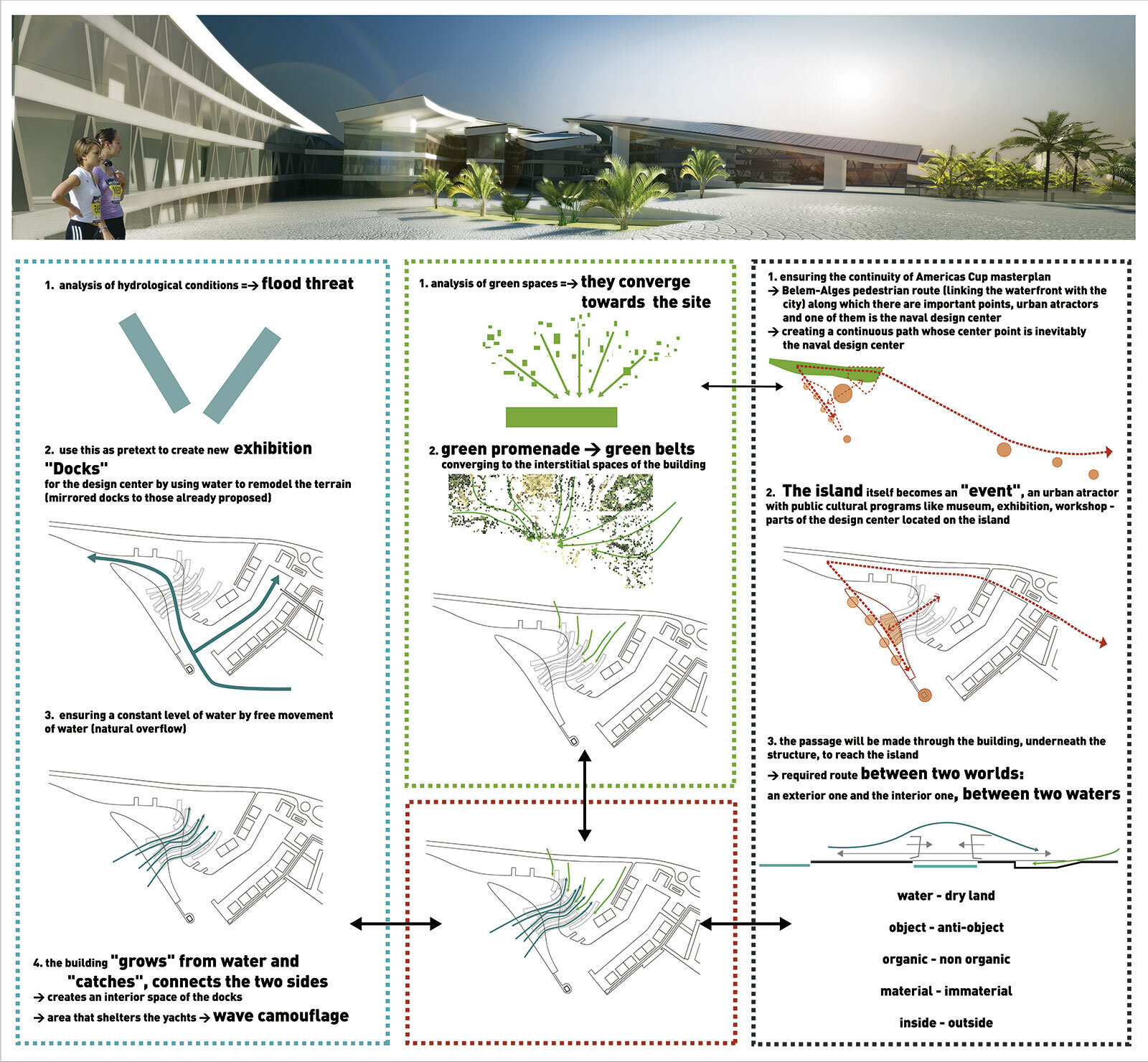
According to studies by the municipality, the site may be flood-prone and is under pressure from underground springs, old watercourses that are currently not adequately controlled.
The land is not currently diked to the full extent necessary. I therefore propose to solve these land problems in direct relation to the design of the proposed building.
The central concept is flexibility. This has led me to look at the needs of the site from a loose perspective, where the end goal outlines the solution to solving a problem. So, with San Francisco as a model - where the land, piers, and pontoons are being remodeled to serve new equipment and a more advantageous configuration - I also treated the shoreline as an easily modeled element.
Taking into account the geologic and hydrologic situation that threatened the land with flooding, I created new exhibition docks, cutting away the dry land, leaving the water free to circulate and forming a central element, an attractor.
At the same time, the concept of dynamic trajectories discussed in this paper will also underlie the architectural design of the project, being closely related to the proposed program.
The form of the building derives from the water, "grows" out of the water and "catches", connects, the two shores, resulting in an interior dock space, a shelter space for yachts, camouflage for waves.
The analysis of the green spaces revealed that they converge towards the site. From this, the landscaping of the green promenade in front of the building is outlined, which consists of green strips, converging to the interstitial spaces of the building.
My project will ensure the continuity of the America's Cup master plan, forming a pedestrian walkway that connects to the city and along which are important landmarks, of which the design center is one. The island formed from the flooding and formation of the new exhibition docks becomes in itself an event, an urban attractor with cultural public functions (museum, expo, workshop - parts of the design center located here). The passage from one bank to the other will be "through" the building, under the structure thanks to an obligatory path between two worlds: an exterior one and an interior one between two waters.
Overall, the project creates an ambiguity between water and land, object - non-object, organic - non-organic, material - immaterial, interior - exterior, an ambiguity that I spoke about at the beginning of this work and that characterizes the shore itself.