

70-300

Restoration of the 19th century blast furnace
project author: Dan Cioclu
supervisor: prof.dr.dr.arh. Ștefan Bâlici
supervisor: eng. Anton Ionescu
From the 19th century industrial complex of Govăjdia there are still a few ruins, which offer a complete, but not instantaneous, reading of the whole story of this place. Ever since the earliest historical records, Govăjdia's past has been closely linked to ironworking. Craft workshops have been attested for more than 500 years.
This tradition of blacksmithing culminated in the activity of the 19th century furnace. We thus bear witness to processes which formed a community and continued to sustain it for more than a century. They have visibly, but not irretrievably, marked the natural setting and consolidated the identity of this place.
A reading, not necessarily in-depth but certainly sensitive, will highlight two major values that any intervention must assume. The first is the historical, architectural and documentary value. In this case, the blast furnace and the ruins which bear witness to a way of life based on iron working. The second is the value of the natural setting. Both values are sufficiently strong and present (in different ways) that repressing or ignoring one of them must be considered inadmissible.
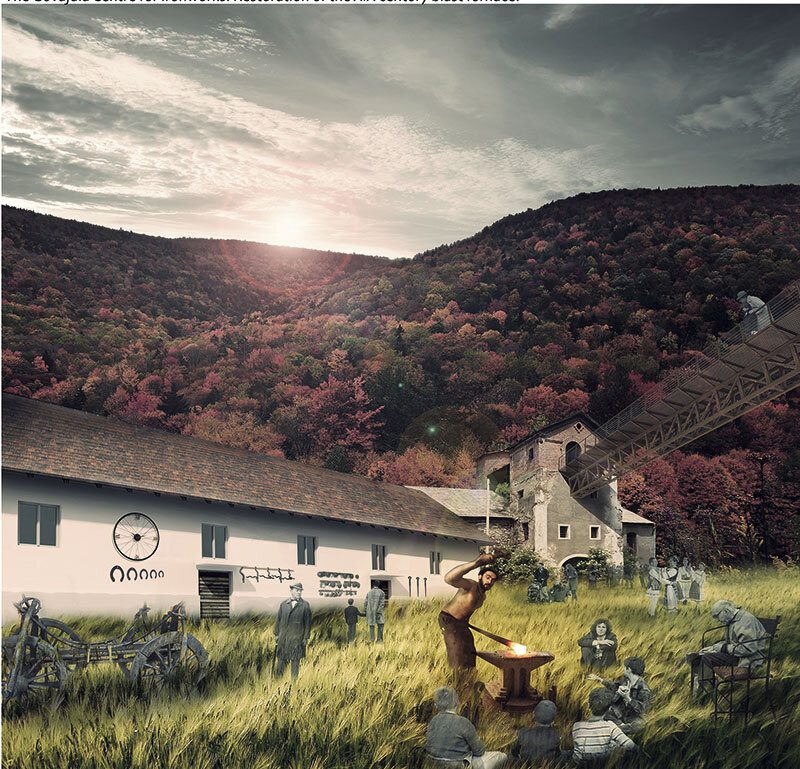
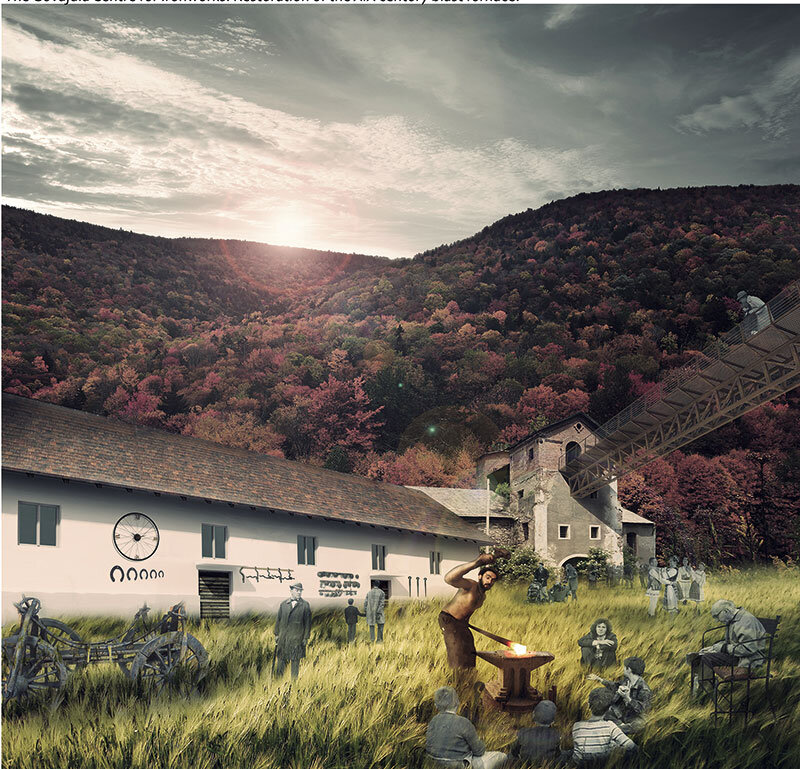
The proposed solution focuses on the dialogue between the industrial heritage and the landscape, more specifically on the valorization and materialization of this link at the level of an ensemble as a living testimony of the craft/industrial past. The intervention aims to subordinate itself to the natural setting and to relate to the architectural-industrial specificity of the area, outlining the image of the once existing industrial landscape. The project attempts to restore the balance between the industrial heritage and the landscape by proposing a center of iron technology. This program, although vague in name, allows for the integration of flexible and complementary functions that allow the industrial site and its surroundings to be exploited on several levels.
The proposedfunctions include an exhibition, demonstration and commemorative space inside the blast furnace. It evokes the metallurgical past. It is useful and necessary to set up an iron-working workshop that actively and permanently involves the community. The training of resident craftsmen will ensure constant production and the resumption of traditional activities in the area. An essential function of this center is educational. The knowledge of the past and practices of this place requires theoretical and practical activities of long or short duration. There are spaces for lectures, presentations and practical activities. The accommodation facilities capitalize on the tourism potential of the area and lead to a better understanding of the relationship between the industrial site and the landscape.
The economic and social context specific to the small rural locality of Govăjdia is that of a settlement in (economic) decline as a result of deindustrialization and the outsourcing of production facilities. The furnace, symbol of the locality, still retains its representativeness due to its historical value, and not as a starting point for economic development and activities in the area. In this sense, the present project proposes the development of a series of complementary spaces and functions, subordinated to the main aim of the iron centre, aiming to achieve a state of economic self-sufficiency through the development of tourism (industrial and other) and the polarization of the life and social activities of the surrounding villages.
The tools for the implementation of this project resulted from the particular needs of the existing buildings on the site and the spaces to be accommodated.
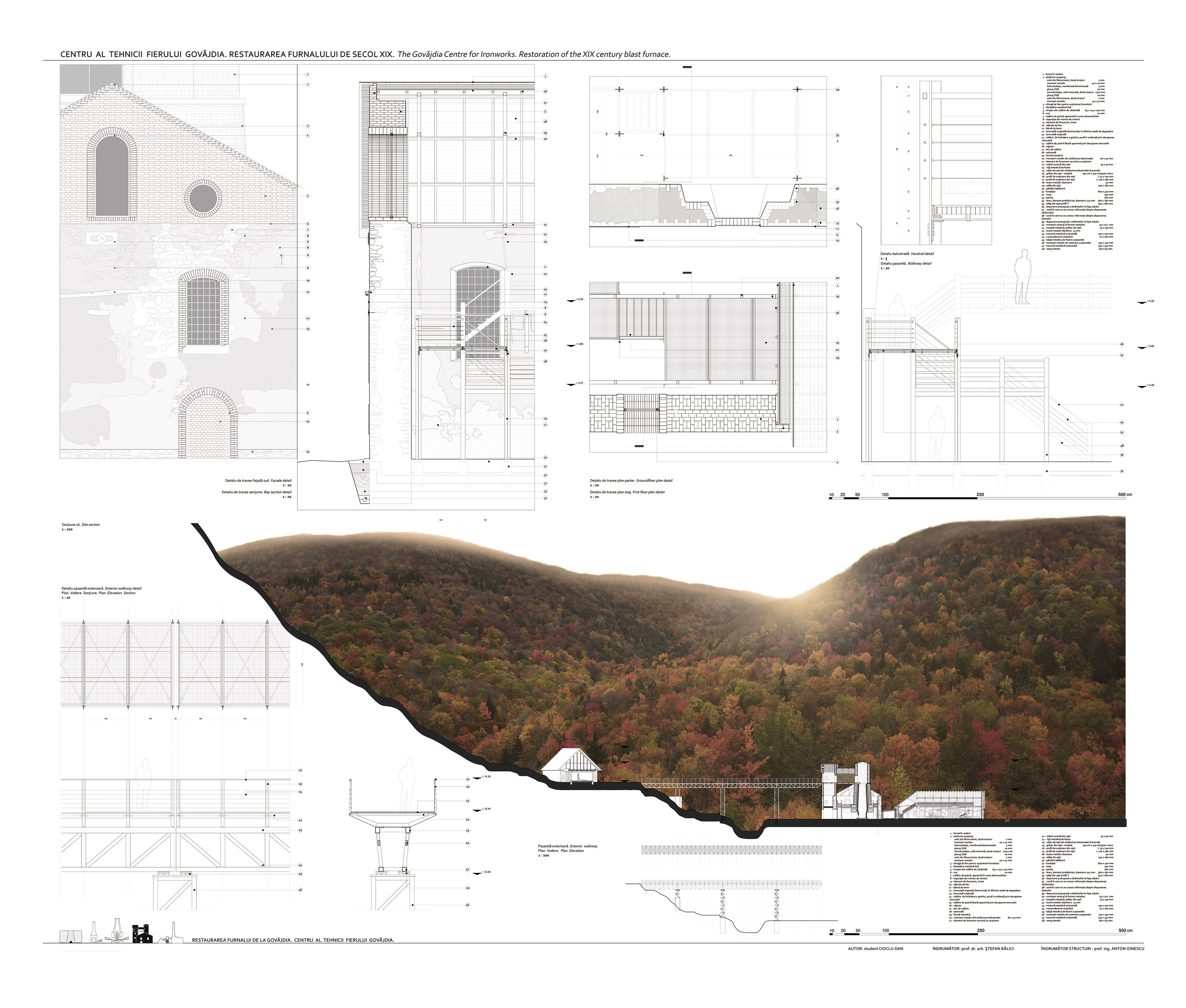
The first of these tools - and a first step in the realization of this project - is the restoration of the Govăjdia fur-nal. Its status as a historical monument requires its protection and preservation. Thus, the aim of this intervention is not to reproduce a faithful image of the blast furnace of a century ago, but to preserve and highlight the different stages of its evolution.
A second tool is the reinterpretation of the ruins of the former production and storage areas. This intervention aims to volumetrically complete the nineteenth-century ansam-bl, while allowing freedom in the spatial and functional configuration of the new buildings.
A third stage and a third intervention tool is the realization of elements linking and articulating the previously reconstructed spaces. It is proposed to create three volumes tangential to the body of the blast furnace, allowing communication with the neighboring spaces of the blacksmith's workshop and the exhibition space, and also including the ancillary functions necessary for a museum space. The link between the activities area and the accommodation area will be created by a metal walkway, and the interior of the blast furnace will be restructured by a system of platforms and walkways made of light metal structures.
A final intervention, small in terms of investment but important in terms of social (and therefore economic) impact, is the development of activity areas, such as a rural or craft fairs, a sports or cultural activities area and a natural amphitheater. These generate a complex of complementary activities to the Iron Center ensemble.
Conclusions
The existing ruins are being utilized by reinterpreting the original production, storage or administrative spaces. They are remodeled so that they can accommodate new functions and thus a new cycle of activities. Through this architectural intervention, the honoring of the historical testimony of the site and the value of the natural setting is based on the construction of a new industrial landscape, faithful to the original one. A purely industrial re-use of these spaces would prove erroneous, as would their museification for conservation purposes. The solution lies in creating an active space in which the industrial function is replaced by a cultural-tourist-educational function. Keeping the craftsmanship of a craft alive is crucial not only for the preservation of the monument, but also for local culture as a whole.