Seaside. A published chronology

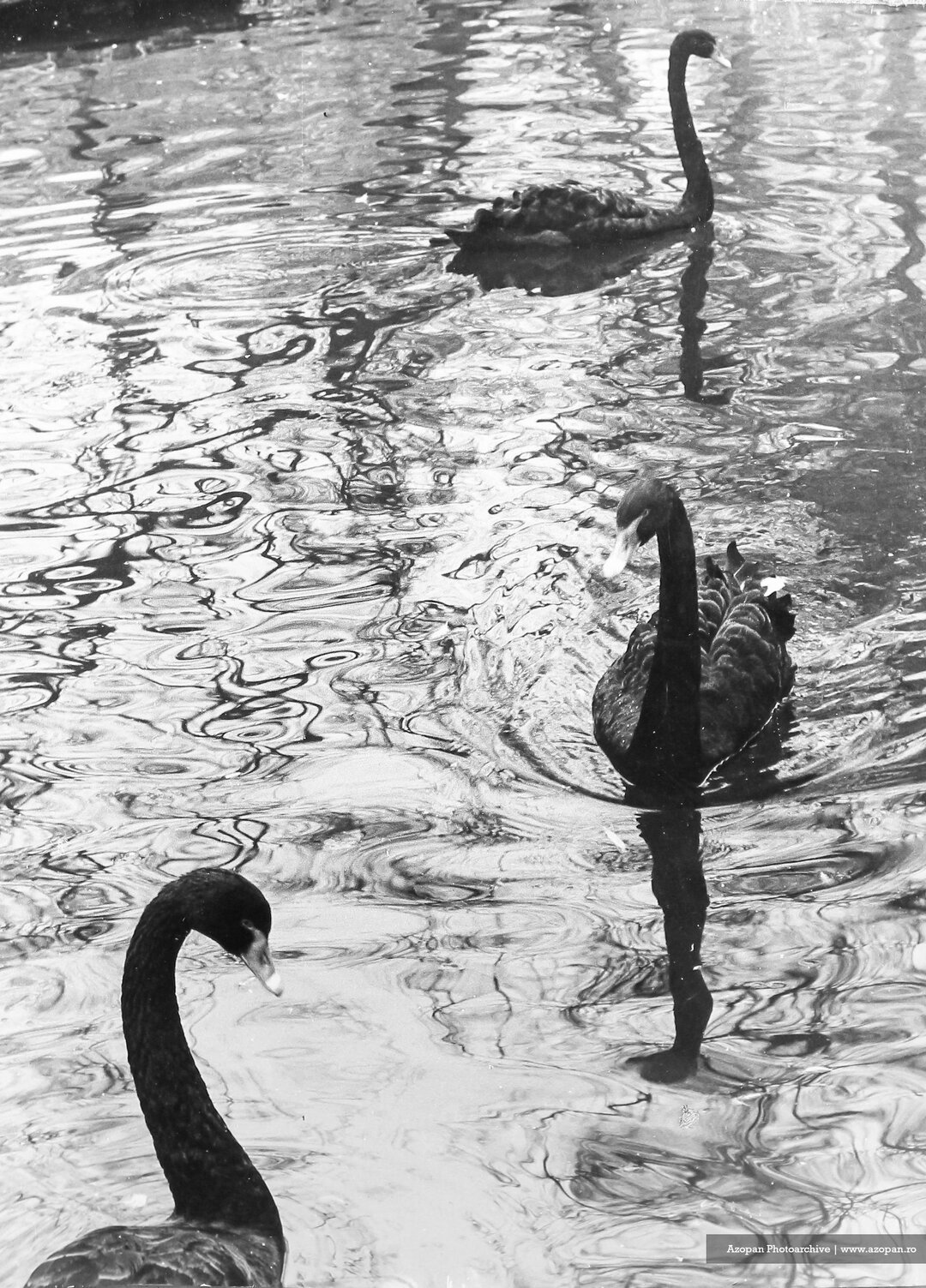
Mangalia: golf with swans
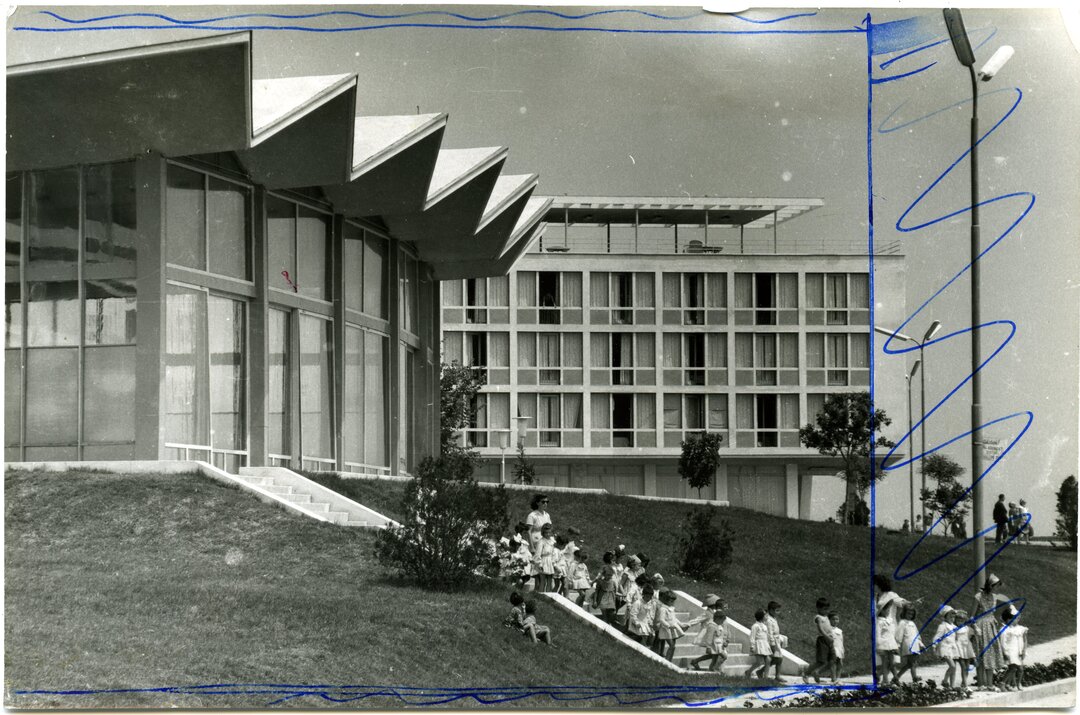
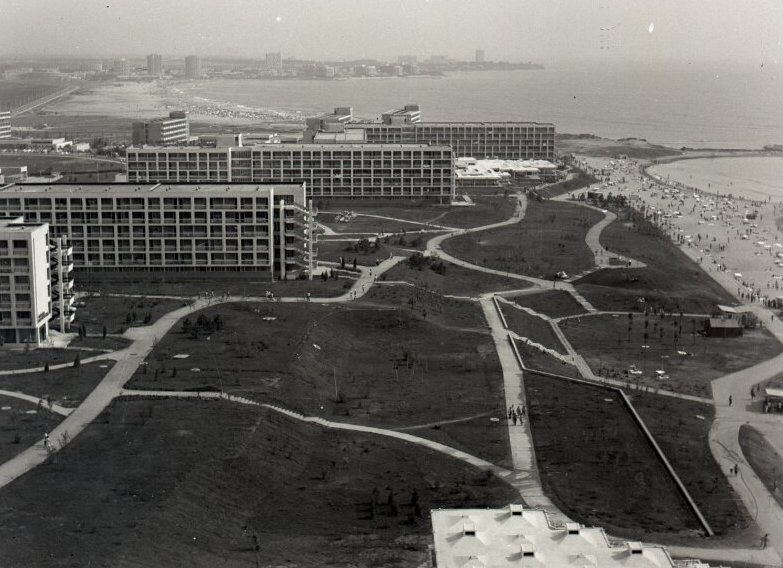
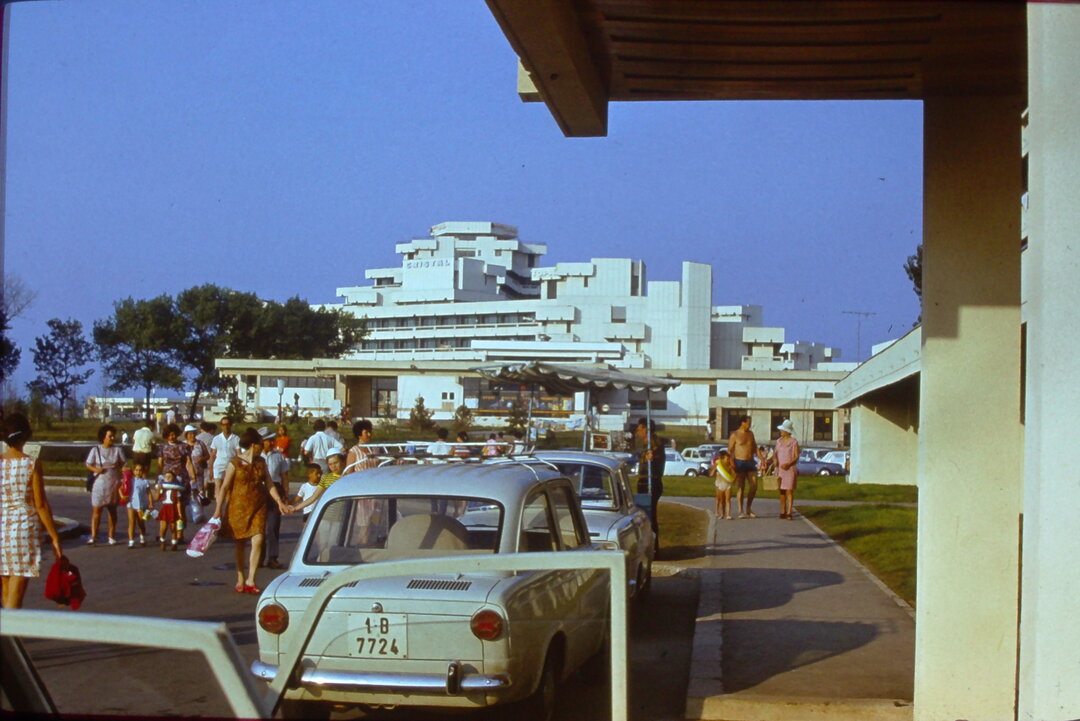
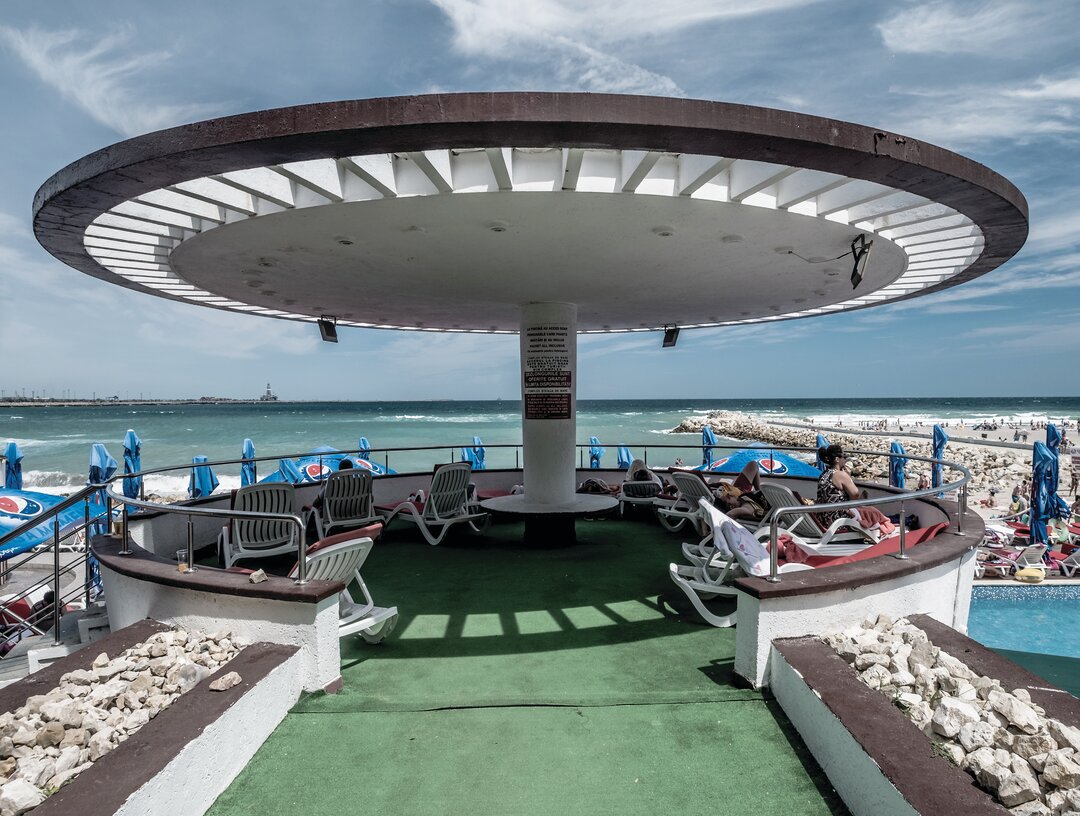
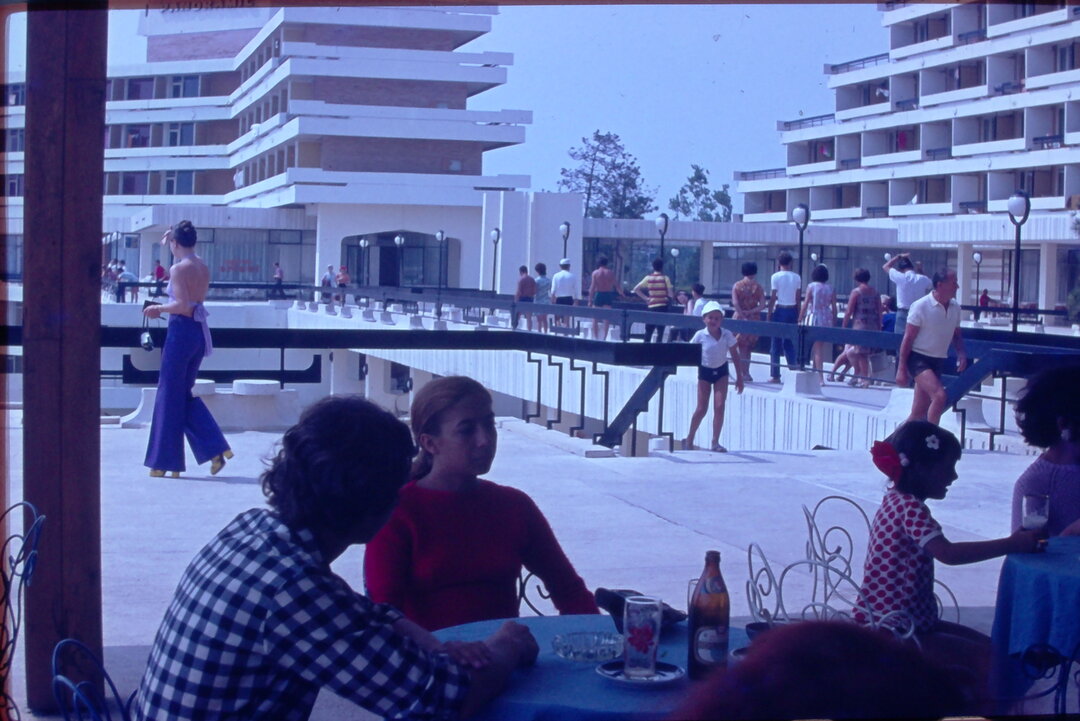
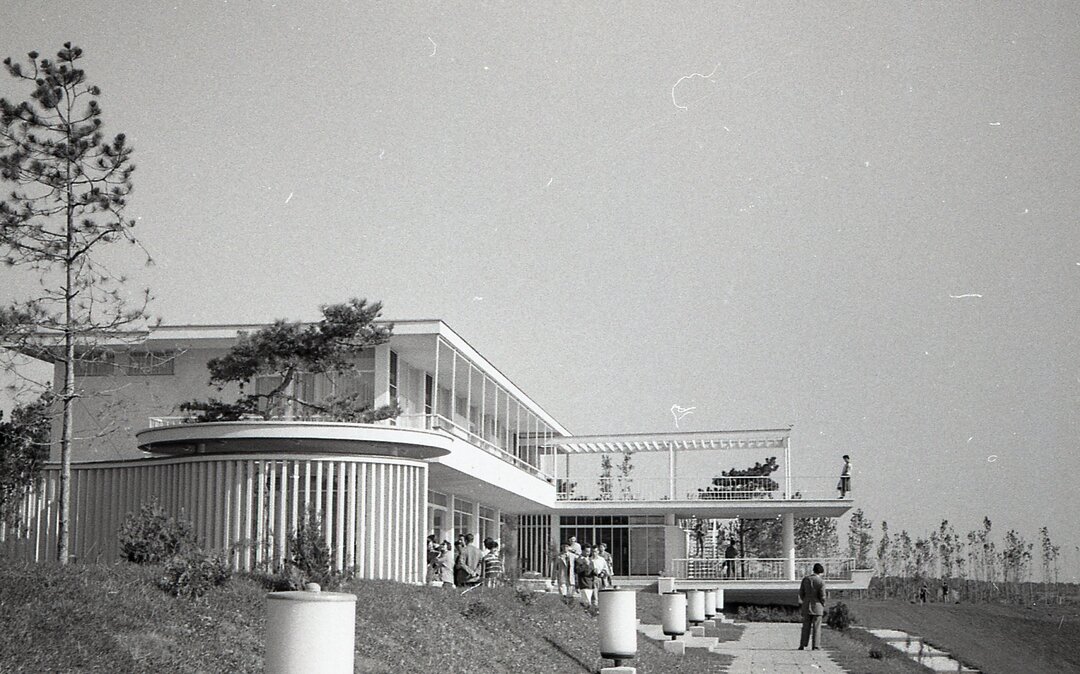
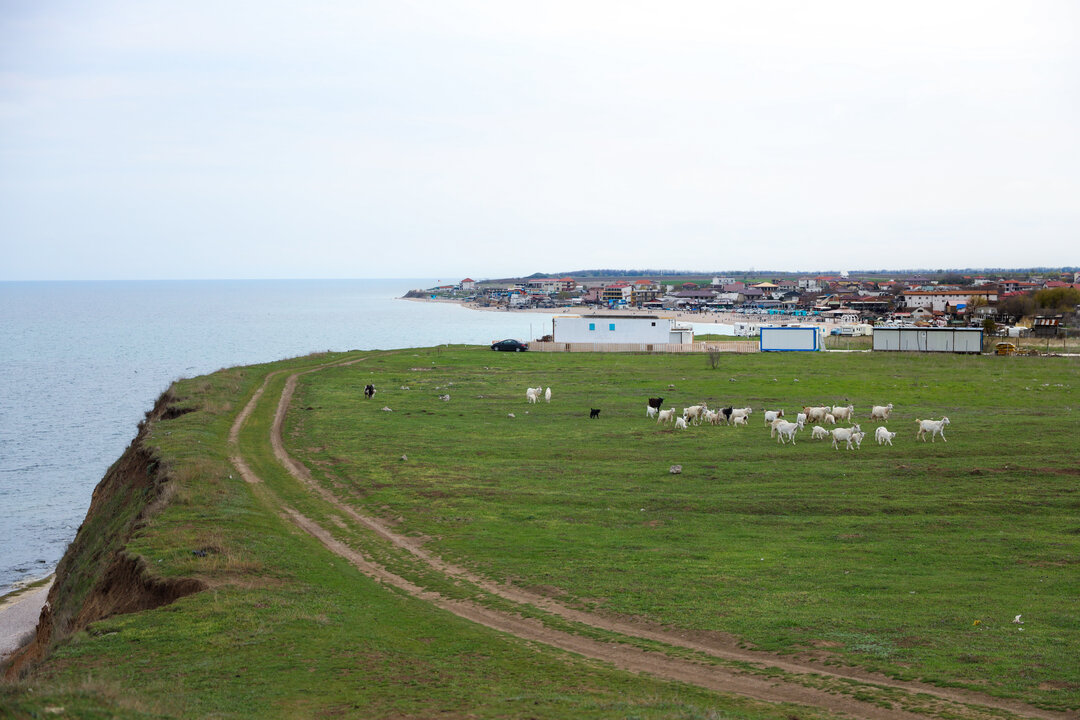
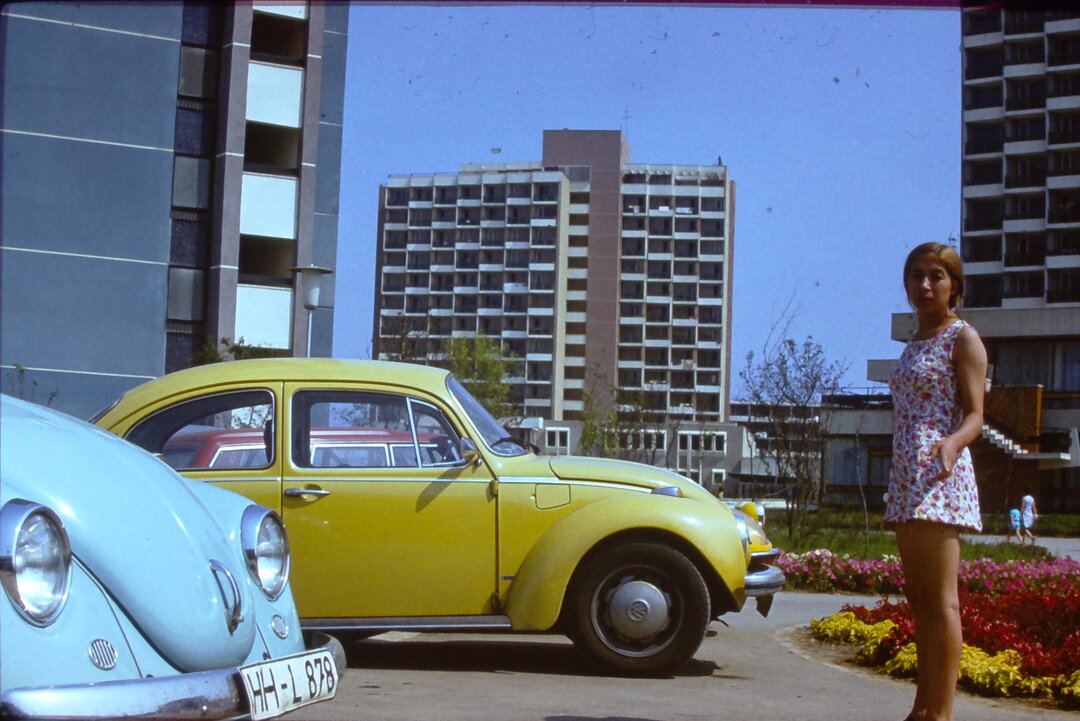
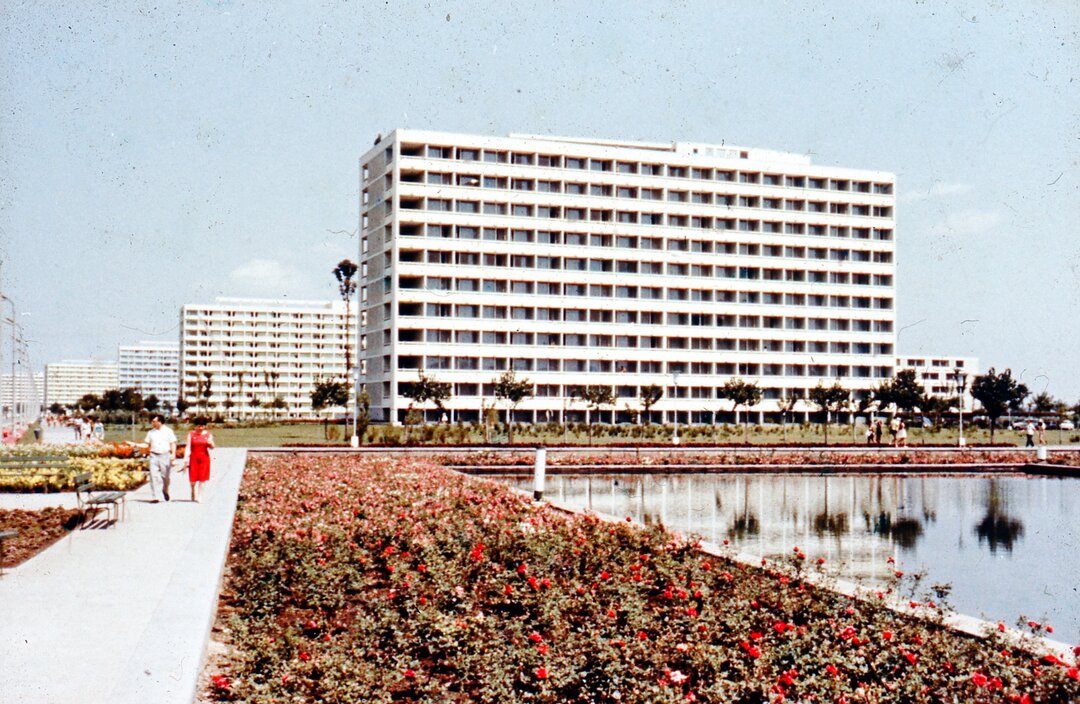
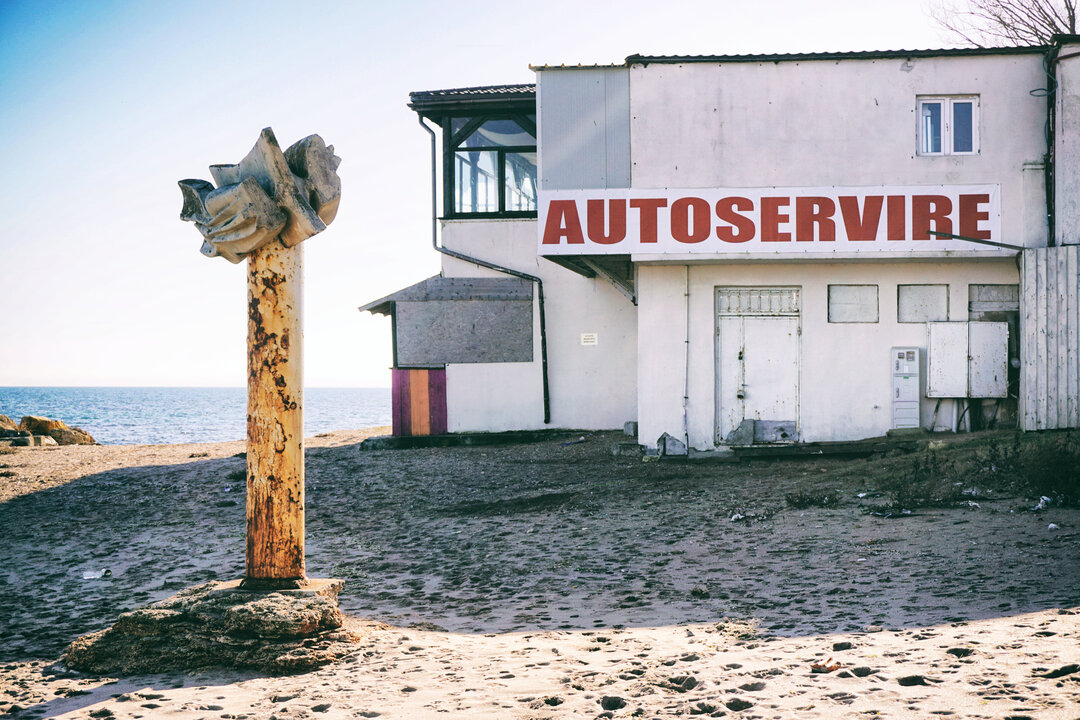
Because of, or thanks to, the program of vouchers to support Romanian tourism, I found myself at the Mangalia Spa Sanatorium, where the doctor sent me to strengthen my spine. I'd only been here in passing, so I decided to revisit the places where the program of terraforming the Romanian coastline started in the second half of the fifties, with Cezar Lăzărescu at the helm. A few villas, the Perla restaurant at Eforie Nord and some of the hotels at Neptun-Olimp, particularly Amfiteatru, still stand the test of more than half a century. See, however, the references and models of the time, see the pressure of communist ideology in urban and architectural conformity. Here you can see the references to Niemeyer's Brasilia, strictly contemporary with the start of the seaside project; but beyond, in the restaurants with hundreds of seats, veritable privately run, unmanageable shit-houses, where signs still remain on the walls indicating the evening meal times, you can also see the mass, working-class tourism.
Not much is left of the old city. The coastal program of hotels on the one side and the Ceausescuist blocks along the main street have squeezed the old town like a vise, suffocating it. Dobrogea's first geamie still survives, and the muezzin has even sung. It's newly restored, with money from Turkey, I presume, given the execrable state of the few historic buildings left standing. Incidentally, the appearance of minarets along the road from Constanța to Mangalia is the most distinctive new sign in contrast to the post-communist squalor.
The disease of a Romanian market town devastated urbanistically under the dictatorship is a freckle and covers most of them, although, you would say, the seaside should be an opportunity. It's not, the level is still the same as it was in the nineties, with poor kiosks and seasonal changes, with restaurants with no menu displayed at the entrance, about which you don't know what to believe, as the name doesn't help... Timidly, there are a few good signs, such as a Tatar pastry shop, with all kinds of good shuberek and brag, but hidden behind a row of blocks, or a confectioner's with... sweets. Turkish coffee - nowhere, full of coffee vending machines or instant coffee at the hotel.
There's a haze in the air, retirees from the shipyard and the military unit are playing politics at a blackboard in front of the so-called archaeology museum (whose poor architecture, although new, reminds us that between Callatis and Mangalia there is an almost continuous collapse...), young people who haven't left yet are sabotaging the emerging capitalism, preferring to stay on their cell phones' facebook, rather than pay attention to the owner of a summer, on whose privatization they pretend to be working...
Seen from the eastern end of the country, from below the socio-economic average of the capital, but next to a glorious landscape, that of the Black Sea full of white cocaine, our homeland is not seen at all, but not at all well...
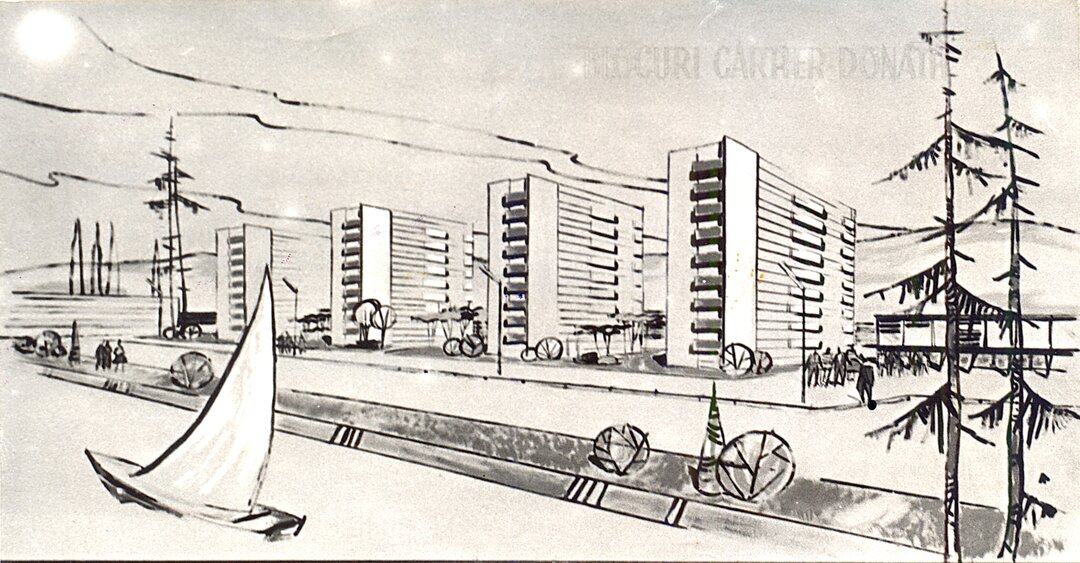
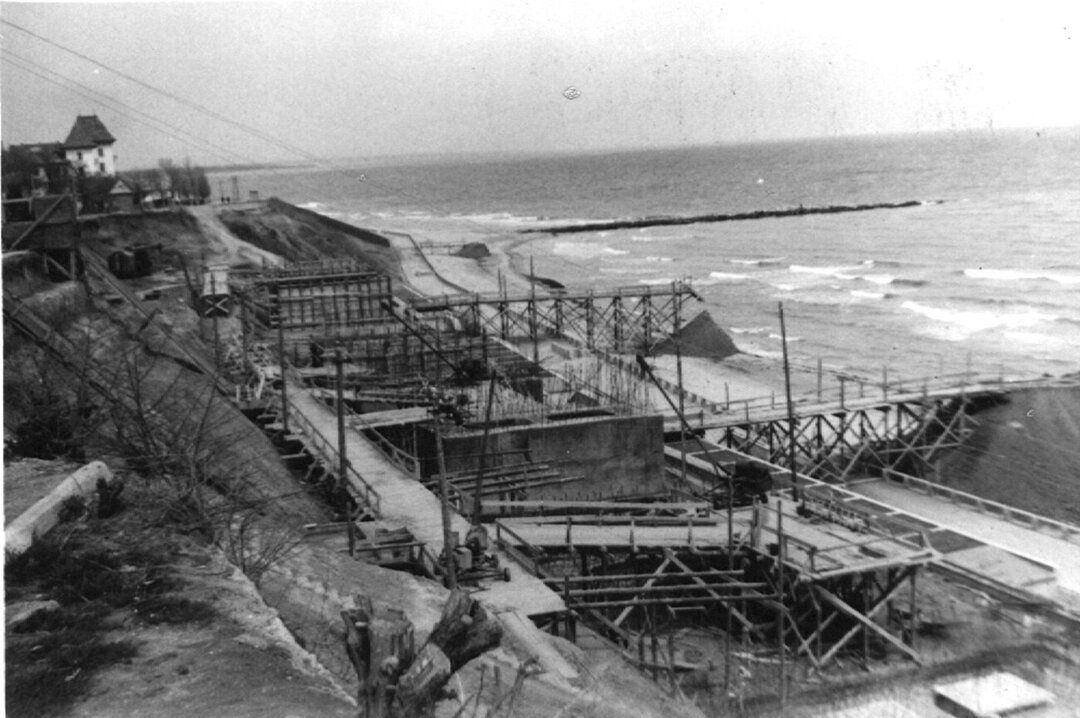
Among the first "meliorist" projects against the "random", "irrational" reality of the communist regime in Romania was the one for the systematization of the Black Sea coastline. There had already been such projects before 1954 for Mamaia, Năvodari, Vasile Roaită. They were coordinated by the same Cezar Lăzărescu and proposed a realist-socialist urbanity, with workers' dwellings on the ground floor, as in Năvodari, where some still survive, severely altered by later interventions.
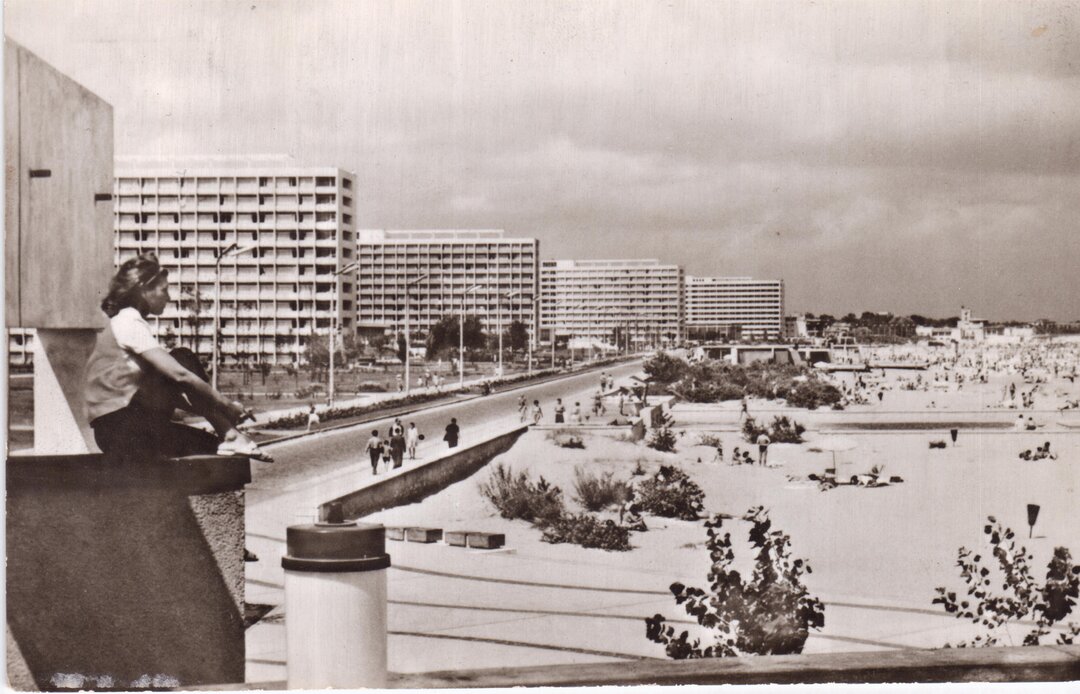
The middle of the sixth decade brought the coastal projects out of their doldrums and gave them momentum, but it was only in the sixties and seventies that they were implemented with vigor, with the entire coastline being 'terraformed'. If in the fifties they started from Năvodari, now they are starting from Mangalia.
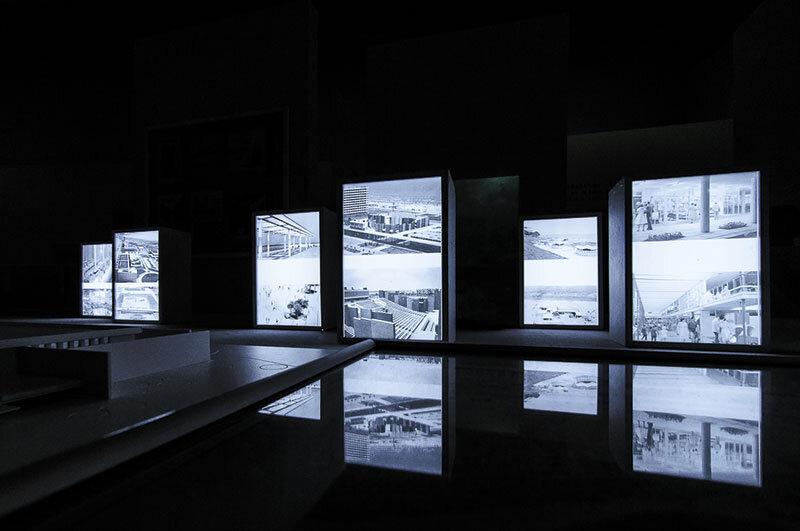
To trace the projects for Năvodari, Eforie, Vasile Roiată, Mangalia and, later, Mamaia is to give an accurate description of all the stages through which Romanian architecture has passed in the years after Stalinism. From the pure realist-socialist perspectives for a Năvodari resulting from the forced labor of political prisoners at the canal and the Bucharest hotel in Mamaia (which could have been signed by any pre-war architect; arch. I. and C. Ghițulescu, A. Corvătescu), on the one hand, to the Perla restaurant (1959), the restaurant-club in Eforie (1957-'58) or the caricatural-Niemeyer-ian restaurant on the Mangalia seafront (1959) - almost contemporary with the architecture of their time - on the other, a radical about-face in the way Cezar Lăzărescu's team and other seaside architects saw architecture is spreading. It is the liberation from formal expression, from rigid symmetries, from classicism unsuited to the function of leisure, to modernism - radical in places - also somewhat unsuited to the picturesque, small-scale image, in harmony with the environment, that the site would have supposed.
Exit strategies from Stalinism
Seaside architecture (which continues as a phenomenon beyond the limits of the period studied here, with projects at Olimp, Neptun, Saturn and Cap Aurora) is perhaps, beyond Bucharest and the civic centers, the most consistent and important phenomenon in the understanding of post-war Romanian architecture; moreover, it also includes some of its most applauded buildings.
Romanian architectural modernism has manifested itself fluctuating, due to the pressure of political power. More specifically, any more relaxed phase was marked by a return to earlier models of autochthonous functionalism: the 1960s saw a return to the architecture of Bauhaus-style austerity and housing and facilities programs and Duiliu Marcu-style power architecture. The same phenomenon occurred in literature, when, after the Socialist Realism phase, the gaze turned back to interwar modernism: Arghezi, Blaga, Barbu, resuming the march of literature from the moment of the fracture; this was, in essence, a gesture of frond and of reestablishing the bonds of normality as if this stage, Stalinism, should effectively be forgotten. While it is clear that the first tendency after the discourse was to 'look back' to overcome the fault line induced by socialist realism in East European architectural discourse, the sources of this 'retrospectivism' varied from country to country. Romania swung for a while within that dual 'purified classicism/classicizing modernism'. This was the famous "Carol II Style" (see the article of the same name by I. D. Enescu in Arhitectura 2/1939, pp. 4-5). Its promoters were inspired by Italian "fascist" architecture (Piacentini, Michelucci, Libera, Terragni), not least for ideological reasons: the Romanians were also a Latin people; their original identity had to be marked through architecture. Architects such as Duiliu Marcu and Tiberiu Ricci, who were active in the design of buildings of pre-war power, were able to work even after the relatively brief Stalinist interlude. Marcu was even the president of the new Union of Architects, which was set up following the decree of November 13, 1952 of the CC of the PMR. Recall that the decree of April 23, 1932 had similar effects in the USSR. Ricci, apparently the author of some of the works in Duiliu Marcu's studio, designed the Radio House and Hall (Nuferilor Street / General Berthelot) after the war in almost the same way as the Marcu studio had built the Regia Monopolurilor before the war. The Palace Hall (an addition to the Royal Palace) was reminiscent of Marcu's classicizing "palaces" on Victoriei Square, but is more indebted to the functionalist language than the interwar models, while the apartment blocks on the perimeter of the new "Palace" square recall the severe Bauhaus aesthetic. A prime example of this "classicizing modernism" is the Romarta Copiilor block, a residential and commercial building opposite the Central Army House. In 1954, a competition was held to design the square in front of the CCA and the perimeter facades. Project No. 18 won second place (architects Al Zamfiropol, Al. Hempel and collective). All projects awarded or mentioned were clearly indebted to Soviet Socialist-Realist architecture. However, the building that was nonetheless erected - symmetrical in composition, with pilasters on the ground floor running the full length of the building - belongs to the vocabulary of the thirties rather than Stalinist. Destalinization was not a sudden process in Romania, as in Hungary. The transition from socialist realism to the strict modernism of the seventh decade took place gradually, through a period of 'cross-pollination'. During these years, interwar precedents were revived - neoclassicism, purified classicism, classicizing modernism - vernacular architecture was courted and the limits of discourse were pushed to accept the naked severity of the Bauhaus. In another form, Grigore Ionescu emphasized the idea: during the 1955-1960 five-year period, the historian cited above observes, there was a radical shift from "design methods characterized by an archaistic, narrow understanding of the relationship between form and content, both in architecture and urbanism". Also, the period around Khrushchev's speech marked "the preparatory stage of the large-scale systematization and construction activity that was to make itself felt after 1960".
The second half of the 1950s, marked by Hungary 1956 and a greater social concern on the part of the PMR, brought in Romania the awareness - at the official level - of the major problems of architecture and urban planning. The PMR plenary of 26-28 November 1958 criticized the construction industry's slow response to the economy ("let's build cheap, good quality housing!") and its backwardness in urban planning issues. Gheorghiu-Dej's speech at this Plenary reiterated the favorite themes of the Khrushchev period in construction and architecture: the enormous amount of (social) housing being built far exceeds that of the building materials industry and - including, therefore - consistent overruns of budgets. "THE MAIN CRITERION IN HOUSING CONSTRUCTION IS THE COST PRICE" (ibidem, capitalization and bold in the original ), Gheorghiu-Dej emphatically announces, as a belated echo of the Soviet leader's express demands of December 1956.
Nothing new, therefore, no local indigenous initiative, the dejist message being clearly out of phase with its Soviet equivalent. To carry through the enormous program of modifying the natural environment, the prefabrication celebrated by Khrushchev was indeed a key word. In Brussels (1957), the USSR presented itself with countless model projects and prefabricated buildings. There was even an international exhibition of model projects in Berlin (October 23-November 10, 1957), while several competitions were launched in the country to design model buildings of a social character - and even for standardized administrative buildings. As the research of Professor Nicolae Lascu suggests, the 'return' meant (also) the continuation of Bucharest within the pre-war framework of urban planning legislation and practice. (...) The beginning of the destruction/modernization of the cities was therefore carried out through isolated interventions, without being able to establish a correlation between them" (Lascu, 1995, 174). The few attempts to draw up a new urban plan for Bucharest seem to have failed along the way, although they are insistently invoked in all the published drafts, which, it is understood, adhere to them with sanctity, despite the fact that they do not exist. There are, however, two explicit mentions: the first is a sketch of a general plan for the systematization of Bucharest, presented in 1958 at the UIA Congress in Moscow, on the theme "Reconstruction of the Cities 1945-1957", and the other concerns the plan of a "square" perimeter of the historic centre; but the latter is indirect evidence: both the Lufthansa block on Bd. Magheru, as well as the two twin blocks Eva-ONT opposite, are cut in such a way as to allow the passage of this perimeter boulevard, respectively, alongside and between them. Similarly, part of the same plan is also the systematization of Știrbei Vodă street in the portion towards the Military Academy (today Bd. Eroilor; although the obvious objection is that we are dealing, in fact, with the resurrection of Duiliu Marcu's pre-war plan).
In fact, there were oral testimonies captured in the course of the research, according to which the plan drawn up two decades earlier was still being used; which sheds new light on the hypothesis of continuity between the two moments - the pre-war and the immediate post-Stalinist. At the plenary session of February 8-10, 1959, the "aesthetic exaggerations" that opposed the "economic factor" in housing construction were criticized in a Khrushchevist spirit. On the other hand, in the same document, when talking about the lack of coherence in urban planning approaches, party and CSCAS officials referred to the siting of large social housing estates: clusters of buildings were either too spread out or too small; the density was too low and services were lacking. In the same year, 1959, the focus began to shift to the so-called "systematization of the national territory". This would become the overriding trend in the reshaping of the local environment, which became more and more far-reaching and radical by 1989.
Also, vernacular architecture once again began to be courted by architects as a possible source of "forgotten", or, more precisely, excessively ideologized inspiration. From the information that architects of the period provided in interviews during the research - and which is indirectly corroborated by the texts published at the time - vernacular architecture, pompously referred to as popular architecture, was regarded as 'left-wing' architecture. In a dispute over how to design representative buildings after Stalinism, between Byzantine architecture (of the kind promoted by architect Simotta at the Patriarchal Palace) and peasant vernacular architecture, the latter won out rather on ideological grounds. While the first source was regarded with suspicion, being the architecture of the "exploiting classes" and alien (remember that political life after Stalin would also have a national(ist)/ chauvinist connotation), popular architecture (i.e. of the "exploited classes") was instead positively regarded for its very genetic data. The vernacular became a possible source of "rationality" (i.e. modernity from the point of view of the Khrushchevist discourse: efficiency in the use of materials, restraint in decoration) and thus might be able to once again irrigate the "urban" architectural discourse which had forgotten its natural roots for a while. It, the vernacular, will be able to explain the new socialist architecture's propensity towards rationality, without the need for "cosmopolitan" theoretical input.
The phrase: vernacular architecture is left-wing architecture and at the same time genuinely national, is claimed both by Nicolae Porumbescu and his autochthonist school of architecture in Iasi, and by the ethnicist architectural nationalism of Constantin Joja (exorcized from the guilt of belonging to the extreme right of the interwar period and recovered for the new nationalist spirit of Romanian cultural policy).
The vernacular also has moral attributes in its subtext: in addition to the ancient "aperceptive background" (N. Porumbescu) - a new name given to the Blagdian "matrix" - popular architecture absorbs and rationalizes (optimizing, weighting) the influences of urban / cultic architecture. Peasants don't blindly throw themselves after outlandish, perishable models (i.e. they have more critical spirit than city dwellers). Of course, there are influences and innovation, but "improvements they assimilate for generations, being distrustful of certain novelties and technical adventures".
In a similar spirit - of a spirit that is both modern and archaizing, because the archaic is rediscovered as a possible source of the modern - minimalist housing was built, for example, in the Cățelu district (Mihai Bravu Road, Bucharest, architect T. Niga and collective) between 1955-1957. I refer here to the little-known testimony of an architect who grew up there, Florin Biciușcă: his volume ExperimentulCățelu does not deserve the silence with which it was greeted and accompanied. The justification for those houses is twofold: on the one hand, the one-room apartments are said to have originated "in our traditional dwelling", on the other, they revive themes common to architects with experience in the field, it is not specified which, but - it is clear from the context of their presentation in the magazine Arhitectura RPR - it is not those of the socialist camp.
Butwedding
(Sonet)
Megaphones and flags mark the camp command,
ombilicus mundi:
phallocentric industry.
Ever since the father of the nation
insulin-brushed the barracks walls
nothing has happened in Năvodari.
The house is burning, the armor is sweating
the plaster has leprosy
plastic pipes are loose
Steluța looks down from above.
The Mesenes paid for the defloration:
the wedding gift:
house by the sea.
4 Midiei Street
(Sonnet)
The garage door won't open.
Dad has a relative in the apartment block.
Life after Armageddon:
the homeland sinks in
and at night there's music.
Neighbors go out in their suits
in the stairwell drinking beer
and smash mailboxes.
The station without trains.
The unvassed water
the sweating water jumps in the basement.
At the pipe the siphon no one can see.
I open the window and look at the nursing home.
Head Midia
(Sonnet)
I open the window and look at reality.
My mother has put curtains with flowers, bars on
windows and bars on the balcony: no one
can't enter the house
and they won't steal the color TV either.
We've brought old things because we're on vacation.
People envy us.
The sea is beyond the camp.
To get there, we cross the wasteland and the pipes through which
Mohammad Reza Pahlavi Ariamer ejaculated his shahanshah oil.
Vipers still calligraph MOHA = LOVE
in the refinery sands.
Thebluepipeline
In the sands are: warm belly, turtle eggs and catfish.
Alexander fishes under the bridge.
The shadow doesn't exist, the water vibrates from the raft and the bounty.
He talks to the woman on the embankment and his woman lazes in my house.
The sea is underheard. The Latin tongue is queen. The sun - holy.
In the sluice is still that primordial soup from which we all curdled at the push of a button.
Just cutting the ribbon.
Then letting it be photographed.
Heavenly choirs blaze the seven and the ark deflates the wilderness.
He stepped on the blue busway and made speeches.
To the canal
The Militian trod on sand and sandy and slippery water. The canal swept behind him at the end of the five-year plan.
The enemies of the people are roaring after Papá Dobrotici's limestones.
The Militian multiplies by budding.
Phytokenosis is his homeland, and the bulanul shows the venitoarele, let our minds im Kopf.
Capillaries through which sweat and salt appear. Bitter es
the taste of stolen gasoline in polyethylene bags.
He has conquered geography and today His ship flits through the osuar.
You go through the channel - "La Delfinul" has belly soup.
On the terrace a Ramona with tits
as the wheel of fortune.
Stereospecifictreatment of isoprene
They make gasoline
and polyethylene bags
nitrogenates and tar into
which then - and super elastic fibers
to sparkle when the power goes out.
There's a fart in the room
-debrac the volcano Pinatubo or a
a shroud across the plane at Vlăhița? I'm jumping
static sparks and
rainbows in oil. Water is being skinned.
And old tires burn at the spillway
and at home we paint signs on the backs
of our horses with lime untouched
ours from
from the top
They hold your hand and reality
smells of burning laurels. But
the refinery will decay
like a thief with the pater
patriae washed ashore by the tide
the morning after with algae and
snails and jellyfish and clams and
in the national stench the people
haunt the shadowy beaches
sun gleams sunk
in the meninges of memory
when above the brains
Kali-Yuga
(Ballad)
The city is spinning
around the refinery revolution time: Kali-Yuga.
Men of iron have brains of iron and have
and hair of iron work in the city
on a shield leaning on the elephants' backs of steel that's so hardened
And the party gives them houses with iron-concrete frames and brick stoves.
They have veins of cast iron to circulate hemoglobin
and railroads to commute;
They've got 'em in a meeting
and puts them in irons
if the five years are over and the sewer's not ready
to this day:
so it says in the Scintilla
and we are ashamed.