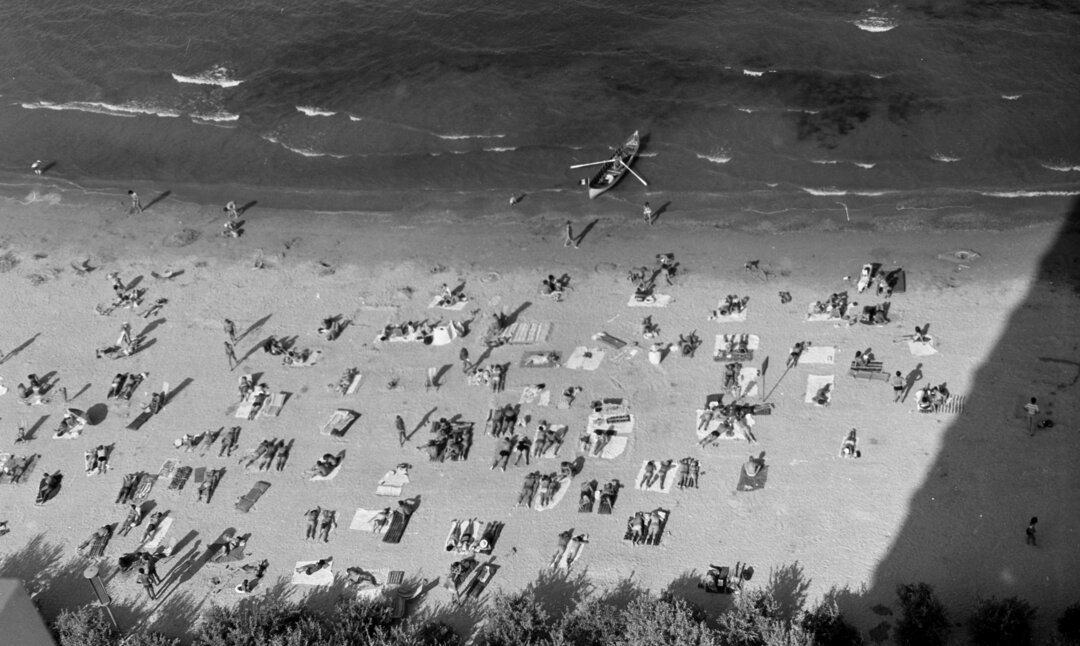
Seaside. A published chronology

The architecture of the socialist period (1933-1991) and the orientations of those years, of socialist realism and modernism, have become increasingly popular among specialists in the field. Perhaps one of the reasons is that, until recently, these types of architecture have not been sufficiently explored in the wider context of world architecture, so that many consider them a mere curiosity. The two architectural phenomena (socialist-realist architecture and socialist-modernist architecture) have been as much ignored locally as globally, not only by experts but also by public authorities (here we are talking about the former Socialist Bloc: Romania, Republic of Moldova, Poland, Hungary, Ukraine, etc.), for political reasons. For this reason, they have not benefited from sufficient academic research, being systematically associated with communism.
Our organization, B.A.C.U., focuses on the promotion of modernist architecture after the Second World War (1955-1989/91) - this would be the acceptable expression for some Romanian specialists and colleagues; we chose to call it socialist modernism, as it is recognized in the international academic sphere, by experts in the field of built heritage, but also by the Socialist Heritage initiative, led by B.A.C.U., together with the Scientific Committee for the Protection of the Built Cultural Heritage of the 20th Century - ICOMOS ISC20c.
For the B.A.C.U., in addition to the conservation aspect, it is also of interest how the urban areas of these countries have developed in the wider context of Central and Eastern Europe and other regions of the former socialist bloc.
Our aim is to revitalize the modernist socialist socialist heritage, not only for symbolic reasons, but because we believe in these elements, which managed to contradict some ideological requirements, giving the urban space a certain flavour, so characteristic of those times. Boulevards, public buildings, residential units and monuments - all are a clear reflection of the social and cultural context of the socialist period. Unfortunately, this type of architecture is associated with totalitarianism. This is exactly what we are trying to clarify: we want to prove that the architecture of that time is valuable in its own right, analyzing the significance of the socialist period in the wider context of world history, without being partisans of that political system.
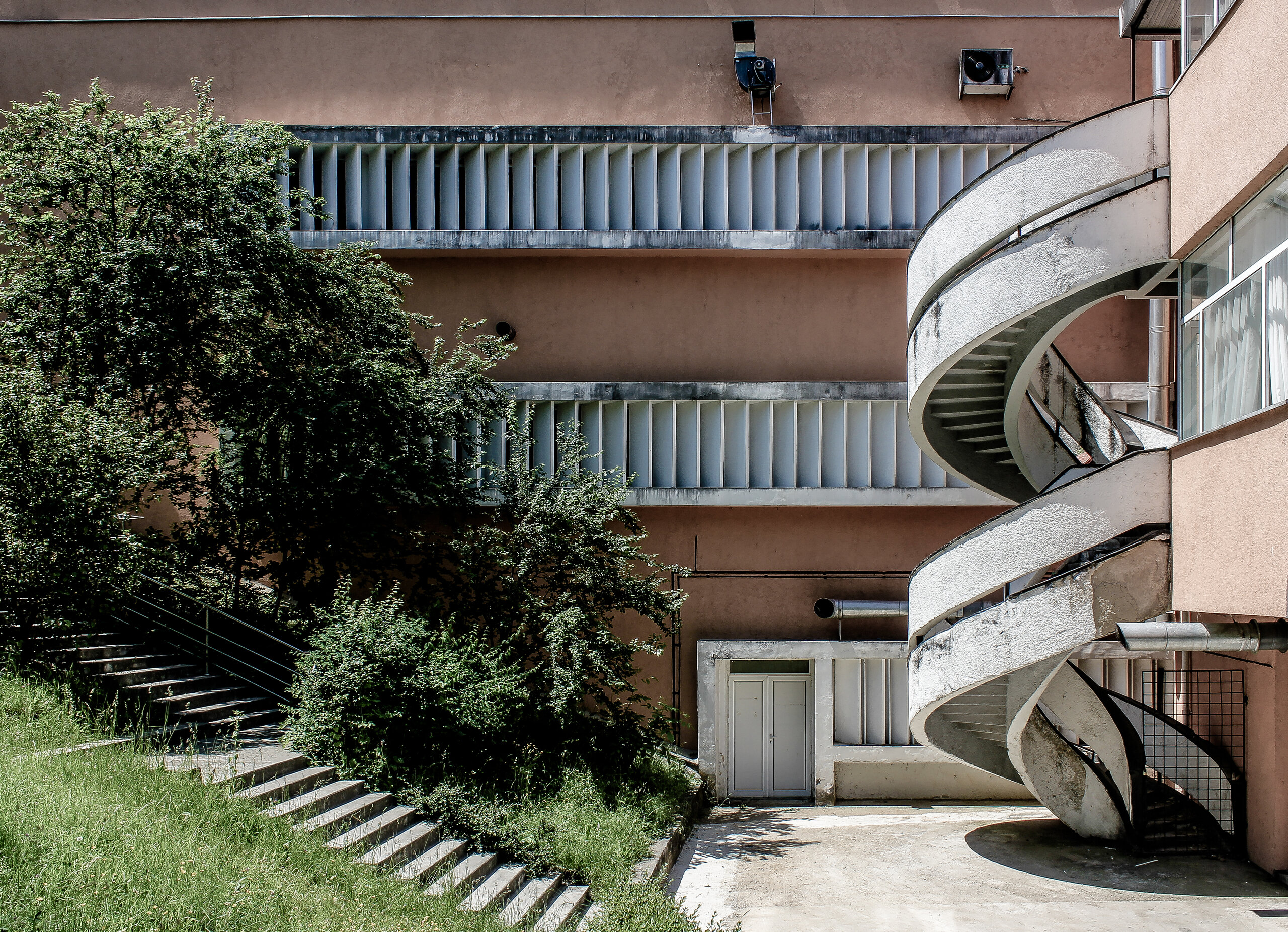
Socialist modernism is an approach to architecture specific to the countries of the former Socialist Bloc in the period 1955-1991. Modernist features consist of: accents of volume, use of light, mass-produced industrial materials, lack of unnecessary ornamentation and detailing, repetitive modular forms and the use of flat surfaces, usually alternating with areas of glass.
This orientation was adopted following historical events. The year 1955 marked the official renunciation of "unnecessary stylistic elements" in architecture by a decision of the Central Committee of the Communist Party of the Soviet Union. The decision was made following an appeal by Nikita Khrushchev, in a speech delivered a year earlier at the "All-Union Conference of Builders, Architects and Workers in the Building Materials Industry, in the Construction Machinery Industry, and in Design and Research". From that point on, Stalinist (or socialist-realist, as it is still called) architecture was abandoned throughout the Socialist Bloc. In the socialist context, modernist tendencies manifested themselves due to influences in the professional sphere, penetrating the frontiers and limits imposed by the ideological system. In socialist modernism there are multiple styles and orientations (utilitarian architecture, brutalist architecture, minimalist architecture and so on). It would be difficult to define it as a style; we believe rather that 'phenomenon' would be the right word. Of course, the seeds or roots of this phenomenon can be traced back to Gropius, Mies van der Rohe and the International Style, which, we could say, has found its way throughout the Socialist Bloc. But although they used the modernist "templates" of Le Corbusier or Niemeyer, many of the country-specific elements were due solely to the talent of local architects. In our case, in Romania and the Republic of Moldova you can find many works from the 1960s and 1980s inspired by works such as Marina City in Chicago (Bertrand Goldberg, 1960s), which can be found in the Romanița tower in Chisinau, designed by architect Oleg Vronski, or Niemeyer's Brasilia, found in the Guguță Café in Chisinau. Felix Candela's hyperboloidal structures from the 1950s can be seen in Nicolae Porumbescu's Circus de Stat/Globus in Bucharest, and the examples could go on.
Between 1955 and 1970 there was an important urban development in both Romania and the Republic of Moldova due to industrialization. It was visible in all cities and district centers. In large and medium-sized cities (Bucharest, Chisinau, Cluj-Napoca, Iași, Iași, Bacău, Onești, Balti, Pitesti and others), new collective housing districts (microraions) were spread over large areas and included all the facilities that complemented housing (for health, education, culture, commerce, sport and other functions). Some of the most important buildings associated with modernist-socialist architecture were constructed during this period.
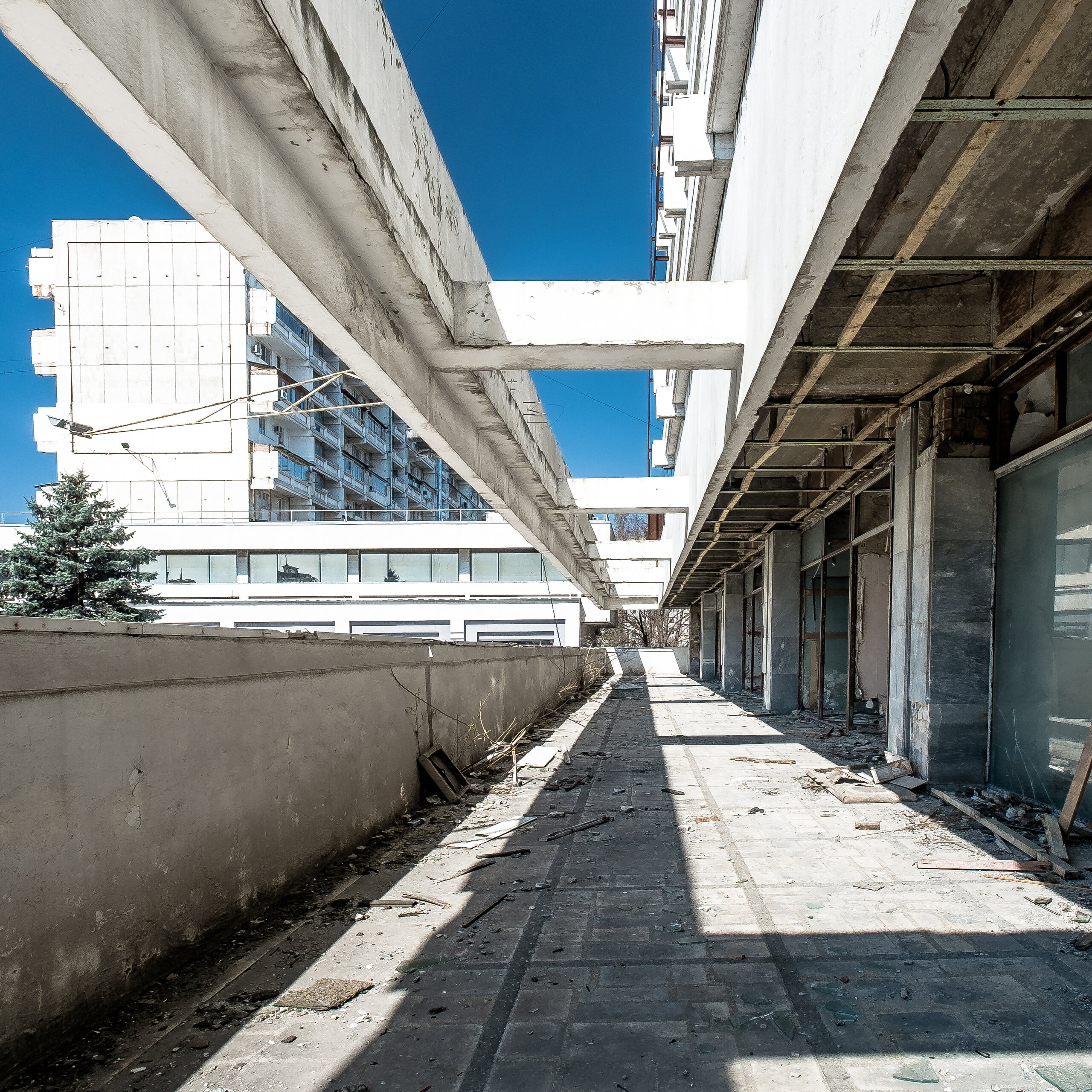
The main objective of the cities' development strategy should be to preserve the inherited urban environment and adapt it to the new development conditions. Unfortunately, many of the socialist buildings (restaurants, shops, stadiums, swimming pools, parks and other recreational areas) in the municipalities and large cities of Romania and Moldova are currently abandoned or in an advanced state of decay.
During the socialist period, the built stock increased considerably, so that even now these buildings represent a large majority in the cities of the former Socialist Bloc. If these urban areas are not protected as a whole, the overall image of cities will suffer. This is where the idea of campaigning for the protection, restoration and rehabilitation of modernist-socialist buildings came from - we want to preserve their historical value and at the same time improve the overall urban image.
We feel compelled to point out an unfortunate aspect of the 1980s in Romanian architecture: the Casa Poporului ensemble and the buildings on the axis of Bulevardul Unirii - Alba Iulia Square, an architecture that is hard to avoid with the eyes, assimilated with the name of Ceausescu. One can clearly see his desire to impose, through the designers involved, his own, hybrid architecture, which is somehow derived from Stalinist aesthetics (the plan of the People's House has similarities with that of the Sparkle House), combining neoclassical elements - in the People's House - or elements seen by Ceaușescu during his visit to North Korea. The recipe has been applied along the entire boulevard, culminating in a mirror copy of the People's House at the end of the axis, in the Alba Iulia roundabout. It's a singular, hard-to-define example, a Ceausescu neoclassicism with a smooth transition to postmodern. Speaking of POMO, there are many other ensembles in Romanian cities that can be categorized as a clear expression of postmodernism, sometimes unhappily inspired by Bofill, visible in neighborhoods such as Mănăștur or Mărăști in Cluj, bd. 13 Septembrie in Bucharest, the Creion block (MF1) or the blocks near the Gară (L1-L3) in Constanța, from the 80s-90s. Obviously, they remain a witness of the period, but they cannot be categorized as valuable architecture or as a case study in the conservation of built cultural heritage, at least not by the B.A.C.U. Association.
*
Looking at the present economic and political situation, we can foresee a dark future for modernist-socialist buildings. Many of them are in the process of forced demolition or inappropriate rehabilitation. In the Socului (Pantelimon or Delfinului) collective housing complex, 70% of the buildings have recently been rehabilitated by applying thermal insulation layers in garish colors (green, orange, etc.). The complex on Dacia Boulevard in Chisinau has become a ruin, infested by parasitic constructions all over the facilities. Blocks everywhere have been mutilated by unauthorized closures of balconies or random thermal insulation, which have changed their original appearance and - by closing balconies - also the full-goal proportion. And much more. The biggest problem is that many of these buildings are surrounded by parasitic structures or are rehabilitated with poor-quality materials, which not only affects the safety of future tenants, but also the image of the city. At the same time, there is resentment in society about the architecture of this period because of the policies implemented by the socialist authorities. Often, this heritage is not perceived for what it is - architectural objects or urban ensembles - but as the result of bad policies.
We briefly present two initiatives that propose a series of actions to preserve the heritage of the socialist period.
The Socialist Heritage Platform (SocHeritage) is a project initiated by B.A.C.U. in collaboration with ICOMOS - the International Scientific Committee for the Architectural Heritage of the 20th Century, through which we campaign for the recognition and protection of works of architecture and art from the socialist era as cultural landmarks and historical monuments. We focus on former Socialist Bloc buildings built between 1933-1991 in Central and Eastern Europe (CEE) and Central Asia. The platform collects and provides information on architectural sites: their location, their current state of preservation, the authors who planned and executed them, and the historical legacy of the buildings.
An important part of protecting socialist heritage is the Socialist Modernism initiative, conceived in 2013 with the aim of protecting modernist heritage built between 1955-1991. The initiative focuses on the revitalization and preservation of buildings from the former Socialist Bloc (Central Europe, Eastern Europe), including Romania and the Republic of Moldova. The uncertain legal situation of the majority of these modernist buildings/complexes is taken into account, but this aspect, although it hinders the project from proceeding at a natural pace, does not discourage us.
The state of these objectives is alarming. Our initiatives are aimed at disciplining the stylistic, architectural discipline and involving both local authorities and civil society in this process, so as to raise awareness of the architectural value of the buildings, of the original urban planning and of the social and cultural fabric that still exists. We are currently working on revitalization proposals for several objectives built during the period of socialist modernism in cities in Romania and the Republic of Moldova, aiming to eliminate parasitic constructions, ban the closing of balconies, stop inappropriate renovations, eliminate aggressive advertising on facades and, finally, classify neighbourhoods, buildings, recreational complexes, parks and so on as protected monuments.
In this context, it is necessary to change the legislation on the protection of heritage built during the socialist period, which is not working, at least in Romania and Moldova. In the given situation, we are concerned about the elaboration of a legislative project proposal for the preservation of this architecture and its specific atmosphere, a project that will aim at the conservation of the built cultural heritage, the establishment of revitalization directions and, finally, the realization and implementation of conservation and classification projects for buildings in an advanced state of degradation.
The argument for including buildings constructed during the socialist period among protected historical monuments is supported by the observation that the liberal policies promoted by municipal authorities (Chisinau, Bucharest, etc.) over the last two decades have neglected the architectural and urban heritage of that period. Thus, a number of buildings with important architectural value are not on the lists of historical monuments in Romania and the Republic of Moldova and are in an advanced state of decay.
Whether it is a question of architectural composition, proportions, technological innovations or the way in which constructive elements are used, buildings from the socialist period must be taken into account and analyzed without being related to the historical-political conditions of the period in which they were built. Most are distinguished by elements, often original, which synthesize local culture and tradition. Those which can be rehabilitated, those which, by their size, function and location, can be reintroduced into the functional circuit and in which contemporary activities can be carried out, are highlighted. They can be adapted to accommodate cultural, sporting, administrative, administrative, social or economic activities that meet contemporary requirements. Therefore, the classification and the initiation of restoration programs for modernist-socialist buildings, in the first phase of those in an advanced state of decay, is the next step to be taken for the preservation of the built cultural heritage of Romania and the Republic of Moldova.
The Bureau for Art and Urban Research Association (B.A.C.U.) is an organization focused on activities in the field of conservation and rehabilitation of the urban and cultural environment. B.A.C.U.'s main directions of activity are the protection, rehabilitation and conservation of the built heritage and art forms of the socialist period and the monitoring of maintenance, protection and conservation activities of the architectural heritage in Central and Eastern Europe. The B.A.C.C.U. also undertakes efforts to classify and protect architectural ensembles, buildings and other objects of built heritage, both locally and internationally. In 2013, efforts began to classify four modernist-socialist buildings in Chisinau, Republic of Moldova, and in 2016, efforts to classify four others in Romania.
Moldova:
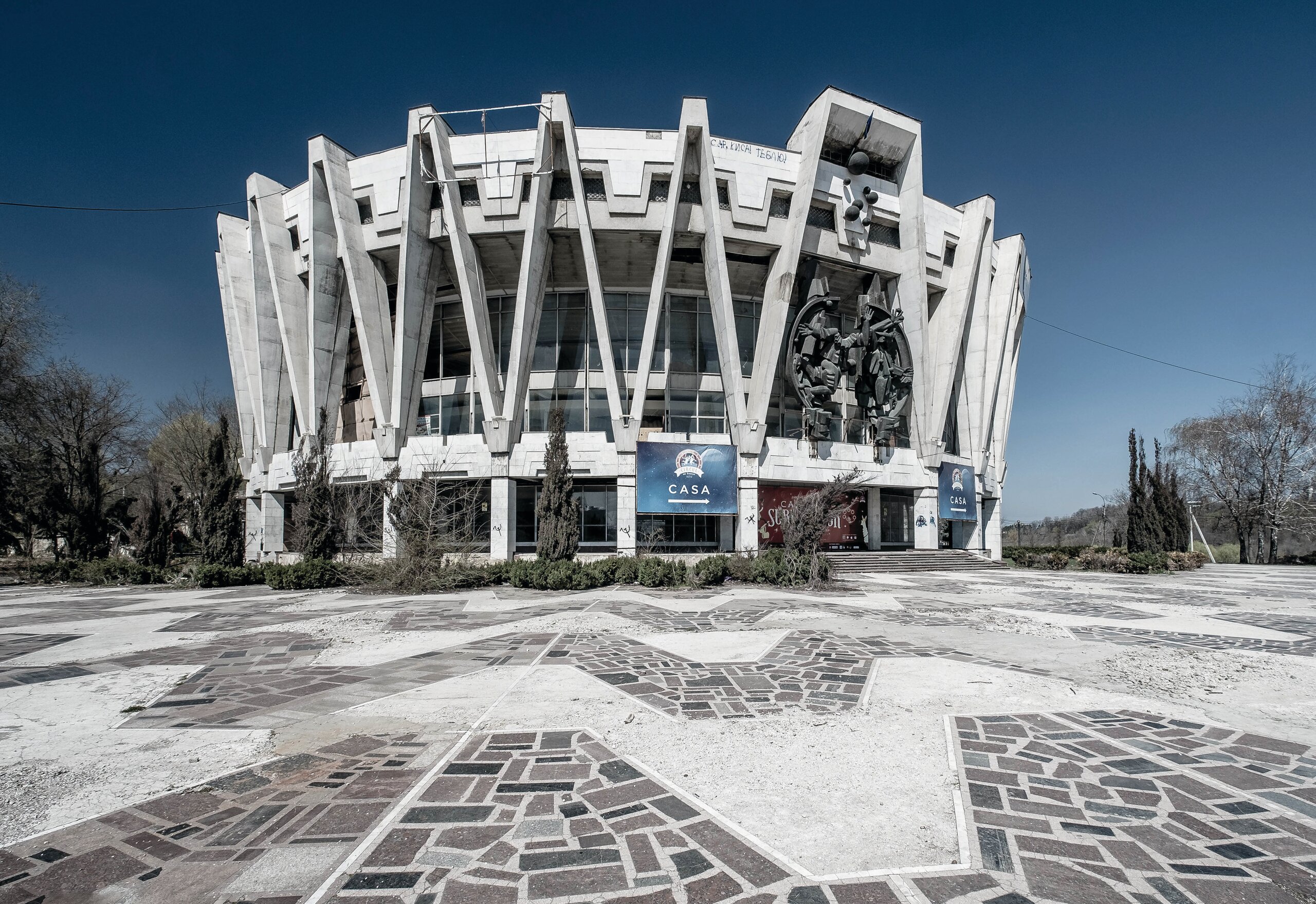
The 500-seat State Circus is a harmonious realization combining acoustic requirements with complex architectural forms. The powerful, sloping pillars on the façade, with their large scale and precise rhythm, are a synthesis of Moldovan horee, giving the building expressiveness and character. Above the main entrance is a large sculpture of circus clowns. Brightly colored interior decorations combined with crystal chandeliers, animal mosaics, ceramic panels and inlays by Moldavian artists reveal the circus function. The building is in an advanced state of disrepair and cannot be used. Since 2014, the Small Arena, originally used for rehearsals, has been functioning as a temporary stage. In 2016, the B.A.C.U. Association initiated the procedures to classify the building, which were completed in 2022 with its inclusion in the Register of Historical Monuments (RMI). Repairs are currently being carried out on the roof and some parts of the ensemble.
Designed and built in 1978-1982. Authors. Alla Kiricenko and others
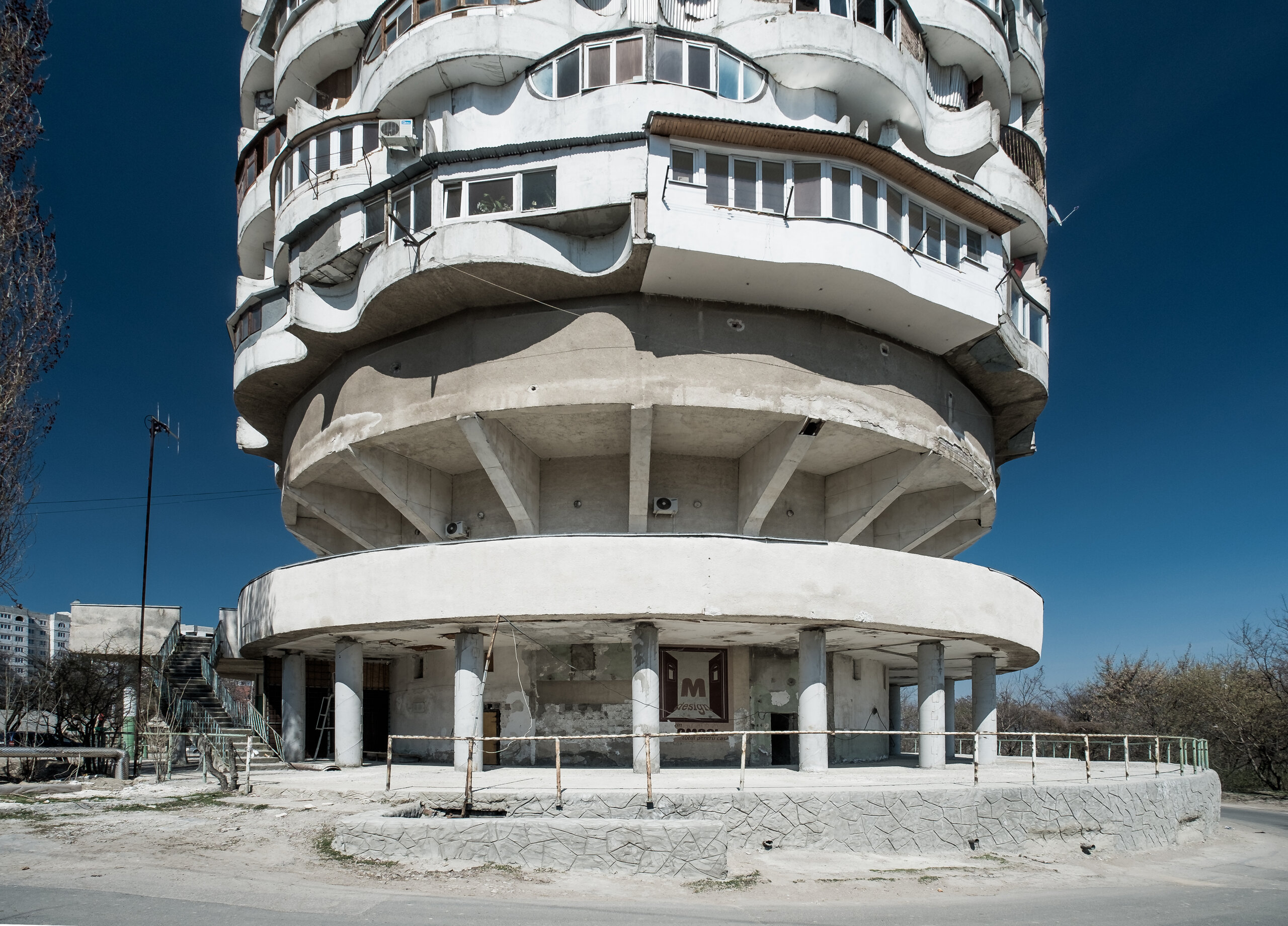
The so-called "Romanița" tower, about 77 m high, on the edge of the Rose Valley Park, was the tallest building in Chisinau. The cylindrical structure comprises four floors of utilitarian spaces (laundry, drying room, dry-cleaning, household rooms) and 16 floors of living quarters. The two upper levels were designed as an observation platform with space for sunbathing. The two subterranean levels contain technical spaces. Obstructed by surrounding construction on land until recently in public ownership, the building is to be demolished within the next 10 years, say officials from the capital's city hall. The procedure for inclusion in the RMI, initiated in 2016 by the B.A.C.U., which presented the building as an emblem of Chisinau, has so far had no echo.
Designed and built in 1978-1986. Authors: arch. Oleg Vronski and others
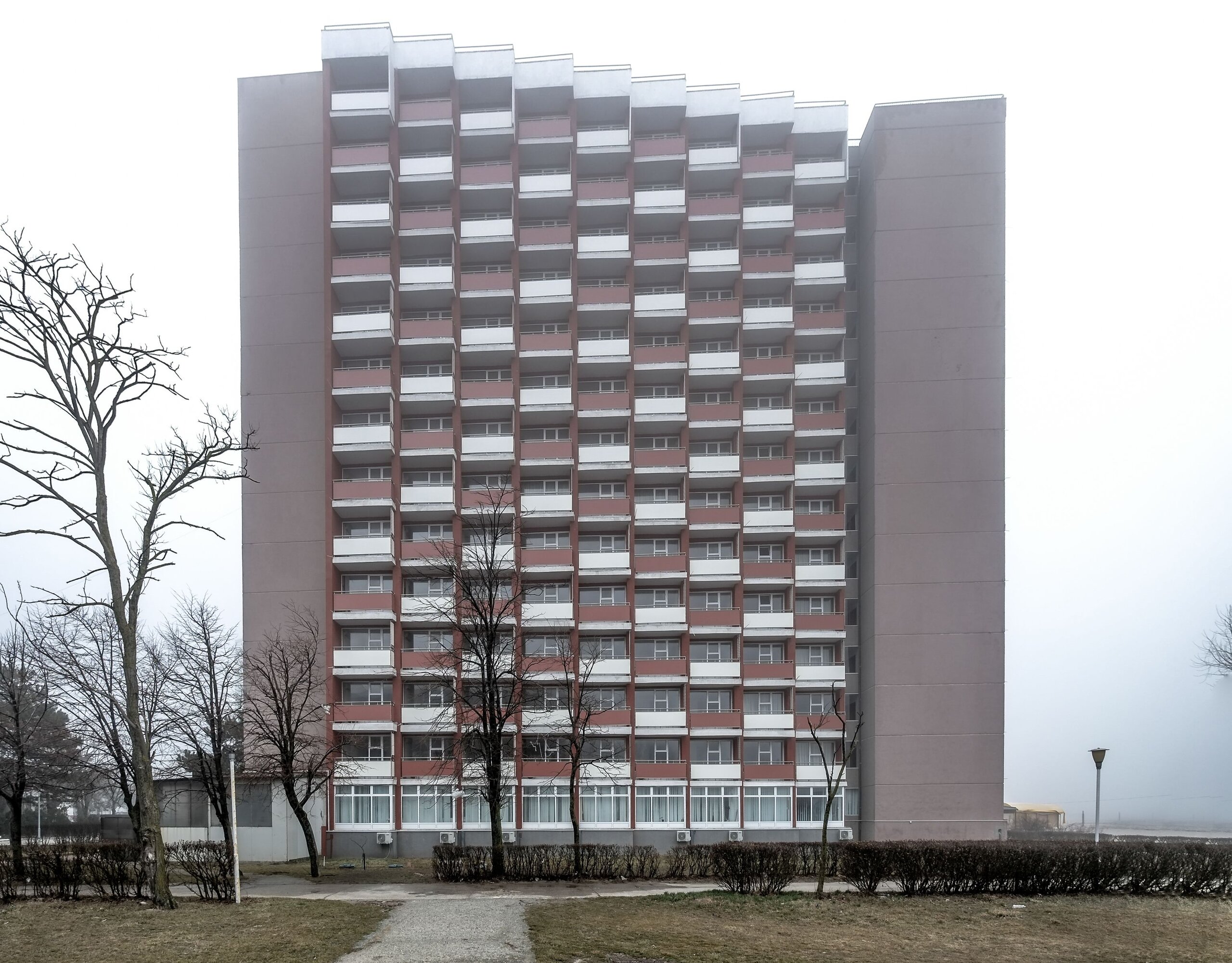
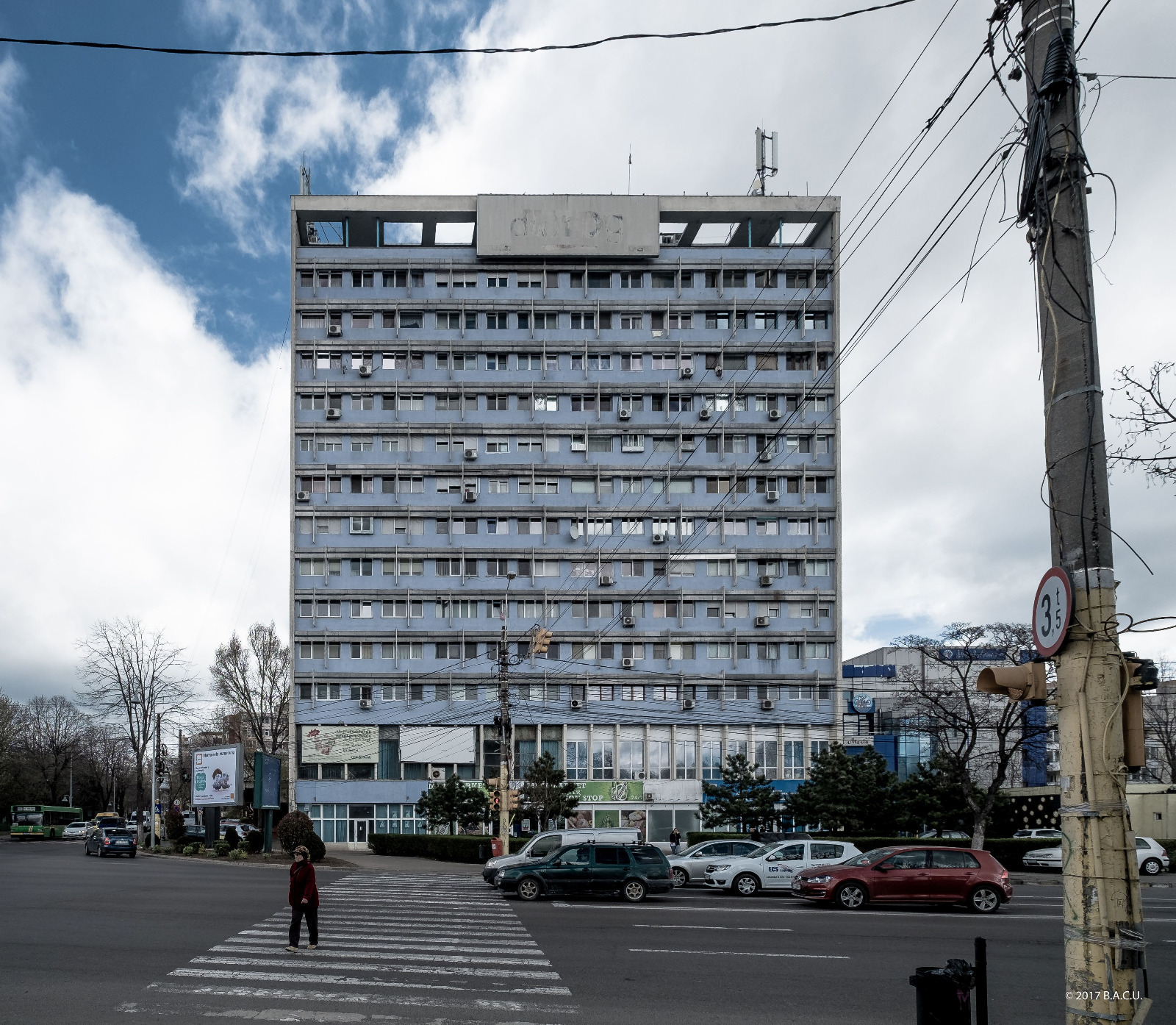
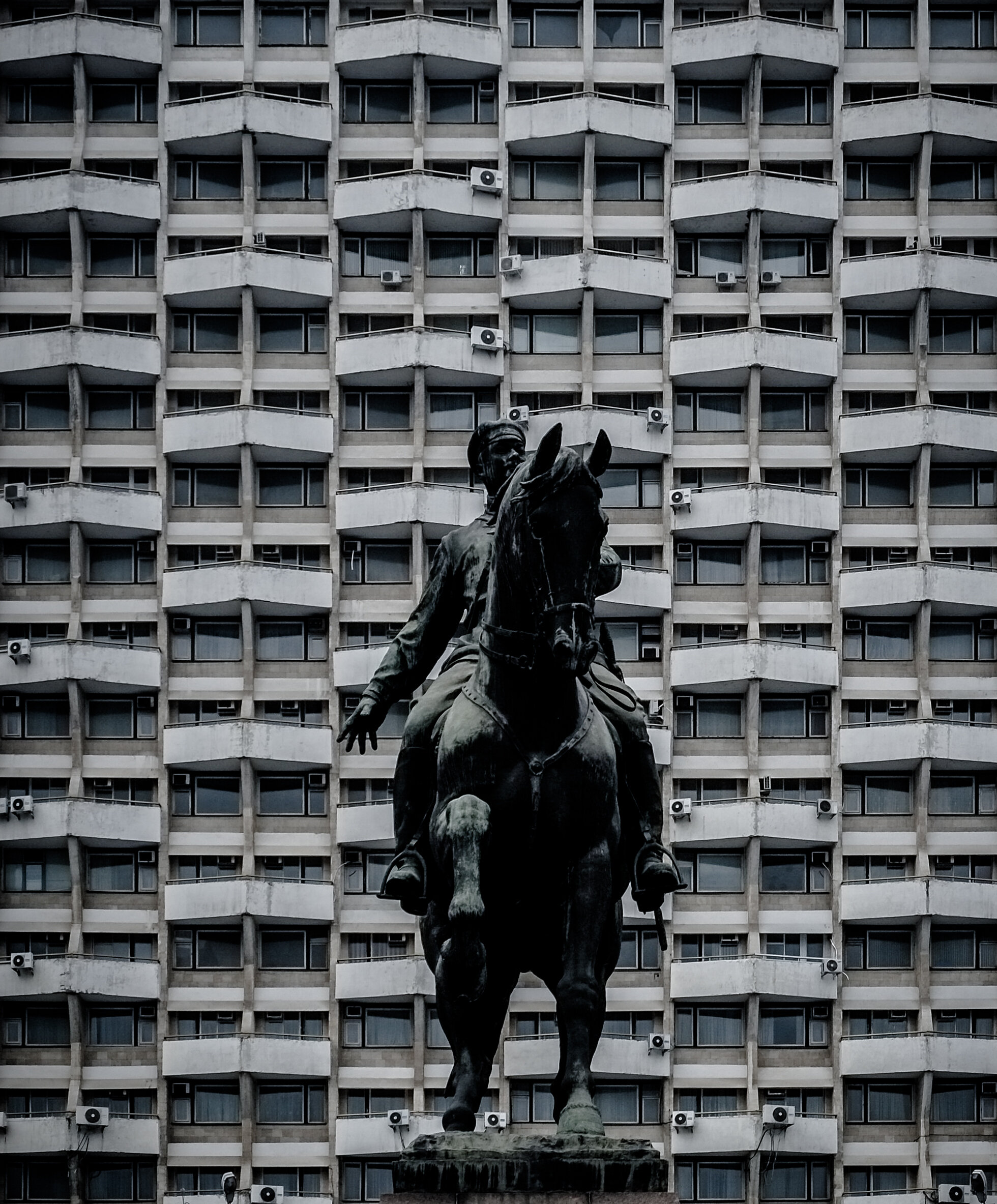
Hotel Cosmos, a project by the LenZNII collective, still forms the perspective end of Gagarin Boulevard, humbly among the parasitic buildings flanking it, emphasizing the entrance to the central sector of the city. The facade has a successful plastic resolution, with balconies arranged in checkerboard on all 18 floors. The two lower levels are occupied by the foyer and restaurant. The hotel was sold at auction in 2007. Today, it is no longer operating at full capacity and no longer meets today's standards of comfort. The entire hotel complex is in a poor state of repair, with both the exterior and interior in need of restoration work and parasitic structures around the hotel detracting from its appearance.
Designed and built in 1982. Authors: arch. B. Banîchin
and arch. Irina Colbaieva
The 15-storey National Hotel was one of the most representative buildings in Chisinau, hosting the most lavish parties for tourists and foreign officials. The upper floors could accommodate up to 580 people, while services were located on the lower levels. A gallery led to the restaurants (470 seats), banquet hall and bar. The interiors were decorated with metal ornaments and wood and stone carvings. Until 1992, the hotel was part of the Soviet Intourist hotel chain, and until 2006 it was part of the state-owned property, after which it was privatized. Now it is abandoned and in an advanced state of decay, the tall volume has been ready for demolition since 2013 and dismantled down to the concrete shell. Since 2016, it has been on the list of objectives proposed by the B.A.C.U. for classification by the Ministry of Culture of the Republic of Moldova, and in 2022 it was saved from demolition by a vote of the Ministry's Heritage Commission.
Designed and built in 1969-1974. Authors: arch. A. Gorbunțov, arch. V. Shalaghinov. Engineers: Y. Skrinski, V. Ivenko, T. Derkacenko
Romania
The Telephone Building in Cluj belongs to the Telecom company, which opposed the inclusion of the building on the List of Historical Monuments (LMI) and sued the County Directorate for Culture and Heritage in Cluj. In 1969, on the basis of a technological study drawn up by the Institute of Telecommunications Design, a P+5 project was conceived, of which a P+3 was realized in a first stage. The ground floor housed the public and administrative areas, while the upper floors housed the telecommunications equipment. Currently, the building is vandalized with graffiti and visibly degraded. The first register is riddled with air conditioners and unsightly wires, marring its appearance. A stylized map of Cluj, created from the architect's sketches and installed on the façade near the main entrance, was removed in 2010 and probably sold for scrap, without regard for its historical value and without any reaction from the authorities. The building, proposed for classification by the B.A.C.U. in 2019, was unanimously voted on by the Romanian Ministry of Culture's heritage commission, but the process was blocked in court and the minister never signed the decision.
Built between 1966-1976. Author: arh. Vasile Mitrea
The Gheorgheni district of Cluj, divided into two micro-regions, at the same time unitary and varied, has seven types of low, tower and blade blocks, originally individualized by color. This has disappeared today due to thermal rehabilitation and the motley color scheme applied at the request of tenants' associations - a common occurrence in Romania. The ensemble stood out for the diversity of the buildings arranged in groups, the interspersing of social-cultural and commercial facilities (one, now demolished) between the blocks and their plastic treatment - all giving it a unified aesthetic. The aesthetics are also affected by the partial and haphazard enclosure of the loggias with different joinery systems, the individual thermal insulation of some apartments and local plaster repairs, which give the buildings a desolate appearance, diminishing the value of the area.
Built in 1967. Systematization: arh. Augustin Presecan, arh. Aurel Buzuloiu, arh. Vasile Mitrea.
Authors. Cristian Iacobi, arh. Domnica Litvin, arh. Alexandru Nemeș - D.S.A.P.P.C. Cluj
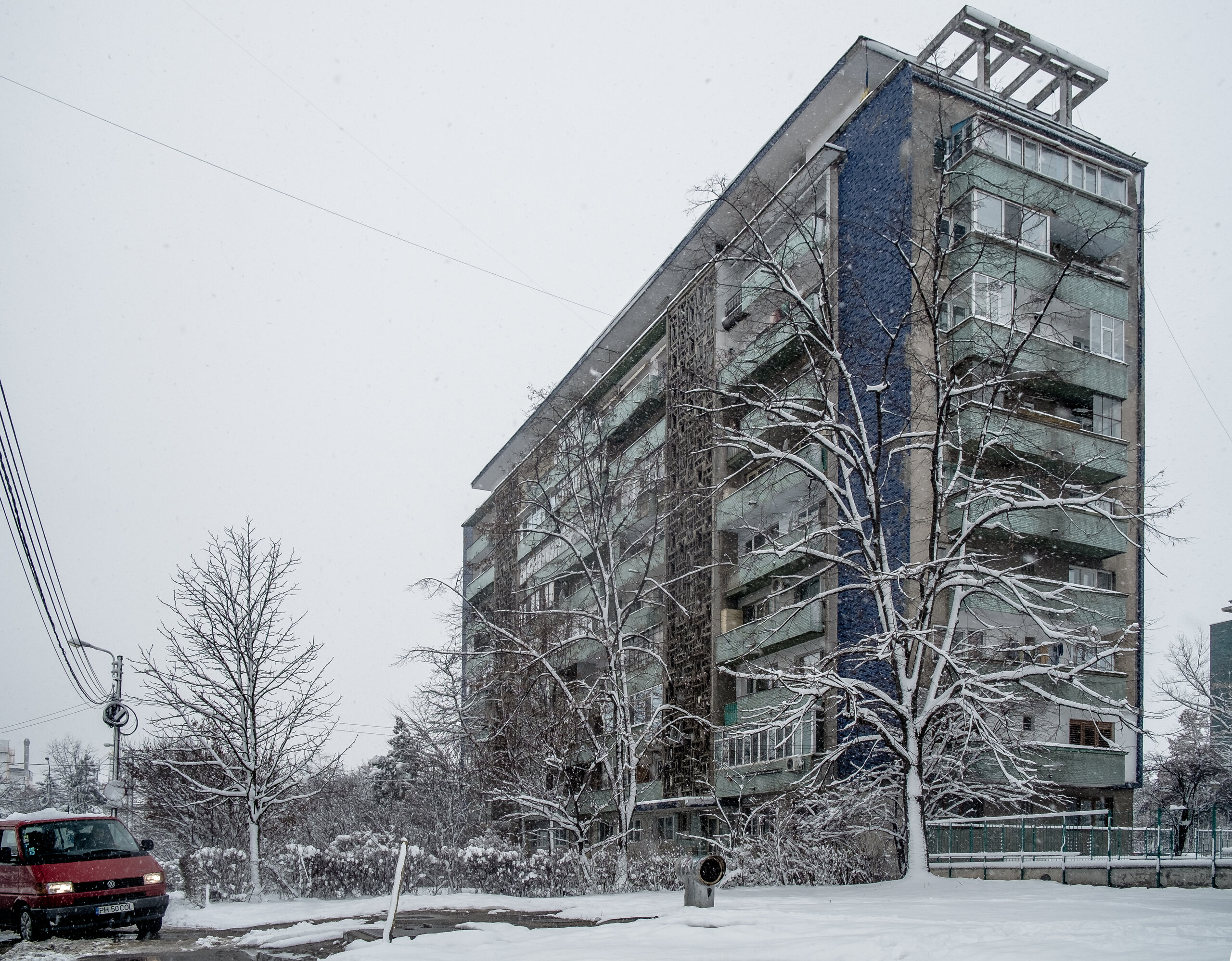
Today, the Ploiești Nord neighborhood fulfills the functions of housing (mass of the built-up area), commerce and services (Small Complex and Commercial Complex North), light industry (textiles - Craftsmen Complex), education (kindergartens), green spaces (North Park and spaces between blocks). The blocks designed by the architect Daniel Guj in the 60s and 70s have interesting characteristics, which give the neighborhood a special personality. They are P+9 and the facades are clad with blue and green mosaic tiles. The staircases are beautifully decorated with prefabricated concrete railings. The main risk faced by these buildings (apart from the seismic risk) is the thermal rehabilitation, with a change of finishes and of the full-hollow proportion. Parabolic aerials and unevenly closed balconies also affect their image and reduce their value.
Built 1964-1971. Author: arch. Daniel Guj
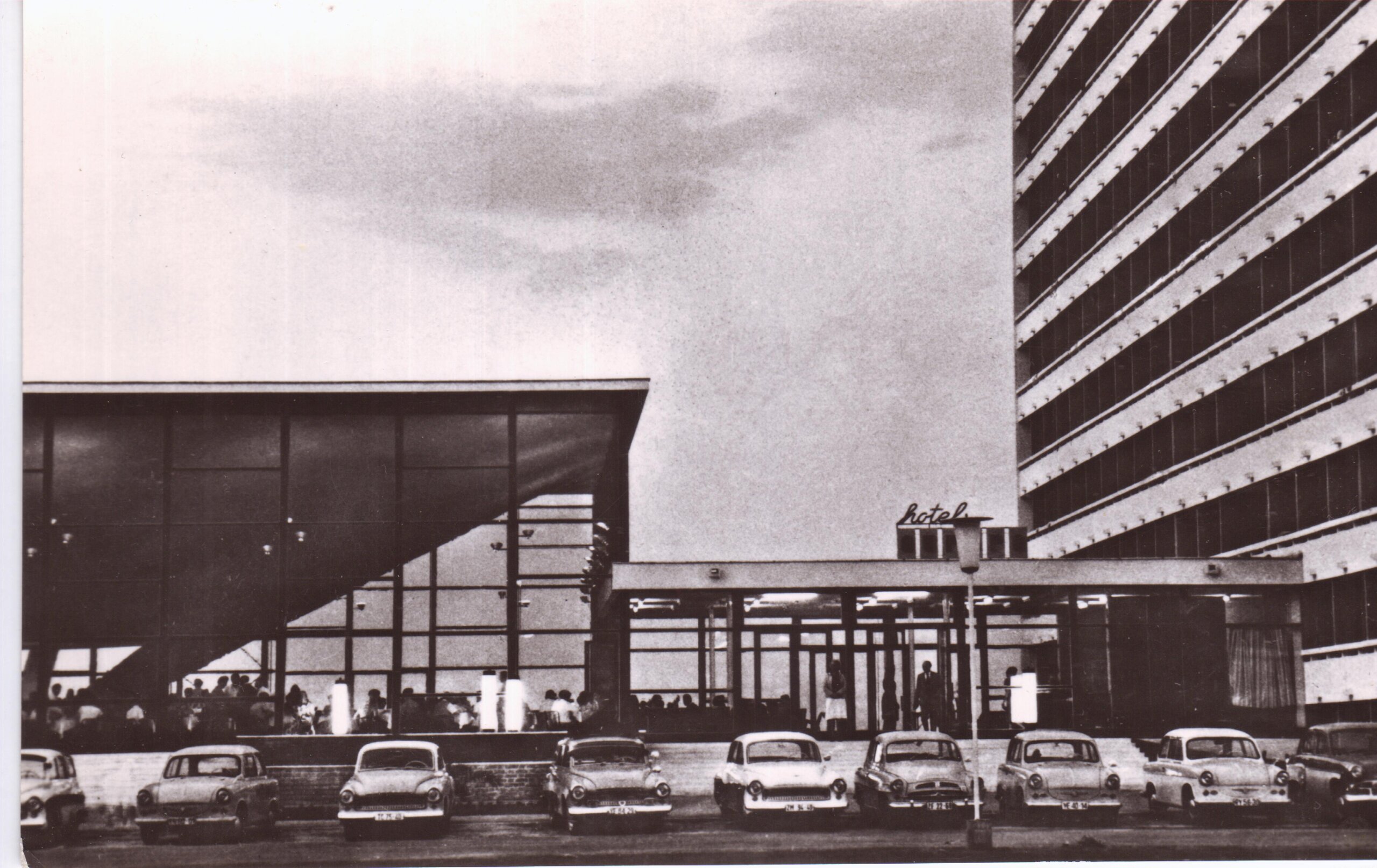
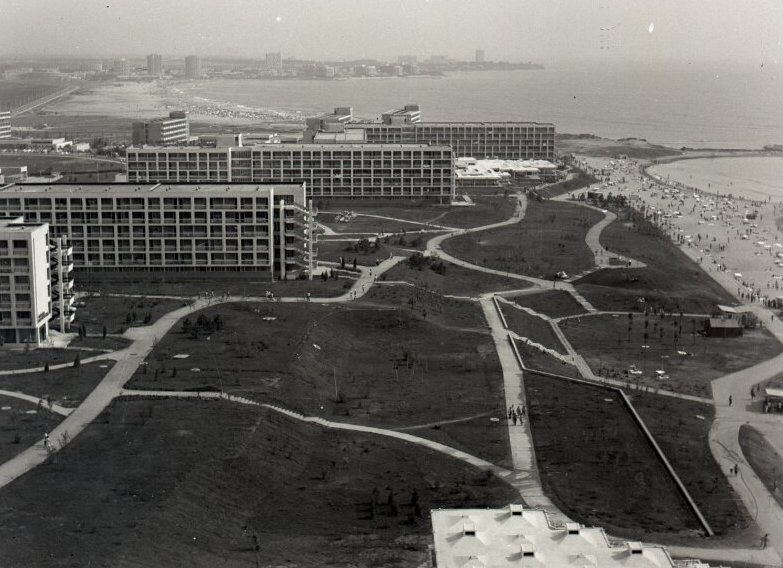
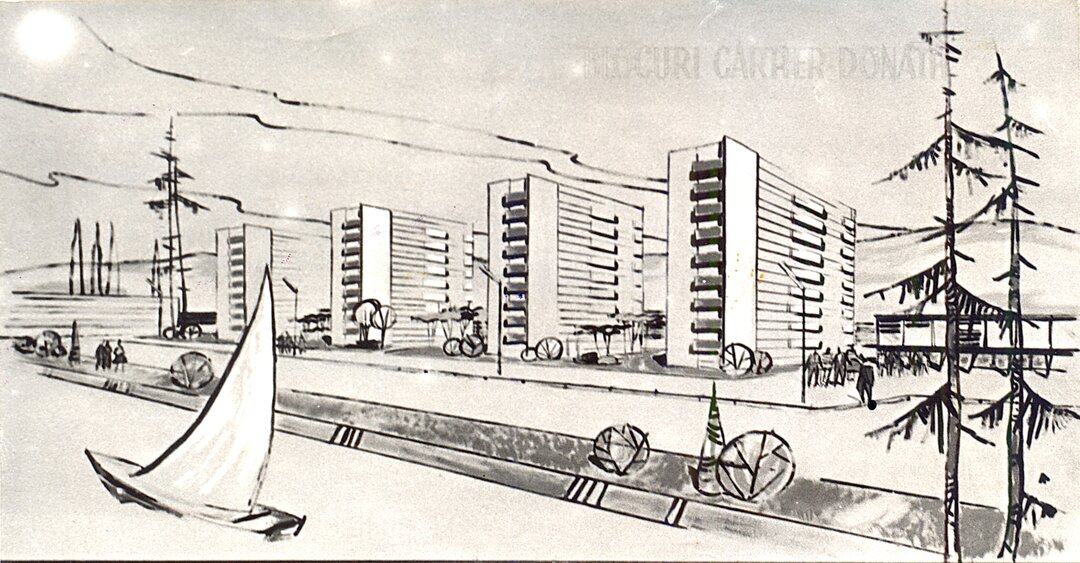
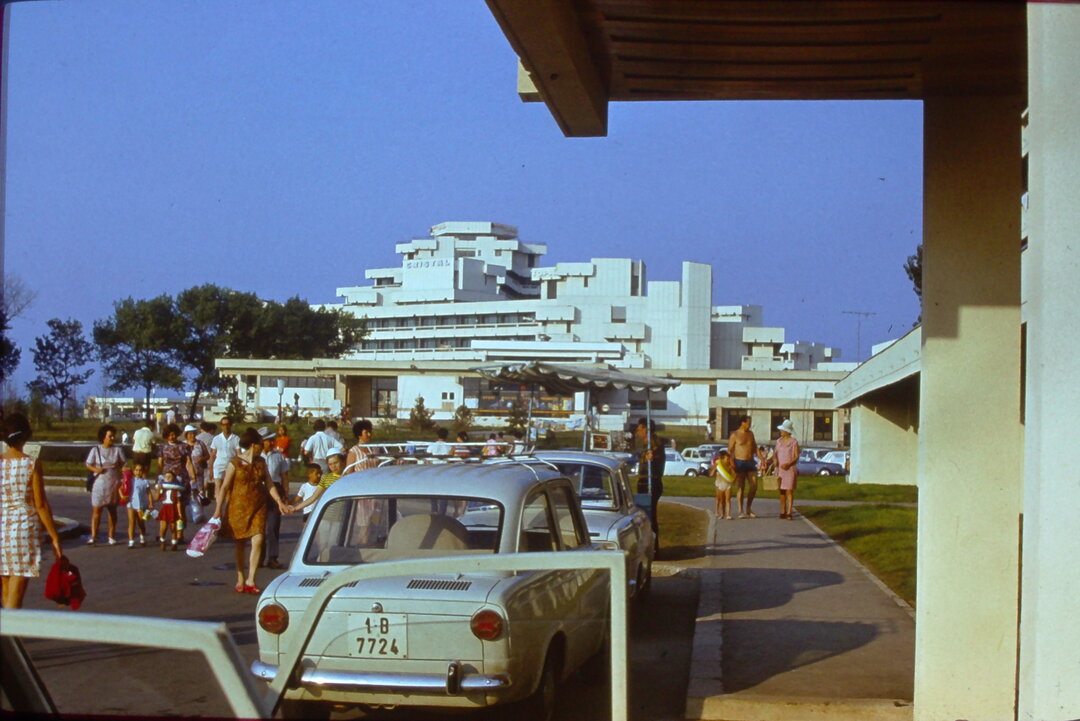
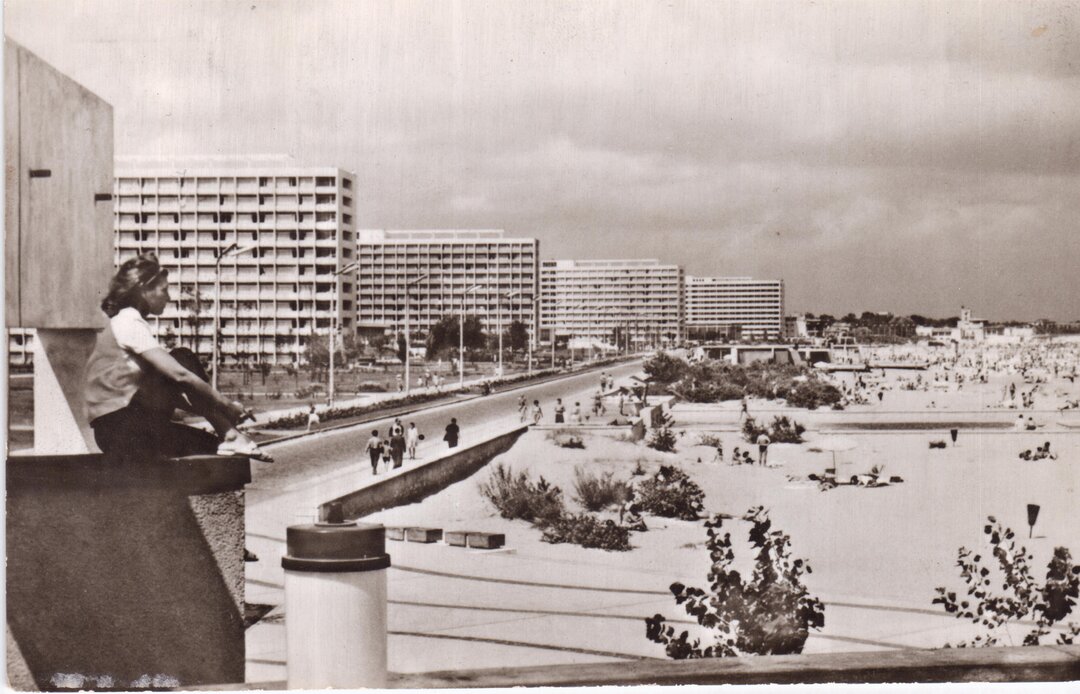
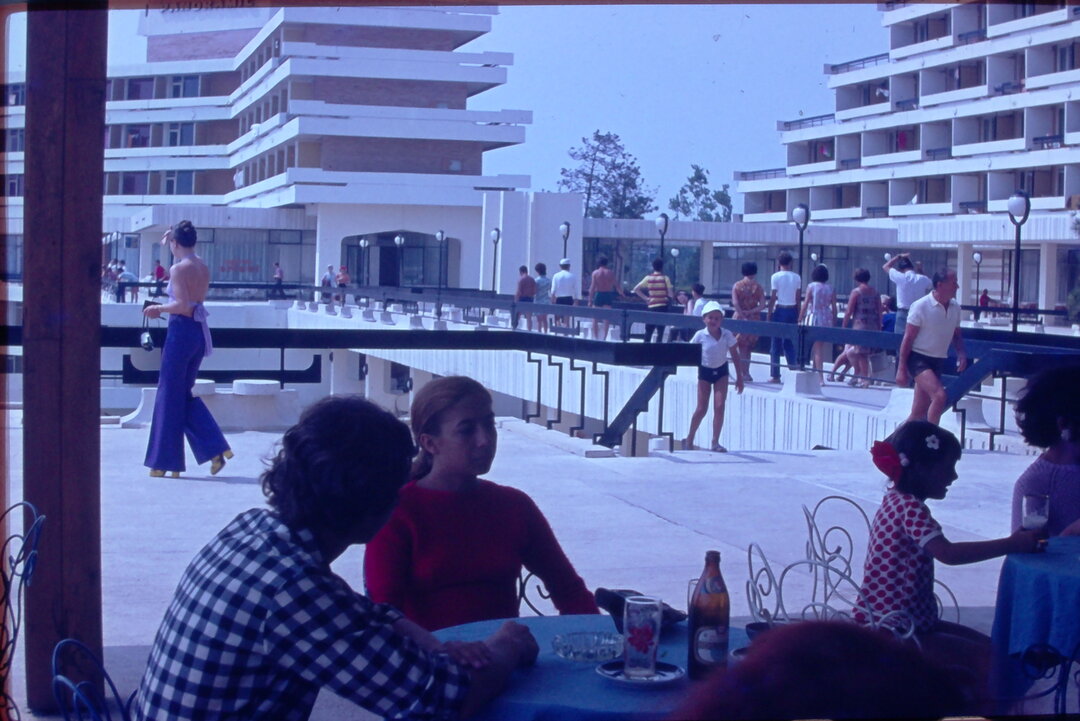
The vacation resorts on the Romanian Black Sea coast were a turning point for many Romanian architects, who had the opportunity to demonstrate their strength and talent. Cezar Lăzărescu stood out among them. In the planning concepts of the Mamaia, Mangalia and Eforie complexes, in the hotels and public buildings, the simplicity and modernity of the new architecture, realized with industrial means, were reflected. This clarity of construction resulted in an unmistakable aesthetic.
Summarizing the results of the first phase of construction of the seaside resorts, Cezar Lăzărescu said: We are convinced that architecture and beauty cannot exist separately: logically, economically and solidly, but simple in structure and without expression of beauty, it represents only a technical construction, which does not rise to the level of a work of architecture. Often a technically excellent construction can lead to results that are comparable to an expressive work of architecture, yet it cannot be a box made of dead stone, it is a living organism that can awaken in the viewer a sense of satisfaction and pride in beauty inherent in human nature.1 This creative attitude of the architect, shared by his colleagues in the working team, was reflected in the design of all the resorts on the Romanian coast.
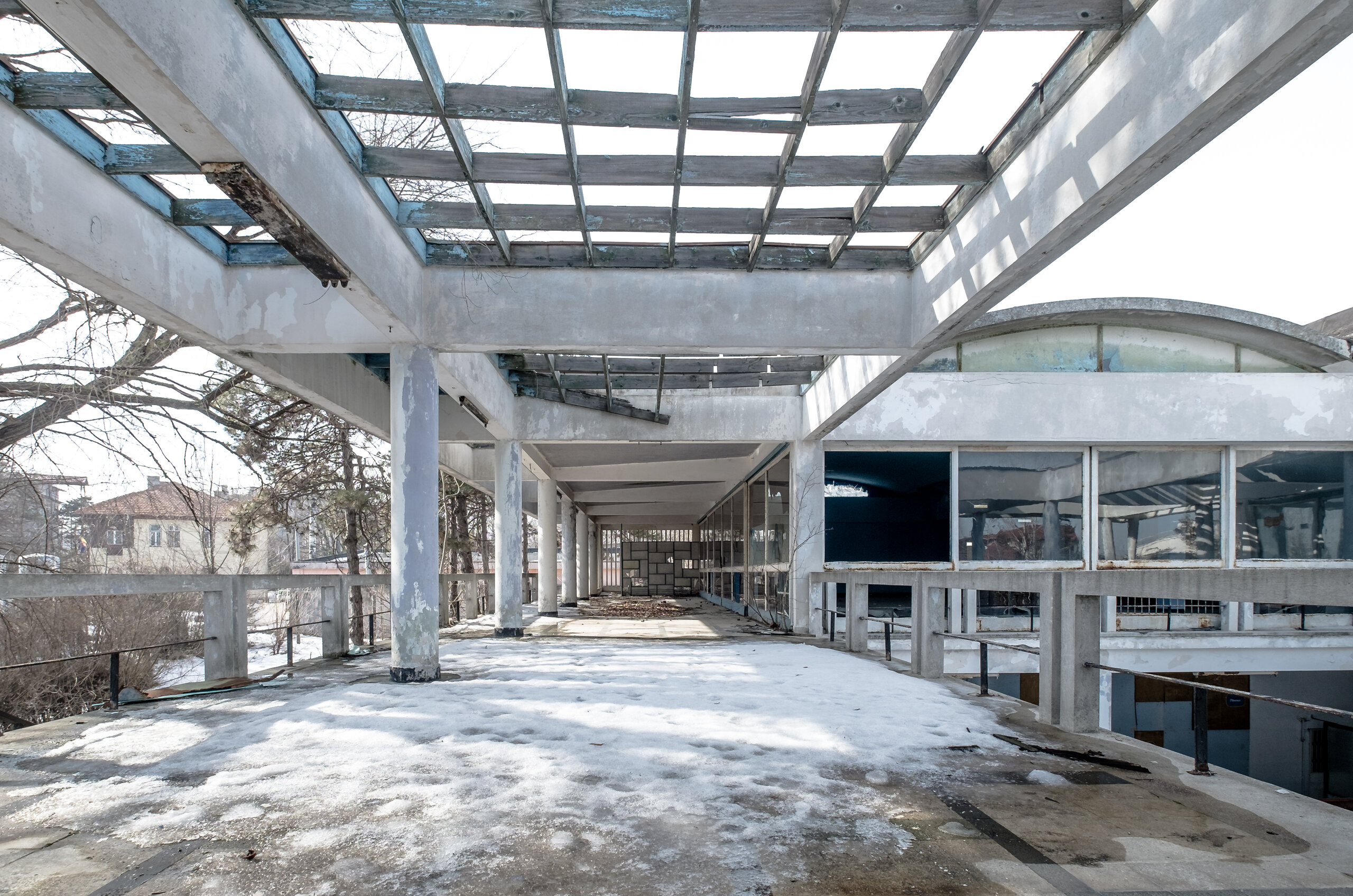
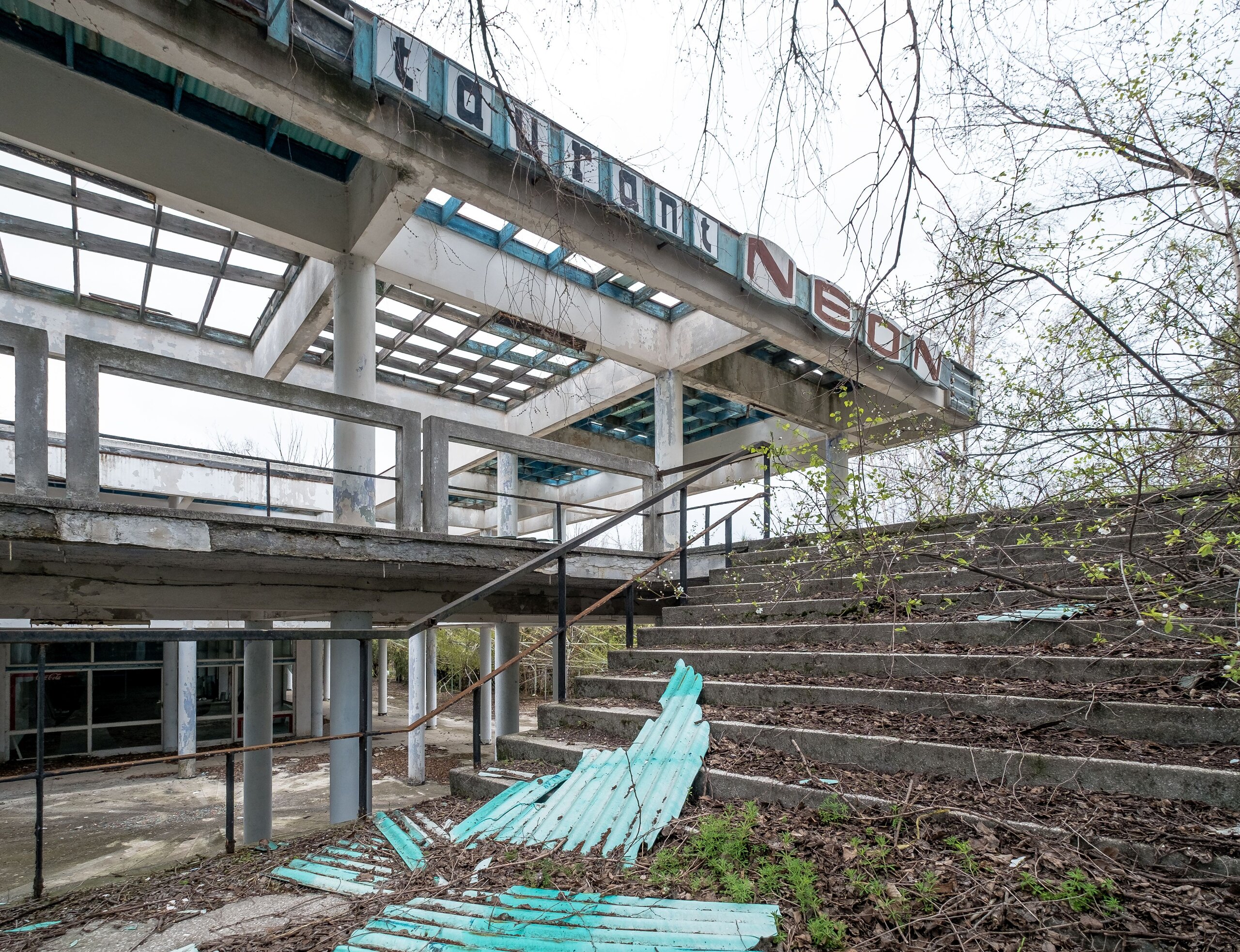
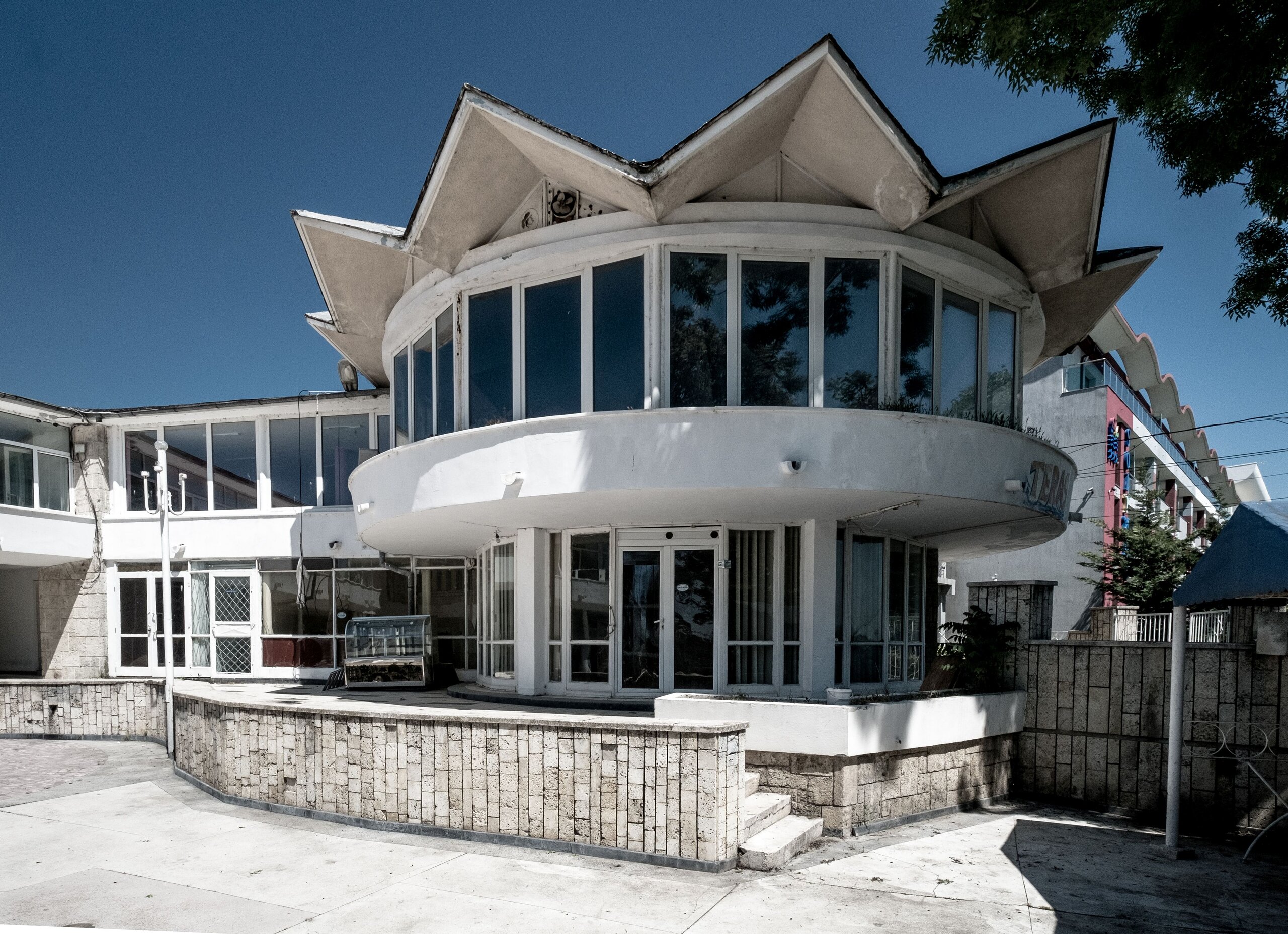
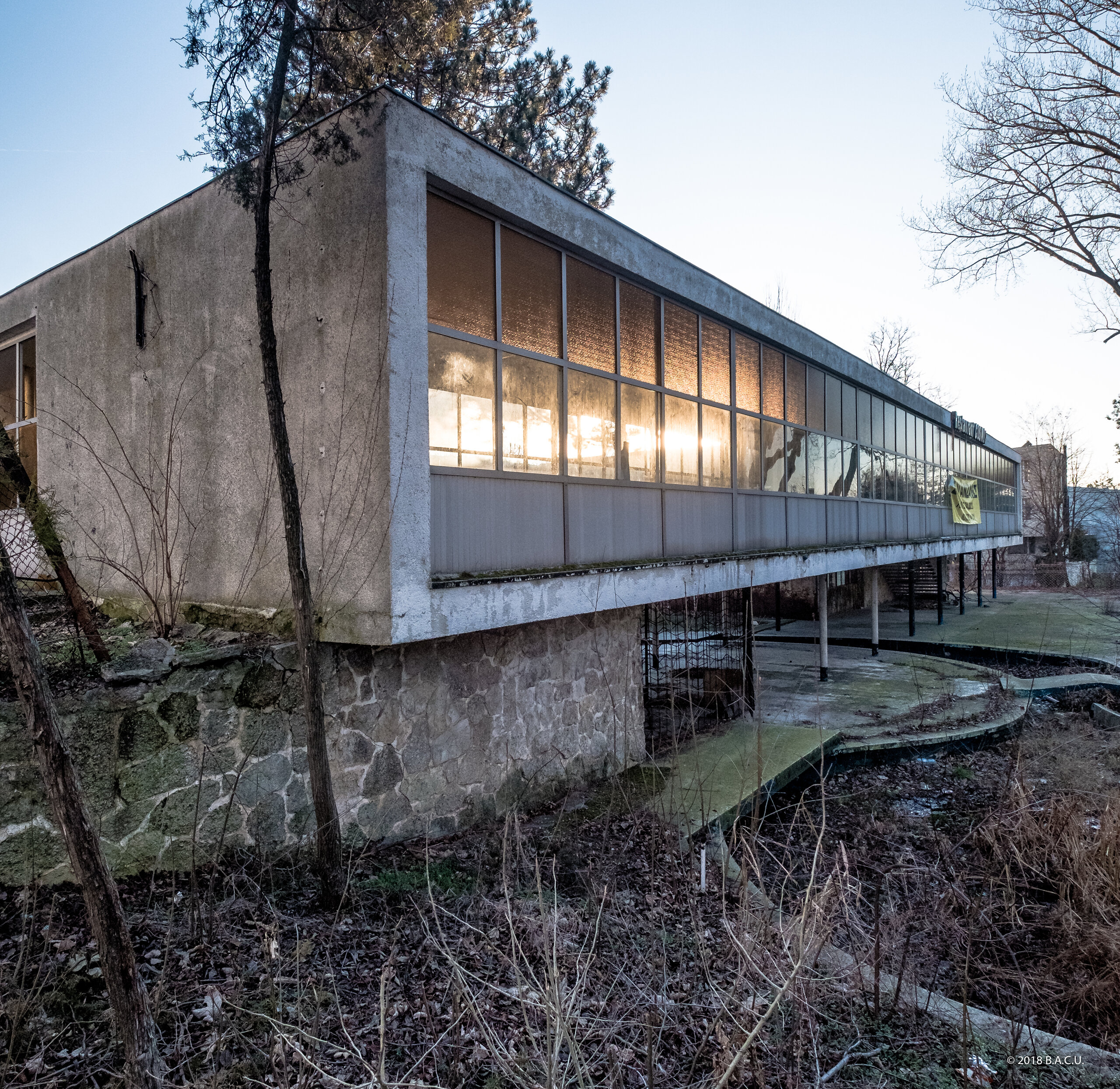
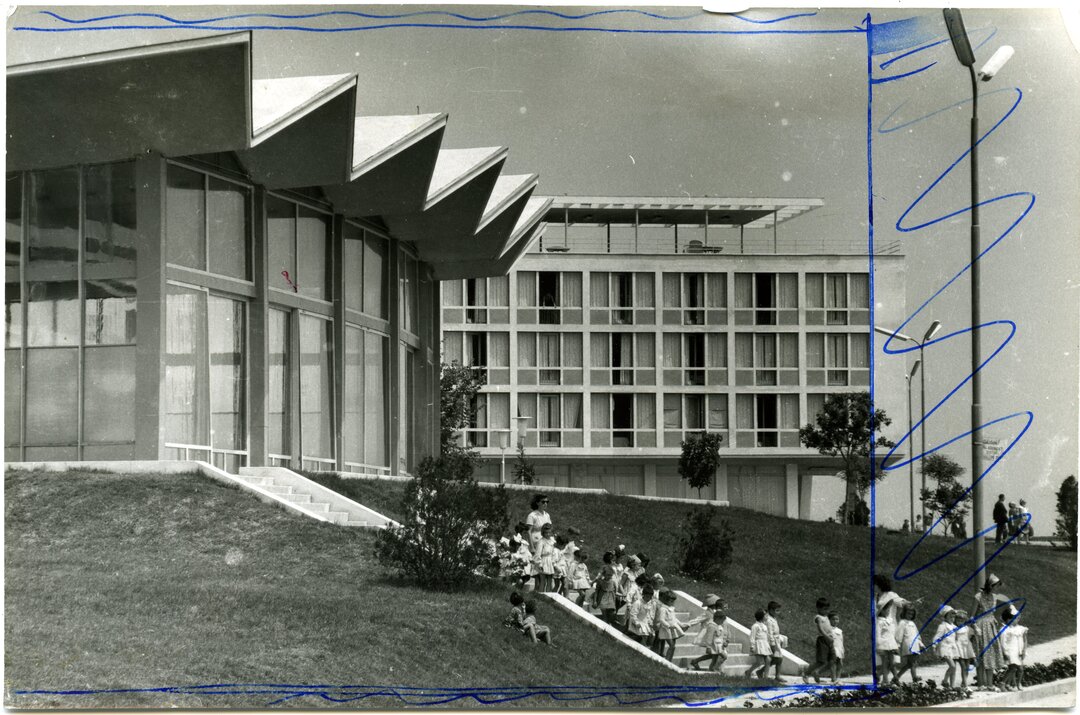
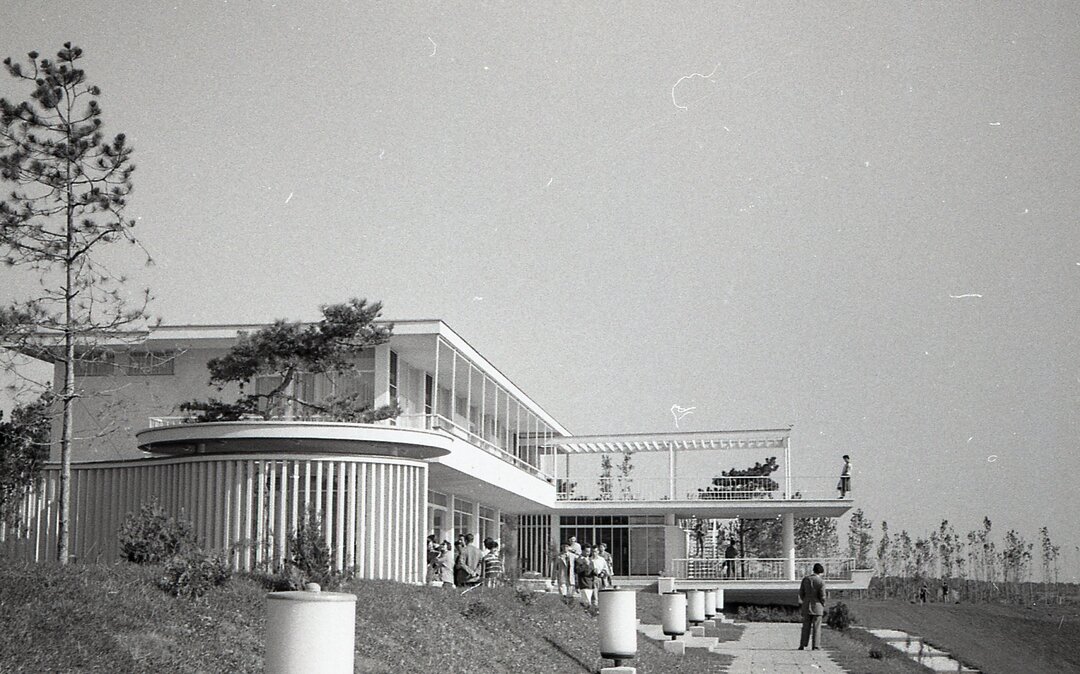
The Eforie I and Eforie II resorts were pioneers in socialist modernism. With a clear conception, without unnecessary exaggerations, trying to convey a summer atmosphere through supple and light structures, they were awarded the State Prize. The Eforie I complex consisted of a group of bar-type buildings with a maximum of 3 floors and a 2-storey community center - the Neon Restaurant, an example of early modernism. Eforie II consisted of similar buildings of up to 5 storeys, with minor plastic variations, positioned laterally to the dominant silhouette of its restaurant, Perla Mării. Both complexes have been fragmented over the last three decades, suffering irrecoverable mutilations, with the Neon Restaurant almost a ruin and the Perla Mării - suffocated by parasitic seasonal installations, although its classification file has been with the Ministry of Culture for years.
Later, equally remarkable examples of modernism were built in Costinești - the Forum Hotel, or in Olimp - the Amfiteatru Amphitheatru complex, unfortunately inaugurated today in a mutilated form, although it was the subject of a classification dossier (by architect Ruxandra Nemțeanu) covering the entire area.
Designed and built in 1950-1960.
Authors: arh. Cezar Lăzărescu, arh. A. Solari Grimberg,
arch. Nathan Stopler, arh. L. Popovici and others
Block D, part of the Eforie I Leisure Complex, groups together the common and service functions: canteen-restaurant, club, bar, confectionery with laboratory, shops, heating plant, ice factory, warehouses, etc., arranged on two levels, in a reinforced concrete structure, mostly apparent. The roofs were made of thin concrete sheets, an economical solution for large openings but also a plastic architectural element. To reinforce the impression of flexibility, the roof is separated from the office wall by a glass frieze, a post-Stalinist innovation. The building is now deserted, the new owner procrastinating on refurbishment and failing to fulfill his commitment. Occupied by homeless people, the building has become insalubrious.
Neon Restaurant
Tudor Vladimirescu Boulevard
Eforie-Nord, Romania
Built 1957-1958. Architects: Cezar Lăzărescu, A. Grimberg-Solari and others.
The Cazino Restaurant, well known to those who used to spend their vacations in Mangalia, was part of the 1958 restructuring works of the Romanian seaside under the direction of architect Cezar Lăzărescu. Identified as Block C in the systematization plan, the building was laid out on two levels and contained, on the ground floor: dining room, kitchen, annexes, staff changing rooms, and upstairs: dining rooms, kitchens, office, annexes and a library in the cylindrical body, overlooking the beach. Nowadays, the complex is in private management and has not undergone any significant refurbishment works, still preserving its original architectural appearance.
Casino Restaurant
Teilor Street
Mangalia, Romania
Built in 1956-58. Architect: Cezar Lăzărescu
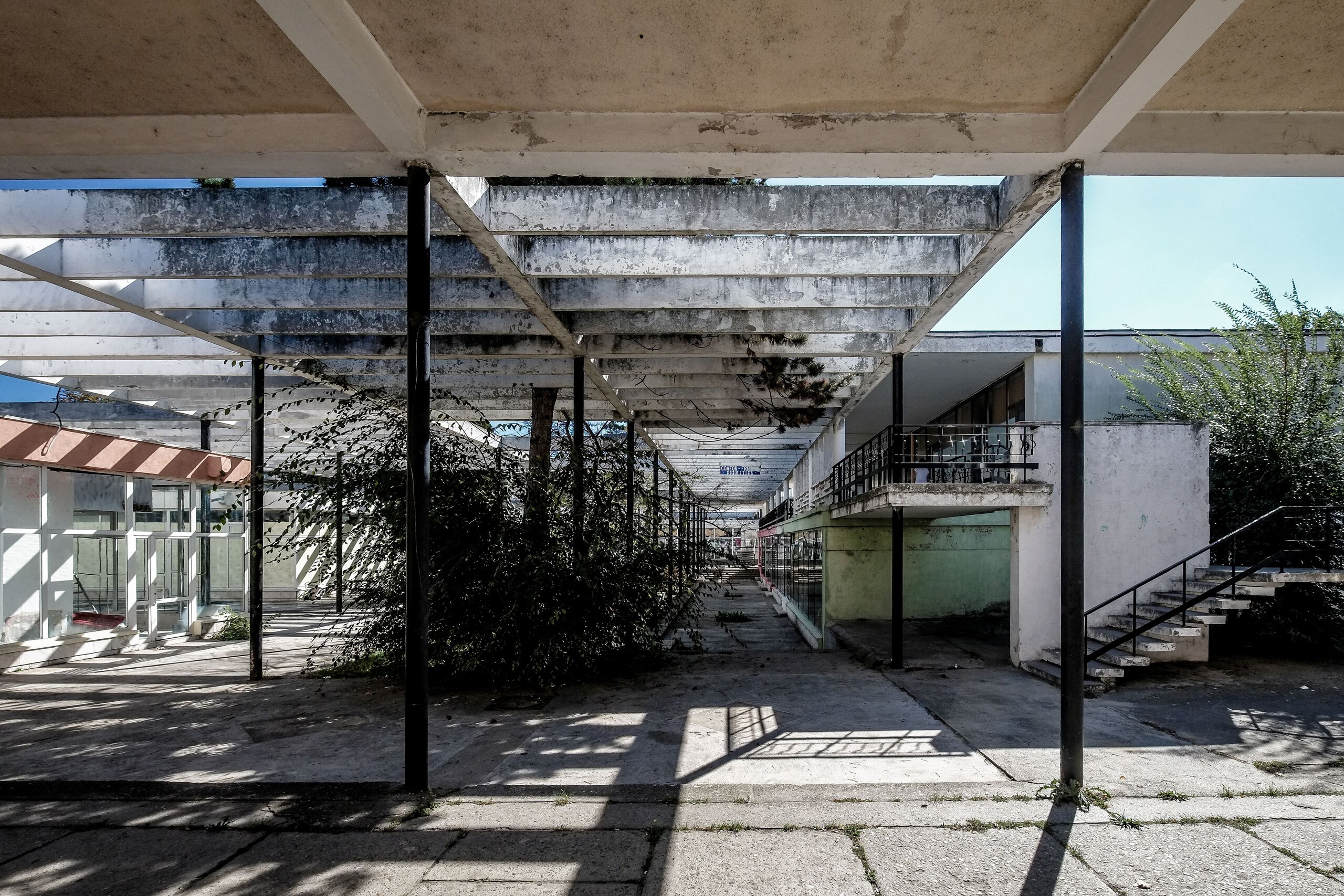
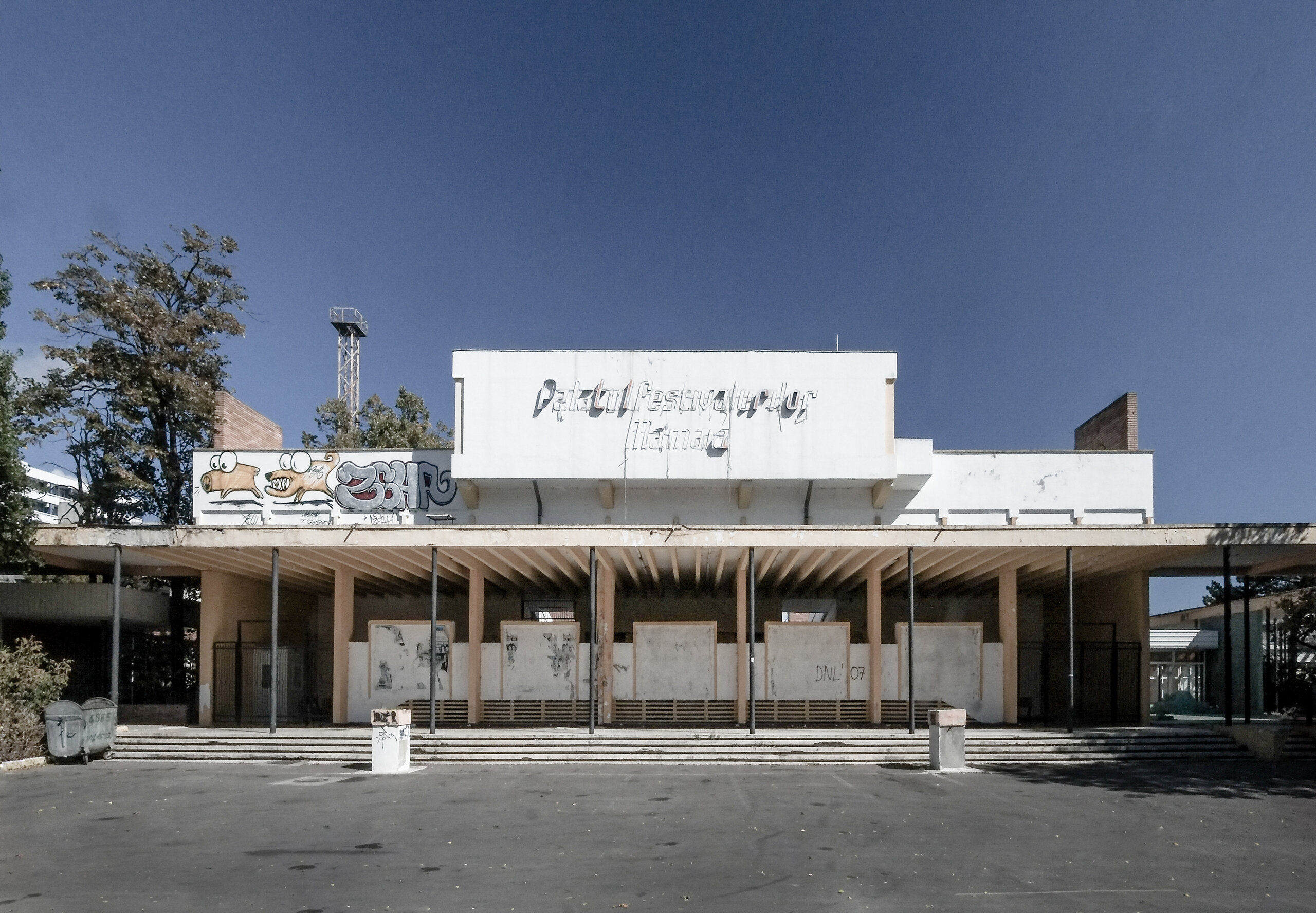
The commercial complex in the neighborhood of the Mamaia Summer Theater stood out for the portico used as a promenade that surrounded it and which motivated the unitary treatment of all the facades. Covering an area of 3,850 square meters, the complex brought together shops, a bookshop, an ONT agency, the C.F.R. office and a self-service grocery store on the ground floor, while on the first floor - post office, telephones, library and a contemporary art room. The roofing was slab on metal posts for the small shops and slab on concrete posts for the P+1 pavilion. For the general racking, a grid of main beams was used, on which prefabricated reinforced concrete slats were placed. Today the complex is occupied by various commercial entities. The bookshop, library and exhibition hall have disappeared and the whole complex is in an advanced state of decay.
La Mamaia shopping complex
Mamaia Boulevard
Mamaia, Romania
Built in 1961. Architect: Aron Grimberg-Solari
The Cosmos canteen, part of the leisure complex of the same name in Eforie-Nord, was created on a slightly uneven site and partially on the ground floor, where the confectionery, reception and food storage services, cold rooms, staff changing rooms, heating plant and laundry were located. The first floor, located at the property boundary, contained the dining rooms, the office and the kitchen. The part of this rectangular volume was resolved with the center of interest towards the interior, through a richly ornamented interior courtyard with covered terraces, wide stone staircases, a dance floor, green spaces and a decorative pool. The Cosmos Cantina is today a restaurant, inadequately rehabilitated and unrecognizable.
Cosmos Canteen
26 Mihai Eminescu Street
Eforie Sud, Romania
Built in 1961. Architects: Al. Ioțu with Gh. Rudich. I.S.C.C.A.S.
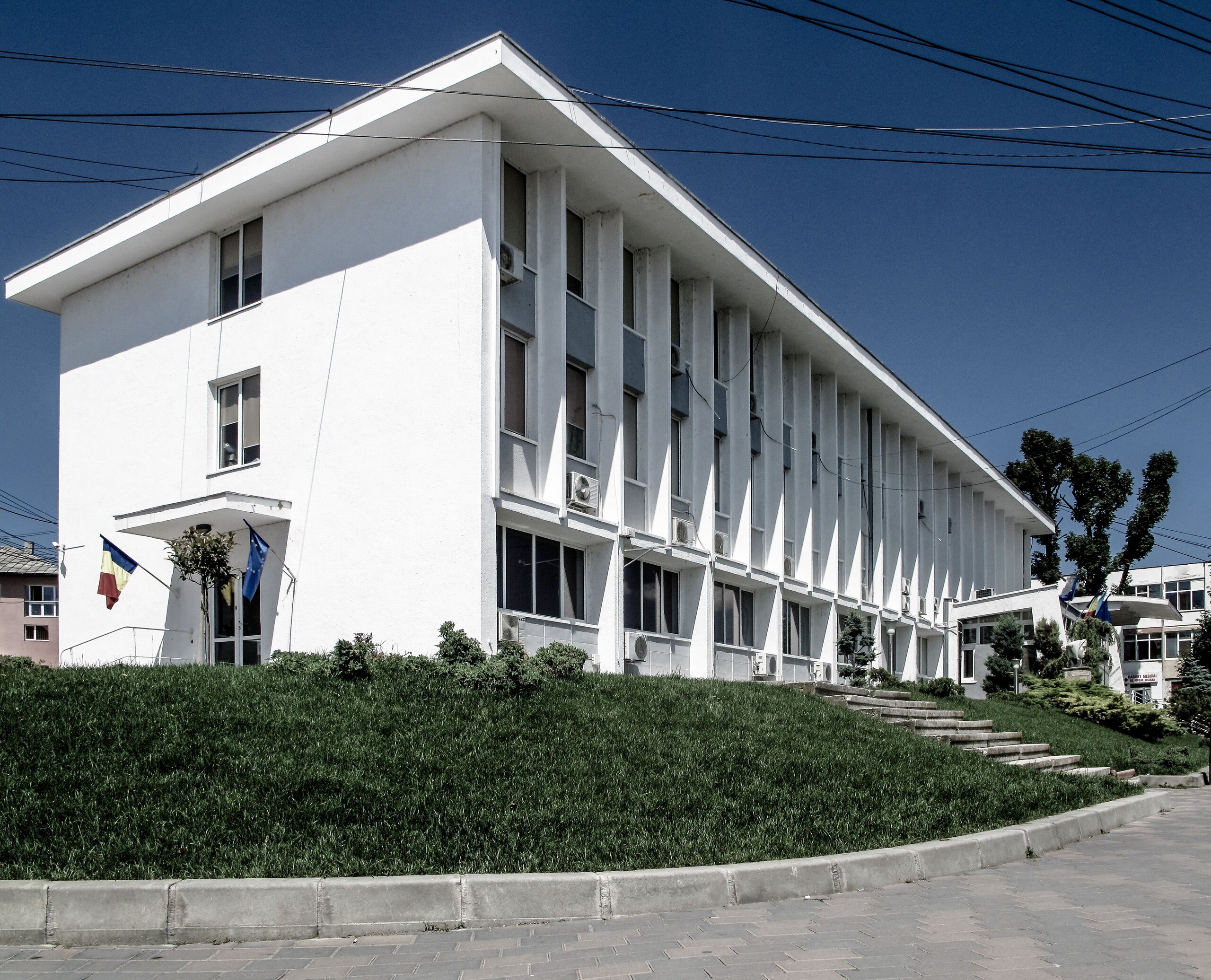
The building of the People's Council of Mangalia was part of the project of systematization and reconstruction of the town, together with the 1,100-bed rest center and the housing units with 120 apartments realized in 1958. The bar-type building was set far back from the alignment to make it stand out, creating a piazza. The design theme involved spaces to house the People's Council on the first floor, the Labor Party on the second floor and the Militia on the ground floor. The study of the facades was coordinated with the architecture of the leisure complex and the new dwellings, with the aim of obtaining a unitary volume that would express the various functions and the construction system adopted. The vertical, lamellar verticality of the facade and the pronounced cornice in the form of an eaves create a surface vibrating with light and shadow - in the spirit of regional modernism.
People's Council (today City Hall)
13 Constanței Street
Mangalia, Romania
Built in 1961. Architect: Cristian Ionescu. I.S.C.A.S.
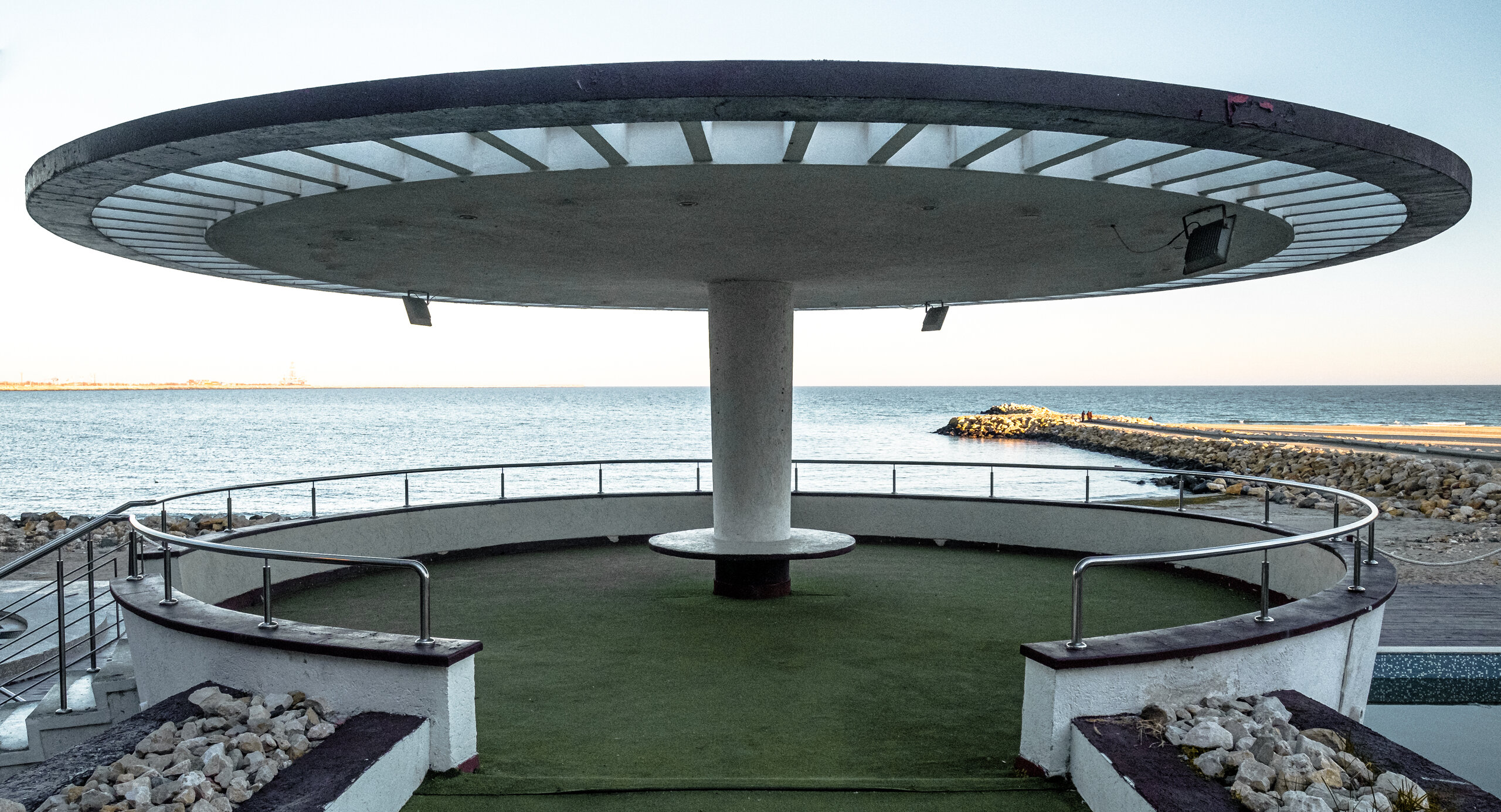
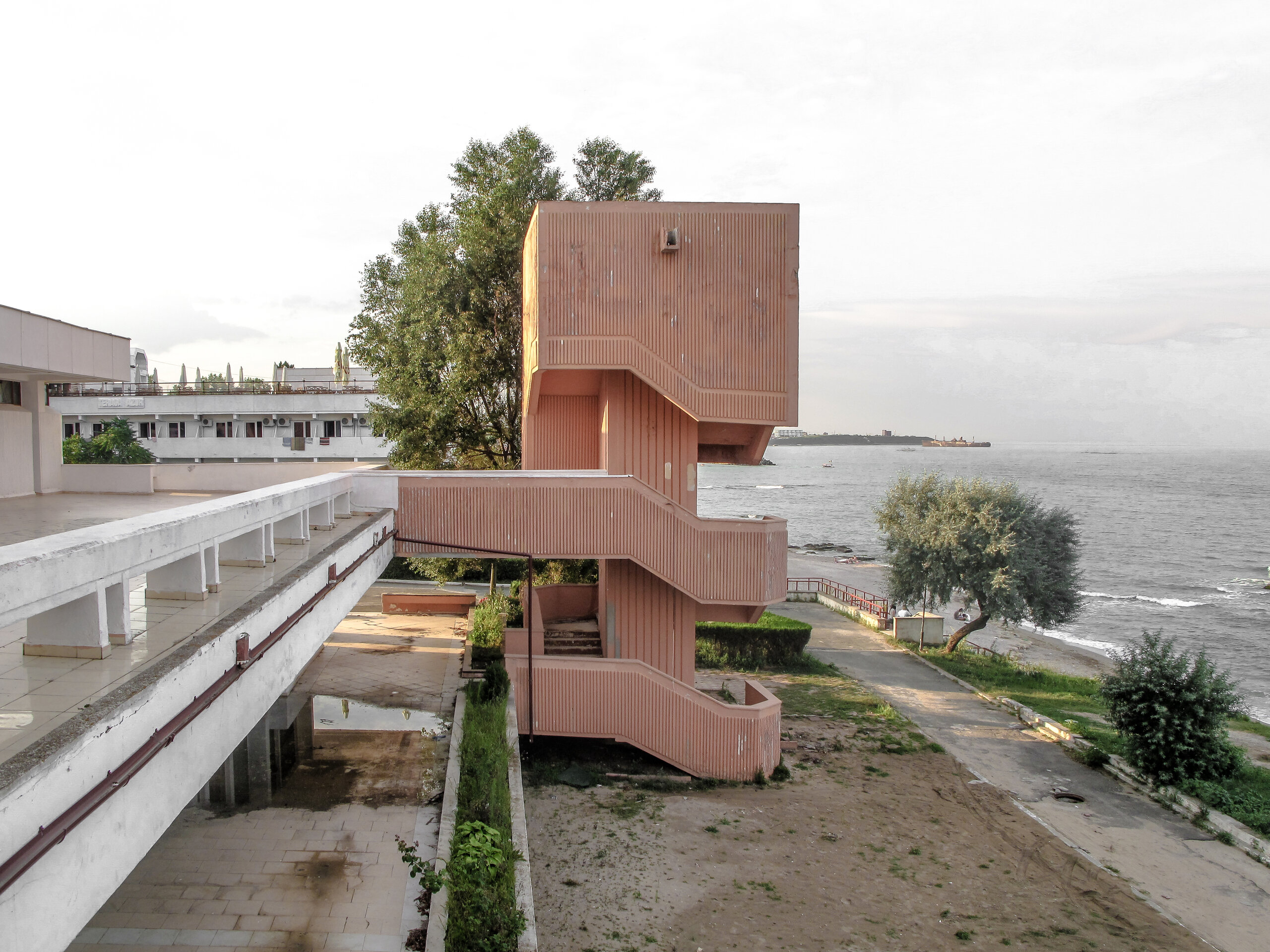
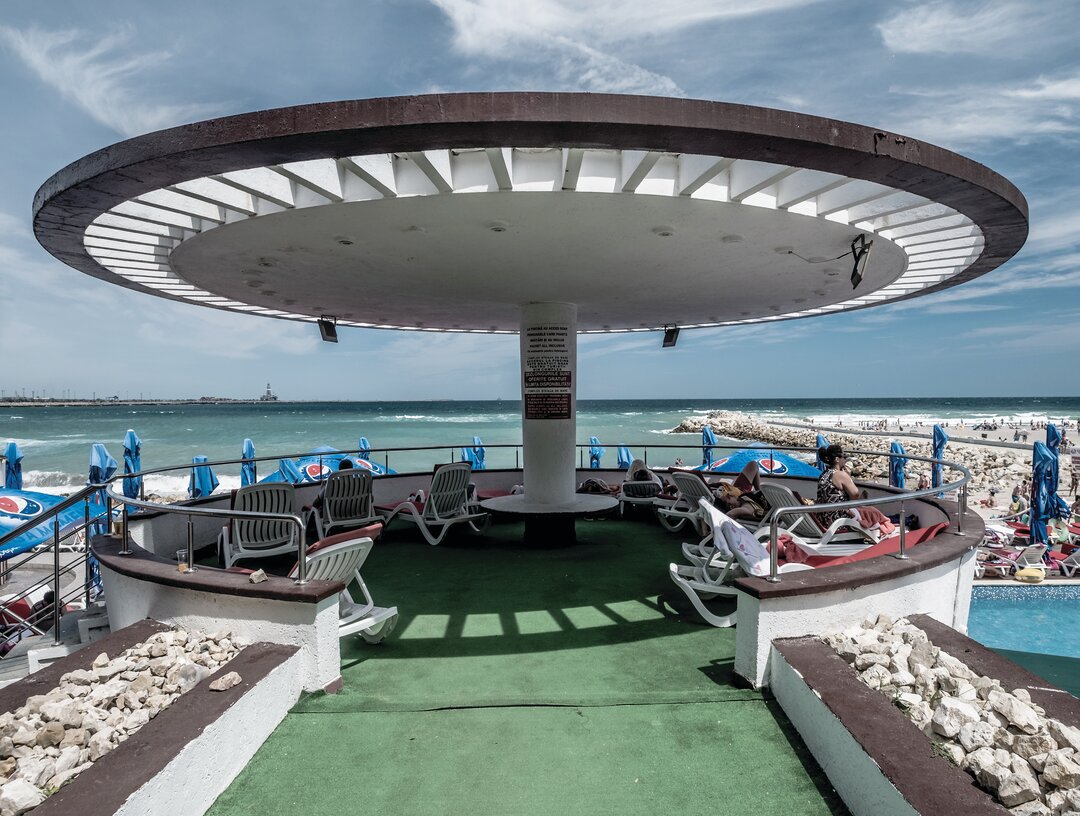
The swimming pool umbrella of the Steaua de Mare hotel was once part of the Eforie I hotel complex. The complex consisted of a group of bar-type buildings with a maximum of three levels and a two-level community center. Today the hotel complex no longer exists as a function. Instead the community center, now called the Neon Restaurant, has been preserved.
The pool umbrella of the Eforie I and Eforie II rest centers
Boulevard Tudor Vladimirescu 39-43
Eforie Nord, Romania
Built between 1957-59. Architects: Cezar Lăzărescu with A. Grimberg, Nathan Stopler and L. Popovici. (Today the pool belongs to the Steaua de Mare Hotel Complex.)
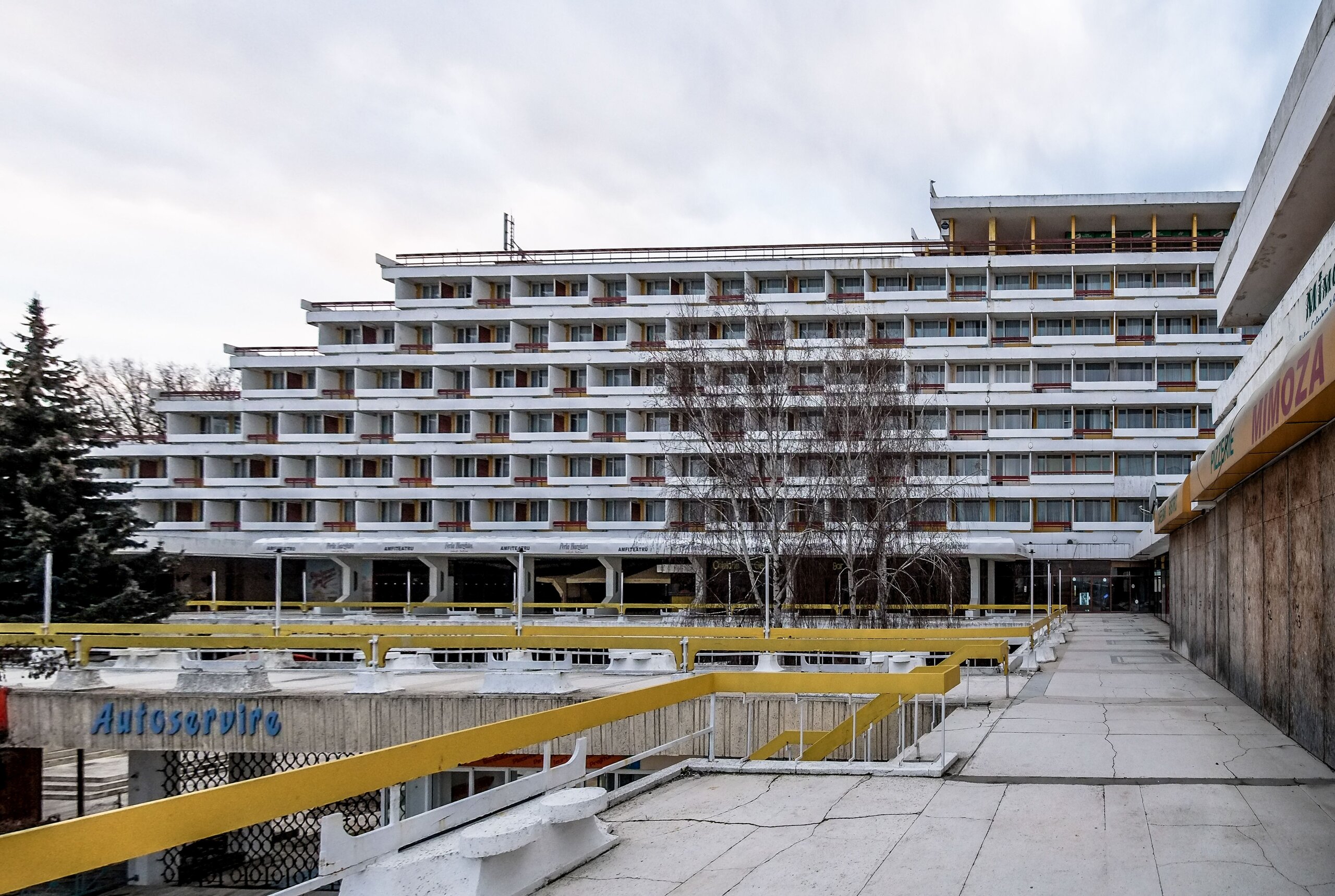
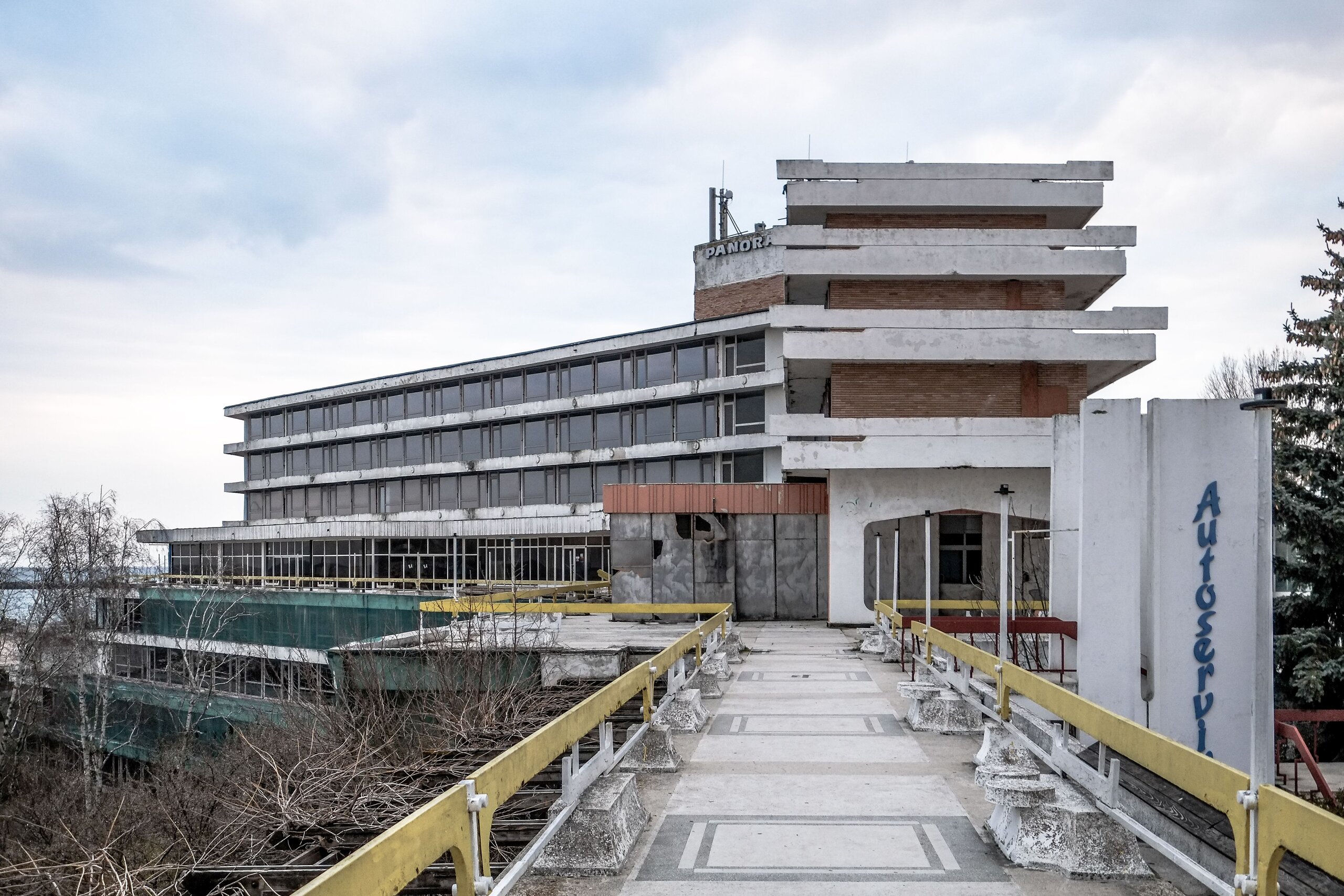
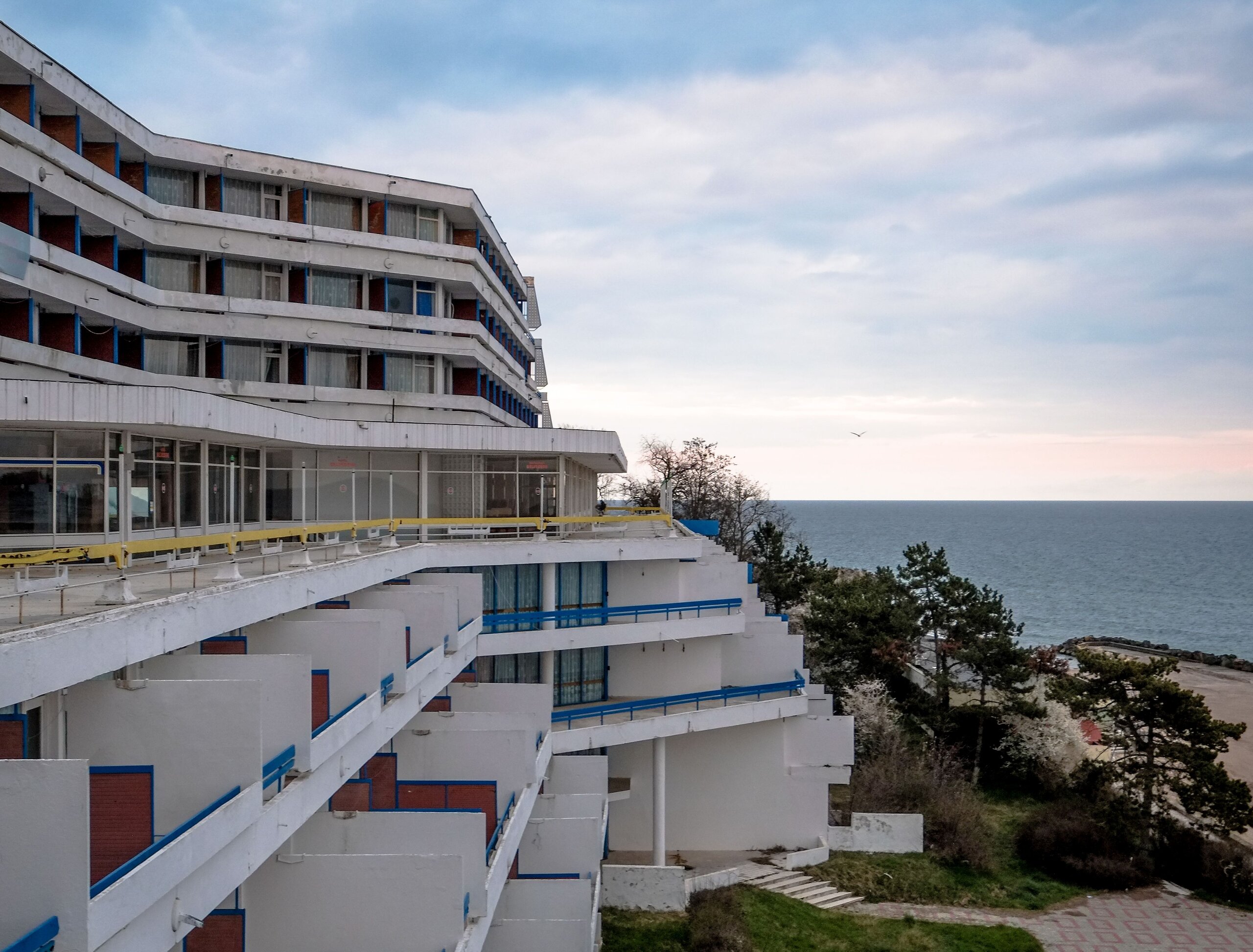
The Amfiteatru complex in Olimp, consisting of the Amfiteatru, Panoramic and Belvedere hotels, is located on the seafront and has a volumetry defined by the strong cornice. Compositionally, the three hotels develop both vertically and horizontally, linked by generous external staircases, walkways and large terraces on the ground floor, which give the image of a continuous curve. Their main characteristic are the successively recessed terraces, with both accommodation and public functions.
The Amfiteatru Hotel, centrally positioned and dominating the ensemble by its height, had in its original form a pronounced verticality of the façade, emphasized by the separating elements of the terraces. The façade was vibrated by alternating concrete and metal parapets.
Amfiteatru complex - Amfiteatru Hotel
1 Amfiteatru Street
Olimp resort, Romania
Built 1970-1972. Architects: Șerban Manolescu, Radu Mănăilă and others
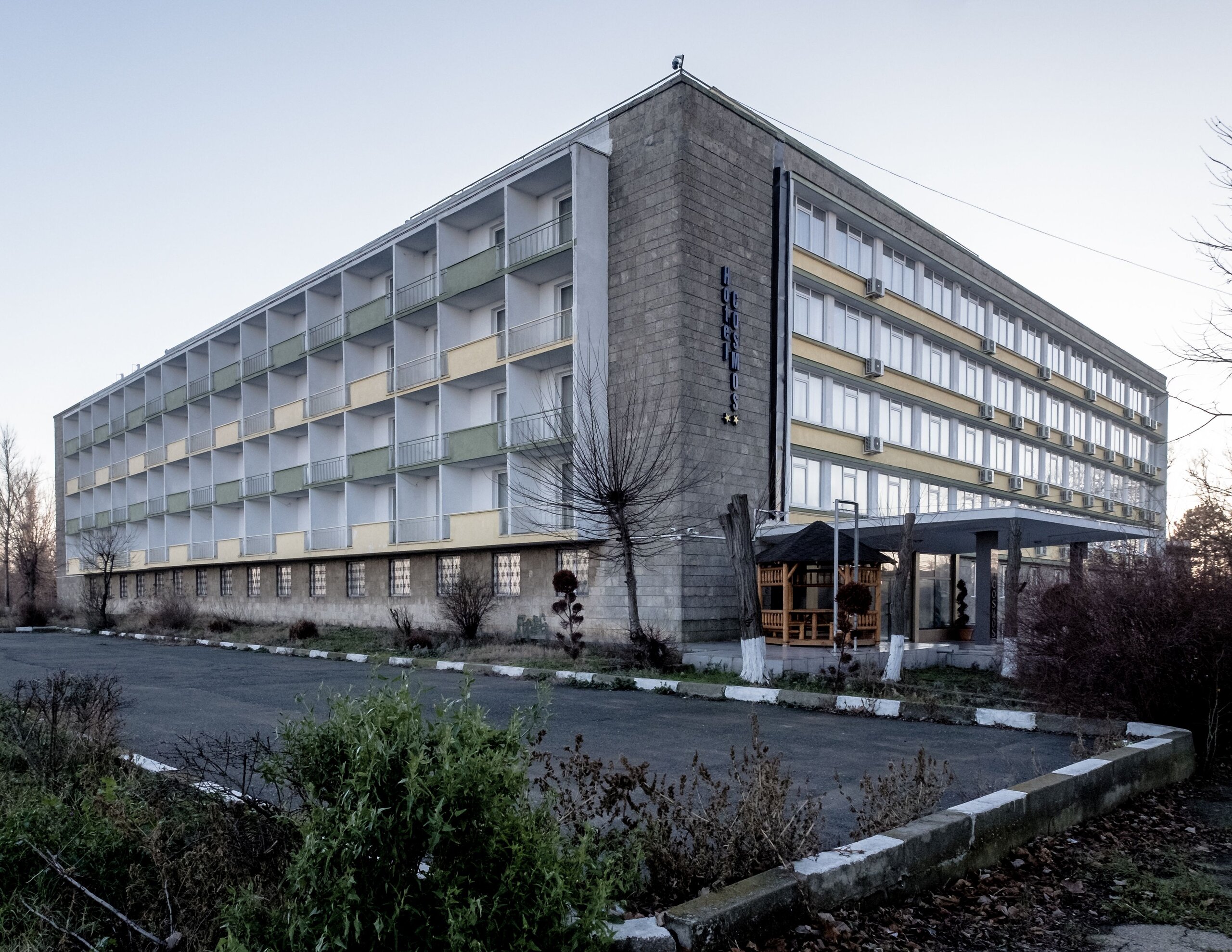
The Cosmos complex was built in Eforie Nord, a locality called Vasile Roaită between 1950 and 1962, on a plot of land on the seafront at the southern end of the promenade. It had a capacity of 512 beds and a canteen serving 1,000 people in two evenings. The accommodation building, the perspective end of the boulevard, consists of two wings. Mirroring the unevenness of the land, the wing on the axis of the boulevard has six levels, with rooms on both sides, and the wing parallel to the cliff has five levels, with rooms facing the sea. Today, the complex is privatized into a hotel and restaurant. The former is still in operation after a rehabilitation that changed its architectural features, while the latter, which is in a very dilapidated state, has been put up for sale.
Cosmos Leisure Complex
56 Mihai Eminescu Street
Eforie Sud, Romania
Built in 1961. Architects: Al. Ioțu with Gh. Rudich. I.S.C.C.A.S.
In the Belvedere Hotel, the glazed area predominated in the composition of the facades, and the wide terraces, open to the beach, had banded windows, a typical image of modernism and a strong linear accent in the composition of the facade. The prefabricated elements of the facades, with their regular geometric shapes, formed a plastic accent that created a rigorous and rhythmic appearance.
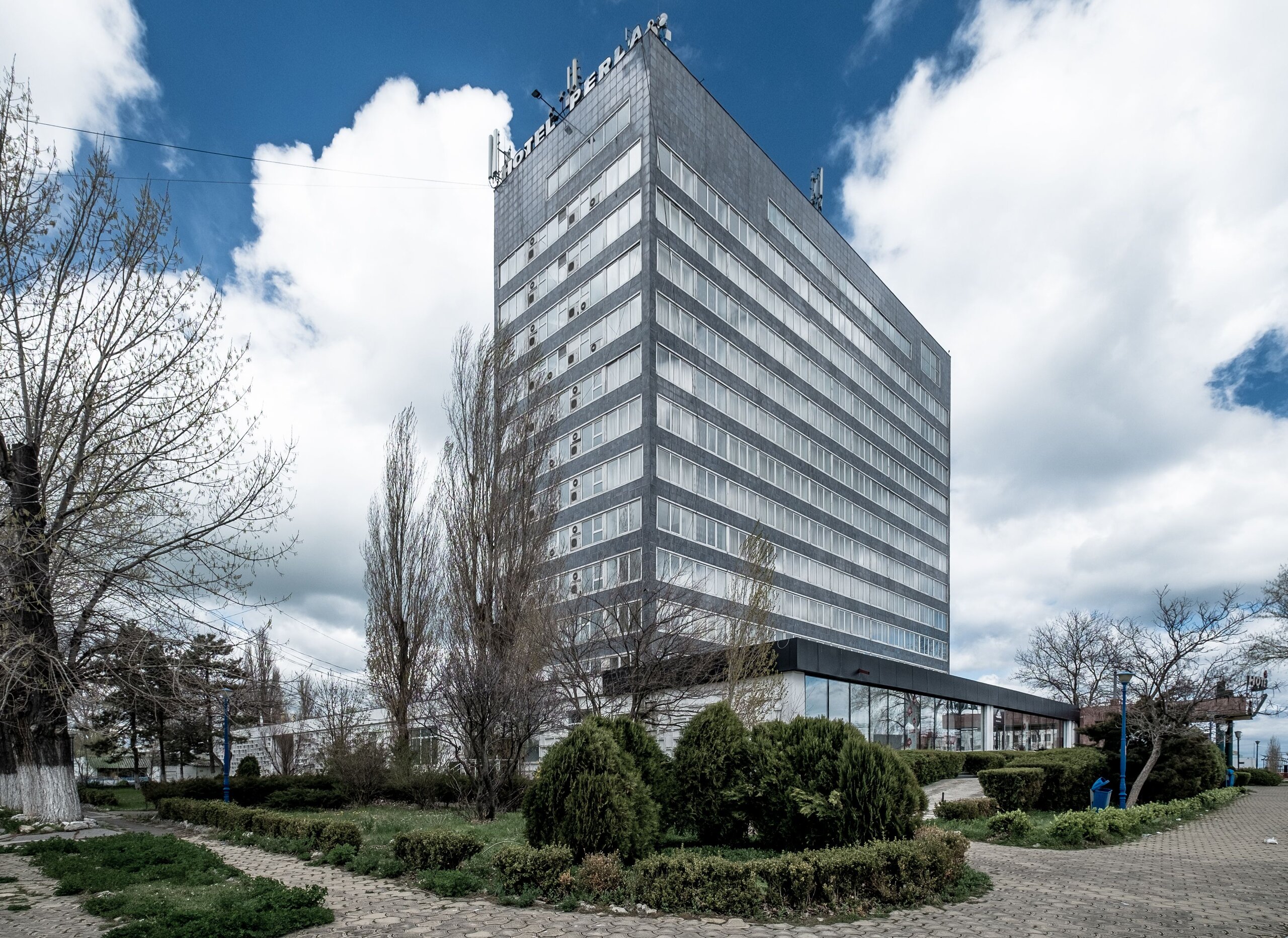
The 580-seater Perla Hotel in Mamaia, located on the axis of the esplanade facing the sea, in a position that gave it a dominant treatment over the other five large hotels, still forms the main accent on the artery leading to Bucharest. The construction system consists of reinforced concrete diaphragms poured in sliding formwork and monolithic reinforced concrete slabs, poured later. The ground-floor structures were built in reinforced concrete structures, with columns with beams at the 9 m span and slab floor at the 6 m span. The facades of the vertical body were treated on all sides, with prefabricated slats used for the joinery, as well as with plastic. The hotel unit underwent aesthetic and functional mutilations, with the facades taking on a turbo-architectural appearance and the lower levels being occupied by clothing shops.
Hotel Perla
Mamaia Boulevard
Constanța, Romania
Built in 1963. Architect: Mina Laurian. I.S.C.C.A.S.
Like the Belvedere, the Panoramic hotel was resolved with a double tract, giving the accommodation spaces sea opening and natural lighting. Like the Belvedere, it was designed with more than 400 rooms with ample terraces, arranged on three levels above the reception area and four below, set into the cliff.
The hotels are now open to the public, but in unrecognizable form. A previous owner undertook to modernize the buildings in 2007, but left them in a deplorable state. Although proposed for classification, the complex was bought in 2017 by an international hotel chain, which rehabilitated it without heeding the warnings of specialists and the buildings' modernist specificity, finishing it with poor quality materials and unnecessary details, in a kind of parody of Islamic architecture.
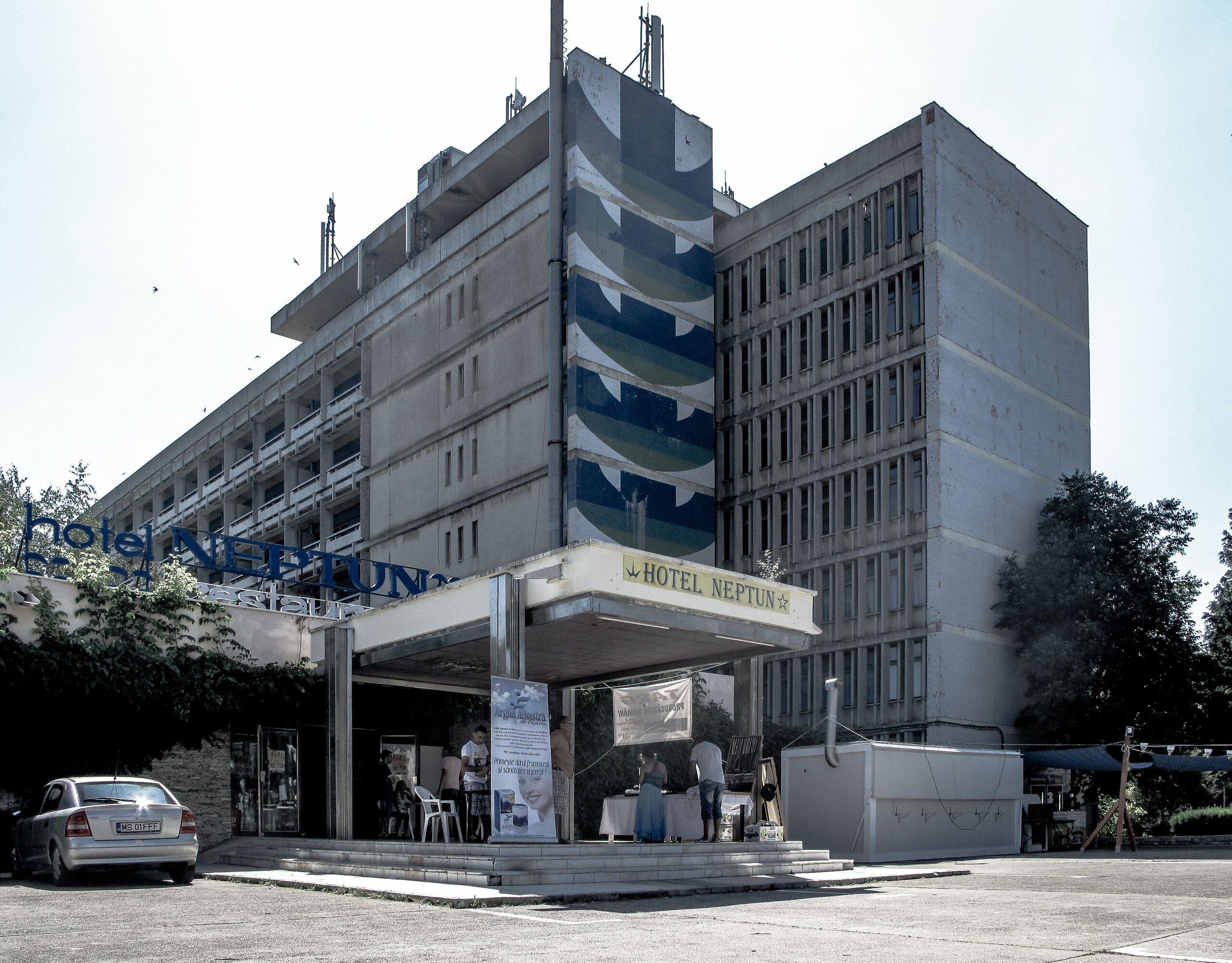
Hotel Neptun, in the resort of Neptun, has a silhouette dominated by two axes: the main entrance, the foyer, the reception areas, the conference rooms, the restaurant and the technical annexes are developed horizontally, in a single-level ensemble of buildings dominated by opaque, prefabricated vertical decorative elements. The accommodation spaces are located in an eight-storey bar-type building with a rigorous facade, dominated by right angles. Today, the hotel is no longer operating at full capacity. The building is in better condition than others in the resort following inadequate refurbishment in previous years, but vegetation is growing on the terraces and facades and the access platforms and green spaces reflect the general state of disrepair.
Hotel Neptun
10 Trandafirilor Street
Mangalia, Romania
Built in 1967. Architects: Doru Dumitrescu, Cosma Iurov
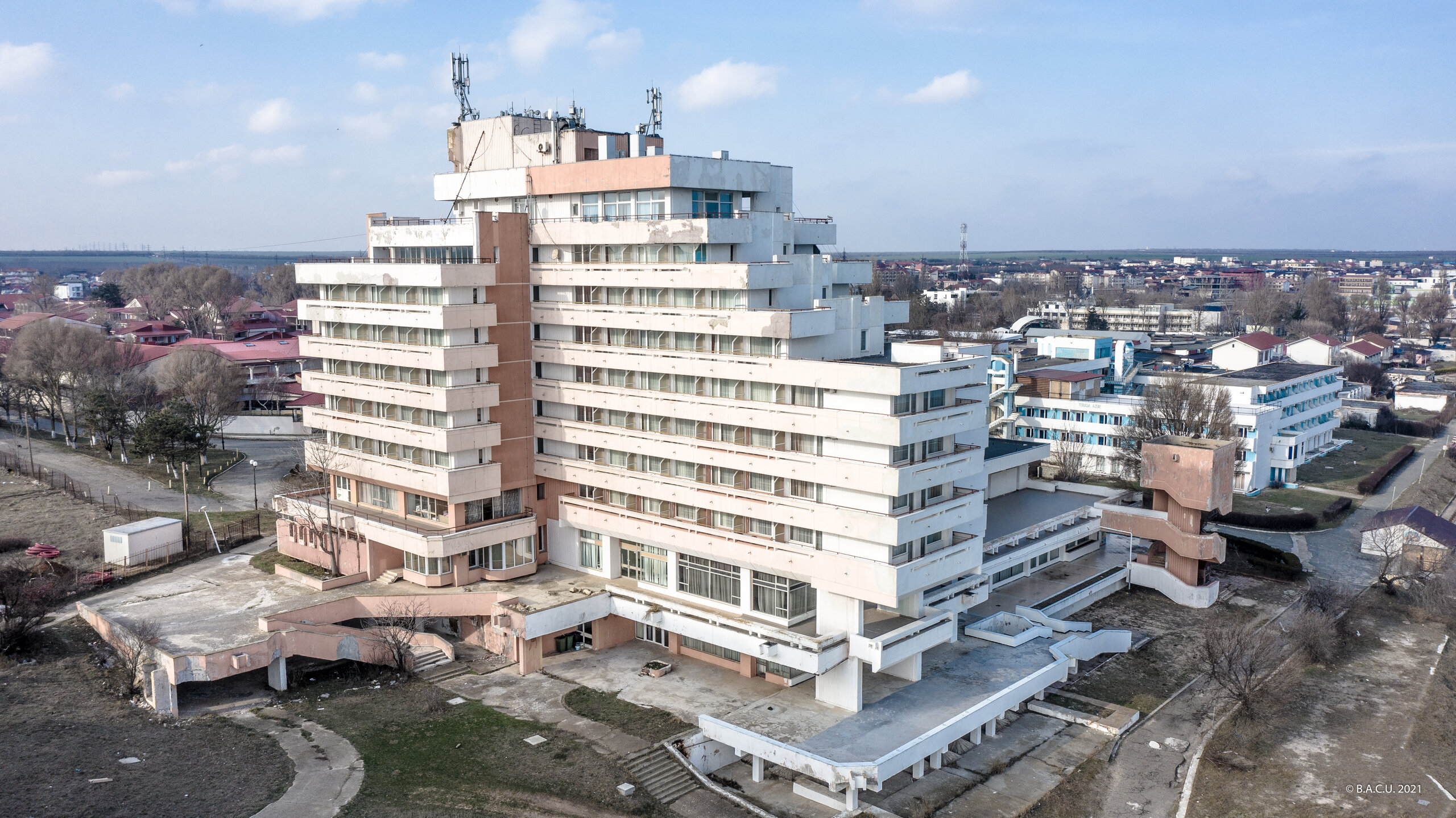
Located in the north of the resort of the same name, the Saturn hotel complex was created to provide around 1,900 accommodation places, as many in the catering facilities, 250 places in the bars and a 300 square meter swimming pool. It comprises three hotels, each with ground floor and 13 floors of accommodation, with the reception lobby and facilities arranged horizontally in a two-storey building. The centrally-located swimming pool adds a special charm to the complex. The construction system of the accommodations is made of reinforced concrete diaphragms poured in heated metal formwork and floor slabs made partly of reinforced concrete poured on metal tables and partly of prefabricated elements. Prefabricated columns and boxed precast slabs were used in the common areas and restaurant. The ensemble still retains its original architectural aesthetics, with minor color discrepancies.
Saturn Hotel Complex
28 Lavrion Street
Saturn resort, Romania
Built in 1973. Architects: Iosif Reinald, Ioana Reinald
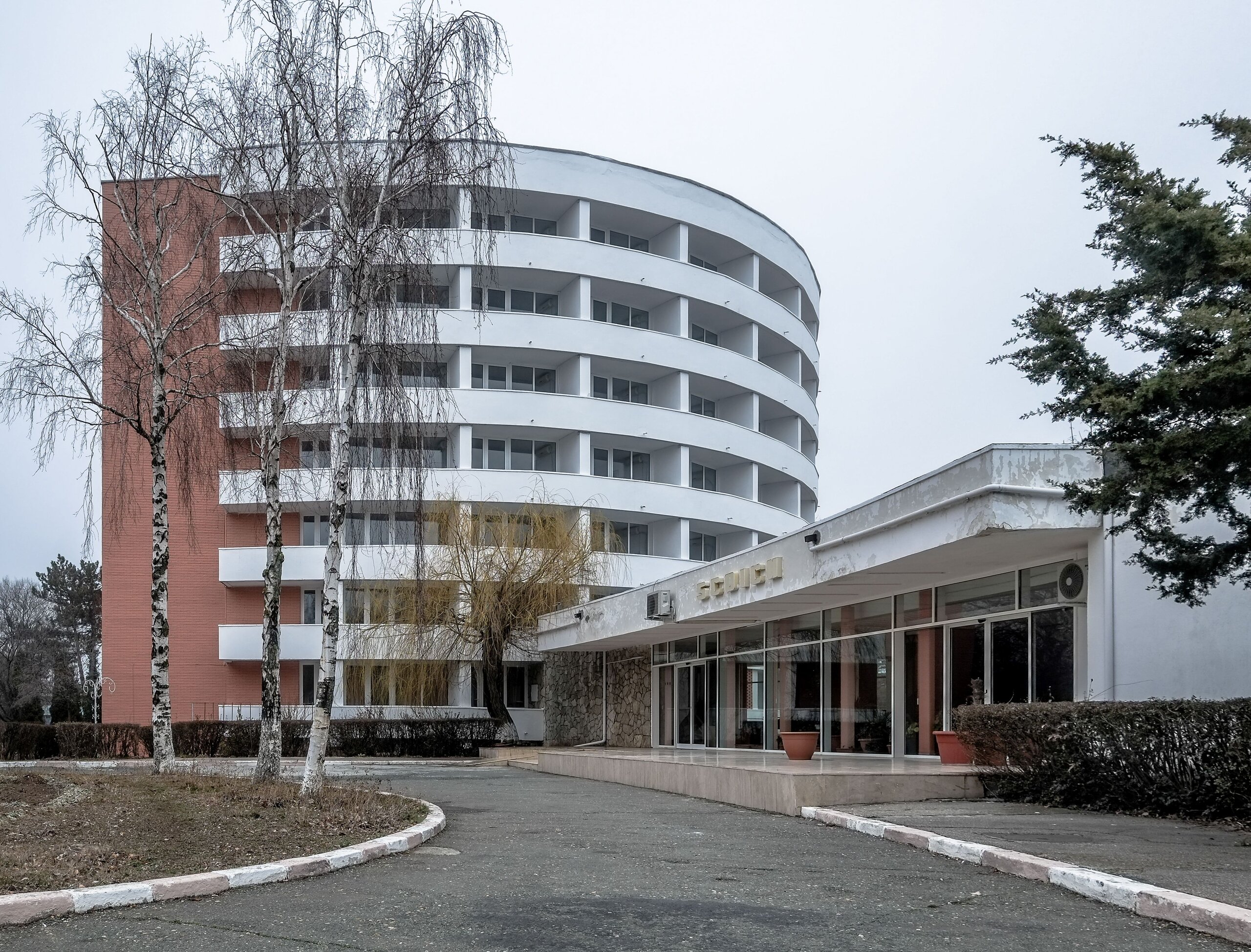
The Hotel Scoica, located on the south-western shore of the two lakes at the entrance to the resort of Jupiter, is striking for its elliptical plan and the functional layout of its 122 rooms on 7 levels. The rooms are arranged around a central nucleus, occupied by services, and offer a good view of the waterfront and the surrounding area. The food and service area occupies part of the ground floor and contains the reception, a restaurant, a brasserie and an inner courtyard with a swimming pool with bar for adults and a children's pool. The construction system of reinforced concrete diaphragms and the curved volumetry of the facades imposed a simple treatment of the finishes, which still emphasizes the overall concept of the hotel. The building retains its original appearance.
Hotel Scoica
45 Gala Galaction Street
Jupiter Resort, Romania
Built in 1970. Architect: Ion Predescu
The silhouette of the Forum Hotel emerges in the south of Costinești resort - a composition of volumes of different heights, which define the vertical and horizontal development of the ensemble. The sensation of slenderness is heightened by the vertical rise of the vertical body on pillars and piers above the mezzanine level and by the retreat into terraces of the last four of the eight levels. At promenade level are the main entrance, foyer and multi-purpose hall. Other common spaces - restaurants, terraces, conference rooms, generously sized technical annexes - are spread over two tiered levels, below promenade level, in direct contact with nature. Over time, the hotel's image has suffered from parasitic outbuildings and off-color plaster. Today, the hotel is owned by a private economic operator who has not maintained it properly, allowing the deterioration to continue.
Forum Hotel
Costinești seafront
Costinești, Romania
Built in 1976. Architect: Ștefan Șteblea and others
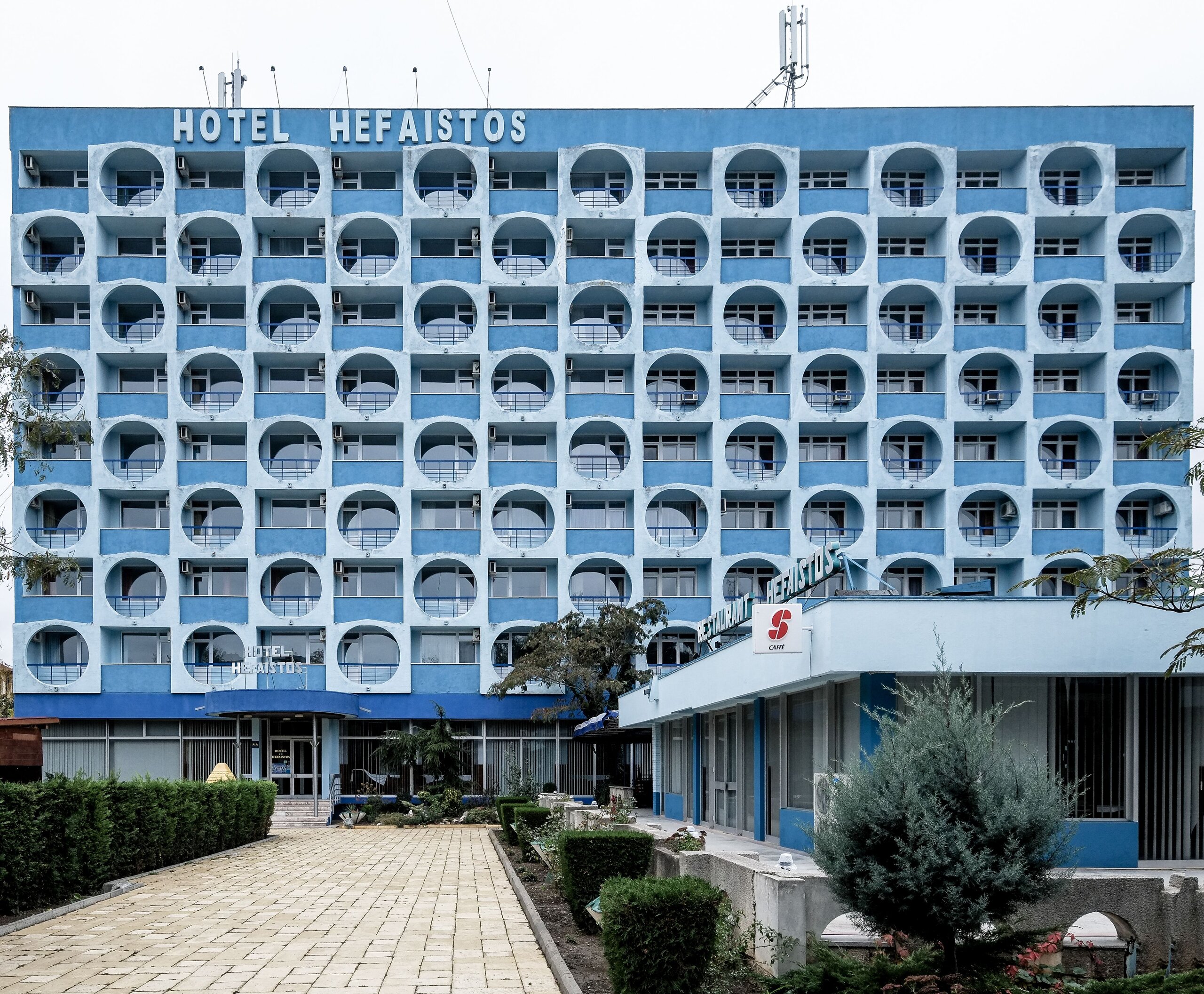
In order to provide resting places for its employees, the Casa de Asigurări Sociale și Pensii din Cooperația Meșșugugărească (CASCOM) (Social Insurance and Pension House of the Craftsmen's Cooperative) built a resting house with restaurant in Eforie-Nord, with 450 places in double rooms and apartments, arranged in two linked buildings. The part consisted of a honeycomb structure and reinforced concrete bearing walls. On the ground floor of the accommodation building were the reception, lounges, day bar, offices and the connection to the restaurant, and in the basement - the technical rooms and eight staff rooms. On the ground floor, the food hall included the dining rooms and the kitchen with annexes. The facades of the accommodation building, which were originally treated with prefabricated panels in the modernist-socialist spirit, are now brightly colored blue.
CASCOM Hotel (now Hefaistos)
Street August 23, 13
Eforie Nord, Romania
Built in 1984. Architects: Lucia Vlădescu and others I.P.J. Constanța
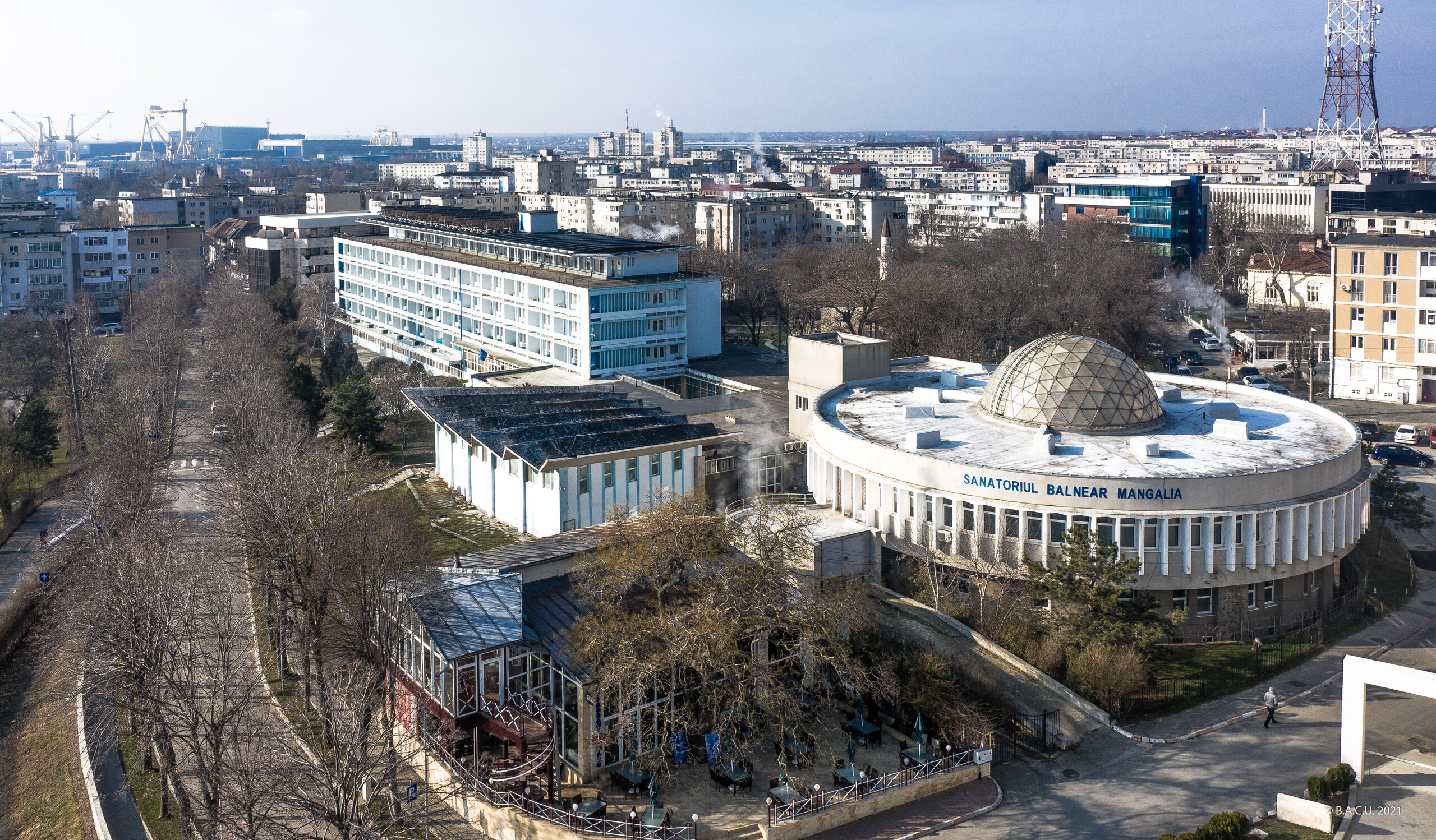
The Mangalia adult spa sanatorium for adults, consisting of 500 beds, a spa treatment polyclinic, club and restaurant, plus annexes, utilizes the properties of the sulphurous mineral waters and mud of the locality. It has an elastic resolution on the natural uneven configuration. The exterior volumetry is characterized by the vertical lamellar rhythm and the horizontal play of the floors, on a white chromatic background, emphasized in the half-light of the loggias. On the top floor, the rooms are surrounded by a shared, partially covered terrace. The body of the pool, covered with fan-shaped reinforced concrete panels, emphasizes the expressive composition of the whole. Today, the resort has been modified with new compartments and materials that change its character, such as the blue-blue printed plaster of the façade.
Adult Sanatorium
2 Mircea cel Bătrân Street
Mangalia, Romania
Built in 1960. Architects: Cezar Lăzărescu, Dinu Gheorghiu
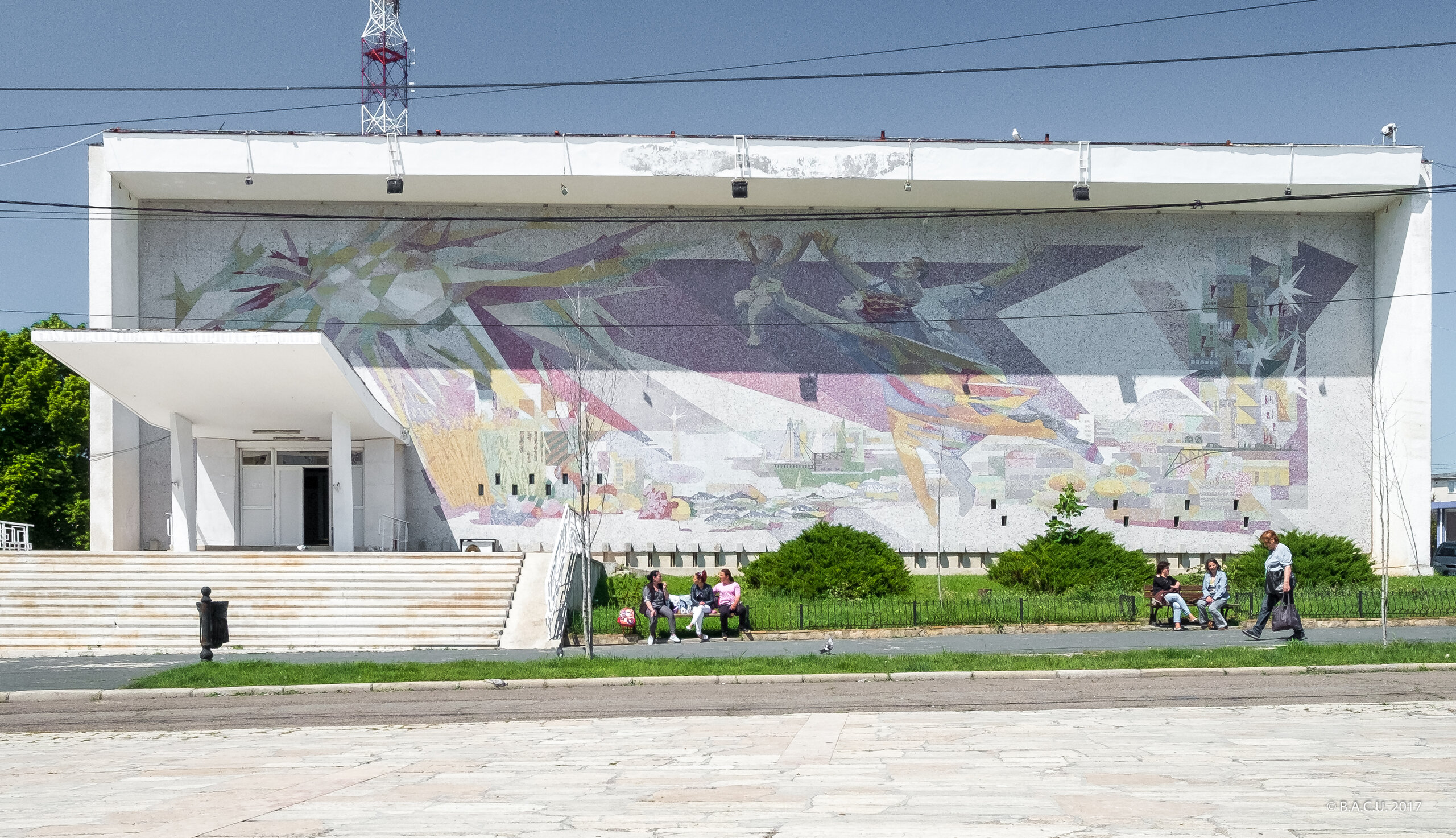
The Mangalia House of Culture is distinguished by a dissymmetrical partition and by the lateral position of the main hall. The expression of this functionality in the partition is translated by the position of the entrance in front of the huge mosaic panel decorating the main façade. The mosaic, entitled "Geneze", made of natural stone, is by Jules Perahim and Mac Constantinescu. It completely covers one of the side walls of the auditorium. The building, in its unfolding, formed the backdrop to the square created for the waterfront development. It is a representative edifice of the Romanian seaside for that period of development.
Mangalia Cultural House
Șoseaua Constanței 7
Mangalia, Romania
Built in 1963. Architect: Nicolae Vlădescu.
Geneze mosaic: Jules Perahim and Mac Constantinescu
Built in 1963. Architect: Nicolae Vladescu.
The first housing estates created in the modernist-socialist aesthetics in Constanta were built on the principle of complex urban units. Among them was the housing complex in the Railway Station area, located in the southern part of the city, between the site of the former railway station and the 1960s railway station, which is still in use today. The complex in Constanta was awarded the State Prize in Architecture for its valuable design and its execution using industrial methods. Today, the image of the whole complex has suffered from thermal rehabilitation, which has changed the facade finishes and the full-hollow proportion. Both the housing, the (privatized) bus station and the railway station have completely lost their original appearance.
Old Railway Station - New Railway Station Complex
Bulevardul 1 Decembrie 1918, 2
Constanța, Romania
Built in 1964. Architects: Gheorghe Dumitrașcu, Theonic Săvulescu, Șerban Manolescu, Ion Răducanu.
Engineer: Constantin Popovici
The stage body comprised, in the basement, the artists' cabins, the hairdressing and grimacing room, the musical instruments storeroom, the electrician's room, the blower's cabin, the administration and the sanitary facilities. At stage level were two covered side decks and cinemascope screen storage. For the construction system, reinforced concrete slabs were used for the walls of the auditorium and a system of Vierindeel beams, framing efficient masonry panels, for the body of the stage. The amphitheater had a reinforced concrete structure in the lobby area, and on the sides - prefabricated bleachers, laid on sand fill. The building was in disrepair for years, becoming a graffiti and homeless shelter. In 2023, funds were allocated for its rehabilitation and modernization, but as it is not a state-protected heritage site, no restoration was planned after the original project. By the spring of 2024, the actual work had not yet started, due to a low budget, which did not attract any takers.
Summer Theater (former "Ovidiu" Theater) Mamaia
Built in 1962. Author: arch. Aron Grimberg-Solari
*
In order to promote the architecture specific to socialist modernism and to protect the most valuable works, the B.A.C.U. has launched a series of publications including an inventory of architectural works from the former Socialist Bloc, which has now reached more than 20 titles - architectural guides and illustrated maps of the capitals.
The series also includes the guidebook "Socialist Modernist Architecture - Romania and the Republic of Moldova", published in 2018. It contains four texts by arh. Dumitru Rusu, dr. arh. Vasile Mitrea (author of the Telephones Building in Cluj), arh. Alla Kiricenko (author of the State Circus in Chisinau) and dr. arh. Tamara Nesterov, 242 objectives in color photographs, described in brief texts and an analysis of their current state of conservation. The objects are divided into eight chapters, according to their functions, differentiated by markings and identified on eight maps, with symbols in the colors of each function. In addition to an alphabetical index of the architects, artists and engineers who realized the works, the guide also contains an alphabetical index of the buildings.
The photo album "Socialist Modernism in Romania and the Republic of Moldova", published in 2020 (2nd edition), contains color photographs of about 90 modernist socialist architectural landmarks, such as the Neon Restaurant in Eforie Nord, the Round Block in Bucharest, the Noroc/Guguță Restaurant in Chisinau, the Technical University of Moldova, etc., divided according to the same eight functions, with up-to-date information on the state of conservation of the objectives. The album complements the guide, both available in bookshops in Bucharest and online.
The Socialist Modernism Platform invites architects, urban planners, historians and art historians, artists, activists and any other people interested in this theme to contribute to its expansion. We welcome any information on relevant neighborhoods, buildings, monuments, monuments, parks and works of art or architectural elements - they can be sent to www.socialistmodernism.com, specifying their exact address. All information is published on our website under the author's name.
NOTE
1 Arhitectura RPR magazine, 1958.
The photographs belong to the BACU photo department,
author Dumitru RUSU between 2013-2023
--16579-xl.jpg)